-
-
Overview
-
Portfolio
The Problem: Driving in the Rearview Mirror
Personal finance applications for students and micro-SMEs are fundamentally broken. They operate as post-mortem dashboards. They are exceptionally good at telling a user they spent ₹500 on Zomato yesterday, but they completely fail to calculate what that means for their survival tomorrow.
Tracking expenses is a solved problem. Predicting insolvency is not.
When a solo founder or student is operating on a razor-thin margin of ₹3,250, static monthly budgets are useless. They don't need a pie chart of last week's spending; they need to know the exact day they will hit absolute zero, and they need to know how to stop it.
What it does
Predictive Insolvency Countdown
Instead of:
"You spent ₹1,000 this month"
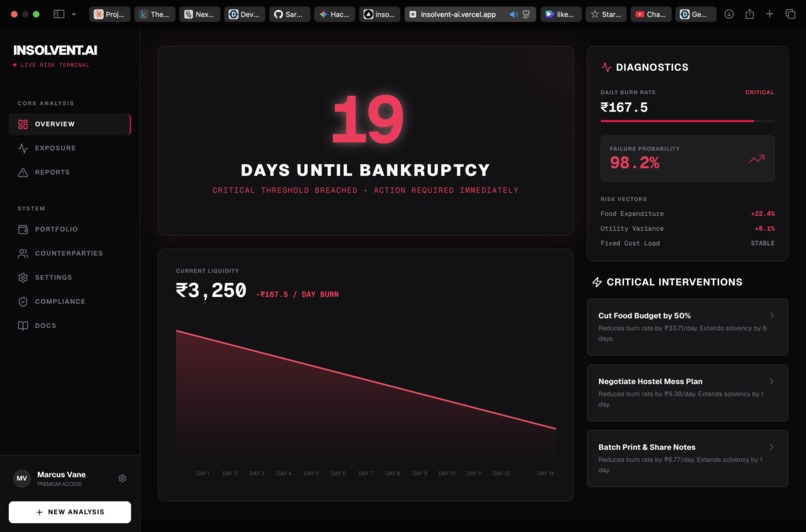
Insolvent analyzes the user's localized spending vector and calculates exactly how many days they have left until bankruptcy.
Example:
- 19 Days Remaining
- Dynamic survival runway calculation
- Behavioral risk tracking
Algorithmic Interventions
The engine doesn't just sound the alarm — it prescribes mathematical levers.
Examples:
- Negotiate Hostel Mess Plan → Extends solvency by 1 day
- Reduce Zomato spend → Extends runway
- Delay AWS billing → Reduces burn velocity
Capital Allocation Heatmap
Liquidity is rarely kept in one place.
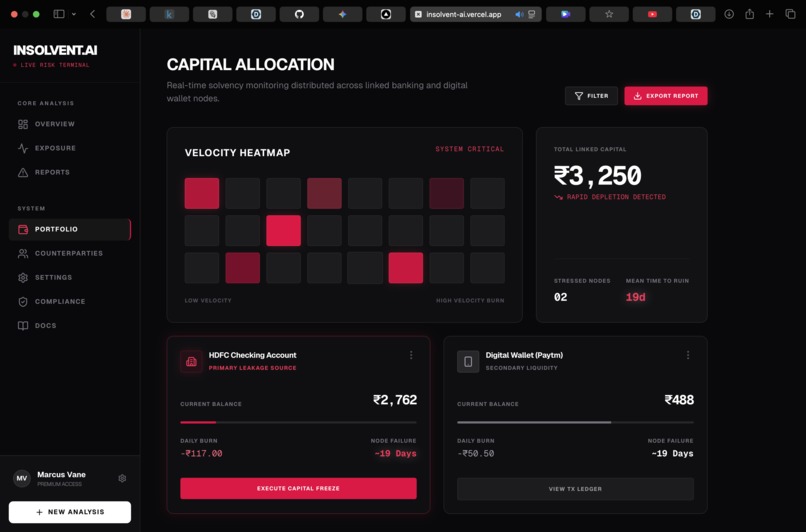
The Portfolio module maps systemic risk across banking nodes, isolating exactly which account is responsible for the highest velocity of capital leakage.
Examples:
- HDFC Checking
- Paytm Wallet
- Savings Account
- UPI Reserve
How we built it
Insolvent.ai was architected entirely during the Nexora Innovation Summit 2026.
The Tech Stack
| Layer | Technology |
|---|---|
| Framework | Next.js (App Router) |
| State Management | Custom React RiskContext API |
| UI/UX | Tailwind CSS + Lucide React |
| Visualization | Recharts |
Framework
Next.js App Router was used for heavily optimized, server-side rendered routing.
State Management
A custom React RiskContext API acts as the central orchestrator, managing the mathematical utility functions entirely on the client side to ensure zero latency when testing interventions.
UI / UX
Tailwind CSS paired with Lucide React icons.
We intentionally designed a dark-mode, crimson-glow aesthetic to mimic the urgency of an enterprise Bloomberg terminal, applying high-finance UI paradigms to micro-economics.
Data Visualization
Recharts powers dynamic and responsive runway trajectories.
The Engine
The core logic simulates client-side Bayesian inference to constantly update the probability of financial ruin as new transaction vectors are introduced.
$$ P(Ruin \mid Spend) = \frac{ P(Spend \mid Ruin) \cdot P(Ruin) }{ P(Spend) } $$
This mathematical foundation allows the application to dynamically adjust the survival runway based on behavioral momentum rather than rigid, fragile budget caps.
Challenges we ran into
The UI / UX Narrative Pivot
Midway through the hackathon, the application was fully functional, but the data payload was simulating institutional hedge-fund exposure (\$140M liabilities).
We realized that applying this predictive math to Wall Street was expected, but applying it to a college student's Paytm wallet was revolutionary.
We had to execute a massive, late-stage refactor of the global RiskContext to normalize the data payload down to micro-SME scale (₹3,250 total liquidity), replacing abstract counterparties with vendors like:
- AWS
- Rent
- Zomato
This shift made the product infinitely more relatable and impactful.
Client-Side Computation
Running dynamic runway calculations and portfolio velocity heatmaps requires rapid recalculation every time an intervention is toggled.
Keeping this logic strictly in the React Context layer without causing re-render loops or UI stuttering required careful memoization and state structuring.
Accomplishments that we're proud of
The Aesthetic Illusion
We successfully built an interface that looks and feels like a multi-million dollar enterprise risk terminal, but serves the everyday user.
The crimson-glow alerts and stark typography create a genuine sense of urgency that forces behavioral change.
Zero-Latency Interactions
Because the Bayesian state is managed locally, the entire application — from the overview dashboard to the portfolio heatmap — feels instantaneous.
Solo Execution
Architecting the Next.js routes, designing the UI, writing the predictive engine, and producing a polished pitch video was executed entirely by a solo founder under extreme time constraints.
What we learned
Narrative is the product.
A brilliant algorithm means nothing if the user cannot emotionally connect with the data.
Scaling our numbers down from billions of dollars to a few thousand Rupees completely transformed the application from a "cool math concept" into a visceral survival tool.
What's next for Insolvent.ai
The ultimate vision for Insolvent is B2B API Integration.
Instead of operating as a standalone app, the Insolvent engine can be integrated directly into neo-banks and digital wallets like:
- Jupiter
- Fi
- Paytm
Banks can use the Insolvent API to identify which users are 15 days away from a zero balance, and autonomously offer micro-bridge loans or structured credit before the user defaults.
We are turning financial survival into a predictive science.
Built With
- bayesian-inference
- canva
- elevenlabs
- github
- javascript
- latex
- lucide-react
- next.js
- react
- react-context-api
- recharts
- tailwind-css
- typescript
- vercel

Log in or sign up for Devpost to join the conversation.