Inspiration
One of the most common injuries in sports, weightlifting, or even when you're going about your day, are anterior cruciate ligament (ACL) injuries. These are by far one of the hardest injuries to overcome especially for athletes that consistently put themselves in scenarios where they are at risk of tearing these ligaments and in some cases ending their professional athletic careers. That is why coming up with a solution where we can accurately and safely ensure the development of the muscles surrounding the ACL can be developed during training and be used in competition practices was our key motivation for developing a design for an insole pressure sensor that can be affordable down the line as it becomes more sophisticated compared to the very expensive options on the market.
What it does
The Insole pressure sensor detects key areas of applied pressure on the plantar (bottom) region of the foot and will alert you based on the exercises that you are doing if your form is correct or if you are applying the wrong amount of pressure in a certain region of your foot so that for future reference you can safely adjust your technique to build your targeted muscle groups or exercise without the risk of injury or track walking/running pressure distributions for step analysis.
How we built it
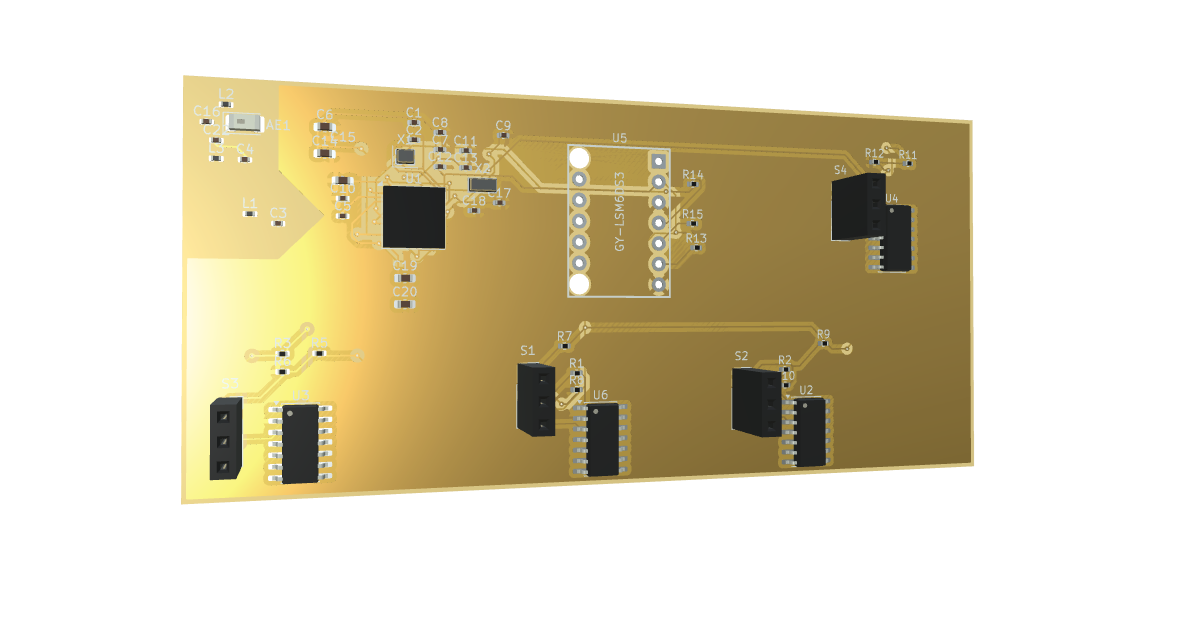
there are three key components of the pressure insole that are used to make it what it is! The first component we used was an IMU which is a gyroscope and accelerator that will track the tilting or rotation of a person's foot to check for imbalances when performing exercises like squats or lifts and send potential health/risk alerts or even detect abnormalities that associate with internal rotating walking dysfunction. The second key component is a flexible pressure sensor that can comfortably bend and stretch to a person's foot pattern that will be the key indicator of when a person is potentially using improper technique in lifting exercises and walking or running imbalances. The final key component will be the microcontroller that will connect these signals from the IMU and pressure sensor so that it can send out a Bluetooth connection to transmit metrics captured for users to see their tracked stats.
Challenges we ran into
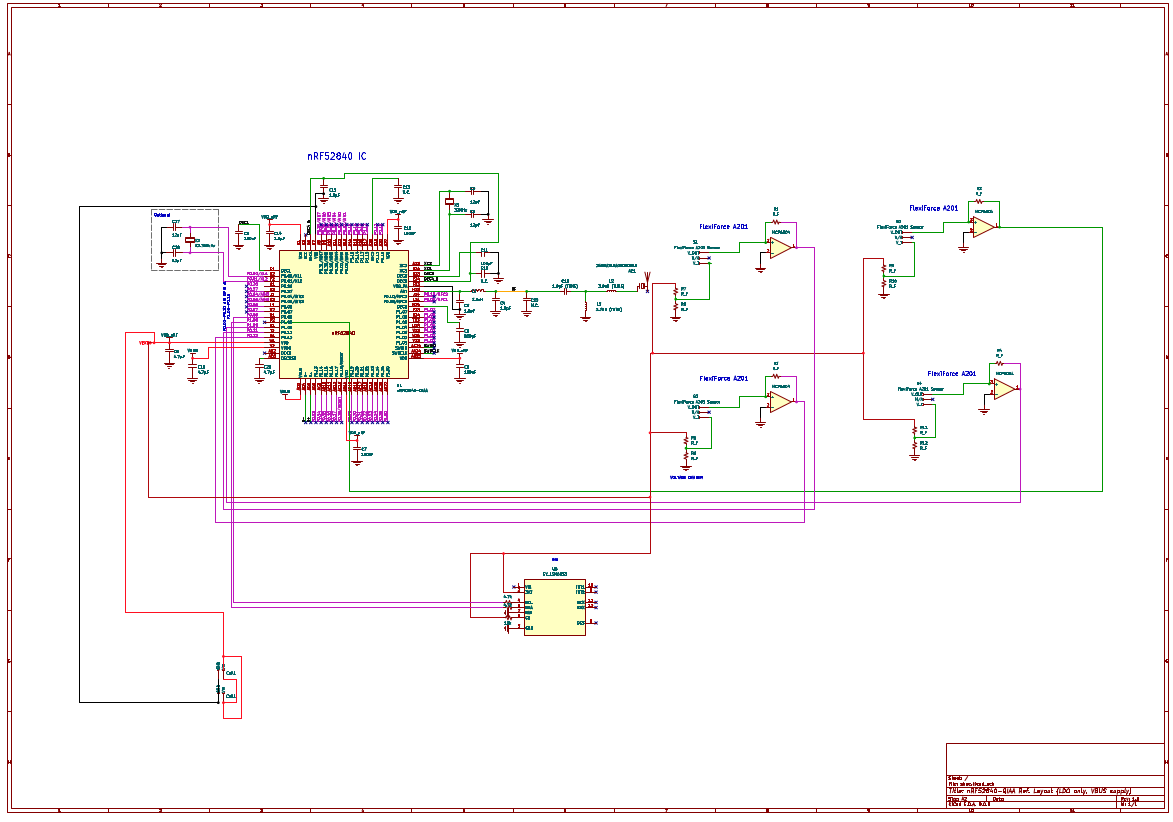
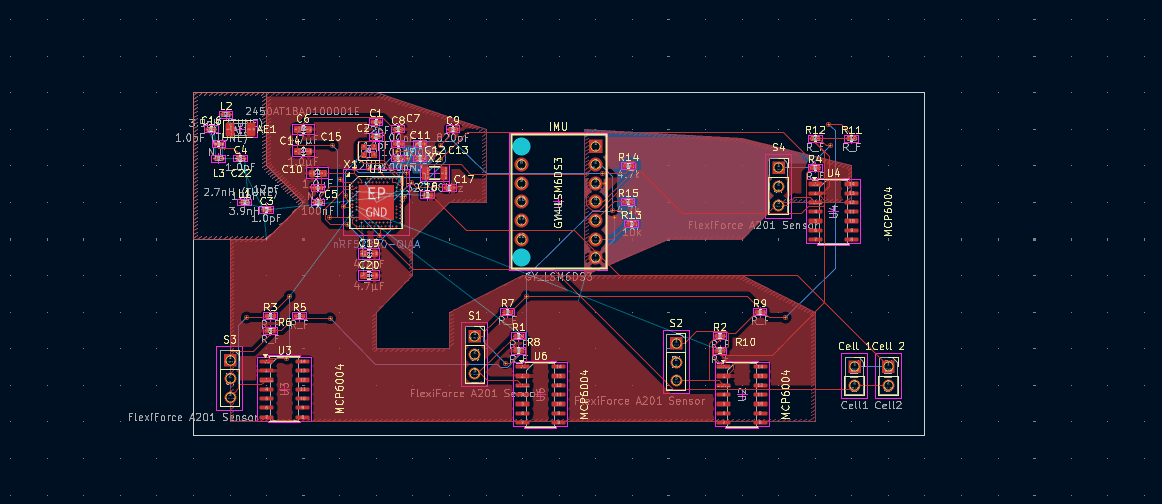
One of the biggest challenges that we faced in this concept was designing the pcb circuit layout for each of the components and how it was all going to connect together. The primary challenge for the PCB was designing the analog circuitry around the bare nRF52840 with the correct decoupling capacitors and internal pull-up resistors. We chose this due to physical limitations of space and rigidity, using this approach we were able to create a prototype that works as a flexible PCB to move freely with the material of the insole. Designing the RF antenna was particularly tricky due to the strict requirements for trace width and regional rules, I followed the datasheet closely to ensure I made a RF track that is aligned with the 50ohm feedline requirements for GCPW, using recommendations by the JLCPCB manufacturer.
Another challenge we faced was figuring out how we were going to obtain pressure sensors that was able to withstand the impact and load of at least 700lbs of force. Specifically in the case of experienced weightlifters who typically weigh a little over 200lbs and are able to squat from ranges of 300-500 additional pounds had proven to be very difficult, luckily with playing around with ohms law and the aid of the circuit diagrams from the pressure sensors we were able to find a work around that will be able to withstand from 100-1000lbs of force.
We also faced challenges in sticking with a topic in general because so many cheap solutions have been made for the ideas that we would come up with and it left room for very little improvement. We moved on from focuses on wrist injuries, concussions, and even CSF fluid detectors that fortunately had improved in the latest years but unfortunately for our case made us run low on ideas on how we could come up with an innovative solution to improve an expensive market.
Accomplishments that we're proud of
one of the biggest things that we are proud of is the completion of the PCB design, that was by far the heaviest task we've had and being able to figure out the wiring placement on top of being able to interpret outside wiring diagrams to where the microcontroller can properly receive input from not only one pressure sensor but 4 and an addition of an IMU was extraordinary.
another big accomplishment was being able to compensate for the 100lb force limit that was placed on us by using a voltage divider to allow us to read higher force values.
What we learned
We were able to learn how to apply ohms law to pressure changes from thinking about it in a physiological perspective (e.g. blood flow), changes in resistance can accurately signify pressure and it'll allow us to apply this concept to build our own pressure sensors in the future.
We were able to learn how to wire and apply op-amps in circuit diagram and additionally reinforced 3d modeling skills for electrical components and housing compartments for components
What's next for Insole Pressure Sensor
The next thing for our Insole Pressure Sensor project is to ensure affordability of our product, the price tag is a hefty sum for now, but in understanding the concept of pressure and changes in resistance, we are pretty confident with more time we are going to be able to step away from market bought sensors and be able to produce our own pressure force sensors that will not only able to ensure performance but better accuracy since the cheaper cost will allow us to place more sensors for mapping accuracy. We are also hoping to develop a functional application that users can use to digest the information from the pressure mapping of their feet when they exercise and be able to provide recommendations on what they can do adjust their form or technique. One of the most innovative additions that we would like to add is a transducer that transforms mechanical energy generated from the impact of the foot into electrical energy to charge the battery powering the components of the device and eliminate the need of tediously being conscious of eventually replacing the battery.
Built With
- kicad
- solidworks
