Inspiration
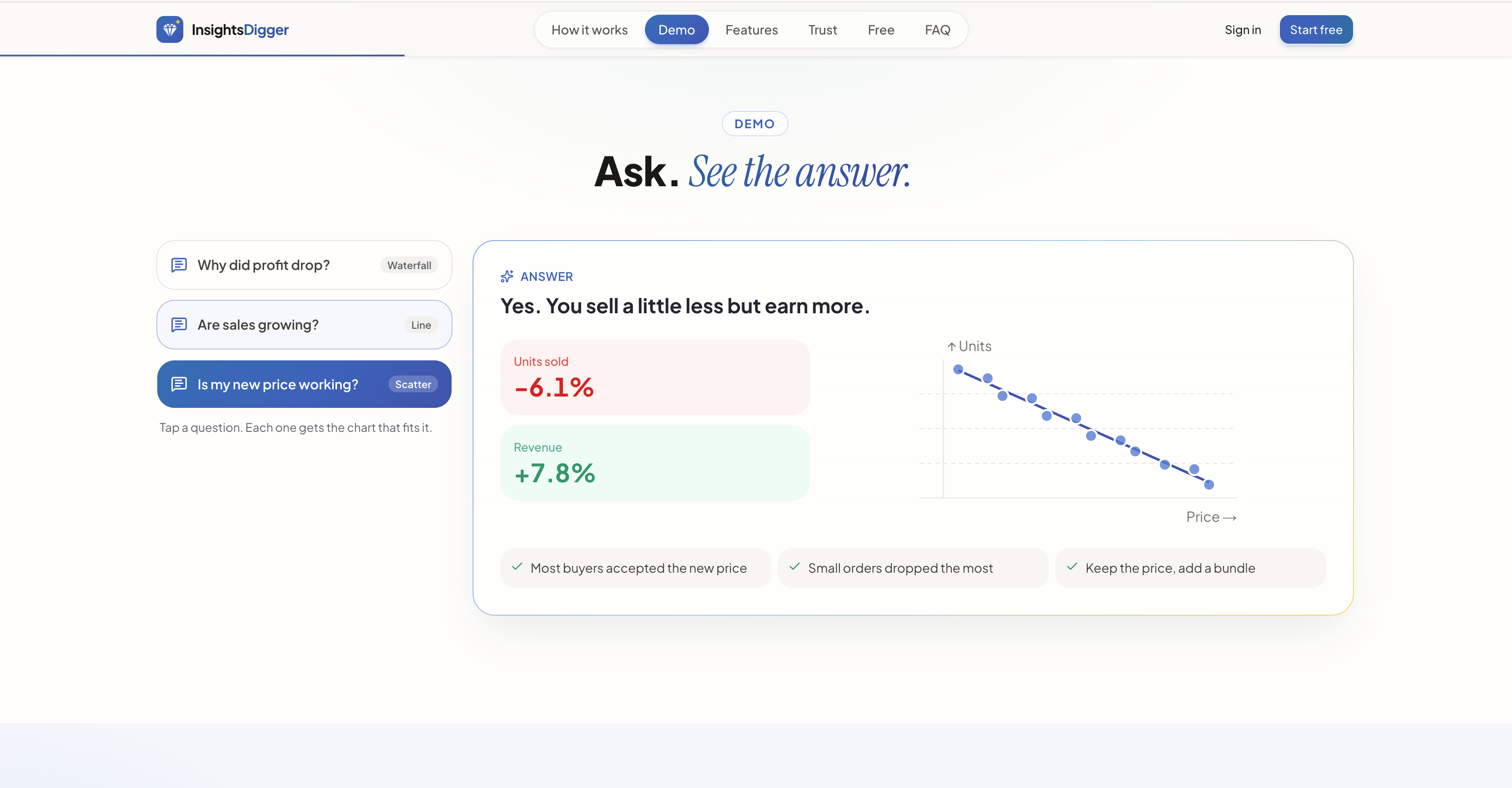
Businesses sit on piles of spreadsheets and reports but still can't easily answer questions like "Why did profit drop last quarter?" AI chatbots are fast, but they confidently make up numbers, and for real business decisions a believable wrong answer is dangerous.
So we asked: what if AI could investigate business data like a real analyst, without ever being allowed to invent a figure?
## What it does
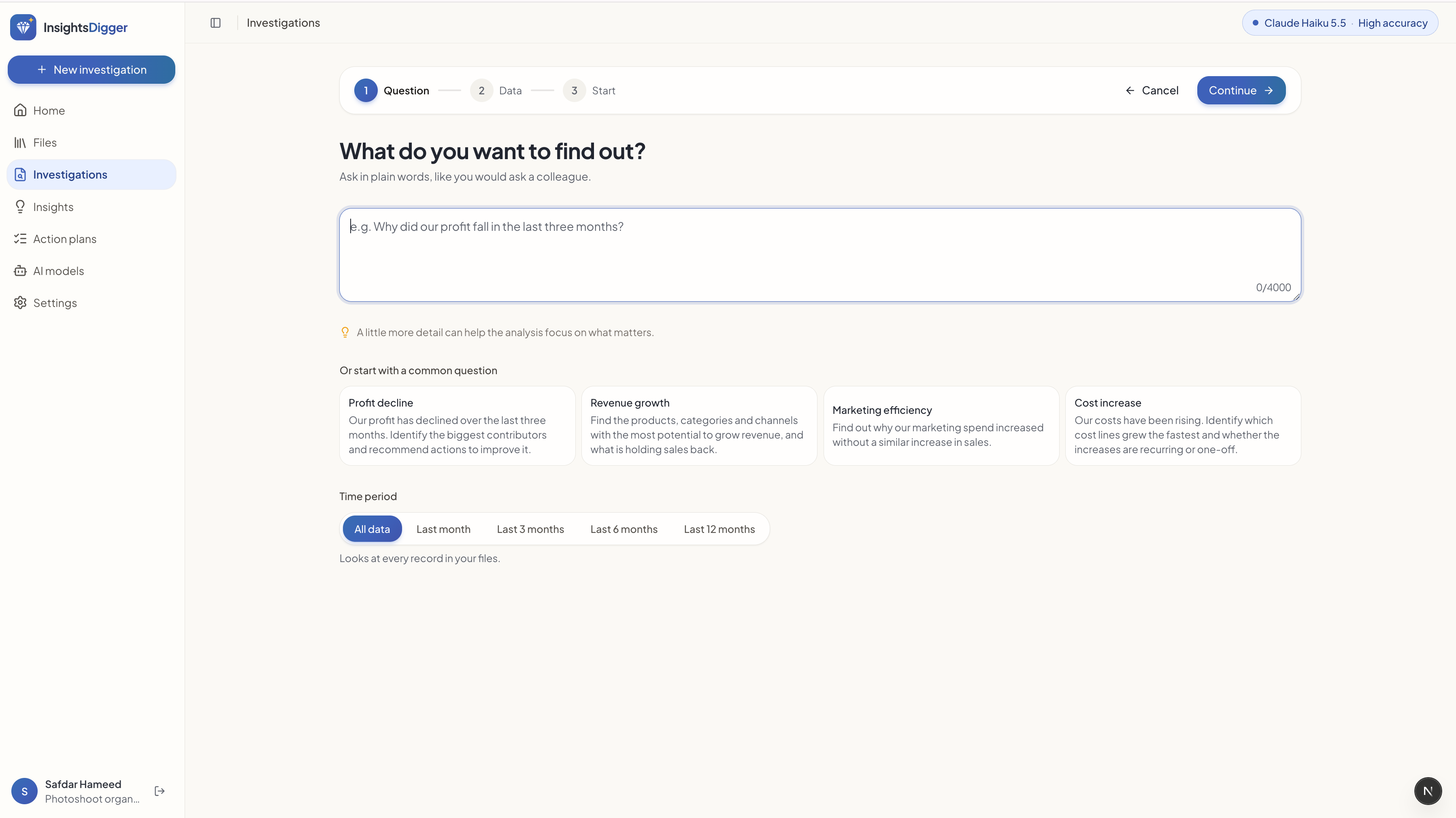
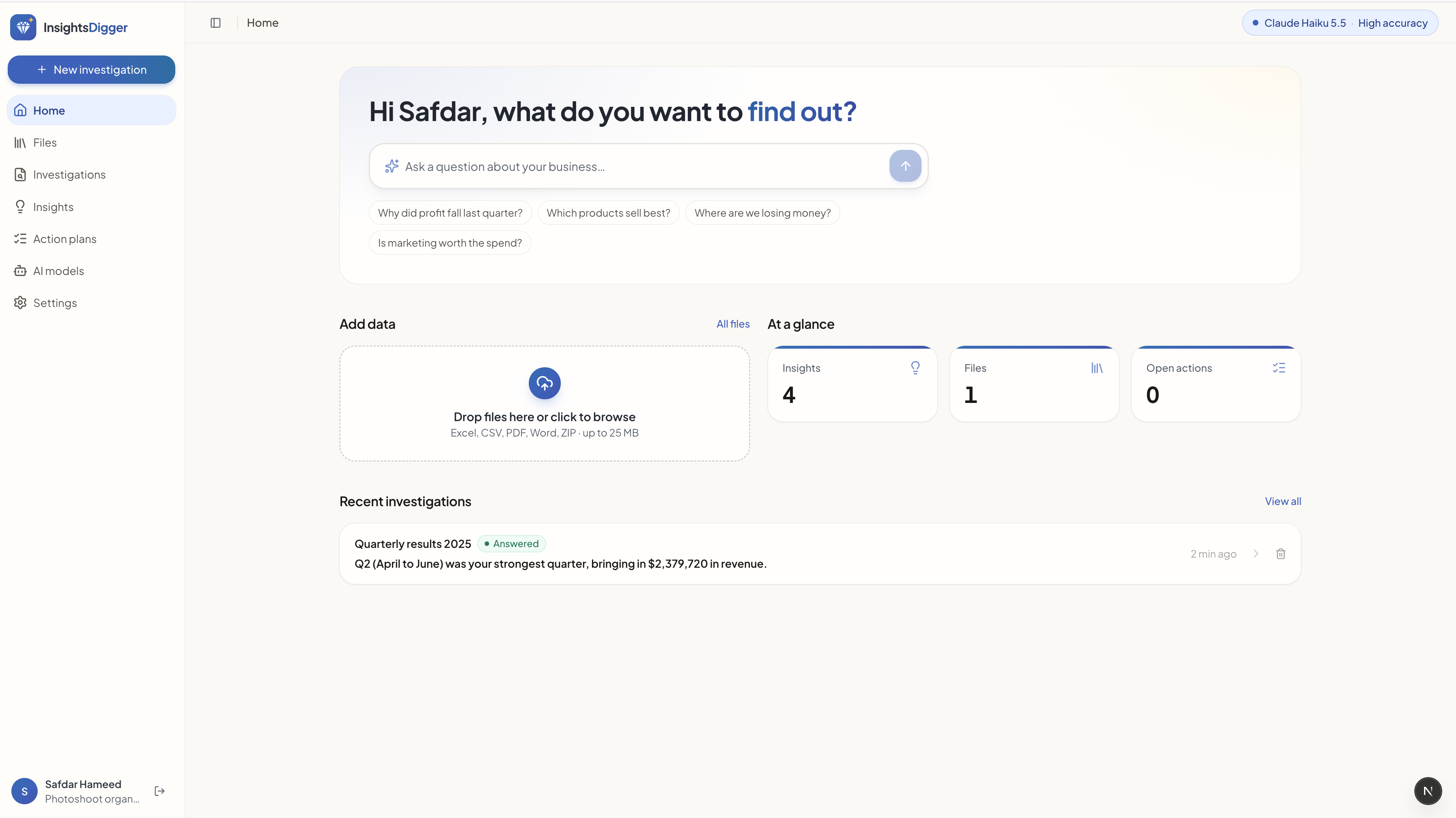
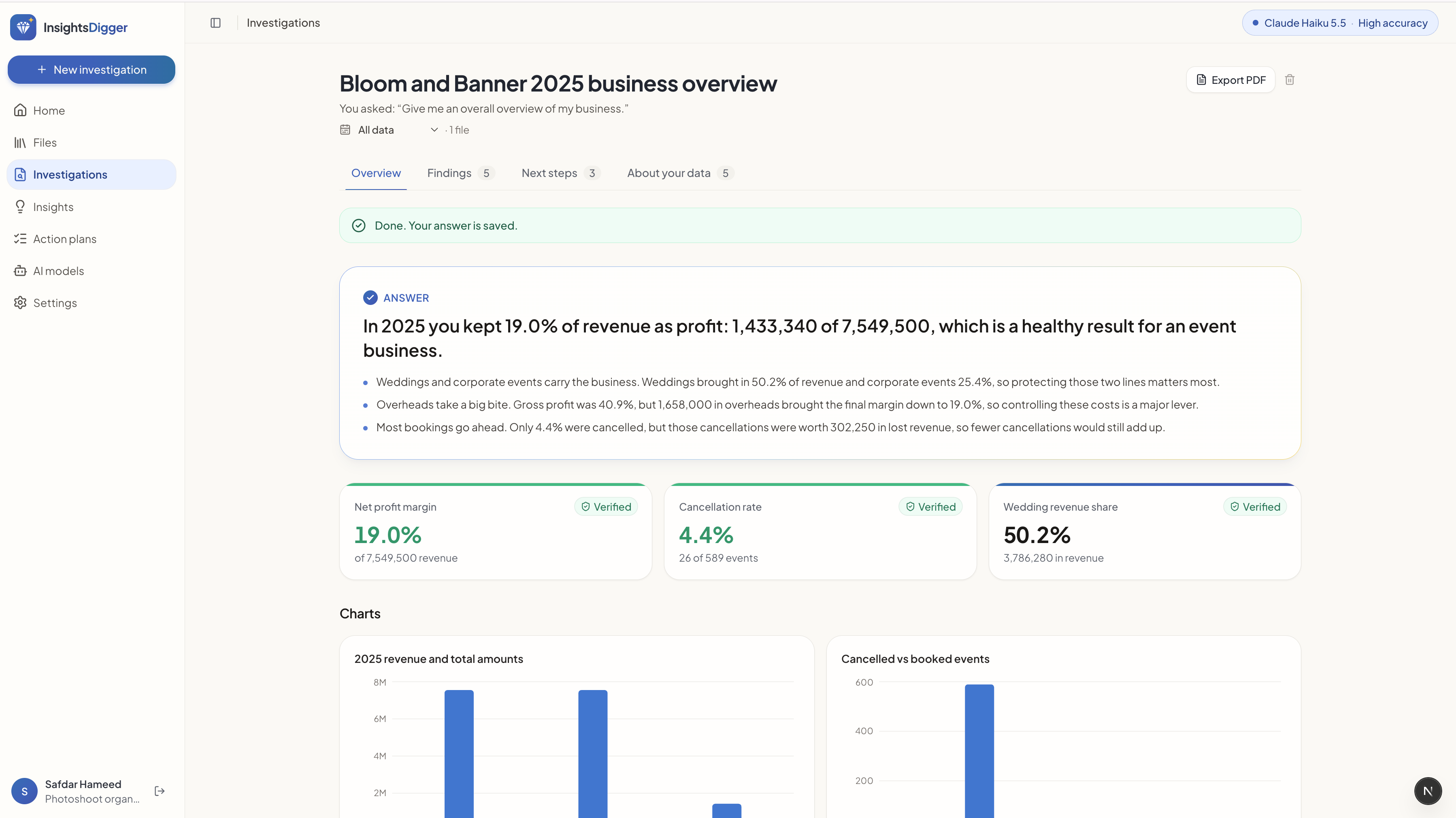
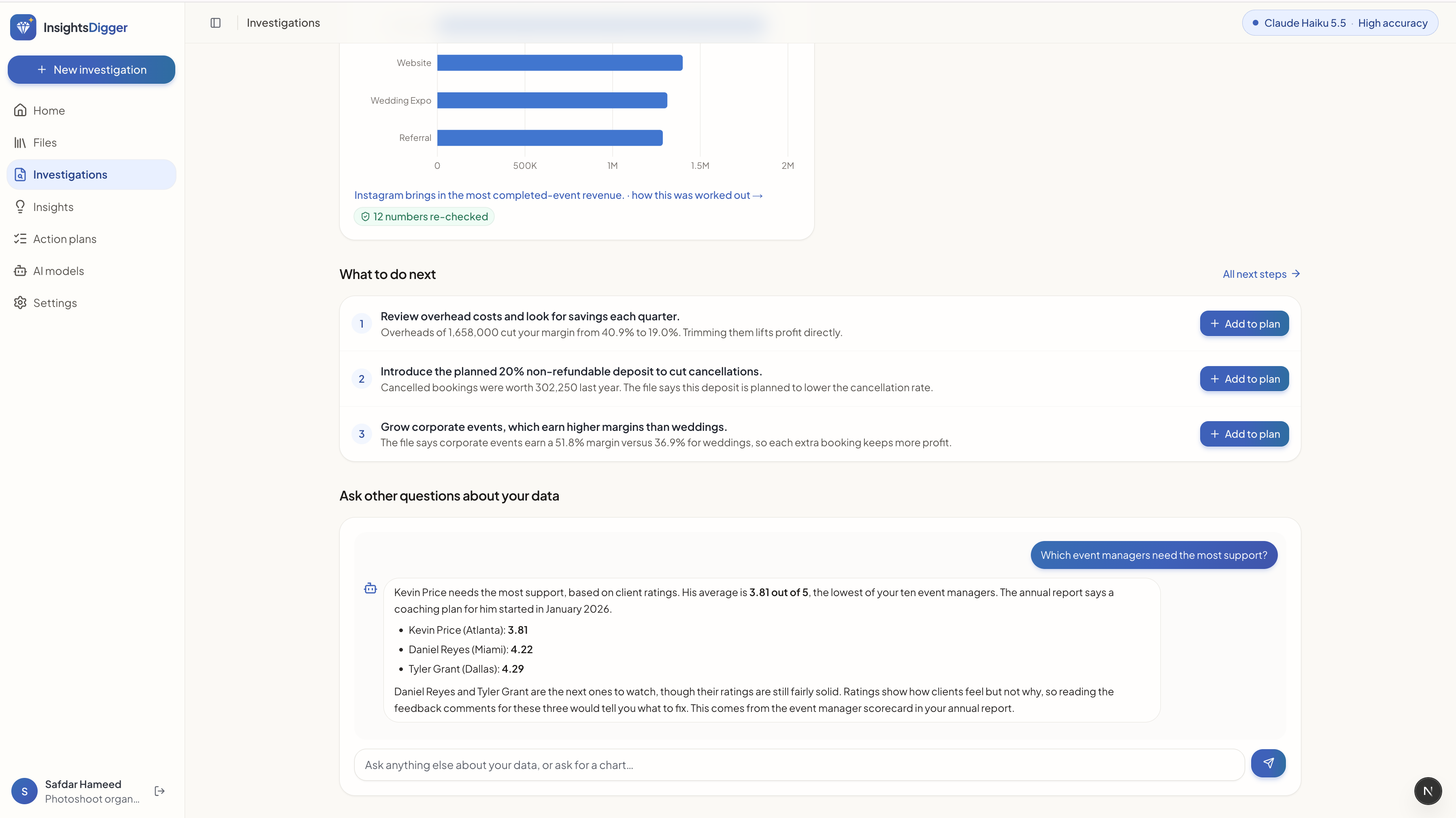
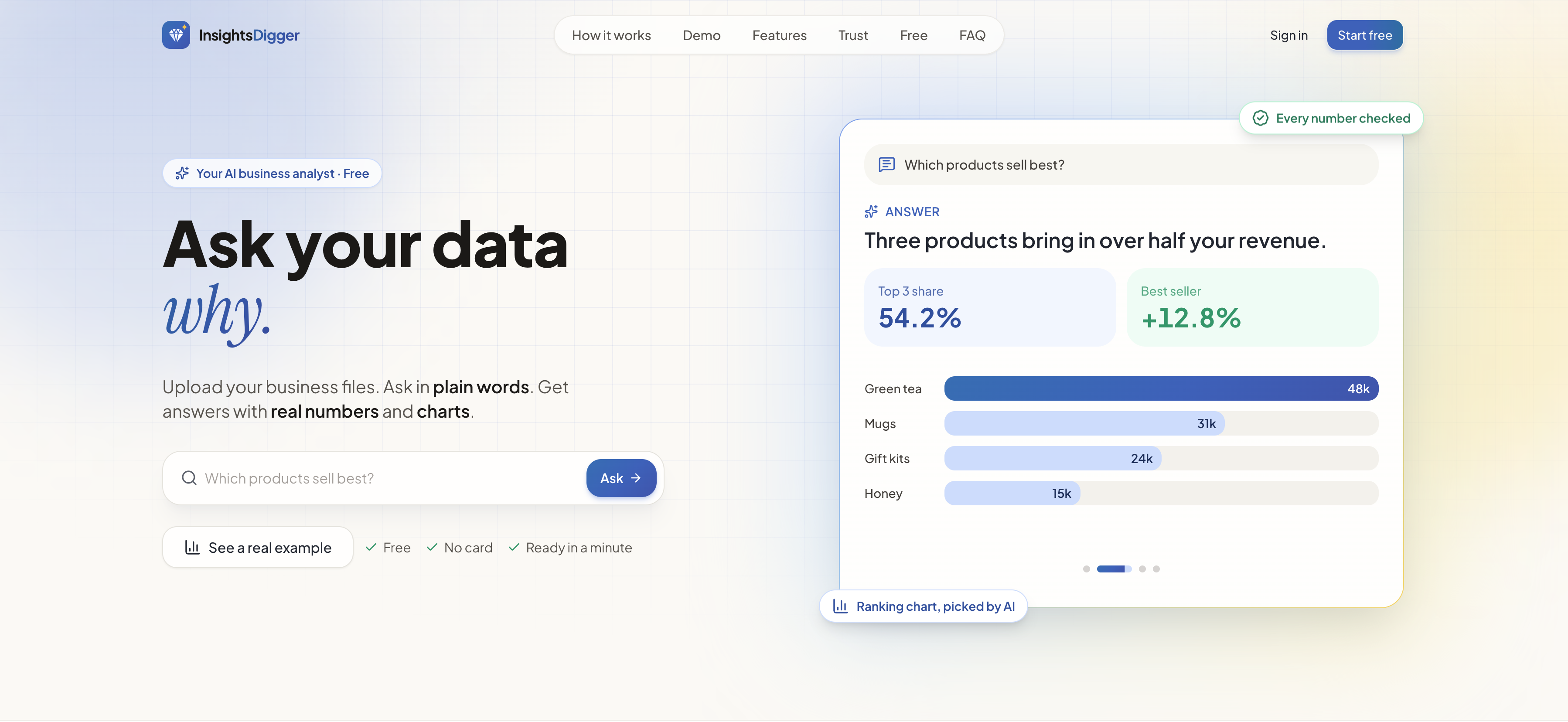
InsightsDigger is an AI data analyst that shows its work. You upload your files (Excel, CSV, PDF, Word, JSON or ZIP), ask a business question, and watch the AI run a live investigation. You get verified findings with evidence, charts, plain-language explanations and recommended actions. You can challenge or discuss any finding, then export the full insights report as a PDF to share with your team.
Know where you stand. Whether you run several small businesses or one large company, it's hard to see the full picture when your data is scattered across files and teams. InsightsDigger lets you bring all of it together in one place and get personalised insights about where your business stands and what to do next.
## How we built it
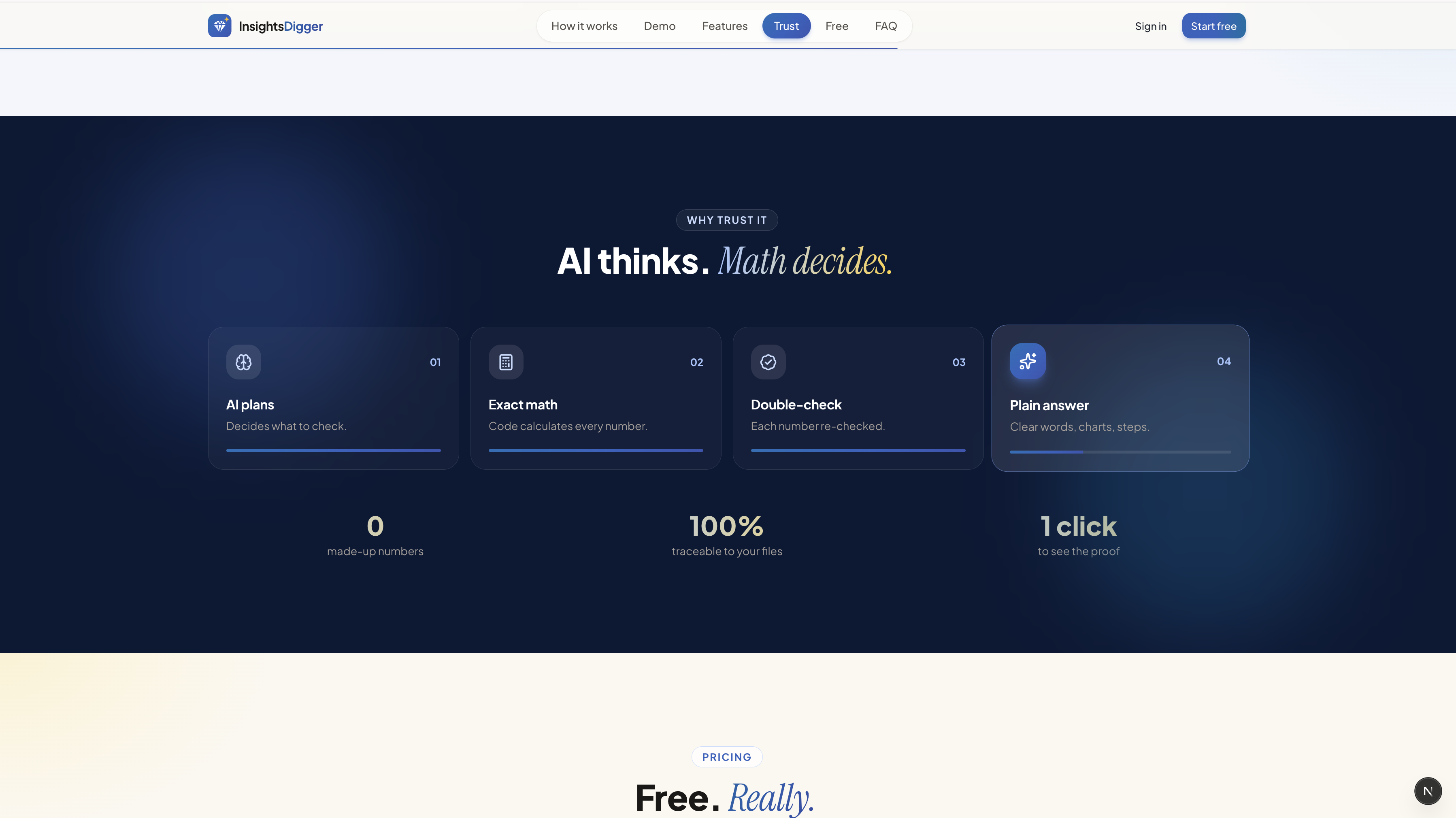
AI does the thinking. We built the ground it stands on.
AI runs the entire investigation behind the scenes: it understands the files, plans the hypotheses, picks the analyses, judges the results, designs the charts and writes the report. We didn't replace the AI with rules. We built a structured, guided framework that tells the AI what to do, how to do it, and what it isn't allowed to do:
- Understand: the AI reads every file and explains what each table and column means.
- Plan: the AI turns the business question into testable hypotheses, written as structured tool calls.
- Analyse: Python (Pandas) runs those tools on the real data.
- Verify: every number is re-computed from the source before anyone sees it.
- Explain: the AI turns only the verified results into findings, charts and next steps.
Guardrails that keep the AI grounded:
- Any number in the AI's text must match the evidence, allowing for rounding: \( |x - a| \le \max(0.051,\ 0.006a) \). Otherwise the AI is asked to correct itself.
- Filters must use values that really exist in the data, and charts are built only from verified evidence tables.
- Challenges are re-computed in Python before the AI judges them.
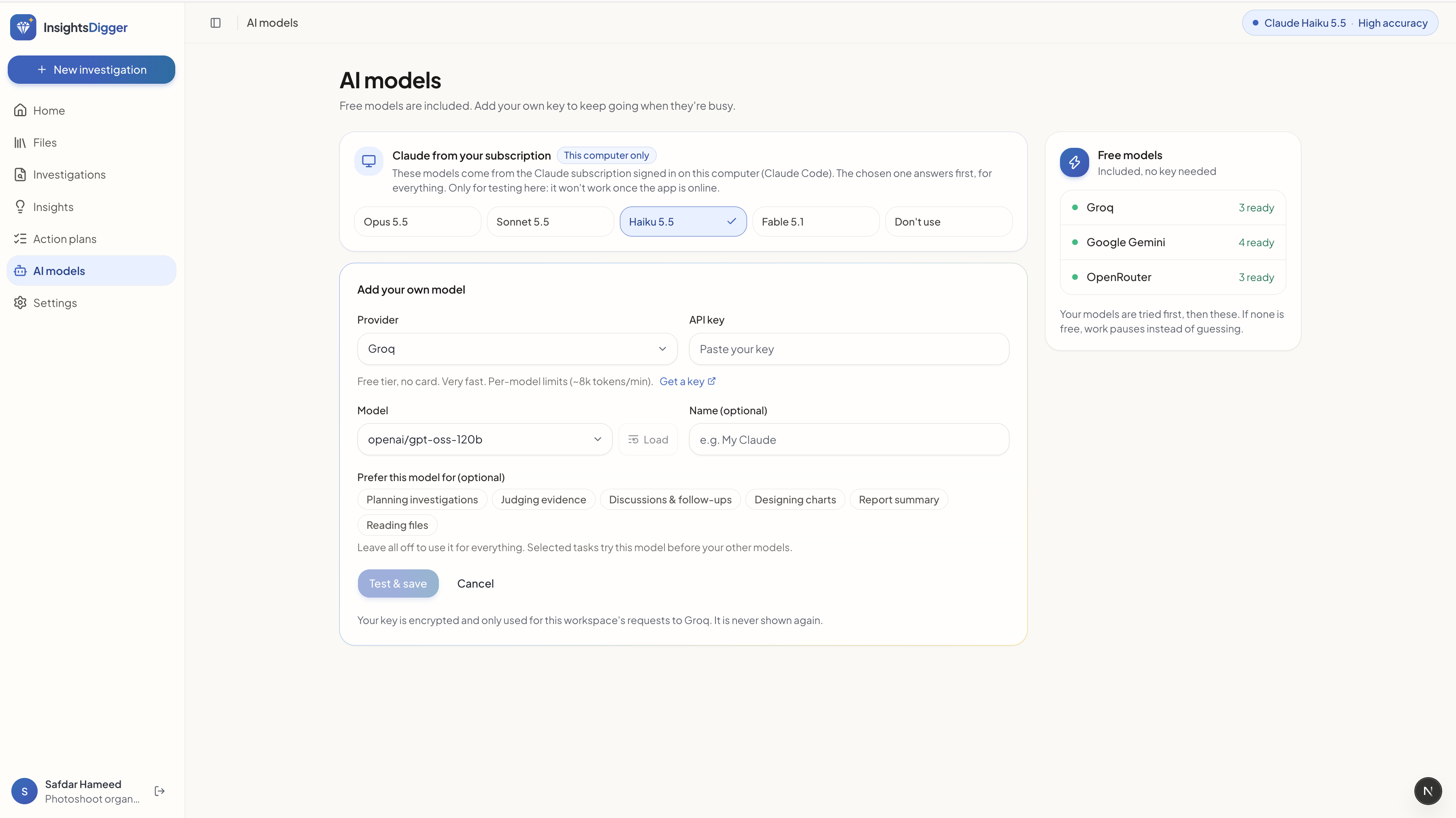
Stack: Next.js 16, React 19, Tailwind, Recharts | FastAPI, Pandas, PostgreSQL | many AI providers (Groq, Gemini, Cerebras, Mistral, OpenRouter and more) with automatic fallback, plus bring-your-own-model support with encrypted keys.
## Challenges we ran into
- Hallucinated numbers: prompting alone wasn't enough, so we built hard checks and retry loops.
- Messy real-world files: merged headers, multi-sheet workbooks and tables split across PDF pages.
- Free-tier rate limits: solved with a multi-provider fallback chain and cooldowns.
## What we learned
AI is most powerful when it's guided, not unleashed. Used as a planner and explainer, with code handling the calculations, it becomes something businesses can actually trust.
## What's next
Connect your data where it already lives. We're building integrations with mailboxes, Google Sheets, cloud drives and other business platforms, so files you receive, create or export flow straight into InsightsDigger, with no manual uploads, just insights that stay up to date.
Built With
- fastapi
- next
- numpy
- pandas
- pdfplumber
- postgresql
- python
- react
- recharts
- shadecn-ui
- typescript
- uviocrn

Log in or sign up for Devpost to join the conversation.