Inspiration
Product teams are drowning in feedback but starving for clarity.
Customer opinions are scattered across app reviews, Reddit threads, news articles, forums, GitHub discussions, YouTube comments, and countless other sources. Valuable insights exist everywhere, yet understanding the true public perception of a product still requires hours of manual research.
We were inspired by a simple question:
"What if you could instantly understand what the internet really thinks about any product?"
Instead of reading hundreds of reviews and discussions, we wanted a system that could surface the most important complaints, opportunities, risks, and customer requests in minutes.
InsightLens was built to turn fragmented public conversations into actionable product intelligence.
What it does
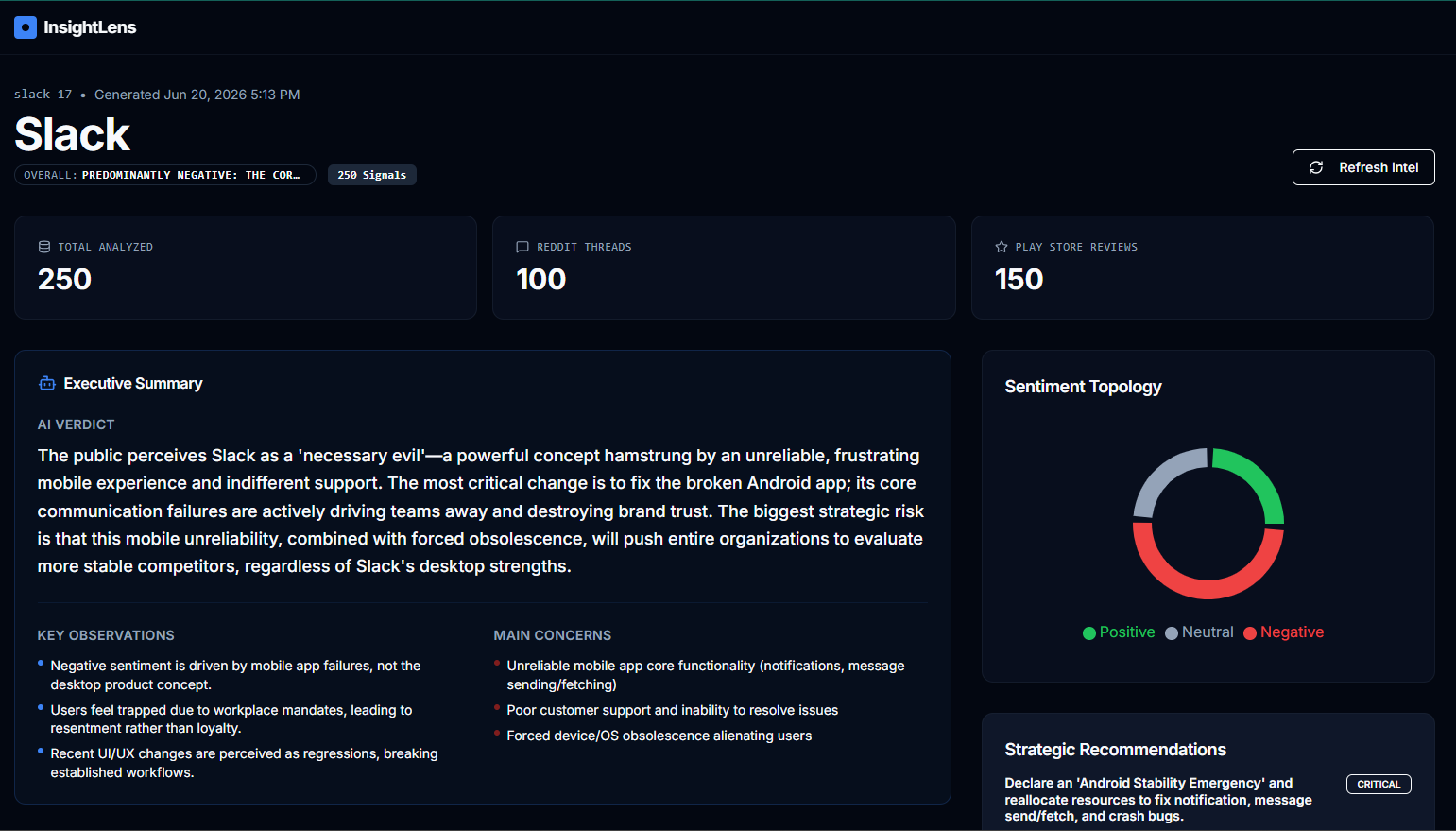
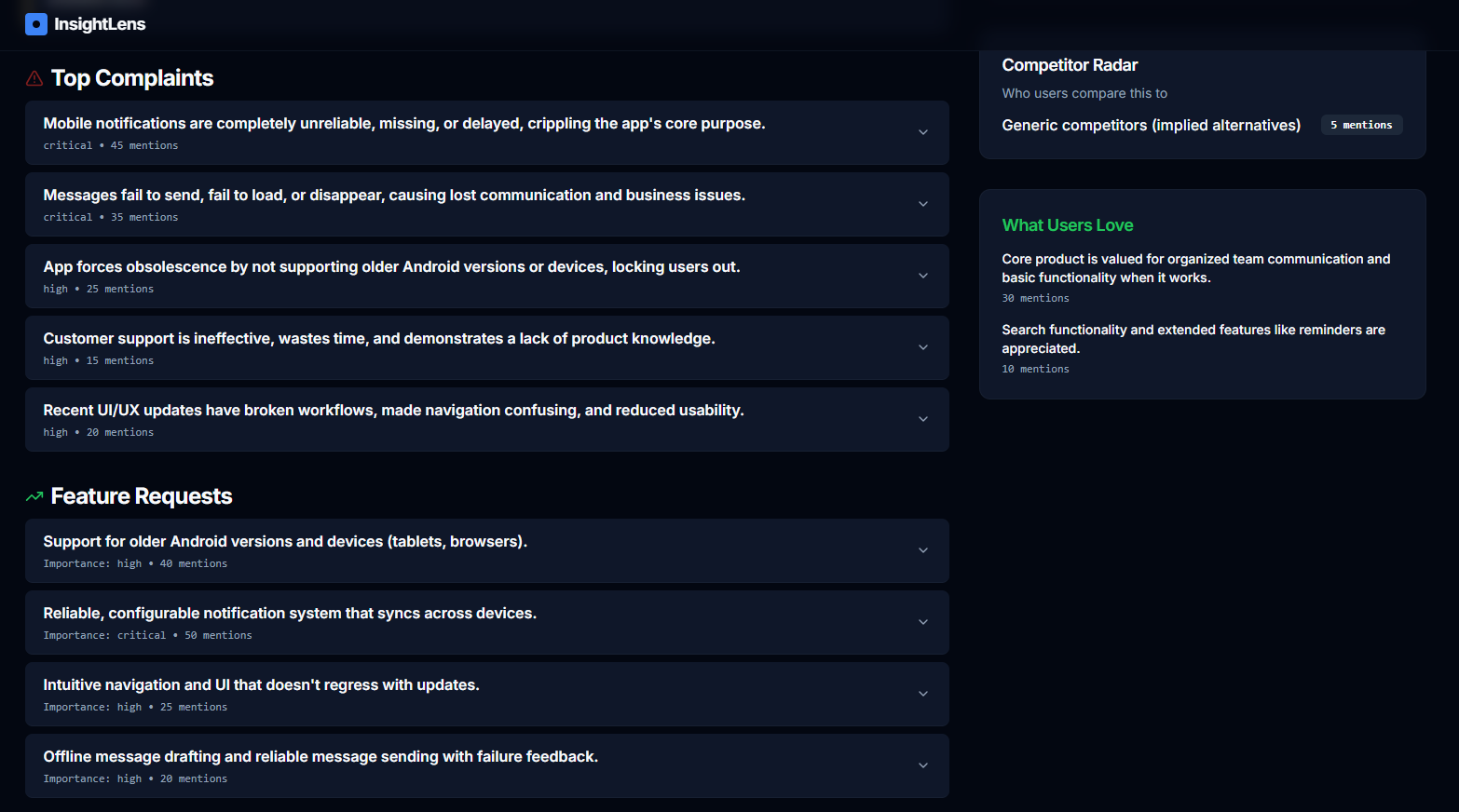
InsightLens is an AI-powered Product Intelligence Platform that analyzes public discussions and feedback from multiple sources to reveal how customers truly perceive a product.
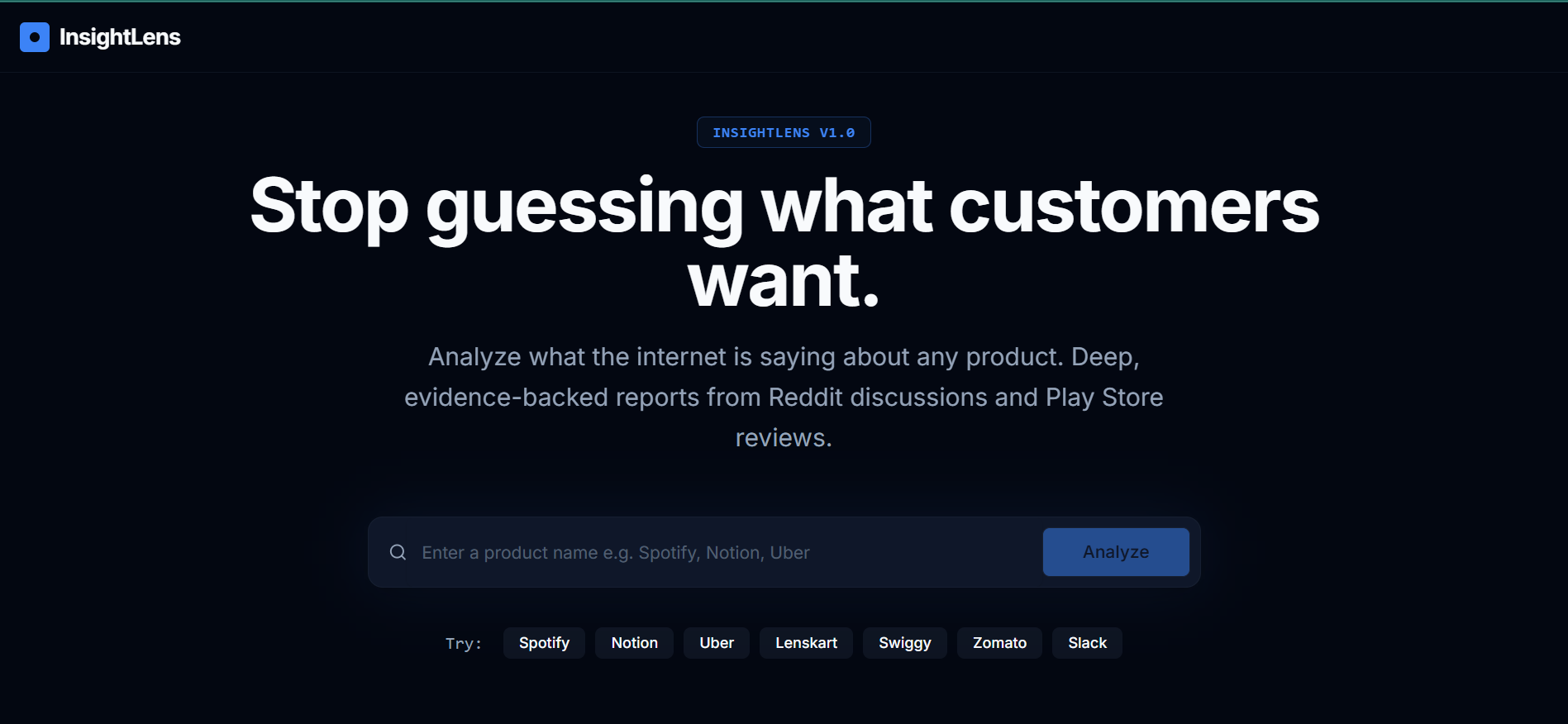
Users simply enter a product name, such as Samsung, Notion, Microsoft Teams, Uber, Spotify, or Lenskart.
InsightLens then:
Aggregates relevant public discussions and reviews Filters irrelevant mentions and false positives Identifies recurring complaints and frustrations Detects feature requests and unmet needs Surfaces positive sentiment and customer praise Tracks emerging trends and shifts in perception Highlights competitor comparisons Generates strategic product opportunities Produces an evidence-backed intelligence report
Rather than showing raw reviews, InsightLens answers higher-level questions:
Why are users unhappy? What do customers love? What should the product team prioritize next? What opportunities are competitors missing? What risks could impact growth?
How we built it
We started by focusing on a core principle:
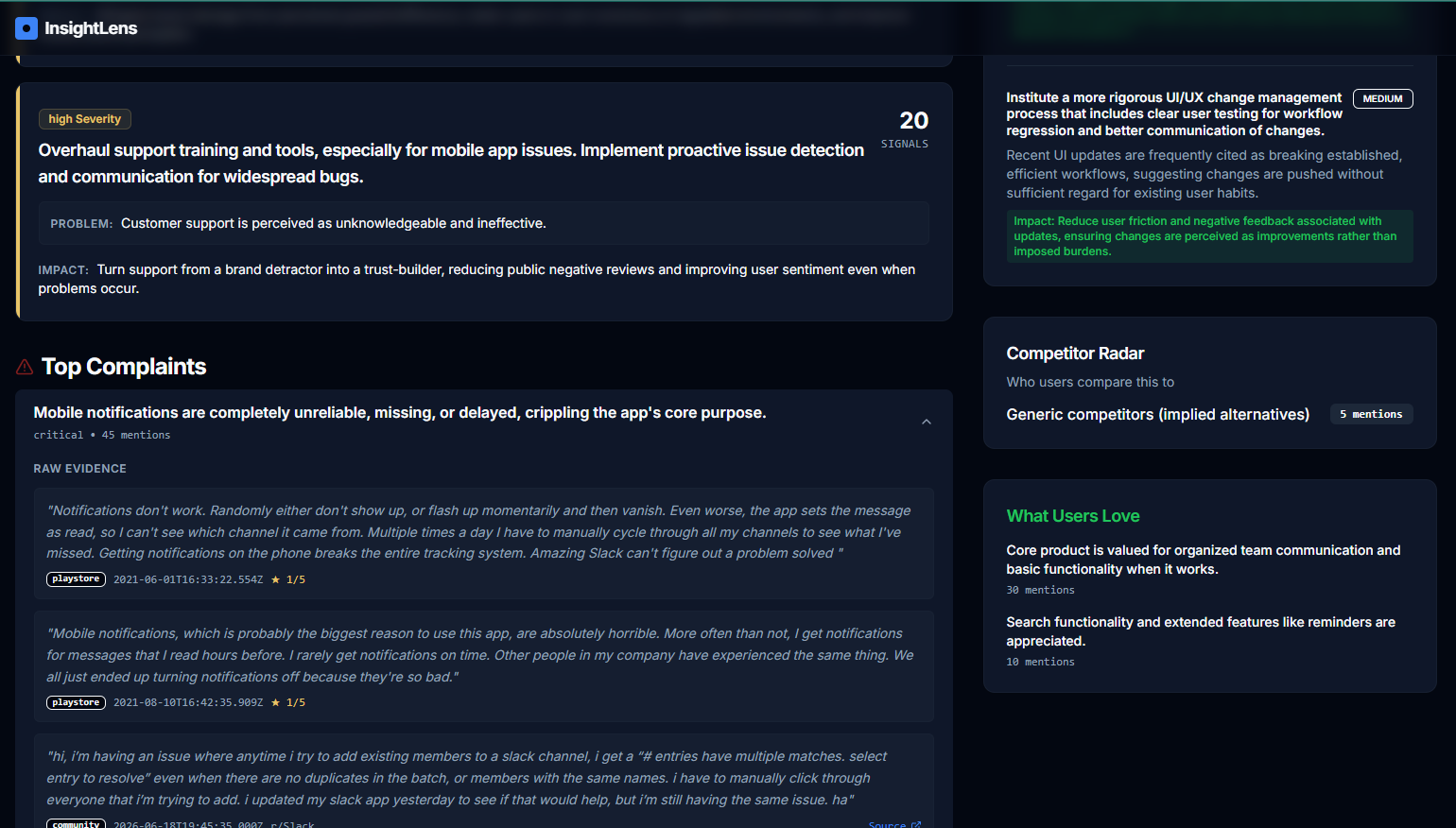
Every insight must be grounded in evidence.
Instead of building another chatbot that generates generic summaries, we designed InsightLens as an intelligence pipeline.
The first challenge was understanding that public sentiment exists across many different formats. Reviews, discussions, news articles, technical forums, and social conversations all contain valuable signals, but each source speaks a different language.
To solve this, we built a multi-stage workflow:
Collect public signals from multiple sources Clean and normalize the data Remove duplicates and irrelevant mentions Identify the specific product being discussed Group similar conversations into themes Extract recurring complaints, praise, and requests Generate strategic insights backed by evidence
A major design decision was to avoid sending raw internet data directly to AI models. Instead, feedback is first processed into structured themes and clusters, allowing AI to focus on interpretation rather than brute-force summarization.
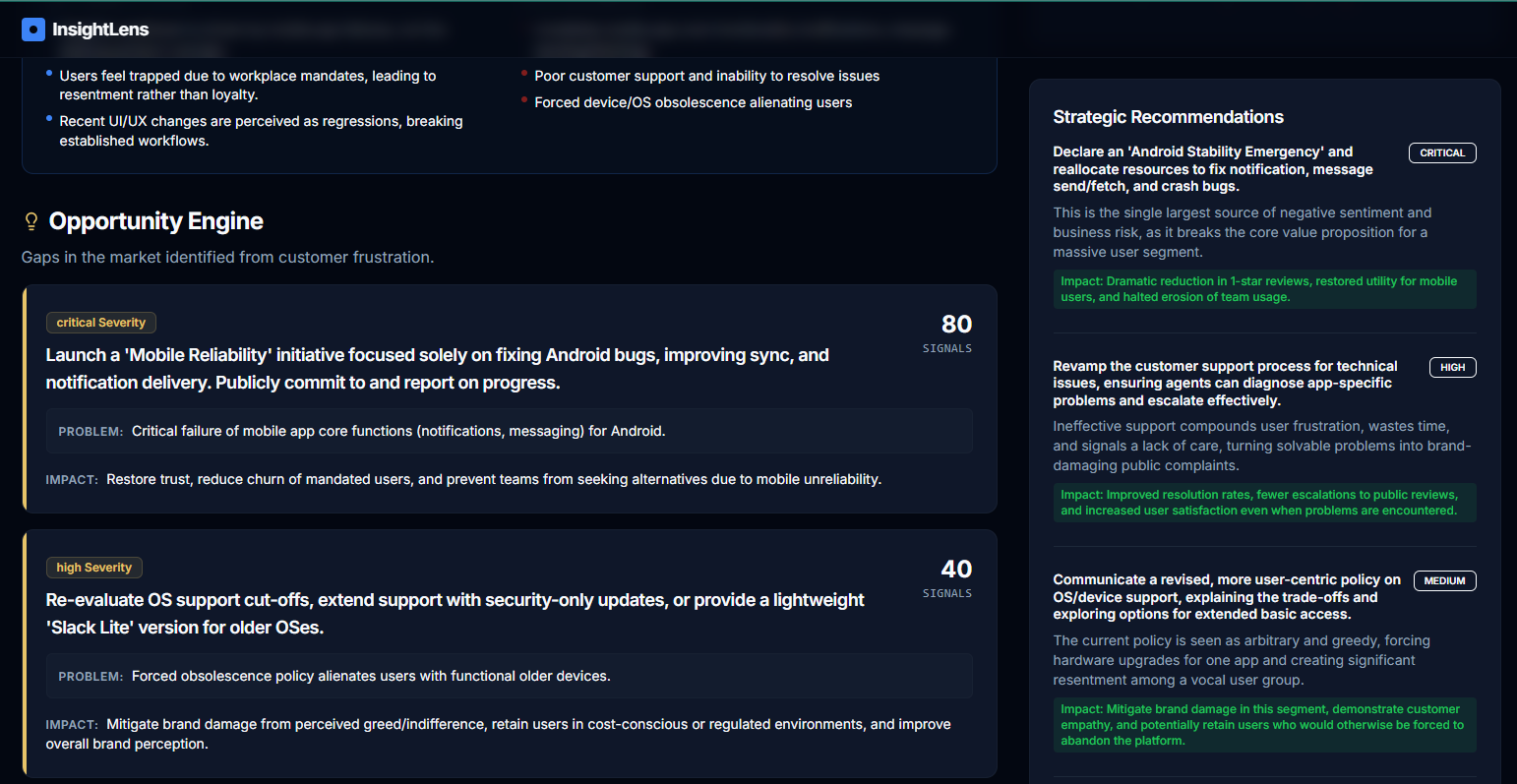
We also designed the platform around the way product managers actually work. Instead of producing a sentiment score and stopping there, InsightLens converts customer feedback into opportunities, priorities, risks, and recommendations that can directly influence a product roadmap.
Throughout development, we constantly asked:
"Would a product manager actually pay for this?"
That question guided every feature we built.
Challenges we ran into
One of the biggest challenges was separating signal from noise.
Many products have generic names that appear in unrelated contexts. For example, searching for terms like "Teams," "Notion," or "Apple" can produce thousands of irrelevant results. We had to build multiple layers of filtering to ensure discussions actually referred to the intended product.
Another challenge was balancing breadth and accuracy. Public opinion exists across many platforms, but not every source is equally trustworthy. We needed a system that could combine information from different places without introducing misleading conclusions.
We also discovered that traditional sentiment analysis often fails in product discussions. A user can sound positive while describing a serious issue, or sound negative while still recommending the product. We had to move beyond simple positive/negative classification and focus on identifying actual product signals.
Finally, ensuring that every insight remained traceable to evidence was critical. It was easy to generate impressive-looking summaries; it was much harder to generate insights that could be verified.
Accomplishments that we're proud of
Built an end-to-end intelligence engine rather than a simple review summarizer Created a system that transforms thousands of public conversations into actionable product insights Designed an evidence-first workflow where every major finding can be traced back to supporting signals Developed an Opportunity Engine that converts customer frustrations into potential product improvements Built a reporting experience that feels useful for real-world product teams rather than just hackathon demos Successfully combined multiple forms of public feedback into a unified view of customer perception Created a foundation that can scale from individual products to full market intelligence
Most importantly, we built something that helps answer a question every product team struggles with:
"What should we build next, and why?"
What we learned
We learned that customer sentiment is far more nuanced than traditional analytics dashboards suggest.
The most valuable insights are rarely found in averages or ratings. They emerge when thousands of individual opinions are connected into larger patterns.
We also learned that AI is most useful when it acts as an intelligence layer rather than the product itself. The real value comes from helping people understand complex information, not simply generating text.
Another key lesson was that transparency matters. Users trust insights much more when they can see the evidence behind them.
Finally, we learned that product intelligence is not just about identifying problems. It's about uncovering opportunities hidden inside customer conversations.
What's next for InsightLens
Our vision is to become the definitive intelligence layer between public opinion and product strategy.
Next, we plan to:
Expand support for additional public data sources Introduce real-time sentiment and trend monitoring Build competitor benchmarking across entire markets Add historical trend analysis to track perception changes over time Create AI-powered roadmap recommendations based on customer demand Develop team collaboration features for product and research teams Launch customizable alerts for emerging risks and opportunities Introduce market gap detection to uncover underserved customer needs Build an evidence-grounded AI Product Consultant capable of answering strategic product questions
Long term, we want InsightLens to become the platform teams use before making any major product decision.
Our goal is simple: transform the world's public conversations into actionable product intelligence.
Built With
- ai-powered-clustering
- analysis
- apple-app-store-reviews
- caching
- claude-3.5-sonnet
- competitive-intelligence
- customer
- dark-mode-ui
- data-normalization
- evidence-based-analytics
- feedback
- github-discussions
- github-issues
- google-play-reviews
- gpt-4o-mini
- hacker-news-api
- llama-3.3-70b
- natural-language-processing-(nlp)
- news-aggregation-apis
- node.js
- openrouter
- opportunity-detection
- product-intelligence-engine
- qwen-2.5-72b
- react
- reddit-data-sources
- responsive-web-design
- rest-apis
- retrieval-augmented-generation-(rag)
- sentiment-analysis
- tailwind-css
- trend-analysis
- typescript
- vite

Log in or sign up for Devpost to join the conversation.