-
-
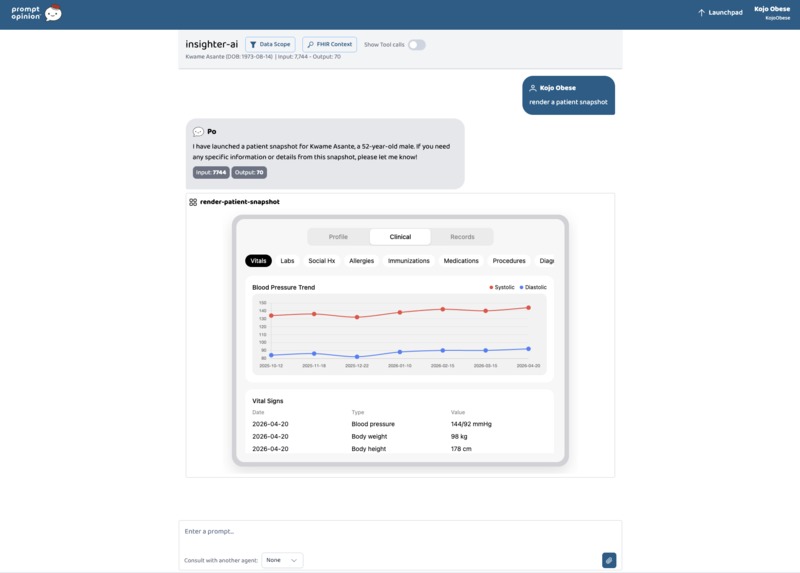
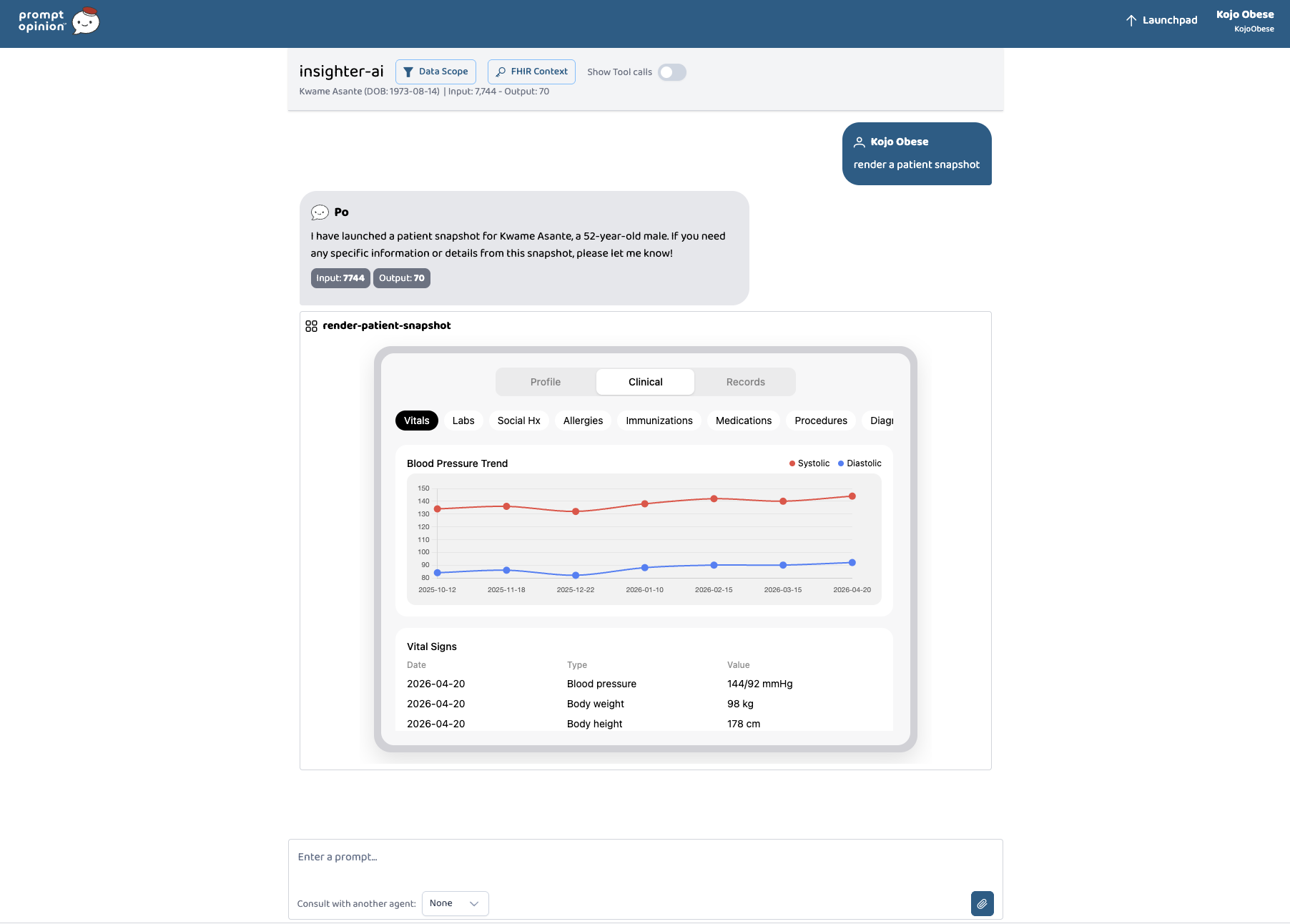
render patient snapshot app
-
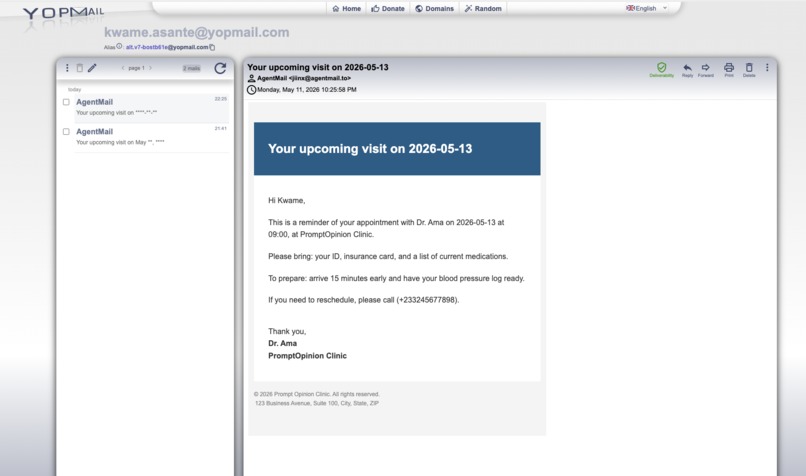
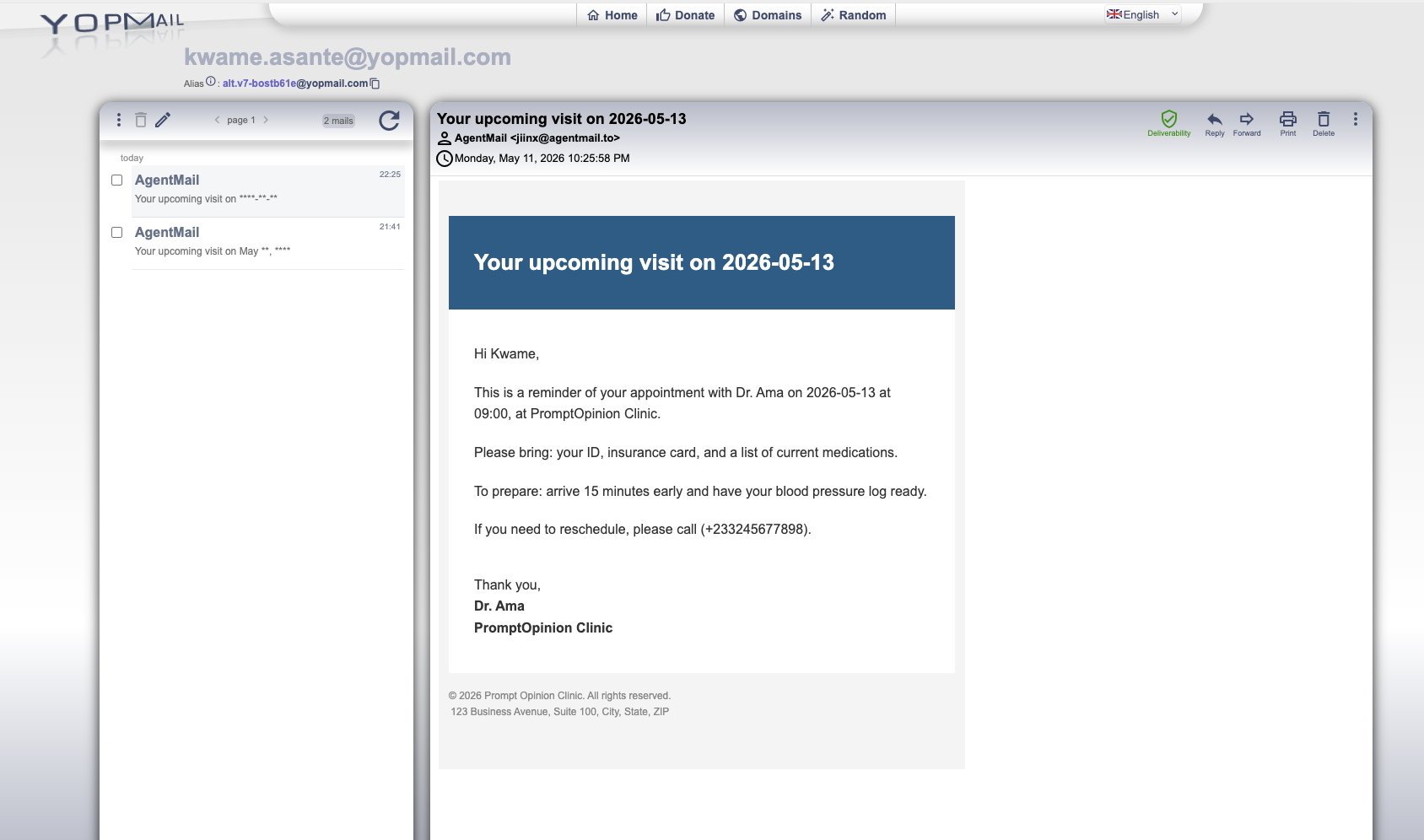
email received by the patient
Inspiration
Insighter AI was inspired by my experience as a pharmacist working in hospitals and seeing how difficult follow-up care can be in practice. Important tasks like patient follow-ups, pre-visit confirmations, and routine outreach often fall through the cracks, not because they are unimportant, but because they are time-consuming, repetitive, and spread across disconnected systems.
I wanted to help fill that gap. My goal with Insighter AI was to make it easier for care teams to quickly understand a patient’s status and take action, especially for the kinds of communication tasks that are essential for continuity of care but often hard to manage consistently.
What it does
Insighter AI is a healthcare assistant that connects to live FHIR context, pulls patient data, and presents it as a concise patient snapshot. Instead of forcing a clinician to manually dig through records, it surfaces key information such as demographics, conditions, vitals, medications, allergies, procedures, encounters, and appointments in a single view.
I also built a patient outreach workflow on top of that snapshot. Once the relevant context is available, the app can help generate and send standardized patient emails, making follow-up communication and pre-visit coordination faster and more consistent.
How I built it
I built Insighter AI as a remote MCP app designed to plug into a clinical workflow. The backend accepts FHIR context from the client, fetches the patient’s data, structures it into a usable snapshot, and exposes tools through MCP. On the frontend, I created an inline patient snapshot widget so the information can be rendered directly inside the MCP client experience.
The stack combines:
- MCP for tool and app integration
- FHIR for patient context and clinical data retrieval
- A custom patient snapshot UI for summarizing patient information
- AgentMail for sending patient-facing outreach
- Bun and TypeScript for fast development and iteration
Challenges I ran into
One challenge was my initial architecture. I first built Insighter AI as a separate agent communicating with the Prompt Opinion agent through A2A, but that turned out to be overkill because the Prompt Opinion agent already had the access and context needed. That taught me to simplify the system instead of adding unnecessary layers.
Another challenge was deciding how much patient data was enough. I needed to give the agent enough clinical context to be useful, without overloading it with irrelevant information. Finding that balance was key to making the workflow practical.
Accomplishments that I'm proud of
I’m proud that I was able to turn a real workflow problem I experienced in hospitals into a working product. I built a system that not only pulls together fragmented patient information into a usable snapshot, but also helps move directly into patient outreach and follow-up.
I’m also proud that I was able to simplify the architecture after realizing my first approach was too complex. Instead of forcing an unnecessary multi-agent design, I focused on building something more practical, streamlined, and useful in a real care workflow.
What I learned
Building Insighter AI reinforced something I had already seen in hospitals: the problem is often not a lack of information, but the difficulty of turning that information into timely action. I learned that AI can be most useful when it reduces workflow friction, organizes context quickly, and supports the next operational step instead of just generating text.
I also learned how important trust and clarity are in healthcare tools. The product has to do more than work technically. It has to present information in a way that is useful, focused, and dependable for real care workflows.
What's next for Insighter AI
Insighter AI is an early step toward a more usable AI workflow for healthcare teams. I see strong potential to expand it into broader follow-up coordination, smarter pre-visit outreach, and more proactive patient engagement. My long-term goal is to help care teams spend less time chasing processes and more time supporting patients.
Built With
- agentmail
- cloudflared
- fhir
- mcp
- mcp-app
- mcpserver
- typescript

Log in or sign up for Devpost to join the conversation.