-
-
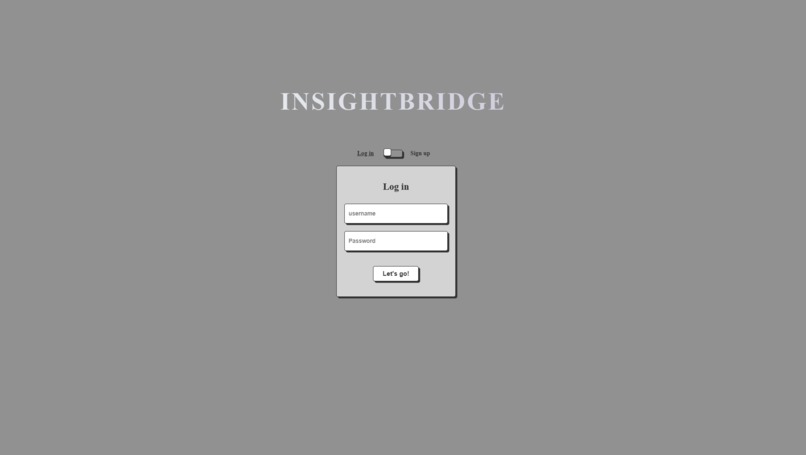
Login/Signup Page
-
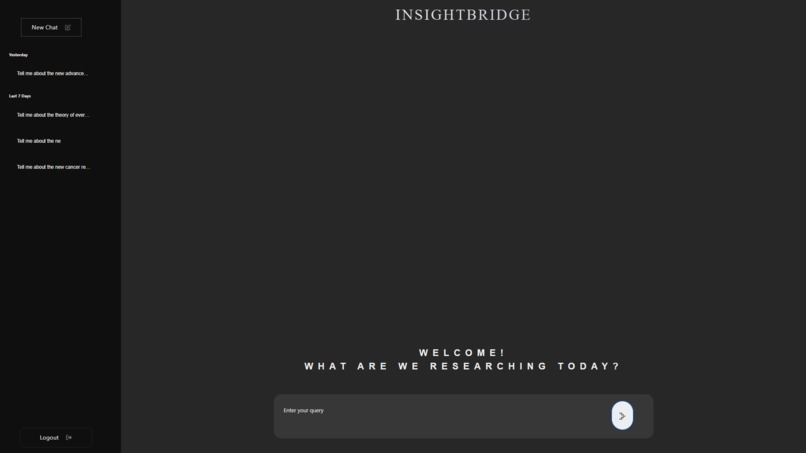
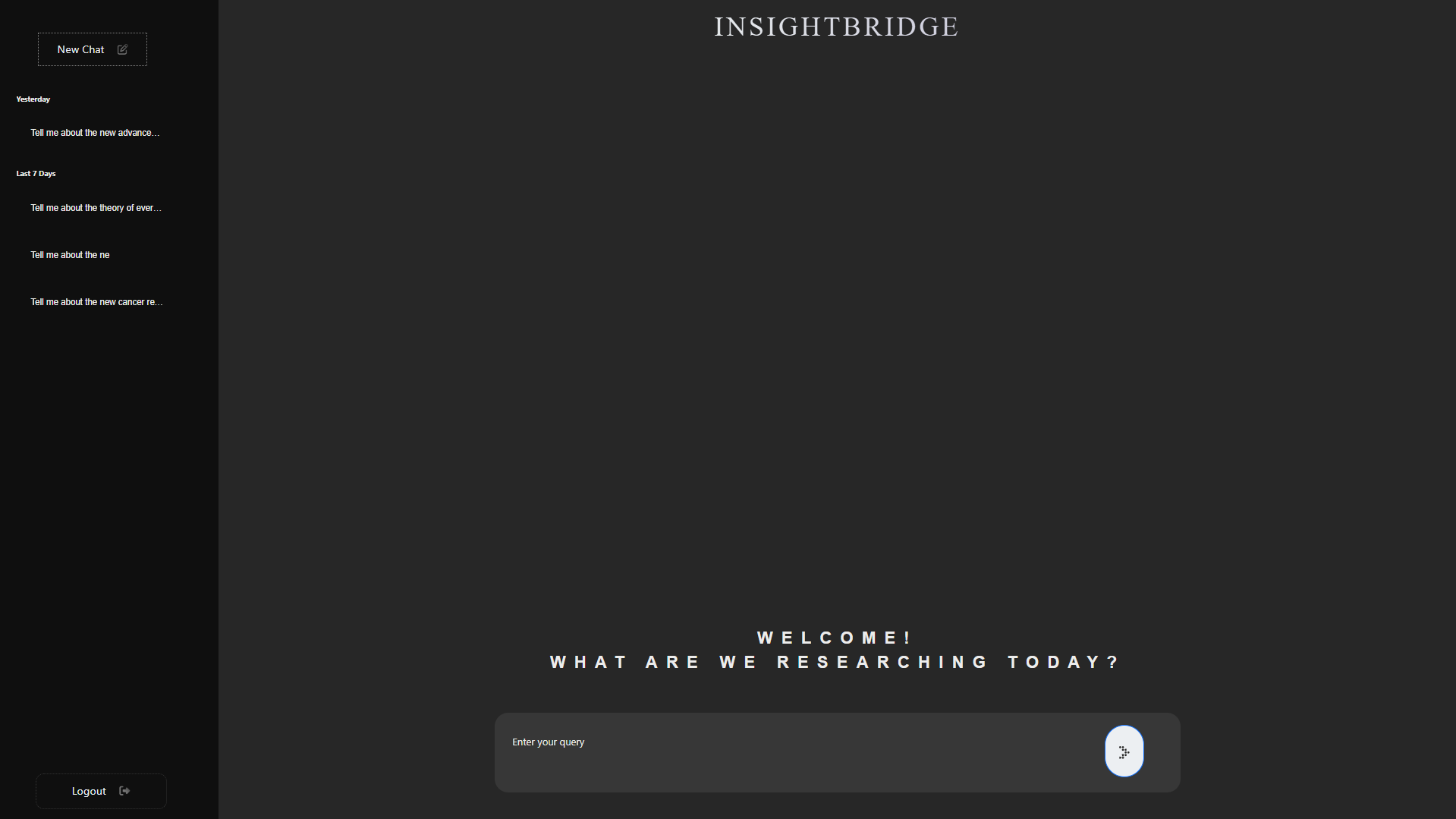
Home Page
-
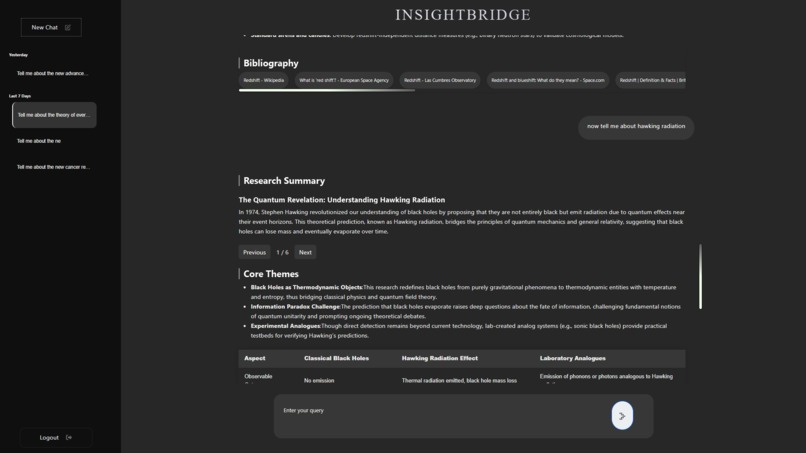
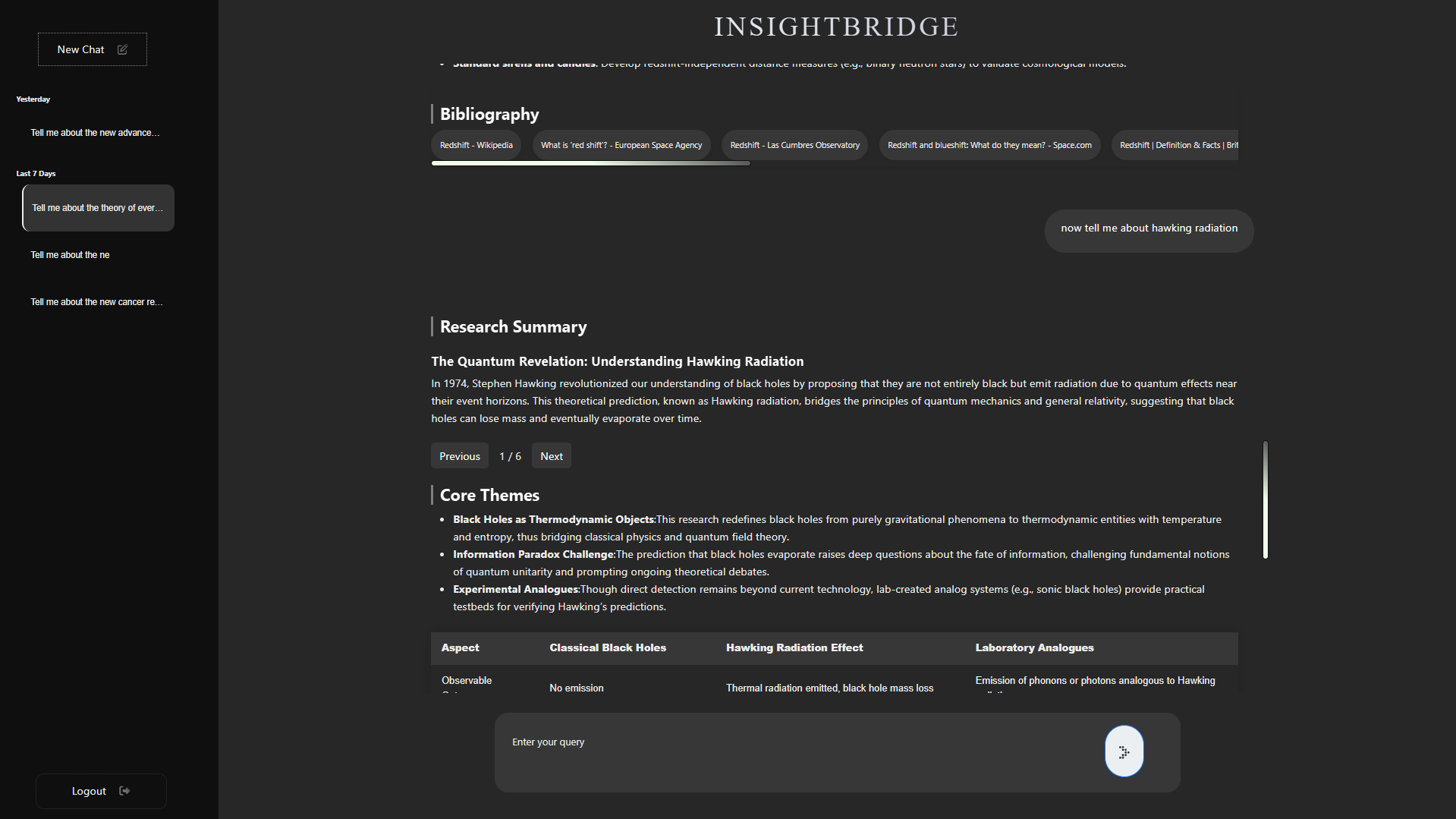
Active Chat Page
Inspiration
We wanted to simplify and accelerate the often tedious and time-consuming process of conducting literature surveys and extracting meaningful insights from vast amounts of research data. InsightBridge was inspired by the need for a smart assistant that helps researchers and professionals quickly gather, analyze, and summarize information with the power of AI agents, saving hours of manual work and enabling deeper understanding.
What it does
InsightBridge uses intelligent AI agents powered by advanced language models to perform deep research and reasoning. Given a research prompt, it automatically searches for relevant content, summarizes findings, extracts core themes and key implications, and generates actionable insights—all organized neatly in an interactive chat format. It supports multiple chat sessions, storing comprehensive histories for easy review and continued exploration.
How we built it
We built InsightBridge using Flask for the backend server and leveraged the Perplexity API integrated through the Agno framework to create two specialized AI agents: one for deep research (leveraging web search and news article summarization tools) and another for reasoning and insight generation. SQLite was used for persistent user and chat data storage, while JSON files handle detailed chat histories. The frontend uses a clean chat UI for user interaction, supported by secure authentication and session management.
Challenges we ran into
- Managing session state and memory across multiple AI agents to maintain context in ongoing conversations was complex.
- Balancing API token limits and response length while ensuring comprehensive research and insight generation.
- Designing a scalable data storage structure that preserves detailed chat histories, bibliography, and insights efficiently.
- Handling user authentication securely and managing multi-user data privacy.
Accomplishments that we're proud of
- Seamlessly integrating two distinct AI agents in a single pipeline to deliver research and reasoning outputs in one unified workflow.
- Creating a persistent chat system that stores rich historical data for future retrieval and expansion.
- Implementing dynamic prompt engineering for the agents to maximize relevance and minimize hallucinations.
- Building an easy-to-use, web-based interface that enables anyone to leverage powerful AI research capabilities without technical knowledge.
What we learned
- The importance of modular design in AI applications—splitting research and reasoning tasks between specialized agents improves both efficiency and output quality.
- Effective prompt formulation is crucial for guiding LLMs to produce focused, accurate results.
- Maintaining user context and session data is key to providing a seamless user experience over multiple interactions.
- Balancing the depth of research with API cost and performance constraints requires thoughtful orchestration.
What's next for InsightBridge
- Enhance multi-modal data support by incorporating PDF and document parsing capabilities for richer source integration.
- Add collaborative features allowing multiple users to work on the same research project in real-time.
- Implement advanced visualization of insights and bibliographies for better comprehension.
- Explore fine-tuning models on domain-specific corpora to boost accuracy in specialized fields.
- Optimize backend performance and scalability to support more concurrent users.
Built With
- agno
- css
- flask
- html
- javascript
- peplexity
- python

Log in or sign up for Devpost to join the conversation.