-
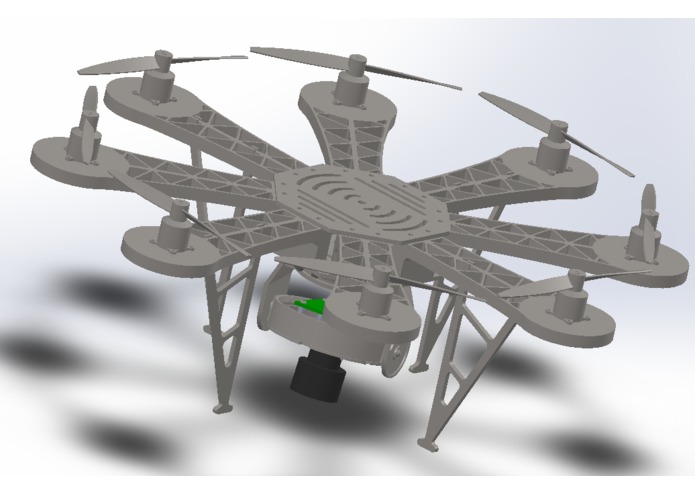
The 3D model of the drone.
-
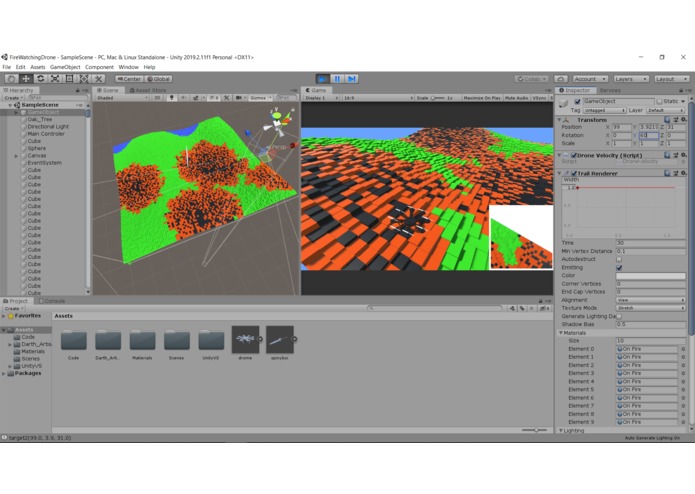
The simulation in unity.
-
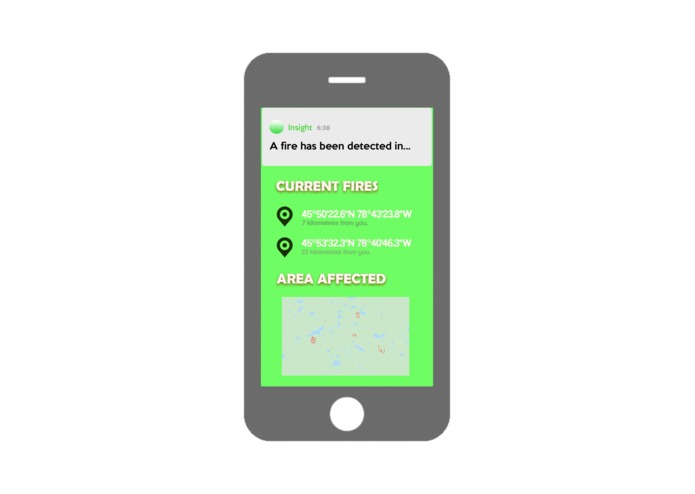
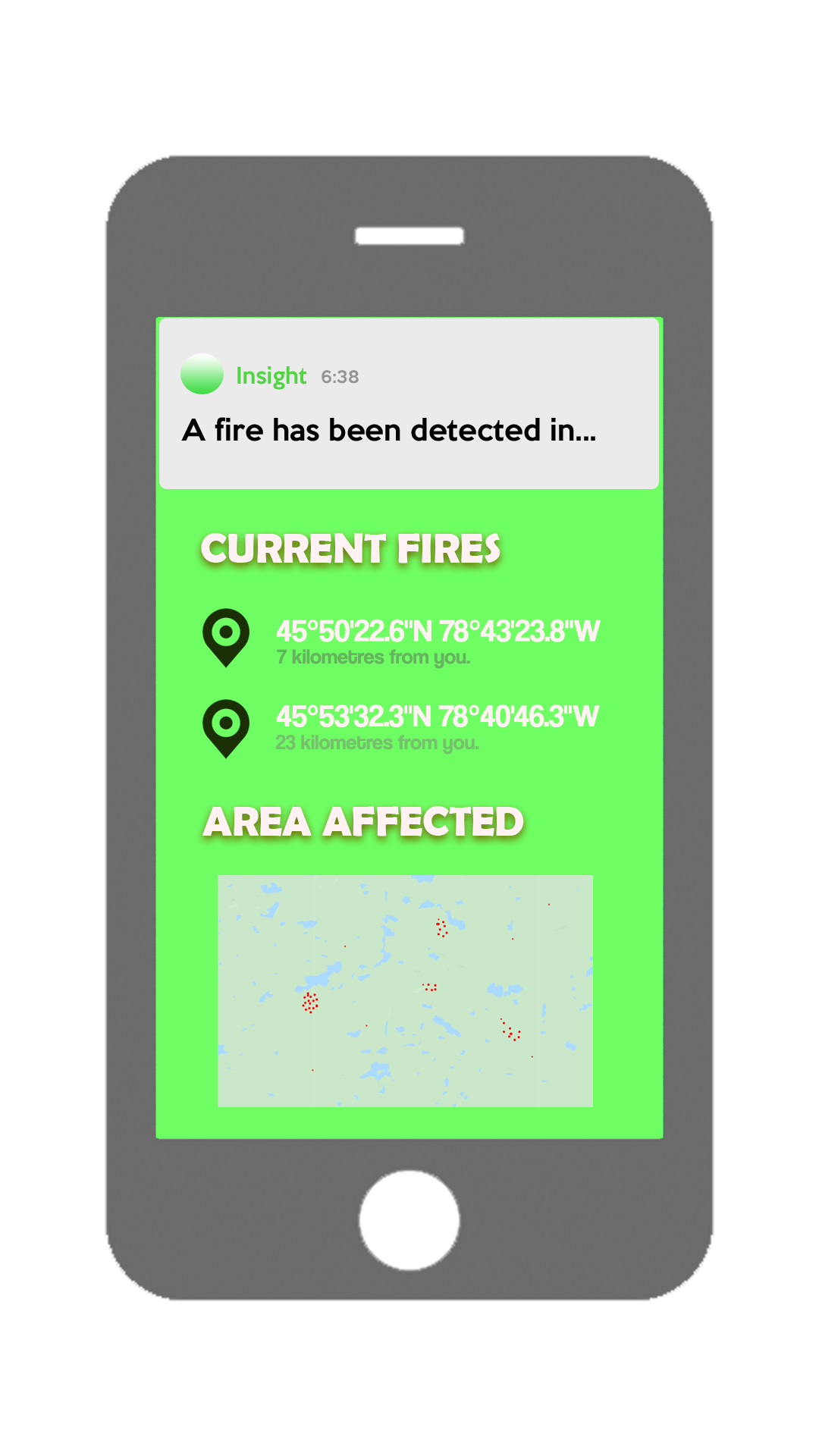
Potential design idea for the soon to come phone application.


Inspiration
When starting to decide what to do we wanted to create something that will have real world application in today's modern society, has to be scalable and solve a problem. It needs to be profitable, have social value, and solve an environmental issue. After brainstorming by writing things randomly on a white board - we connected drones and forest fires. Drones which are a fun and interesting device and forest fires which occur around the world with detrimental effects to the environment. Therefore, we decided to combine them together - giving birth to Insight.
What it does
10 million acres of land a year is burnt due to forest fires, and this amount is increasing yearly by 15%. Which causes a downwards spiral of higher temperatures and dry condition for even more forest fires.
And the only prevention or monitoring system for forest fires are fire lookouts and satellites. Lookouts are based around human eye sight which is unreliable because only after the fire spread to a degree where it can not be stopped can they see the fire. And satellites are updated on a weekly bases due to orbits and images may be distorted due to weather and cloud cover. These two options are unreliable and only usable when the fire is so large it can be seen over a large area. At this stage the fire can only be stopped by preventing any more fuel (trees) for the fire.
To solve this Insight from the lookout locations that are already used, uses these as drone bases. Which from here drone are sent out in an elliptical route on a routine basis to analyse an area greater than what the human eye can see my at-least tenfold and in a more adequate way. After in which if there is a fire it will notify authorities and measure the rate and direction in which it expands
How we built it
Insight was built in 2 parts. The physical drone was designed on solid works based and was made into a octo-copter to have better stabilities in all weathers. Then in which was wiring and sensor were added via solid works circuit works. Such as the battery, infrared sensors, camera, motors, micro controllers, and the H22 chip. The second part was a unity simulation of how the data analysis and response would work.
Challenges we ran into
In general, coming up with an idea that we were all satisfied with took a long time. Not because we disagreed with any of the ideas, but we had to consider the future of it and see if it was worthwhile. Also, we generally faced sleep-deprivation. But, that's okay. Who needs sleep anyway! :)
Accomplishments that we're proud of
We were very proud of integrating complex mathematical aspects to our program which was an essential aspect to this program. This includes, but is not limited to: trigonometry, probability with dependent events, path finding, and centripetal force (physics). Also, we were proud of the end-result of the product. With all of our diverse skills grouped together, we were able to create a successful product.
What we learned
Throughout the during of the project, we learned many important elements that would be beneficial in the many hackathons to come. Technically speaking, we learned how to use GitHub in order to collaborate together simultaneously. Also, we learned how to incorporate C# and the game engine, Unity, to create a simulation of our product. Practically speaking, we learned how to better manage our projects and work together diligently.
What's next for Insight
In terms of what's next for Insight, we would look to create an app for the public that notifies them of fires nearest to them. Also, we would like to create more versions of the drones, that have more advanced optical technology and other features in order for improved fire detection, speed, battery life, etc. As well, we are planning to expand our market reach to states in America that tend to experience forest fires - such as California. From there, we will see how success the product is and then re-market it with our observations of the product success.

Log in or sign up for Devpost to join the conversation.