-
-
insight autopsy
-
drift chart
Insight Autopsy
When analytical insights silently expire
Inspiration
Dashboards are excellent at answering what is happening.
They are dangerously bad at answering a more important question:
Is this insight still true?
While working with analytical insights, we noticed a recurring failure mode: once an insight is declared “true,” it is treated as permanent. Teams continue to rely on it even though the data and assumptions underneath may have shifted.
When reality changes, dashboards do not raise alarms.
They keep reporting with confidence — quietly misleading decision-makers.
This project was inspired by one uncomfortable question:
Why did this insight look true… and when did it die?
What it does
Insight Autopsy treats analytical insights as living objects, not static results.
Instead of trusting insights forever, the system:
- Models each insight as a claim
- Decomposes that claim into explicit assumptions
- Continuously monitors those assumptions over time
- Flags or retires insights automatically when assumptions break
This shifts analytics from static reporting to assumption-aware decision intelligence.
How we built it
We designed Insight Autopsy around the lifecycle of an analytical claim.
1. Insight as a Claim
An insight such as:
“Campaign 1 outperforms Campaign 2 for high-income customers.”
is treated as a claim, not a chart.
Each claim depends on hidden assumptions, including:
- Stability of the high-income customer segment
- Consistency of the income distribution
- Validity of the segment definition over time
Traditional dashboards visualize outcomes but never formalize these assumptions.
Insight Autopsy makes them explicit and measurable.
2. Monitoring Assumptions with Drift Metrics
Each assumption is monitored using statistical drift metrics.
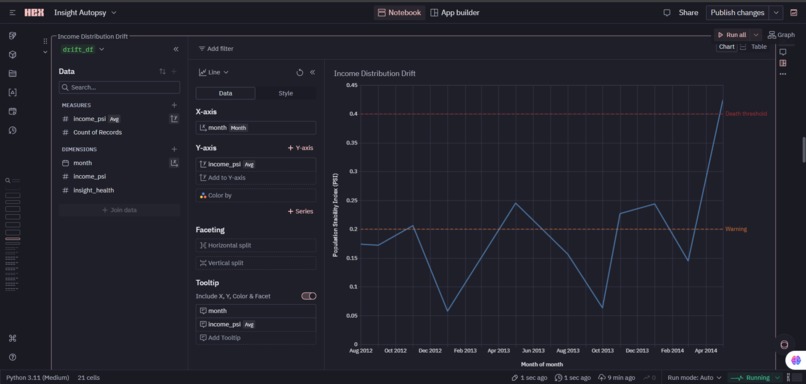
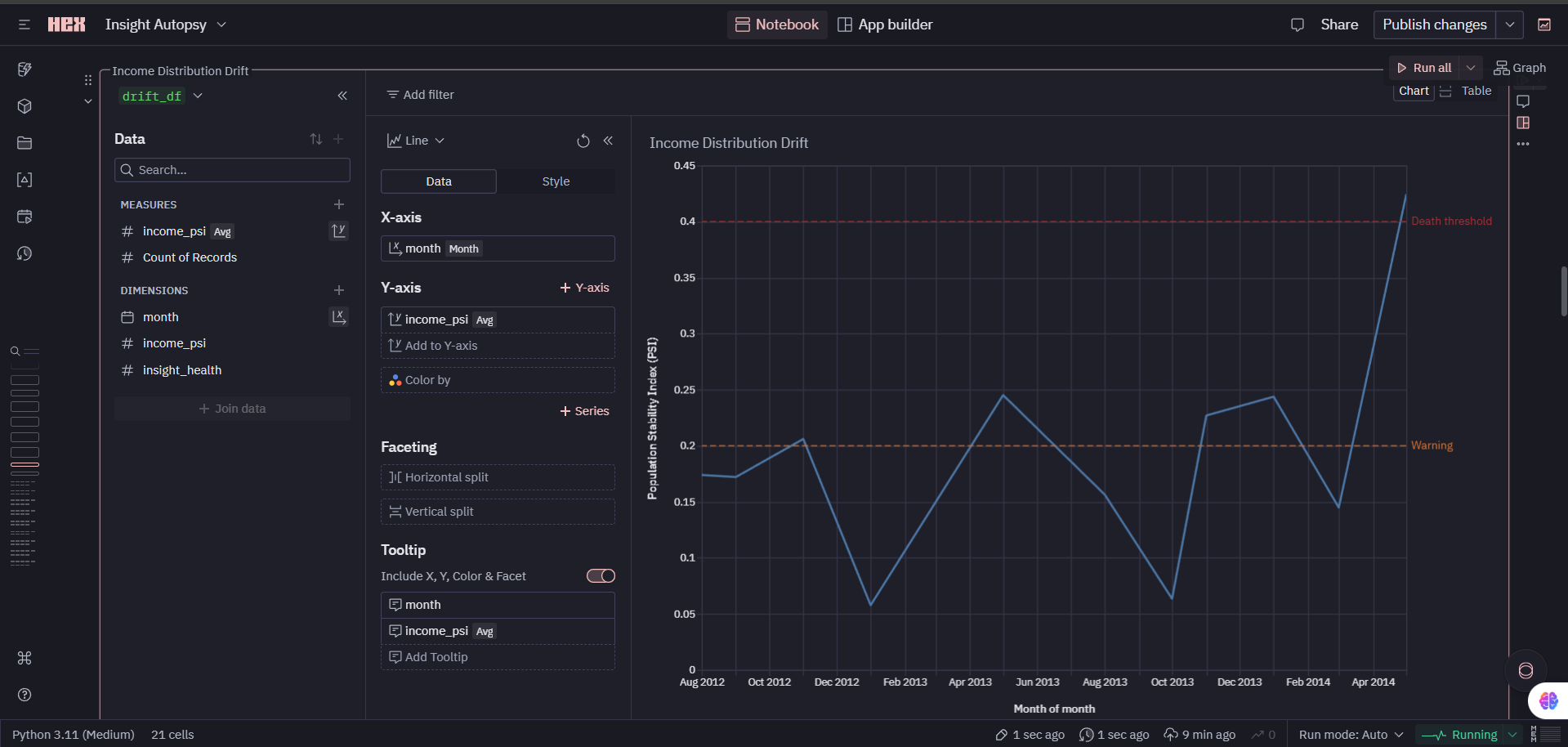
For income stability, we use Population Stability Index (PSI):
$$ PSI = \sum (Actual_i - Expected_i)\ln\left(\frac{Actual_i}{Expected_i}\right) $$
Interpretation:
- PSI < 0.2 → Stable
- 0.2 ≤ PSI < 0.4 → Warning
- PSI ≥ 0.4 → Significant drift
When PSI crosses thresholds, the system signals that the insight’s assumptions are degrading — even if performance metrics still appear strong.
3. Insight Retirement
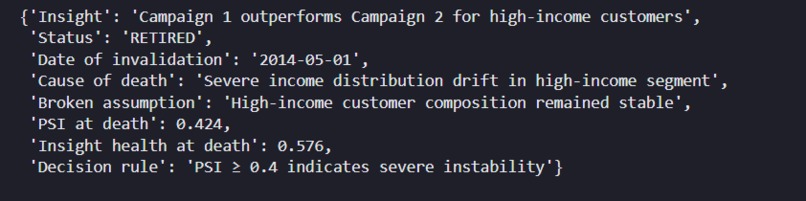
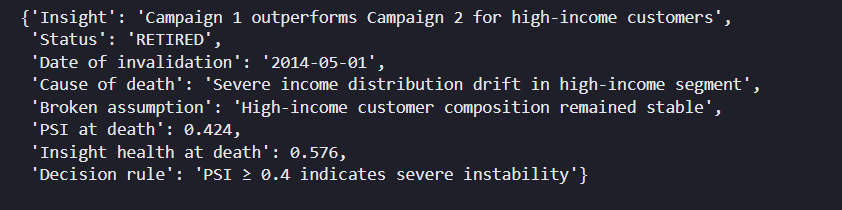
When key assumptions fail, the insight is marked as expired.
Instead of silently misleading stakeholders, Insight Autopsy explains:
- Which assumption broke
- When it broke
- Why the insight is no longer valid
This allows teams to trust insights only while their assumptions remain valid.
Challenges we ran into
- Translating abstract assumptions into measurable signals
- Choosing drift thresholds that are interpretable, not just statistically correct
- Avoiding false alarms while still detecting meaningful shifts early
- Designing the system to feel intuitive for analysts, not academic
Balancing rigor with usability was the hardest challenge.
Accomplishments that we're proud of
- Turning vague business intuition into formal, monitorable assumptions
- Detecting insight failure before KPI degradation becomes visible
- Explaining why an insight failed, not just that it failed
- Shifting the mindset from “trust the dashboard” to “trust the assumptions”
What we learned
- Analytical insights are hypotheses, not facts
- Data drift can invalidate conclusions long before metrics collapse
- Making assumptions explicit is more powerful than adding more charts
- Monitoring why an insight works is as important as monitoring how well it performs
What's next for Insight Autopsy
- Support for additional drift metrics beyond PSI
- Automated insight lineage and dependency tracking
- Alerting workflows for decision teams
- Integration into production BI and experimentation pipelines
The long-term vision is to make expired insights as visible as broken data pipelines.


Log in or sign up for Devpost to join the conversation.