-
-
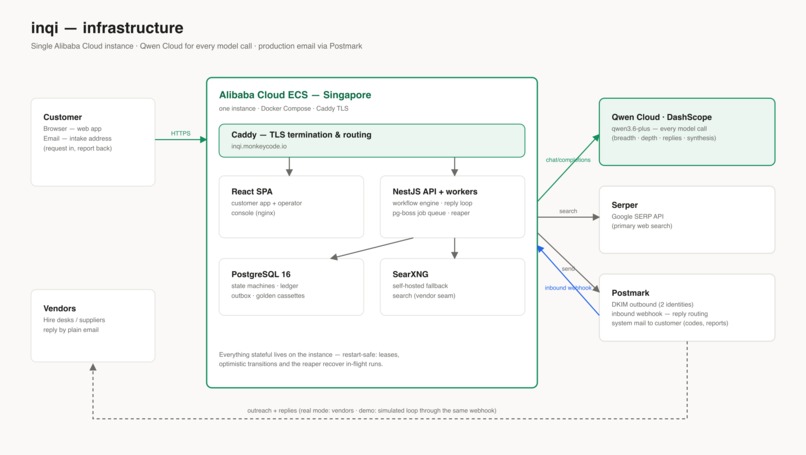
Infra
-
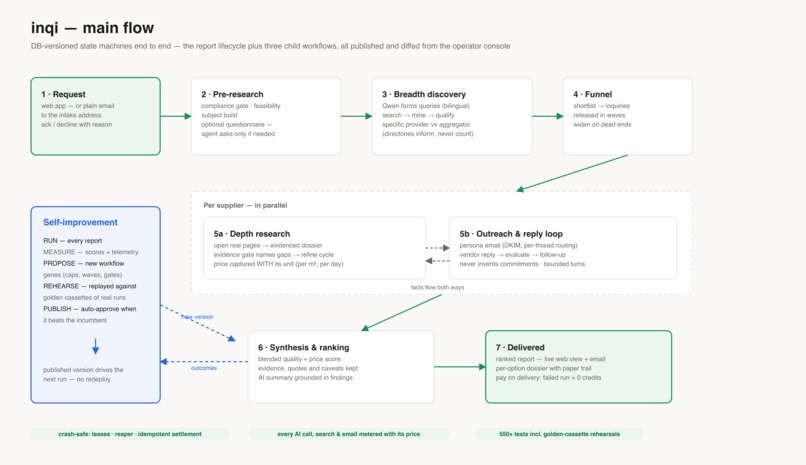
Flow + synthesis + Self update
-
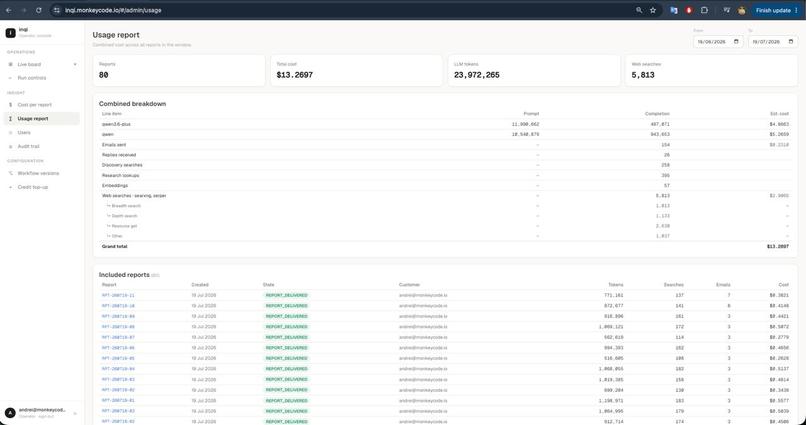
Admin Panel Cost Control
-
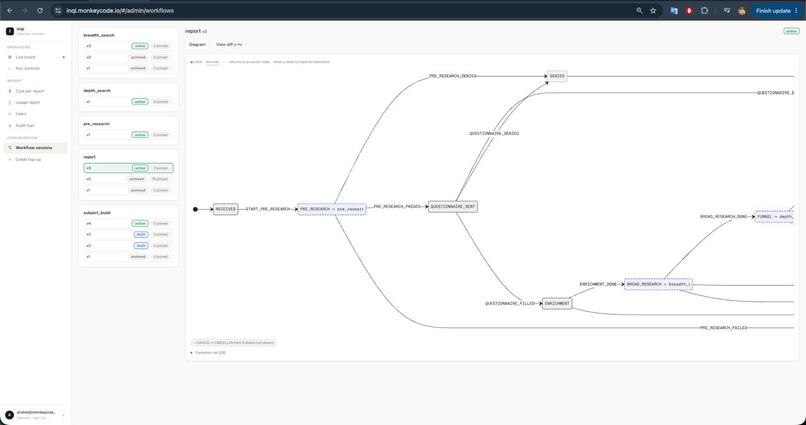
Workflow and SubWorkFlows
-
Product Title
-
Problem Value
-
Innovation and Creativity
-
Self Update Loop Innovation
-
Technical depth
-
Operability and Transparency (Admin Features)
-
Future Vision
-
What it does
Inspiration
Sourcing a vendor is tedious back-and-forth work that consumes hours of human attention — searching, comparing, form-filling, email ping-pong. Meanwhile the world is moving to faster business cycles and faster decision-making. inqi is a first step toward closing that gap: a workflow state machine infused with AI capabilities to analyse and compose, automating the whole process up to the decision point. The track brief's first example — "customer inquiries to quotes" — is literally what inqi does.
What it does
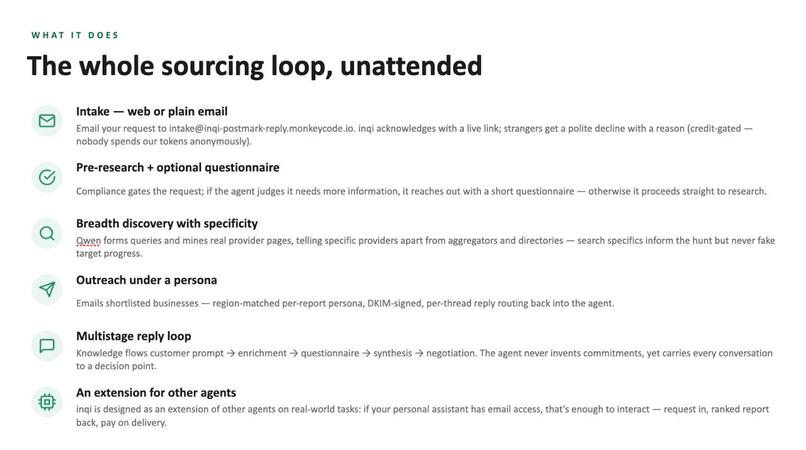
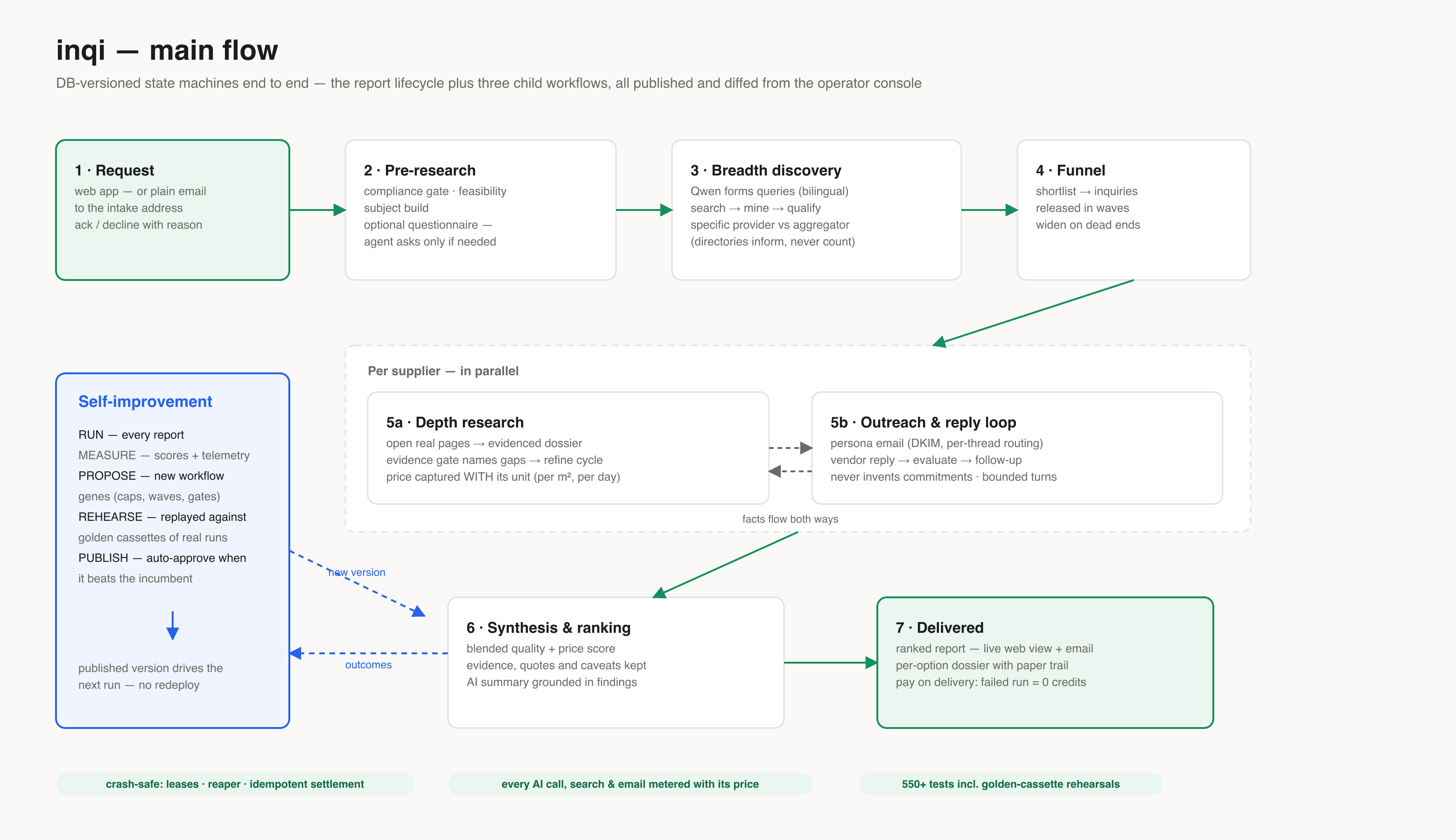
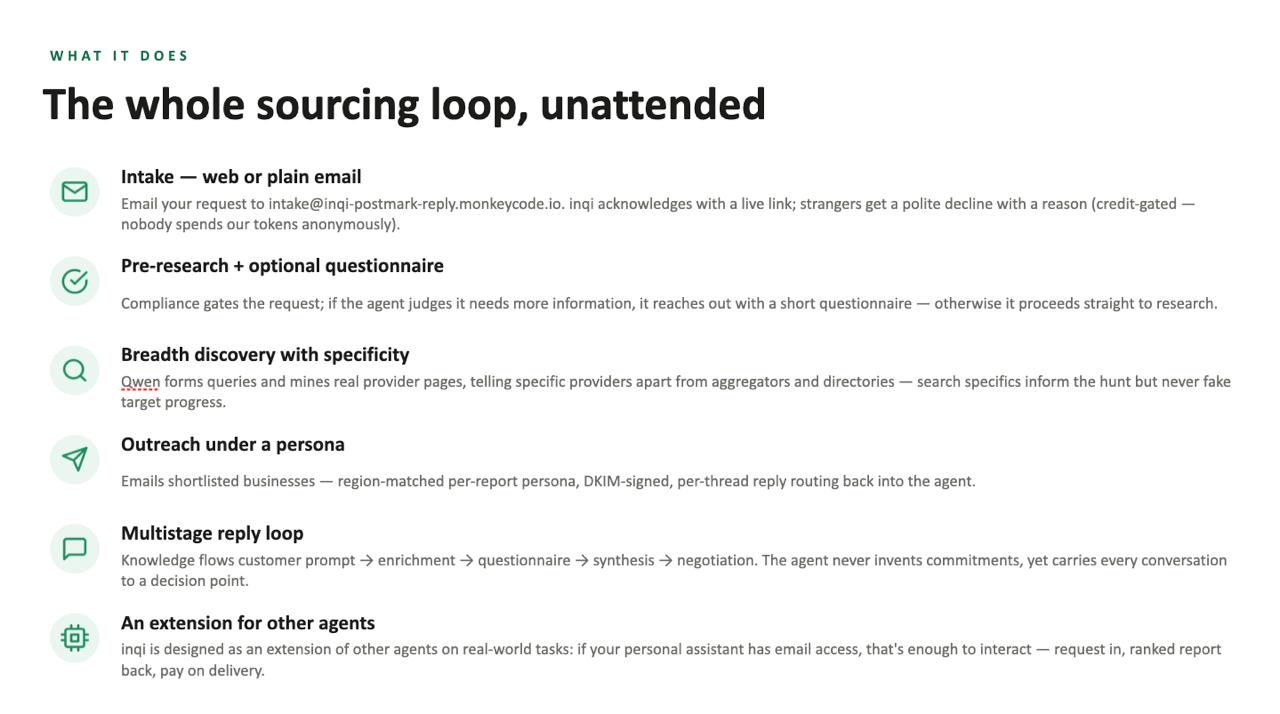
inqi is a service for humans and for other agents: it takes a request through the web interface or by plain email (intake.service.ts) and delivers the result without requiring further attention. The demo case: "facade scaffolding rental including assembly and dismantling, about 600 m², 10-week renovation project in The Hague" — a request where quotes genuinely spread 2× across vendors, so the ranking and negotiation earn their keep:
- Pre-research + scope questionnaire: compliance-gates the request, then confirms scope with a short questionnaire whose options the agent generated itself (questionnaire-generator.ts) — any question can be left to the agent ("decide for me").
- Breadth discovery: Qwen forms search queries (in Dutch and English for a Dutch job), mines real provider pages, and tells specific providers apart from aggregators and directories — marketplaces inform the hunt but never count as results (breadth-lifecycle.ts).
- Outreach: emails shortlisted businesses under a region-matched, per-report persona (DKIM-signed, per-thread reply routing — email.service.ts).
- Multistage reply loop: every vendor reply is evaluated (real answer? counter-question? risk?) before it is answered — the agent never invents commitments, yet carries every conversation to a quoted price (agent.service.ts). In production this negotiated an actual price with a real dog-grooming salon — a 20 EUR first-visit groom, confirmed over a multi-turn thread.
- Depth research + synthesis: verifies claims, ranks options, and delivers a report with evidence, quoted prices with the unit they were quoted in (€9.50/m² is not comparable to a €18,500 job total — inqi keeps the basis and ranks only like against like: ranking.ts), and honest caveats where vendors didn't answer — by email and live web view.
The golden point: inqi is built to improve itself — on three legs.
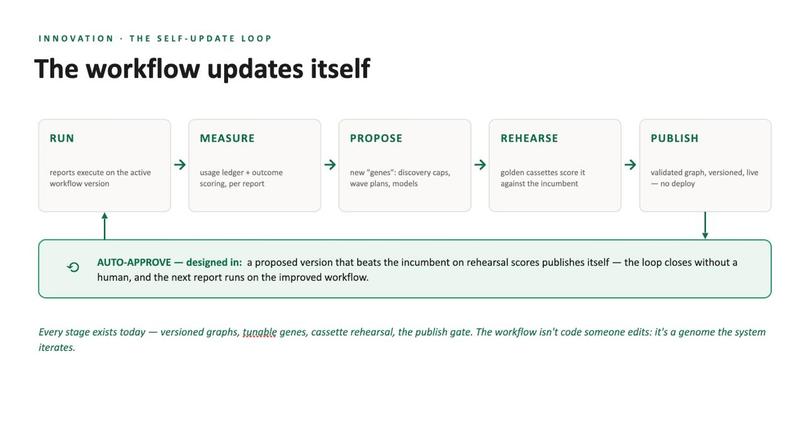
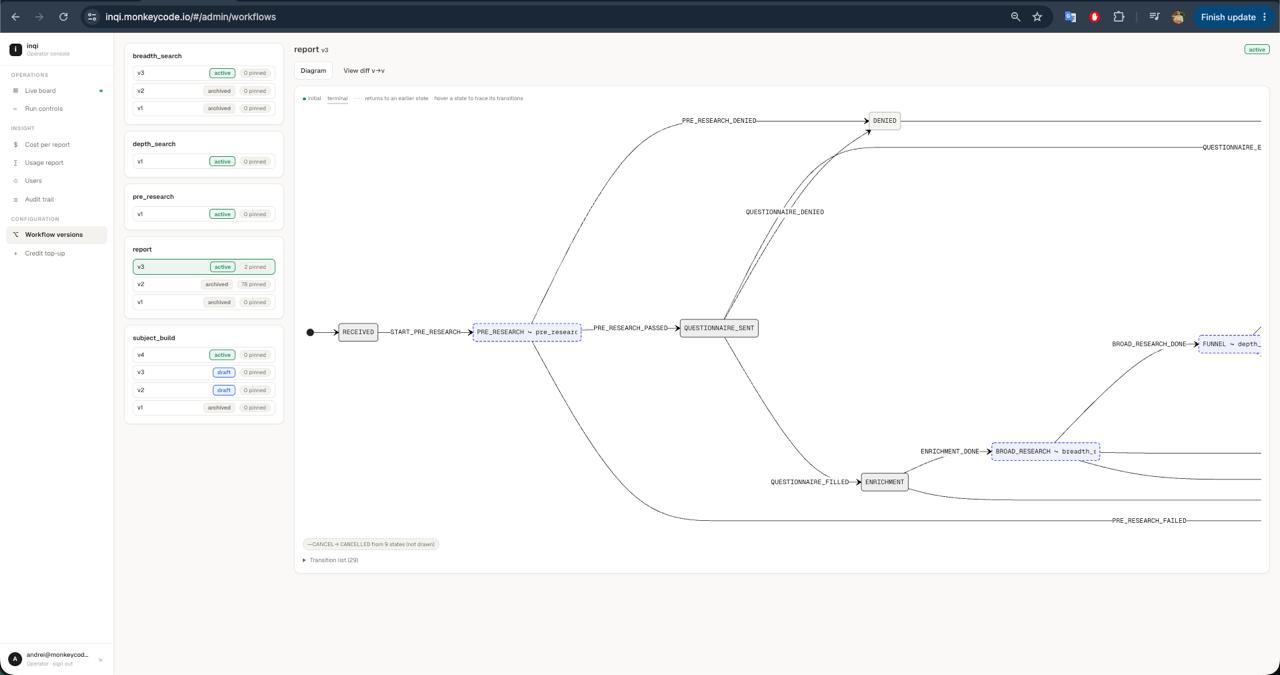
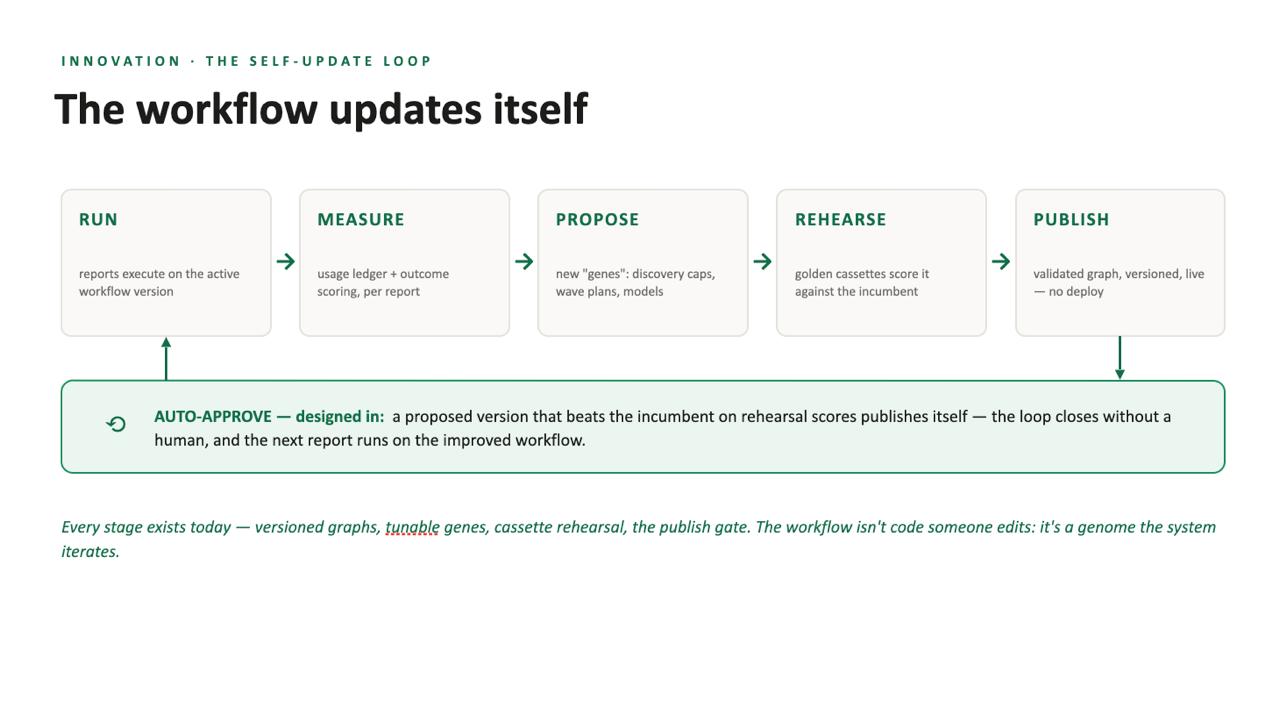
- Genes + dynamic workflows = long-term research memory. The pipeline runs on DB-versioned workflow graphs with tunable "genes" (discovery caps, wave plans, gate thresholds — phase-tunables.ts). What the system learns from delivered reports is written back into the next workflow version — knowledge accumulates in the genome, not in someone's head. Operators publish new versions live from the admin console, no redeploy; the publish gate scores every proposal, and auto-approve lets a proposal that beats the incumbent publish itself. The demo itself ran on a version published this way (v3: a wider first outreach wave).
- Golden cassettes = the stabilisation phase. Real phase runs are recorded and replayed to score every candidate configuration or model before it ships (rehearsal/) — regression testing that respects LLM non-determinism (scores, not exact-match assertions). Nothing publishes on vibes.
- Live reports — delivery is not the end. A report is not a static PDF: if a vendor replies after delivery, the reply runs the normal evaluation loop, the options are re-ranked and the summary re-synthesized in place, and the customer is notified (snapshots.service.ts). Every report stays actual — recalculated on meaningful events.
The customer pays on delivery from a credit ledger; a report that fails costs nothing.
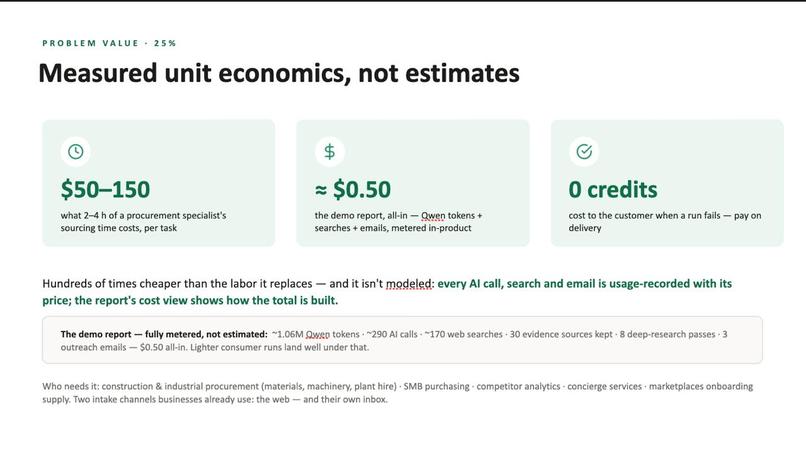
Problem value · 25%
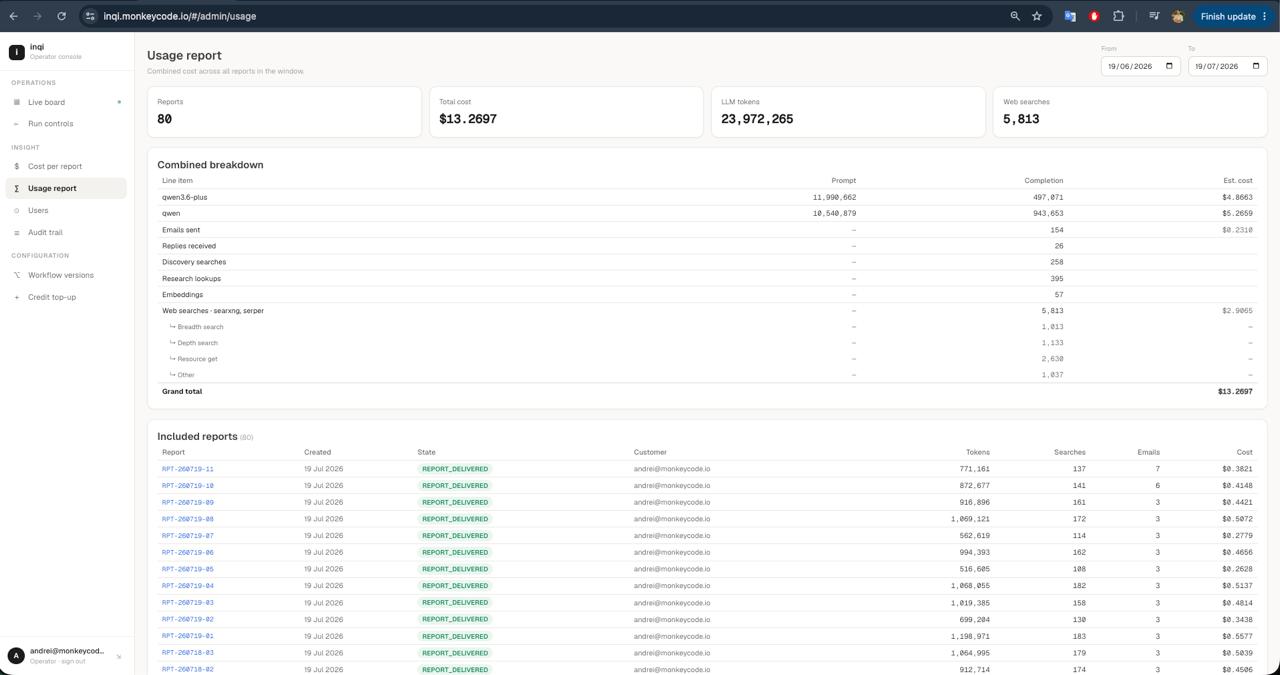
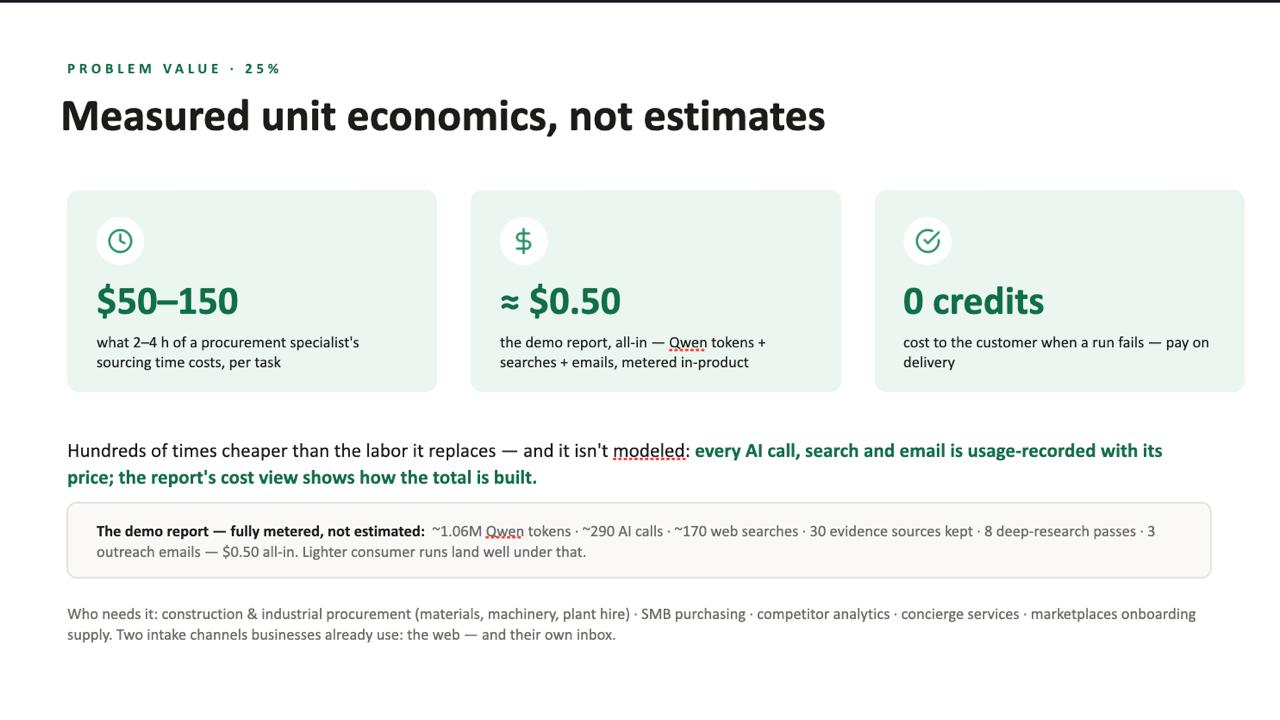
- $50–150 — what 2–4 hours of a procurement specialist's sourcing time costs, per task. ≈ $0.50 — what the demo report cost in metered compute (Qwen tokens + searches + emails): 100–300× cheaper, every cent itemized in the operator console. 0 credits — the cost to the customer when a run fails: pay on delivery.
- The filmed demo run, fully metered, not estimated: ~870k Qwen tokens · ~250 AI calls · ~140 web searches · 4 parallel email negotiations · under half a dollar all-in. Lighter consumer requests (grooming, coffee, ceramics in our production runs) land well under that.
- Who needs it: construction & industrial procurement (materials, machinery, plant hire), SMB purchasing, competitor analytics, concierge services, marketplaces onboarding supply — and other AI agents: inqi speaks email natively, so any assistant with email access can delegate real-world sourcing to it. Request in, ranked report back.
How we built it
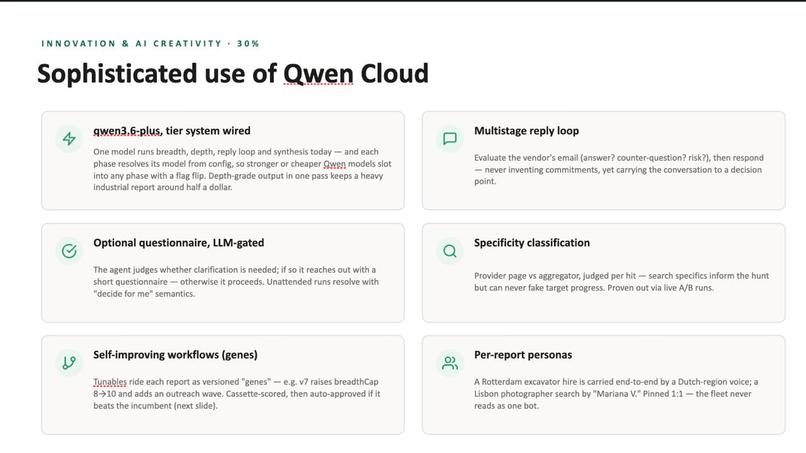
Innovation & AI creativity · 30%
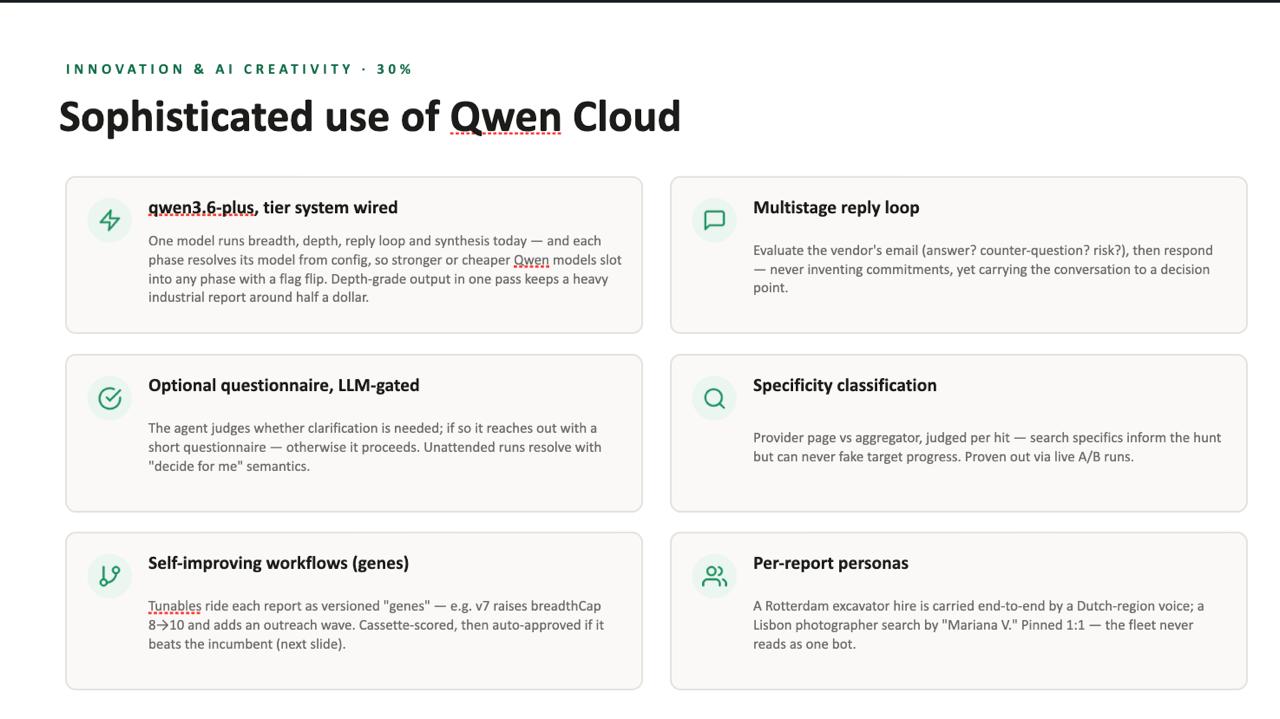
- Sophisticated use of Qwen Cloud: every model call goes to DashScope — an
OpenAI-compatible client with per-phase model tiers, JSON-mode
schema-validated structured output, and an agentic tool loop where Qwen
drives
web_searchand a real headless-browseropen_urltool during depth research (qwen-provider.base.ts · config.service.ts#L13). 20+ specialized prompts live in one inspectable module (prompts.ts). - Self-improving workflows (genes) — the versioned-genome loop above: run → measure → propose → rehearse → publish, with auto-approve designed into the publish gate.
- Per-report personas — a Rotterdam machinery inquiry is carried end-to-end by one region-matched voice; pinned 1:1 so the fleet never reads as one bot (personas.ts).
- Multistage reply loop with a target goal — every thread drives toward a concrete cost estimate + timeline: evaluate the vendor's email, answer their questions from the customer's scope (never imagination first), push to a comparable price (agent.service.ts).
- Self-evaluation loops — the depth-research verdict is audited by an evidence gate that names concrete gaps to close before a candidate settles, and every outbound draft passes a progress + topic-correlation check before sending (background.prompt.ts · reply.prompt.ts).
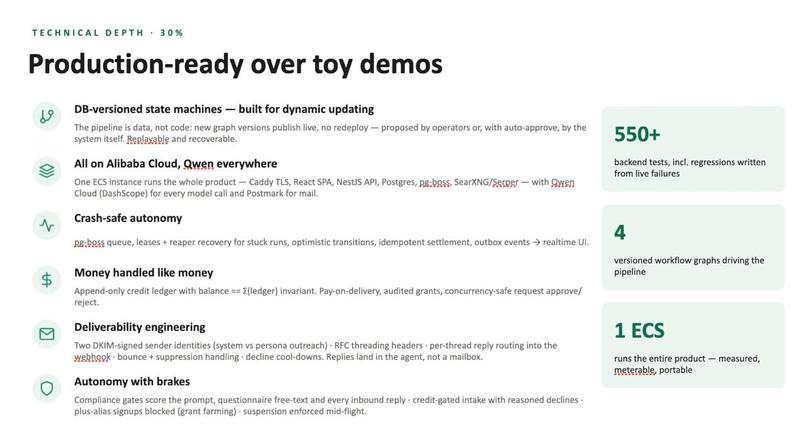
Technical depth & engineering · 30%
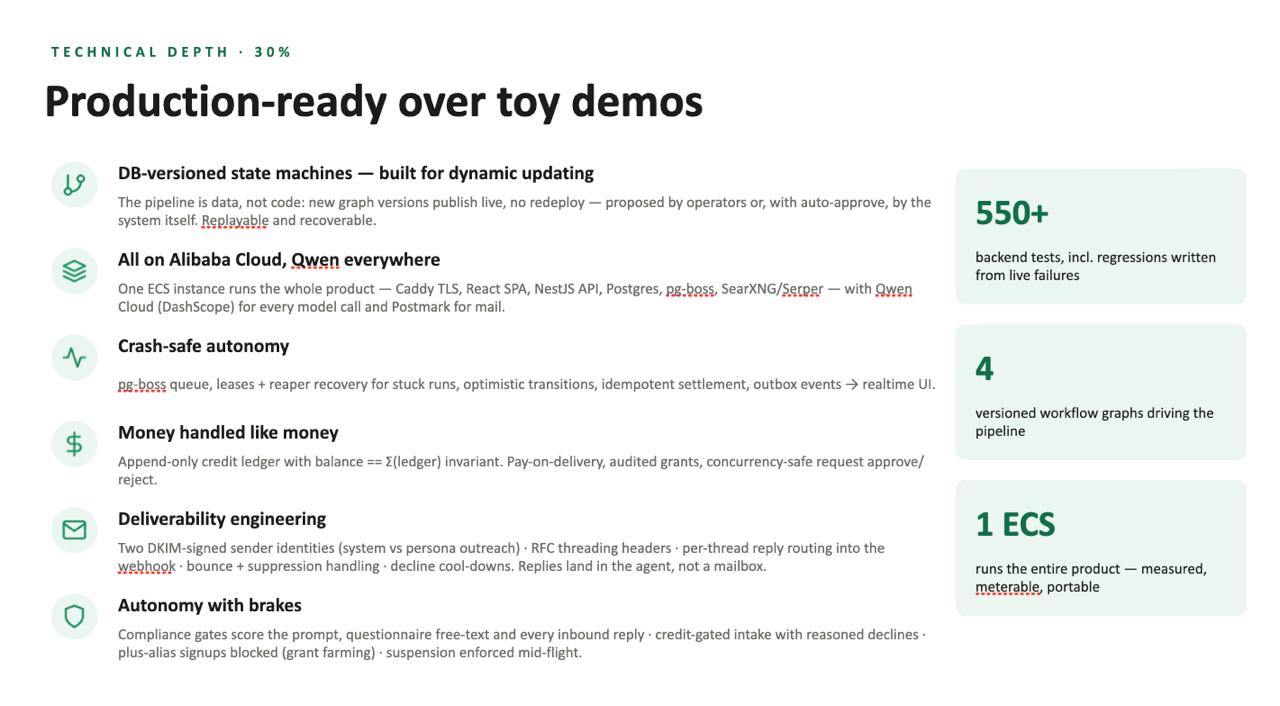
- DB-versioned state machines — built for dynamic updating: the report
lifecycle plus three child workflows (
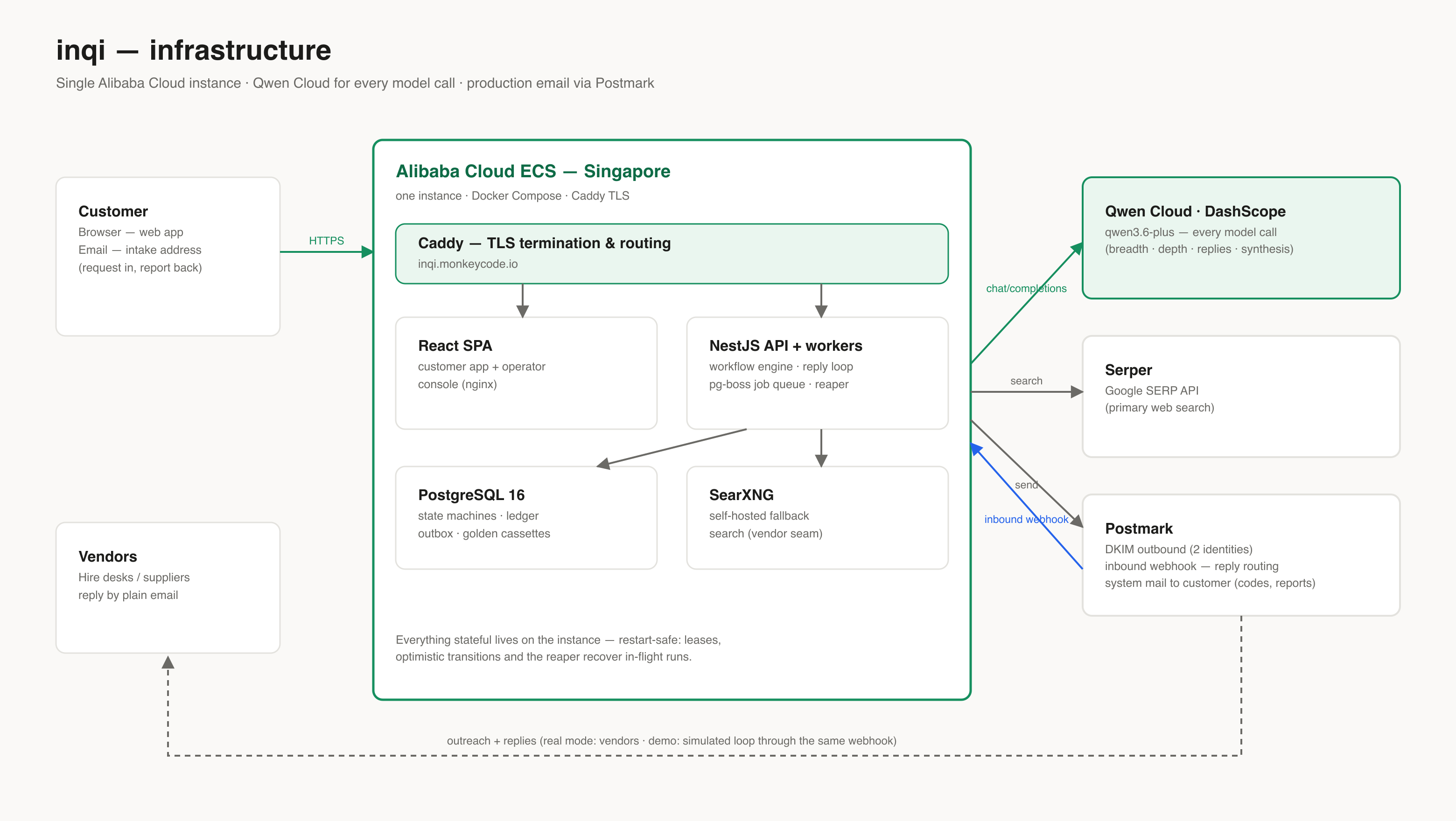
pre_research,breadth_search,depth_search) are persisted, versioned state graphs advanced with optimistic transitions; operators inspect, diff and publish live (workflow-engine.service.ts · phases/). - Crash-safe autonomy: pg-boss job queue, leases + a reaper that recovers stuck runs, idempotent credit settlement, outbox events streaming to a realtime UI (orchestrator.service.ts).
- Deliverability engineering: two DKIM-signed sender identities (system mail vs persona outreach), RFC threading headers, per-thread reply routing into the inbound webhook, bounce/suppression handling, decline cool-downs so the intake address can't become a spam reflector.
- Autonomy with brakes: compliance gates on customer prompts AND inbound vendor replies (compliance.service.ts), bounded reply turns, operator hold/cancel controls, and a full audit trail — the agent is autonomous, never unaccountable.
- Runs entirely on Alibaba Cloud: single ECS instance, Docker Compose, Caddy TLS, on-box Postgres (deploy/docker-compose.prod.yml). NestJS + Prisma backend, React frontend, shared typed contract package, 550+ backend tests. Architecture diagrams: infra · main flow.
Challenges we ran into
- Tuning an autopilot is a moving target. Change a model or a parameter and quality — or cost — regresses silently. Our answer: golden-cassette recordings of real phase runs, replayed and scored by rehearsal drivers before a configuration ships. Built around LLM non-determinism from day one: we score outcomes, we don't assert exact outputs.
- Rates are not totals. Real research surfaced €10/m² rates next to €18,500 job quotes — and a naive ranking called the rate "cheapest." We shipped basis-aware ranking mid-hackathon: prices carry the unit they were quoted in, only like competes against like, and the ranked list now agrees with the AI synthesis verdict (ranking.ts).
- Moving between models, safely. Every model swap shifts tone, JSON discipline and cost. We migrate by rehearsal: record real runs as golden cassettes, replay them against the candidate Qwen model, compare quality and spend — then flip a config flag. No big-bang migrations.
- Token burn vs depth of analysis. Deep research wants strong models, and strong models cost. Workflow-level fixes carried most of the weight — query dedupe, cycle caps, evidence floors cut our discovery search volume ~10× with no quality loss — and Qwen Cloud carried the rest: qwen3.6-plus gives us depth-quality results in a token budget smaller models need multiple passes for. That's what keeps even a heavy industrial report around half a dollar.
Accomplishments that we're proud of
- A real multi-turn price negotiation with a real business, conducted autonomously and safely.
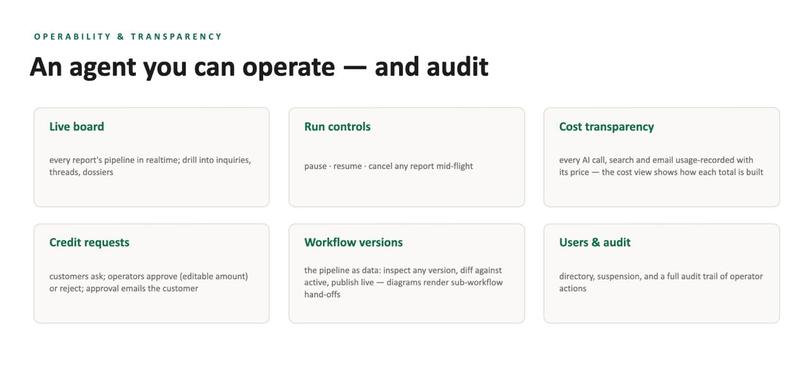
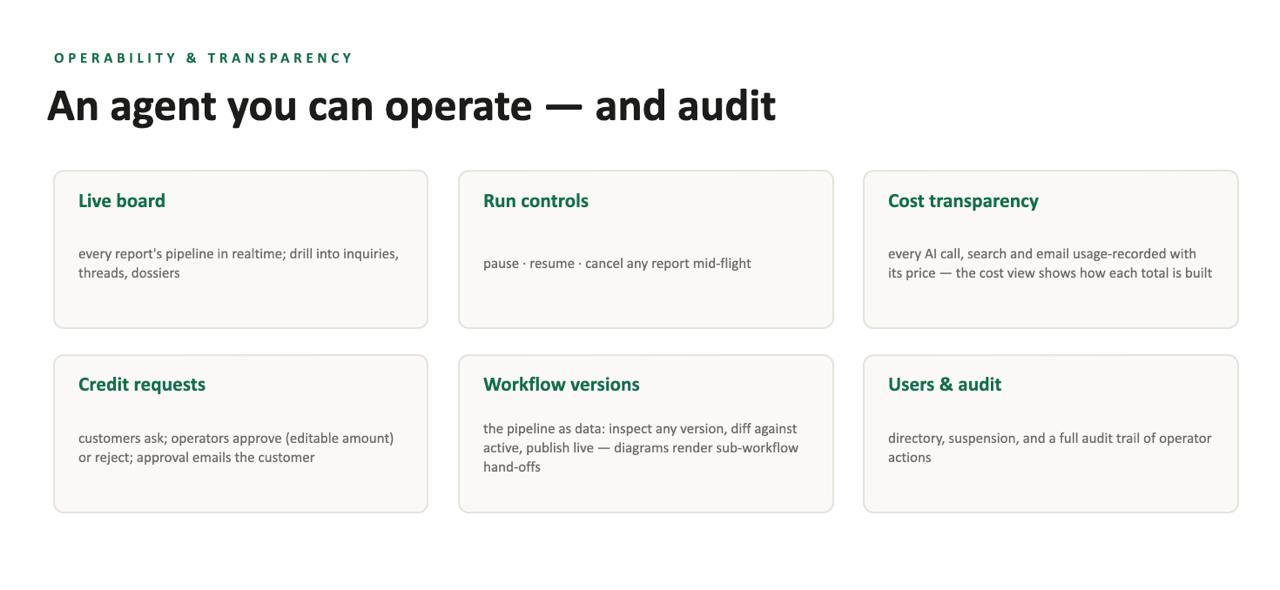
- A production operator console with full cost transparency: every AI call, search and email usage-recorded with its price — per-report cost view, live board, run controls, credit approve/reject, audit trail and workflow version publishing.
- Judges can try it live: sign up at inqi.monkeycode.io and the system grants 10 credits automatically — run your own report during judging.
What we learned
Production-ready agent work is 20% prompting and 80% systems engineering: idempotency, recovery, money invariants, deliverability, honest gates — and a regression harness that respects non-determinism. Every "it works" claim we made was later corrected by running the real thing, so we kept the bugs in the story.
What's next for inqi
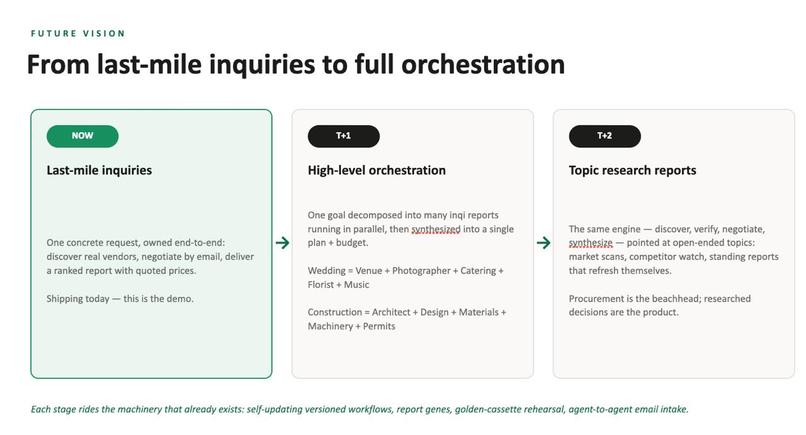
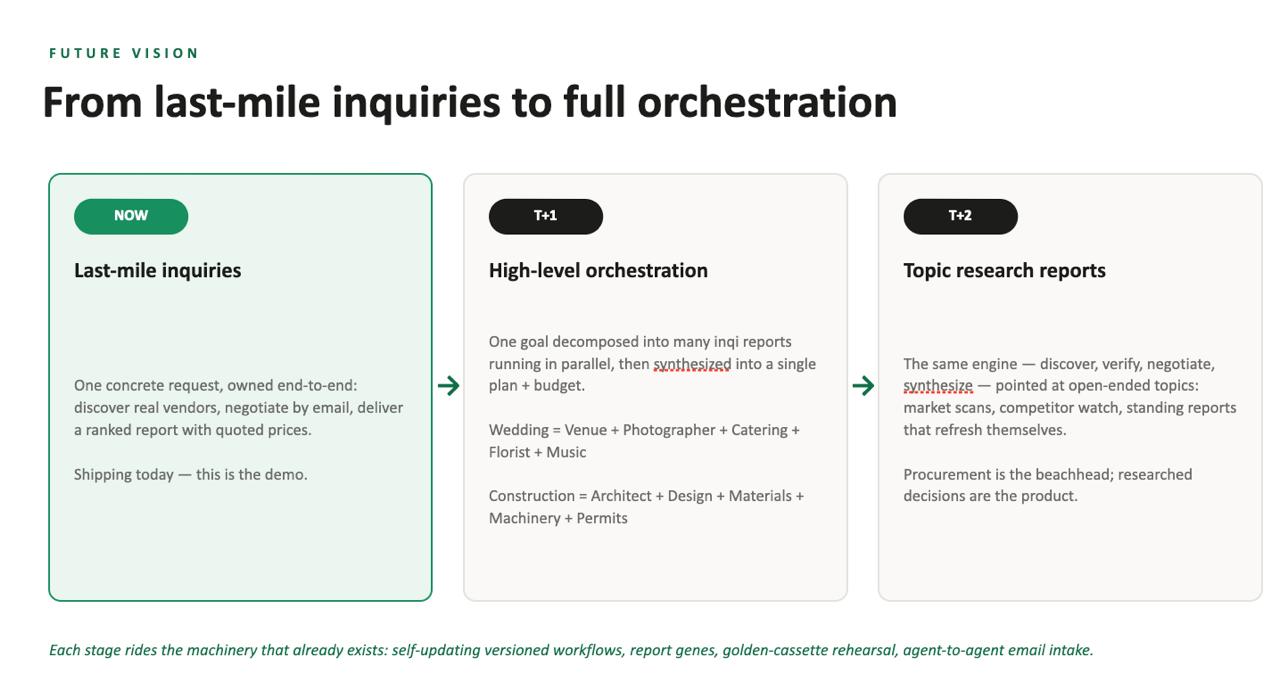
Today inqi owns the last mile — one concrete inquiry, end to end. The road ahead:
- T+1 — high-level orchestration: one goal decomposed into many inqi reports
running in parallel, synthesized into a single plan + budget. *Wedding = Venue
- Photographer + Catering + Florist + Music. Construction = Architect + Design
- Materials + Machinery + Permits.*
- T+2 — topic research reports: the same engine — discover, verify, negotiate, synthesize — pointed at open-ended topics: market scans, competitor watch, standing reports that refresh themselves.
- Plus: closing the self-improvement loop end-to-end (the system proposing and rehearsing its own next workflow version from delivered-report outcomes), payment-backed top-ups, provider-side scheduling (quotes → booked appointments), and multi-language outreach personas.
Demo note (transparency): in production, inqi emails real businesses. For judging, vendor replies are simulated (simulated-replies.provider.ts — a decorator over the real mail transport, looped through the production inbound webhook) so demo runs don't spam real shops — the real-mode Hundesalon thread in our materials is the identical loop against a real business.
Built with: Qwen Cloud (DashScope) · Alibaba Cloud ECS · NestJS · Prisma · PostgreSQL · pg-boss · React · Vite · Postmark · Serper/SearXNG · Docker · Caddy
Built With
- nestjs
- react
- typescript


Log in or sign up for Devpost to join the conversation.