Multi AI Agent – Traffic Monitor
Inspiration
Conventional traffic management systems rely on fixed timers, passive CCTV monitoring, and manual intervention. These systems fail to adapt to real-time traffic dynamics and do not scale with increasing urban congestion.
Traffic is inherently a distributed and dynamic system, yet most existing solutions attempt to control it using centralized logic. This mismatch inspired the development of a Multi AI Agent–based Traffic Monitoring System, where specialized agents independently observe, analyze, and act—mirroring real-world traffic ecosystems.
What It Does
The system actively monitors and manages traffic rather than merely recording it.
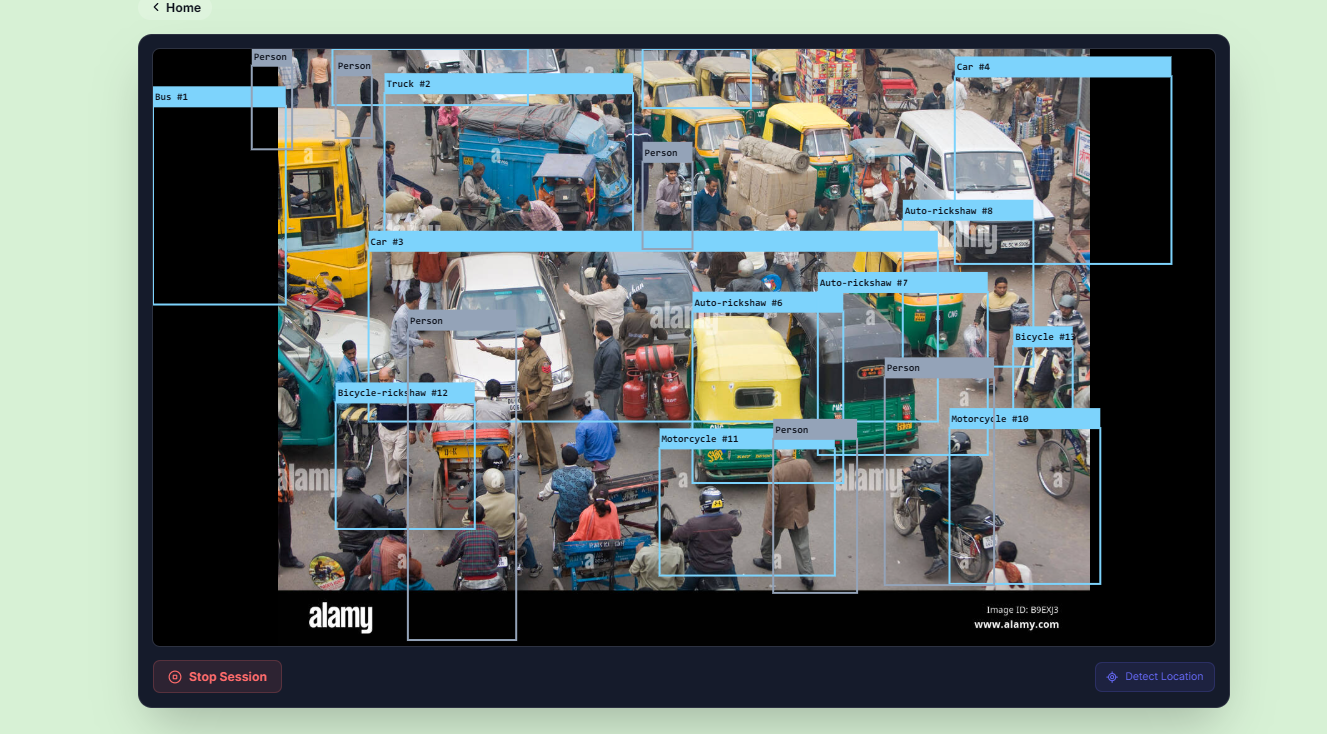
- Vehicle Detection Agent: Detects and classifies vehicles such as cars, bikes, buses, and trucks from live video feeds.
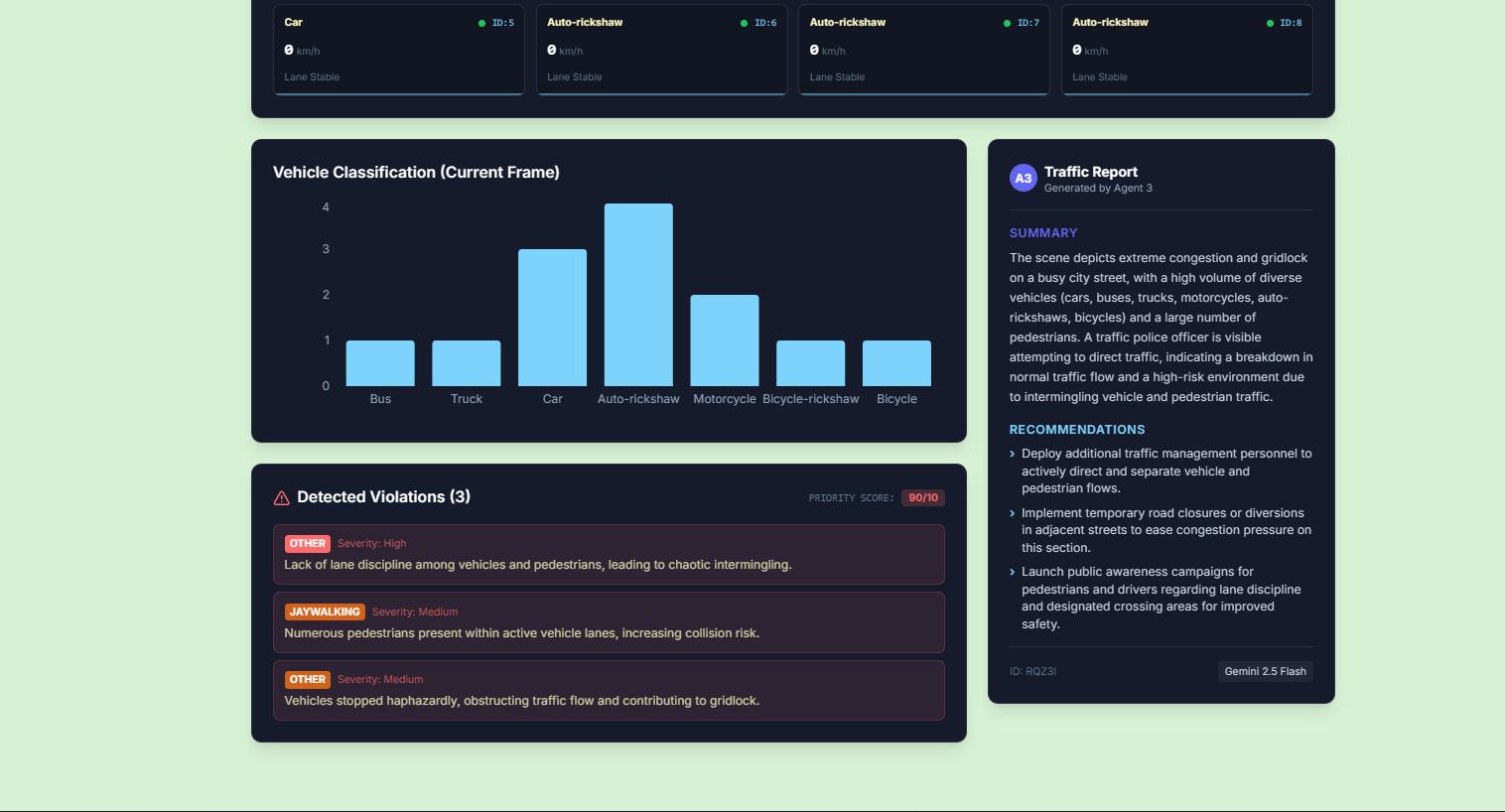
- Density & Congestion Agent: Computes lane-wise traffic density and identifies congestion hotspots.
- Incident Detection Agent: Detects accidents, stalled vehicles, and abnormal traffic behavior.
- Decision Agent: Dynamically adjusts traffic signal timings and prioritizes critical lanes.
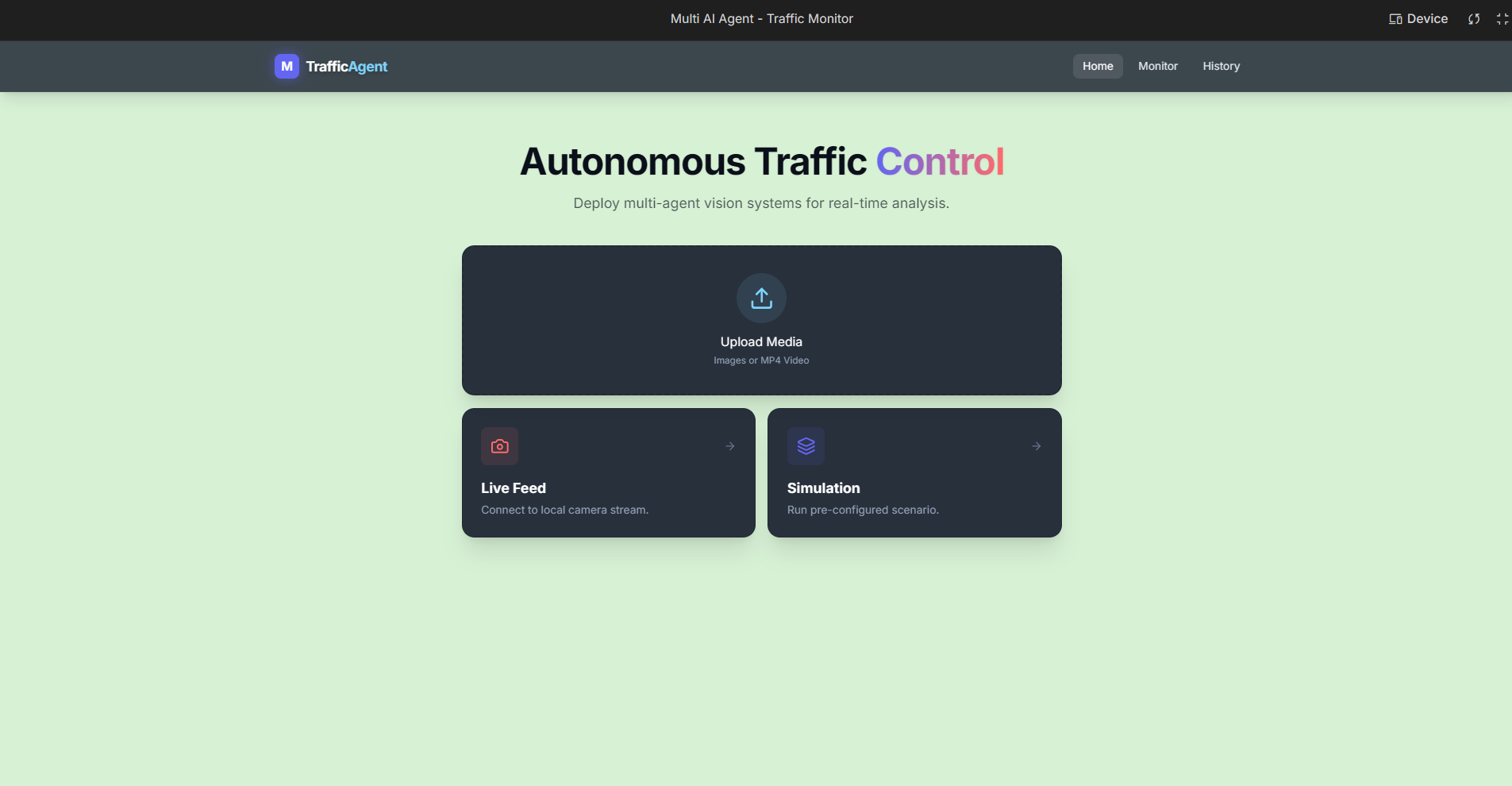
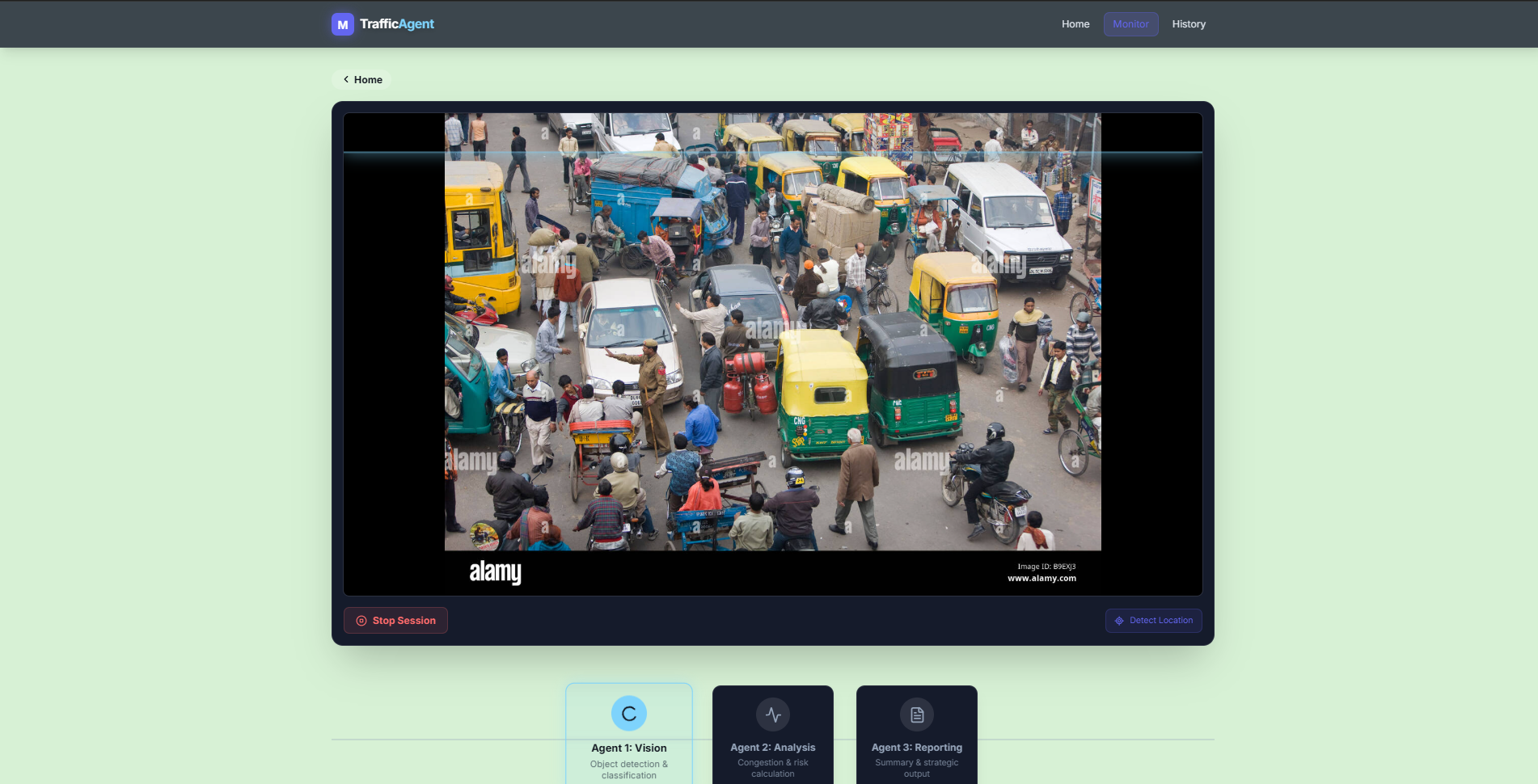
- Web-Based Monitoring Dashboard: Displays live traffic feeds, heatmaps, alerts, and historical analytics.
How We Built It
The system follows a modular, scalable architecture.
Technology Stack
AI & Computer Vision:  Python, OpenCV, YOLO
Architecture:          Independent multi-agent services
Backend:               Flask / FastAPI
Frontend:              HTML, JavaScript, React
Data Flow
The data flows linearly through the agents to produce actionable insights:
Camera Feed → Detection Agent → Density Agent → Incident Agent → Decision Agent → Dashboard & Alerts
Each agent is decoupled, enabling independent scaling and optimization.
Challenges We Ran Into
- Real-time Performance: Achieving low latency without sacrificing accuracy.
- False Positives: Handling visual noise caused by shadows and parked vehicles.
- Coordination: Managing decision logic between multiple agents.
- Scaling: Efficiently processing across multiple camera feeds.
- Data Quality: Dealing with inconsistent real-world video quality.
Accomplishments That We’re Proud Of
- Implemented a true multi-agent AI system.
- Achieved real-time traffic analysis on live video.
- Transformed CV outputs into actionable traffic decisions.
- Built a functional and intuitive web dashboard.
- Designed the system for city-scale deployment.
What We Learned
- AI solutions require strong system design, not just models.
- Modular architectures outperform monolithic systems.
- Real-world data is noisy and unforgiving.
- Performance optimization is as important as accuracy.
Key takeaway: AI-driven traffic systems are systems engineering problems, not just machine learning problems.
What’s Next for Multi AI Agent – Traffic Monitor
- Reinforcement Learning: For adaptive signal control.
- Emergency Prioritization: Emergency vehicle detection and green corridor creation.
- Edge Deployment: optimizing for devices like NVIDIA Jetson.
- Predictive Forecasting: Anticipating traffic congestion before it happens.
- Smart City Integration: Connecting with broader city infrastructure.
- Privacy: Privacy-preserving video processing.
- Simulation: Testing with traffic simulators.
Long-term vision: A self-learning, city-wide adaptive traffic control system.


Log in or sign up for Devpost to join the conversation.