Inspiration
Mental health decline is almost always a silent struggle. We noticed that when people go through prolonged periods of stress or depression, their support networks like therapists, partners, or close friends are usually completely disconnected from their day-to-day emotional state. By the time someone actually reaches out for help, they are usually already in a crisis.
We also realized that traditional journaling feels like a chore, and standard mood-tracking apps rely on subjective 1-to-10 sliders that people often lie to (even to themselves). We wanted to build something that completely removes the friction of self-reflection and proactively bridges the gap between individuals and their support systems.
What it does
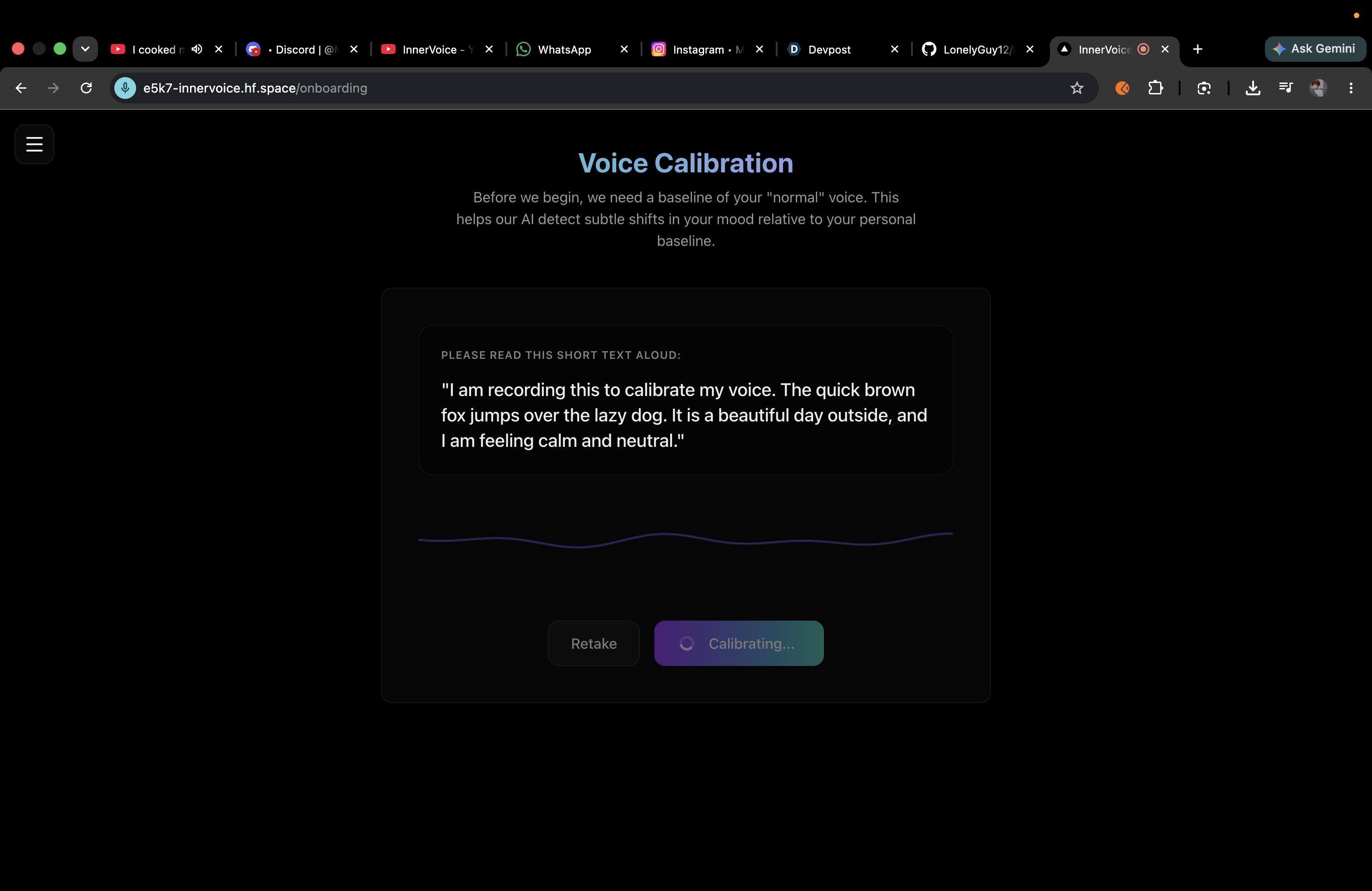
InnerVoice is an AI-driven emotional wellness tracker that listens to how you speak, not just what you say. Users simply talk into their device for 60 seconds. Instead of just transcribing the words, InnerVoice runs a deep acoustic analysis on the raw audio—tracking pitch deviation, speech rate, and voice tremors to uncover latent, subconscious emotions.
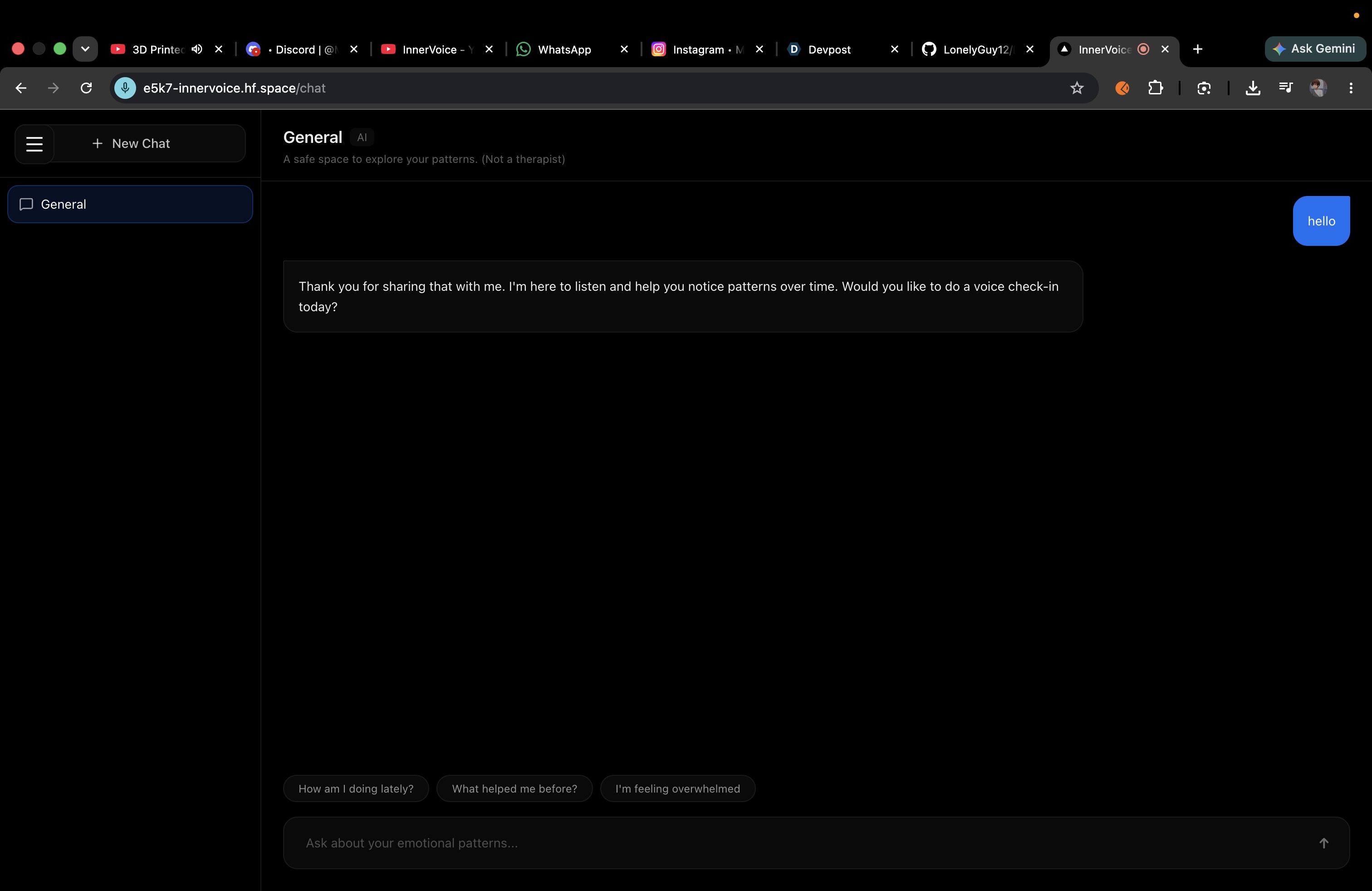
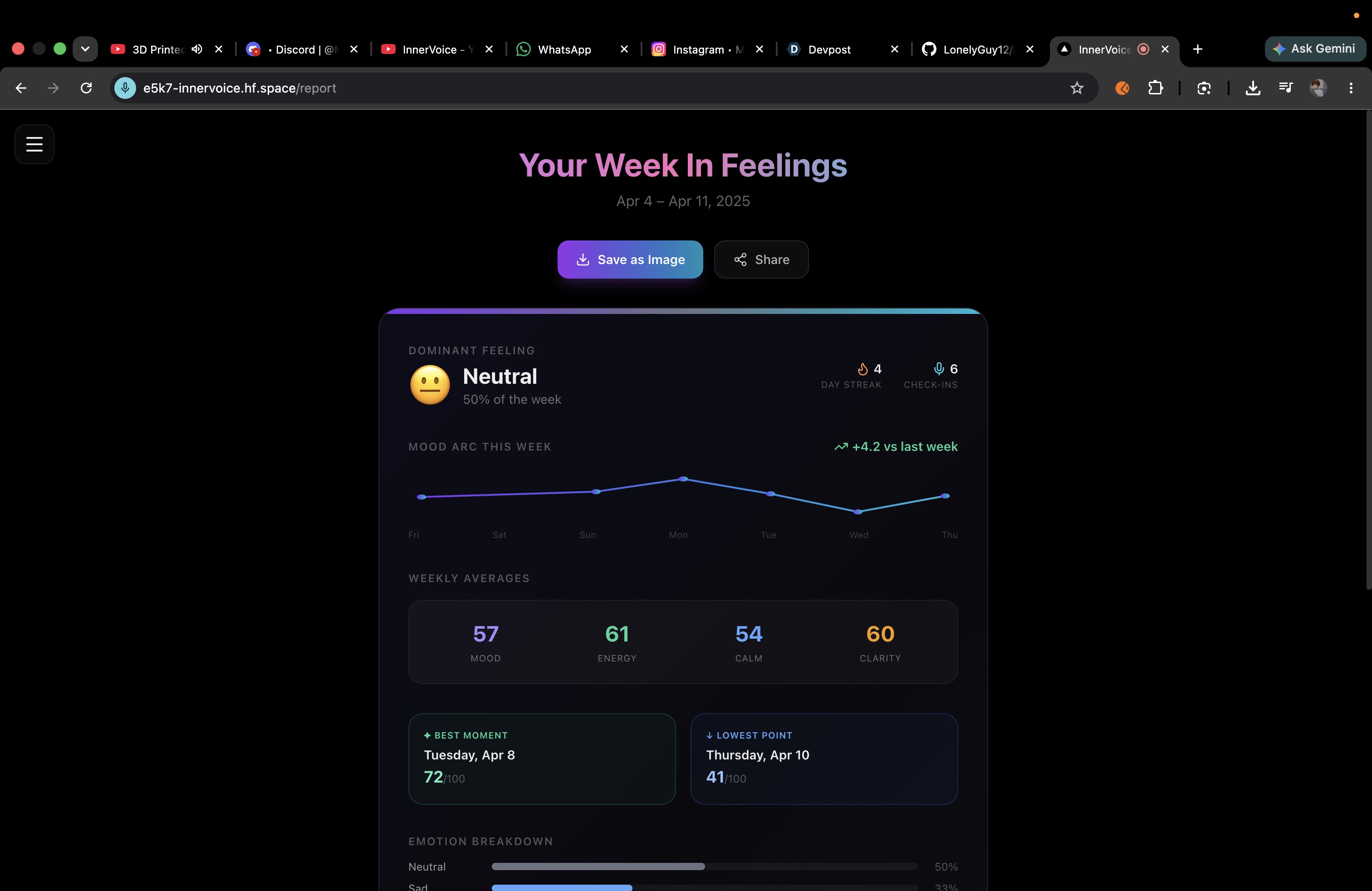
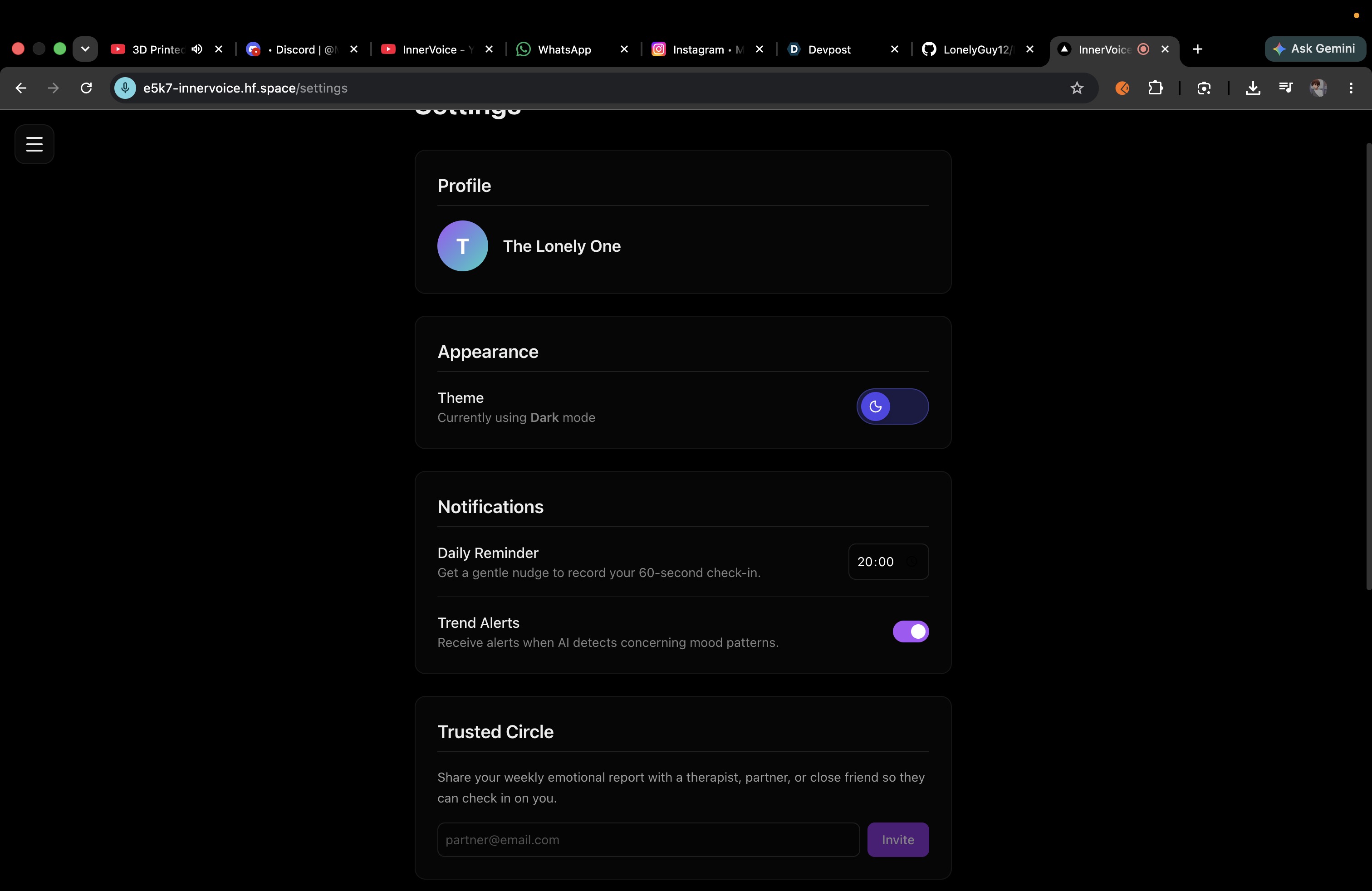
But it doesn't stop at just tracking. InnerVoice breaks the isolation of mental health struggles through its "Trusted Circle" feature. It securely synthesizes your weekly emotional trends using an LLM and automatically emails a report to your pre-approved support network. This allows your loved ones or therapist to step in and offer support proactively, long before a crisis hits.
How we built it
We built the frontend using Next.js and TailwindCSS to create a beautiful, frictionless, and responsive UI with real-time audio waveform visualization. The backend is powered by Python and FastAPI, using SQLAlchemy to manage our database.
For the core intelligence, we utilized librosa to extract physiological distress markers directly from the audio bytes. We then passed those features through localized Hugging Face machine learning models (like wav2vec2 for speech emotion recognition and roberta for text emotion). We used OpenAI's Whisper for immediate audio-to-text transcription, and Groq's blazing-fast inference to synthesize the final insights. Finally, we integrated the Brevo API to handle the automated transactional emails for the Trusted Circle feature.
Challenges we ran into
One of our biggest hurdles was dealing with background noise. Initially, our stress algorithm was heavily weighted toward raw volume, meaning if a user was sitting in a quiet room but the microphone picked up a slight static hiss, the app thought they were highly stressed! We had to redesign the acoustic math to implement a silence gate and heavily prioritize voice instability (spectral flux) and pitch over raw loudness.
Another major challenge was making sure these heavy machine-learning models could actually run in a cloud deployment environment without crashing the server or running out of memory, which required a lot of optimization and Docker container tweaking.
Accomplishments that we're proud of
We are incredibly proud of the real-time vocal stress meter. Watching the UI react dynamically to the exact tremor and pitch of a user's voice feels magical and validating. We're also really proud of the Trusted Circle architecture it takes the heavy burden of "asking for help" completely off the user's shoulders, which is often the hardest part of struggling with mental health.
What we learned
We learned a ton about digital signal processing and how much emotional data is hidden in the physical frequencies of the human voice. We also learned how to seamlessly bridge heavy Python based machine learning pipelines with modern, snappy React frontends using REST APIs and Docker.
What's next for InnerVoice
In the future, we want to expand the biometric tracking to include integration with smartwatches (like Apple Watch or Oura Ring) to cross-reference vocal stress with resting heart rate and sleep data. We also plan to train our own custom models specifically on therapeutic data to make the insights even more clinically accurate, and eventually launch native mobile apps for iOS and Android so users can check in on the go.
Built With
- css3
- fastapi
- html5
- javascript


Log in or sign up for Devpost to join the conversation.