-
-
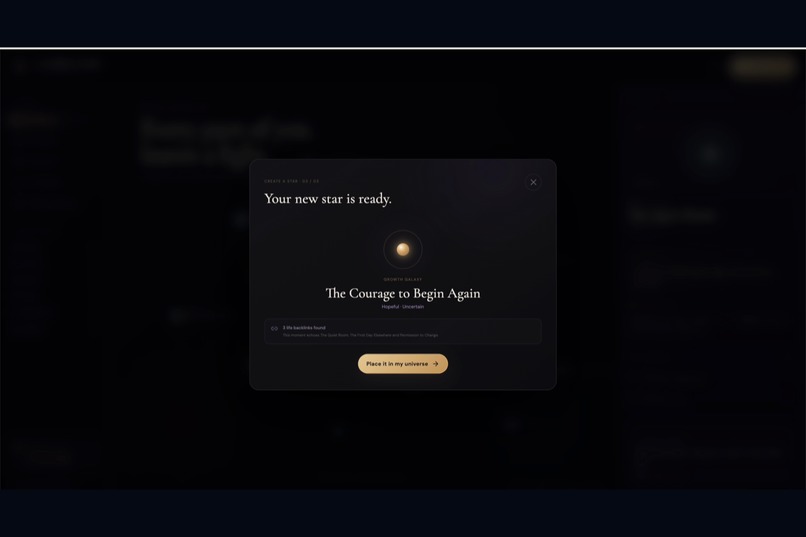
Explore memories, emotions, dreams, and turning points
-
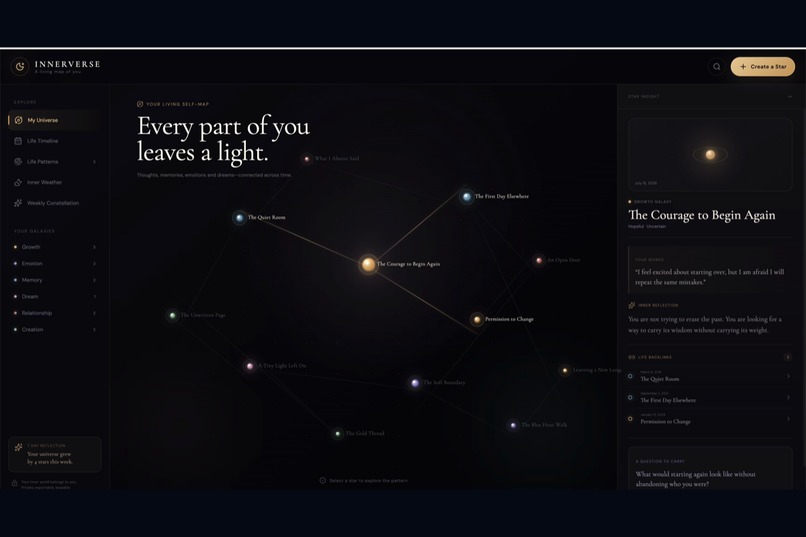
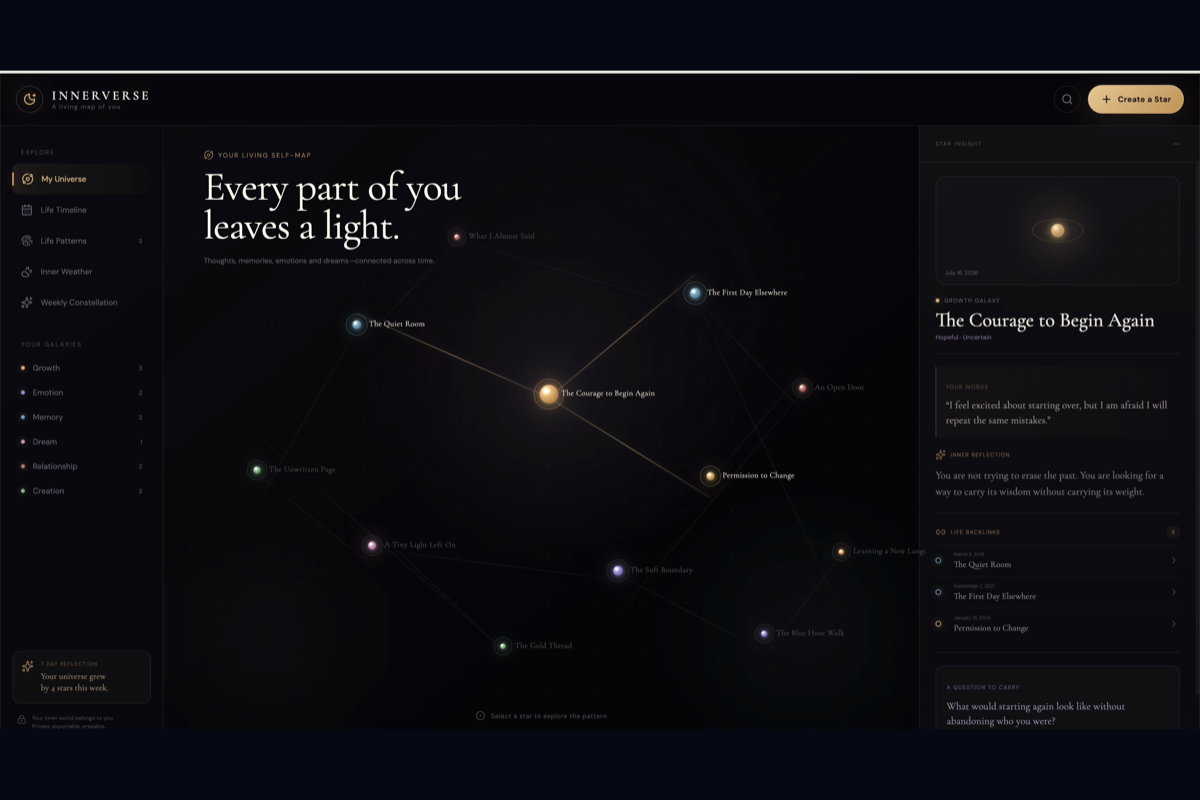
Innerverse: a living universe of connected Life Stars
-
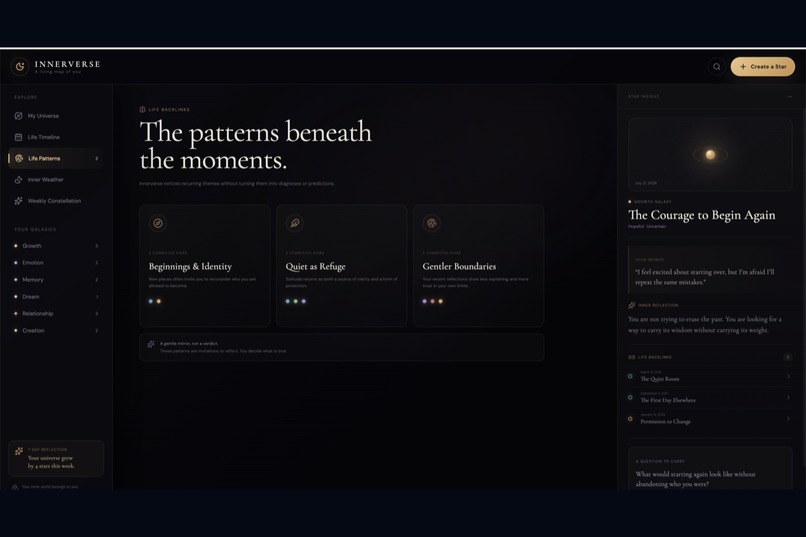
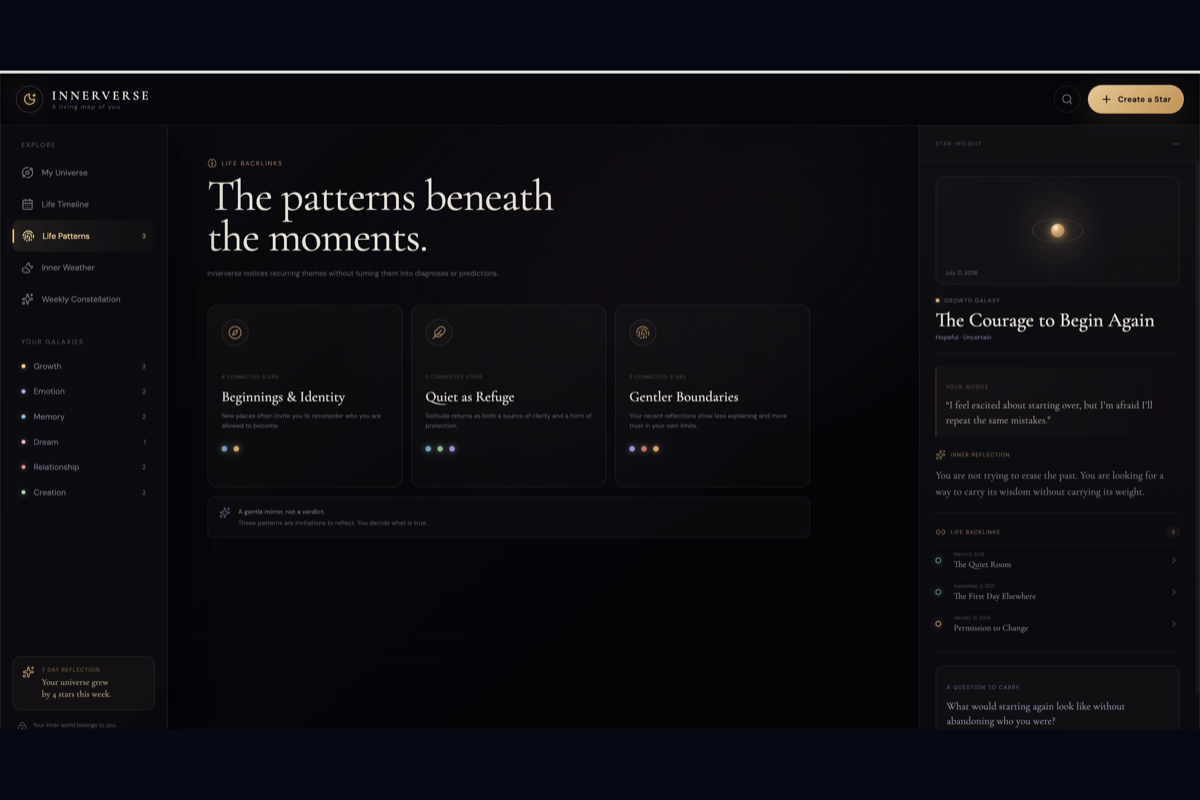
Life Patterns surfaces recurring themes across connected moments
-
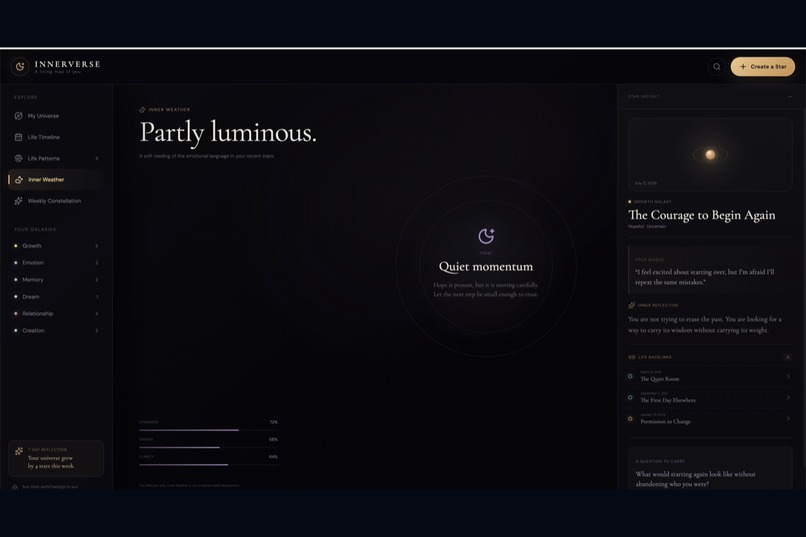
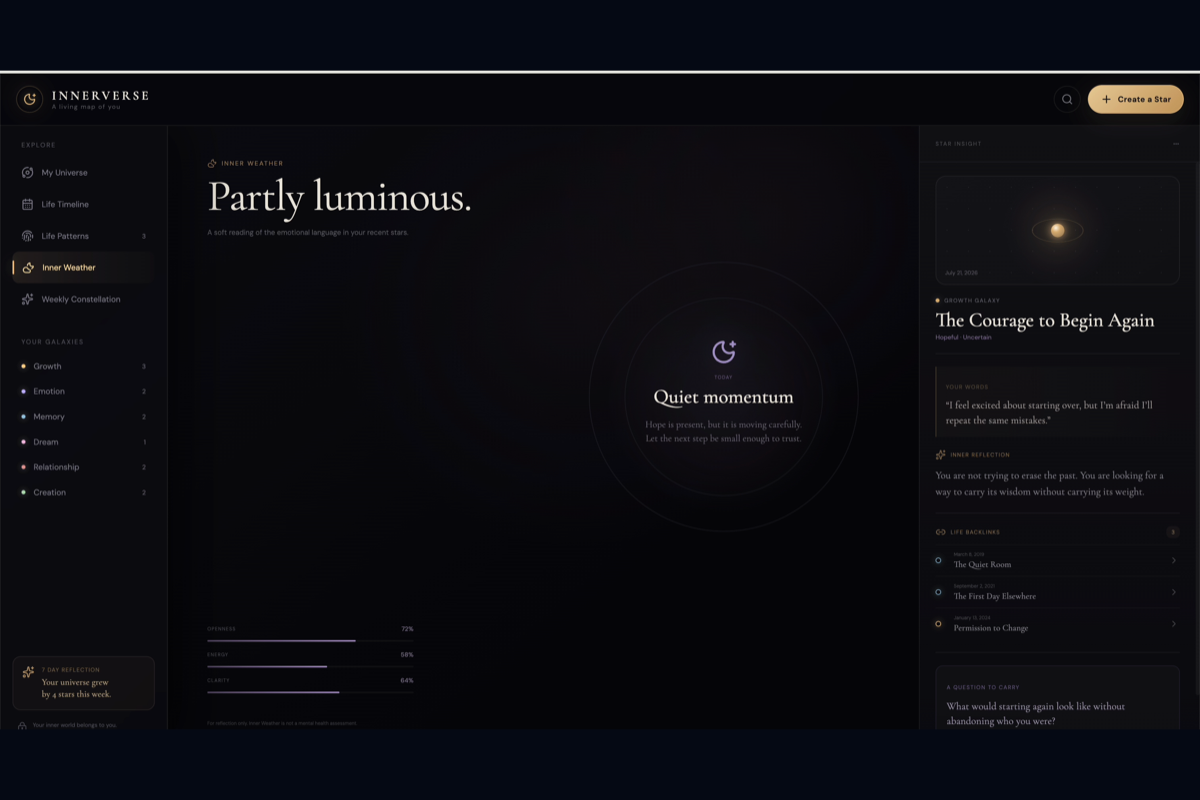
Inner Weather offers a gentle, non-diagnostic reflection
Inspiration
Our lives are scattered across photos, notes, messages, memories, dreams, and half-finished reflections. Traditional timelines preserve chronology, but they rarely show how a person’s experiences connect. Innerverse began with a simple question: what if your life could be explored as a living universe instead of a list?
What it does
Innerverse turns memories, emotions, relationships, dreams, creative moments, and turning points into “Life Stars.” Each star preserves the user’s original words, offers a gentle reflective interpretation, and links to related moments across time.
The interactive prototype includes:
- My Universe — a visual constellation of connected Life Stars
- Life Timeline — a chronological view of meaningful moments
- Life Patterns — recurring themes surfaced across connected experiences
- Inner Weather — a soft reflection on recent emotional language
- Weekly Constellation — a weekly summary framed as reflection rather than a score
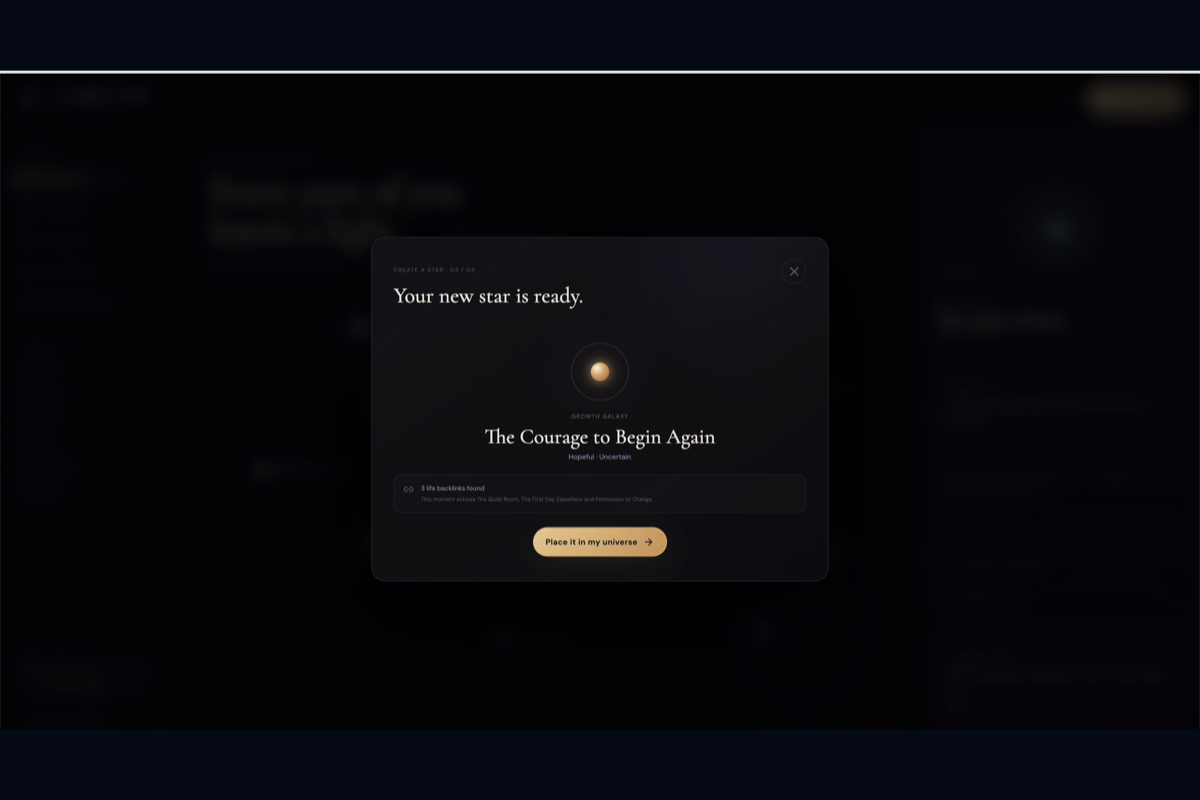
- Create a Star — a guided flow that transforms a thought, feeling, memory, or dream into a new star
Innerverse is designed as a reflective companion, not a diagnostic or predictive system. AI interpretations are presented as possibilities, never facts. The user remains the authority on their own story.
How we built it
I used Codex and GPT-5.6 as product, design, and engineering collaborators throughout Build Week. GPT-5.6 helped shape the product logic, reflection language, information architecture, and trust principles. Codex helped implement, debug, and refine the React/Vite prototype, create the demo workflow, and produce the final synchronized recording.
The current prototype uses React, Vite, JavaScript, CSS, SVG-style connections, Lucide icons, and static local data. The AI analysis shown in the demo is simulated so the core interaction, transparency language, and user experience can be evaluated safely without sending personal memories to an external service.
Challenges
The main challenge was making the universe feel emotionally meaningful without becoming mystical, overwhelming, or visually game-like. Another challenge was balancing useful reflection with epistemic humility: the product must never present an inferred emotion, date, relationship, or life pattern as certain truth.
We also had to communicate a complex concept quickly. Iterating with Codex helped compress the experience into a clear flow: open the universe, explore a star, create a new one, and see how it connects.
Accomplishments
- Built a complete interactive prototype in a short Build Week window
- Created a cohesive visual language for memories, emotions, dreams, relationships, growth, and creativity
- Designed explicit safeguards such as “AI reflection, not fact”
- Added timeline, pattern, emotional-weather, and weekly-reflection views
- Produced a clean, automated 60-second product demo with synchronized narration
- Kept user ownership central: private by default, exportable, and erasable
What I learned
Personal-memory products need more than attractive visualization. Trust depends on clearly separating the user’s own words from AI-generated reflection, making uncertainty visible, and avoiding claims the system cannot verify. I also learned how effectively Codex can connect product strategy, interaction design, frontend implementation, debugging, and demo production in one continuous workflow.
What’s next
The next stage is to replace simulated analysis with an opt-in GPT-5.6 workflow that produces structured suggestions for emotional tone, themes, and backlinks while preserving provenance and uncertainty. I would also add encrypted storage, user-controlled export and deletion, manual editing of every inferred field, and optional shared constellations for family memories.
Built With
- codex
- css
- gpt-5.6
- javascript
- lucide
- react
- vite

Log in or sign up for Devpost to join the conversation.