-
-
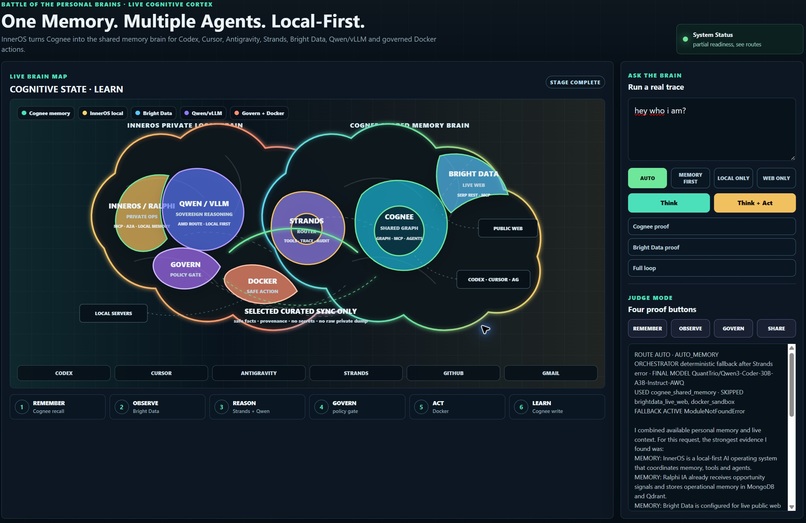
InnerOS Brain
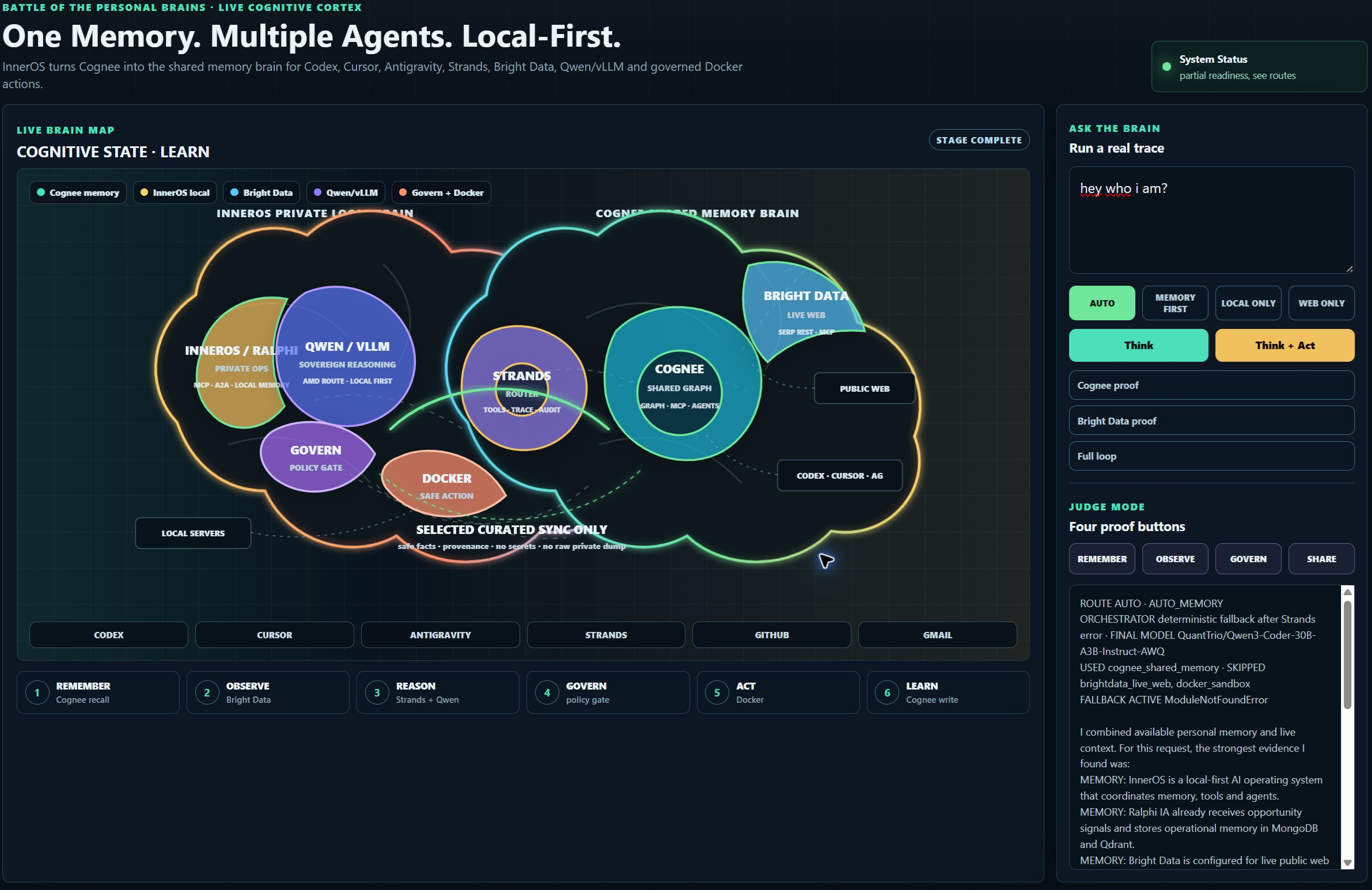
InnerOS Personal Brain
One memory. Multiple agents. Local-first.
InnerOS Personal Brain is a sovereign personal AI brain that can observe live information, remember durable context, reason with a local model, coordinate multiple AI agents, execute bounded actions, and learn from the result.
The problem
AI agents are powerful, but their knowledge is fragmented. One agent learns something and another does not know it. A new session starts and useful context disappears. Live web information is disconnected from long-term memory, and many agent systems depend entirely on cloud inference.
We wanted one persistent brain that multiple agents could share while still keeping private operational context and inference under owner control.
What we built
The system follows one visible cognitive loop:
Observe → Remember → Reason → Act → Learn
- Bright Data provides live external web perception.
- Cognee provides persistent shared graph memory.
- AWS Strands orchestrates reasoning, memory and tool routing.
- Qwen via local vLLM provides sovereign local inference.
- Docker Sandboxes provides isolated action execution.
- InnerOS MCP/A2A provides optional local tools and multi-agent coordination.
Shared memory with Cognee
Cognee is the long-term shared memory of the Personal Brain.
We built a curated dataset containing safe, reusable knowledge about the owner's work, projects, operating principles and architecture. Secrets, credentials, private customer records and other sensitive operational payloads are intentionally excluded.
The key proof is simple:
Agent A learns → Agent B remembers.
Different agents can recall the same durable knowledge instead of manually copying context between sessions.
Local-first reasoning with Strands
AWS Strands is the orchestration layer.
Strands can call Cognee memory, route to external evidence and use an OpenAI-compatible local vLLM endpoint running Qwen. This keeps the core reasoning path local while still using Strands for agent orchestration.
Live external perception with Bright Data
Bright Data acts as the brain's eyes to the web.
Current public information can be retrieved when needed and treated as external evidence. Useful durable conclusions can then be stored in Cognee instead of blindly saving raw web noise.
Safe action
Docker Sandboxes provides an isolated environment for bounded execution.
The brain can perform an action, inspect the result and preserve evidence without giving unrestricted access to the host.
Two memory layers
The system deliberately separates:
Cognee Shared Memory
- reusable project knowledge
- durable decisions
- concepts and relationships
- lessons that multiple agents should remember
InnerOS Private Memory
- sensitive operational context
- private business/system data
- local Mongo/Qdrant memory
- information that should stay under owner control
The shared graph and the private operational memory are connected by policy, not by automatic bulk copying.
Multiple agents, one brain
The memory fabric is designed for multiple agent surfaces including:
- AWS Strands
- Codex
- Cursor
- Antigravity
- InnerOS / Ralphi MCP clients
The goal is not simply to make one chatbot remember more. The goal is to make memory portable across agents while preserving control.
Live Cognitive Cortex
We built a visual interface that makes the cognitive process understandable.
A prompt enters beside the brain and the interface shows the real route through orchestration, memory, external knowledge, local reasoning, action and response.
Visible states are backed by actual backend events rather than decorative fake activity.
What is already working
We have validated real end-to-end paths including:
- Cognee remember → graph build → recall
- Strands → Cognee recall and remember
- Bright Data live search
- Strands → local Qwen through vLLM
- Docker Sandbox execution
- Cognee memory through MCP
- shared memory across agent surfaces
- Personal Brain → reasoning → memory update
Why it matters
Personal AI becomes far more useful when knowledge survives across tools and sessions.
But giving an AI more memory should not mean giving away control of everything you know.
InnerOS Personal Brain demonstrates another approach:
share the knowledge that should travel, keep private context private, reason locally when possible, and make important actions observable and verifiable.
Built for Battle of the Personal Brains
The challenge was:
Build a brain. Build an agent. Then make it do something.
We built a brain that multiple agents can remember through, connected it to live information, gave it local reasoning, gave it a safe way to act, and made the full cognitive path visible.
Observe. Remember. Reason. Act. Learn.
Built With
- aws-strands
- bright-data
- cognee
- docker-sandboxes
- fastapi
- mcp
- python
- qwen
- vllm

Log in or sign up for Devpost to join the conversation.