-
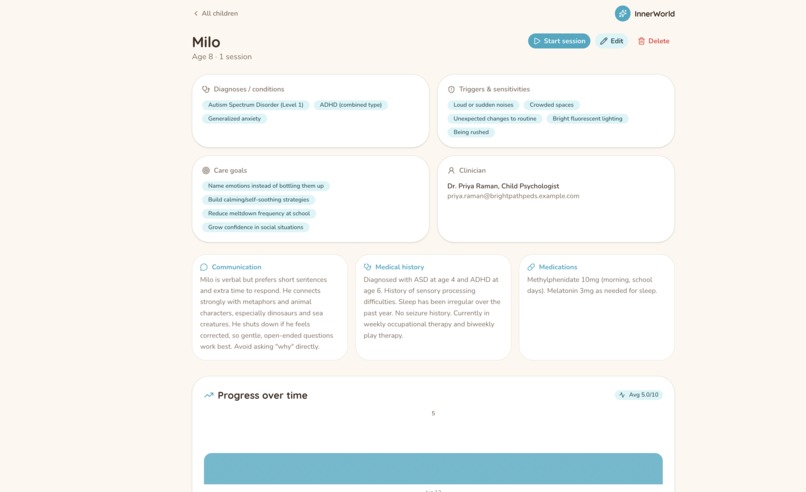
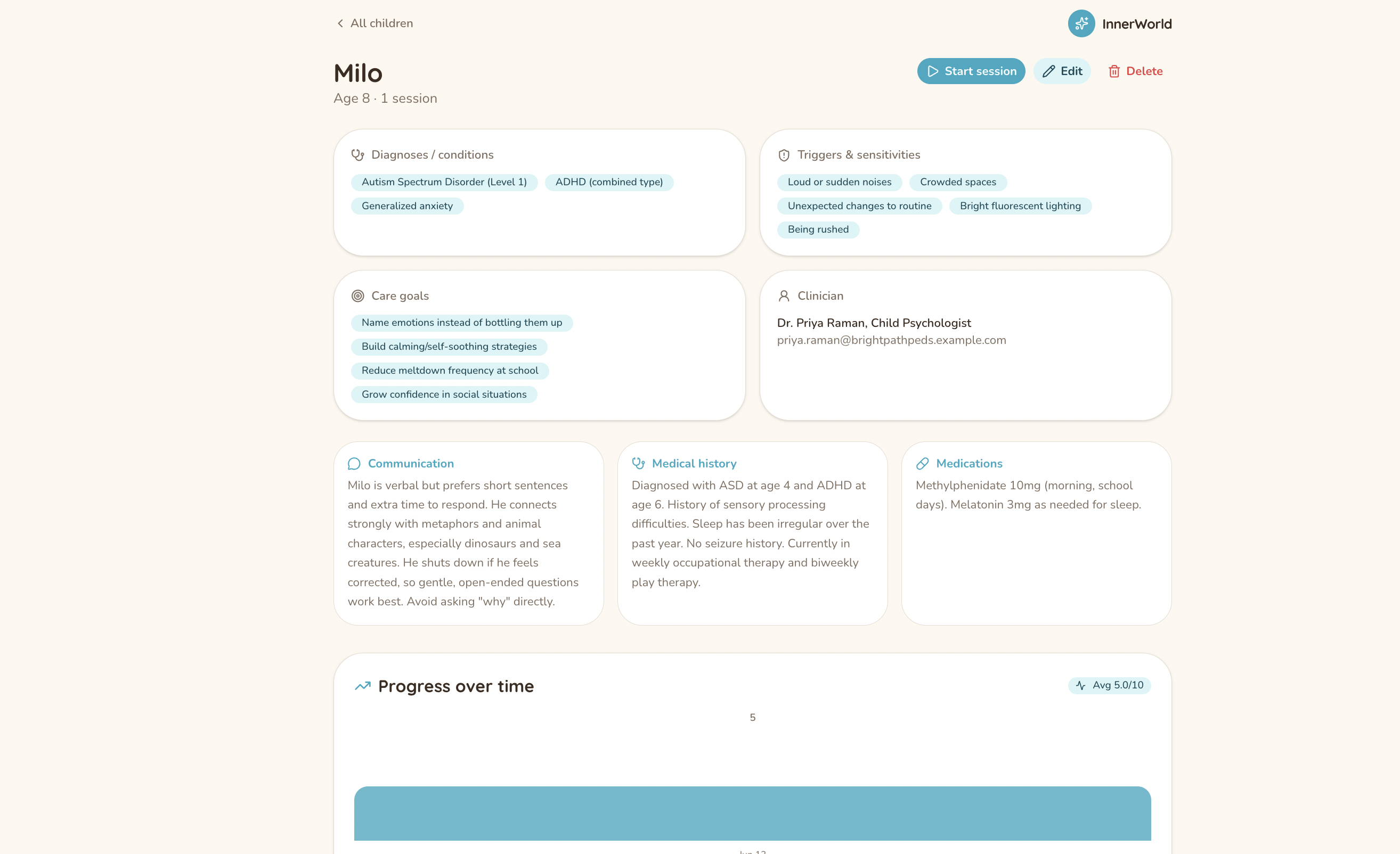
Report for doctor
-
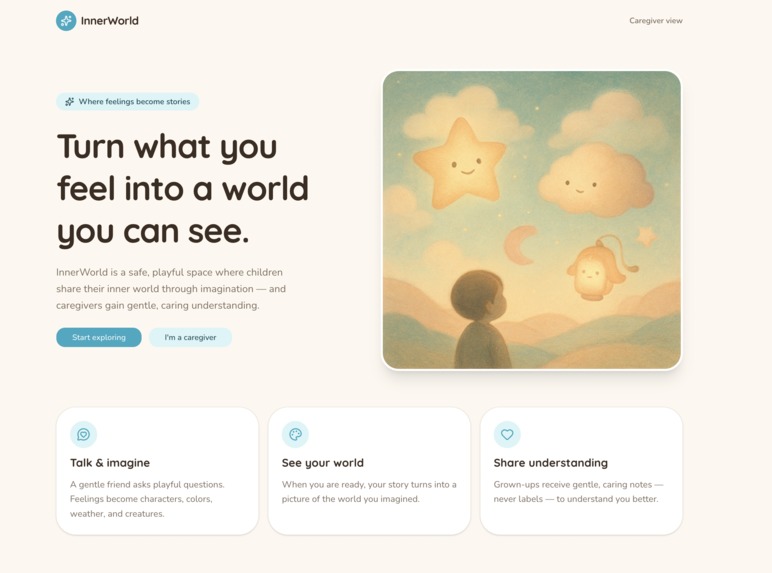
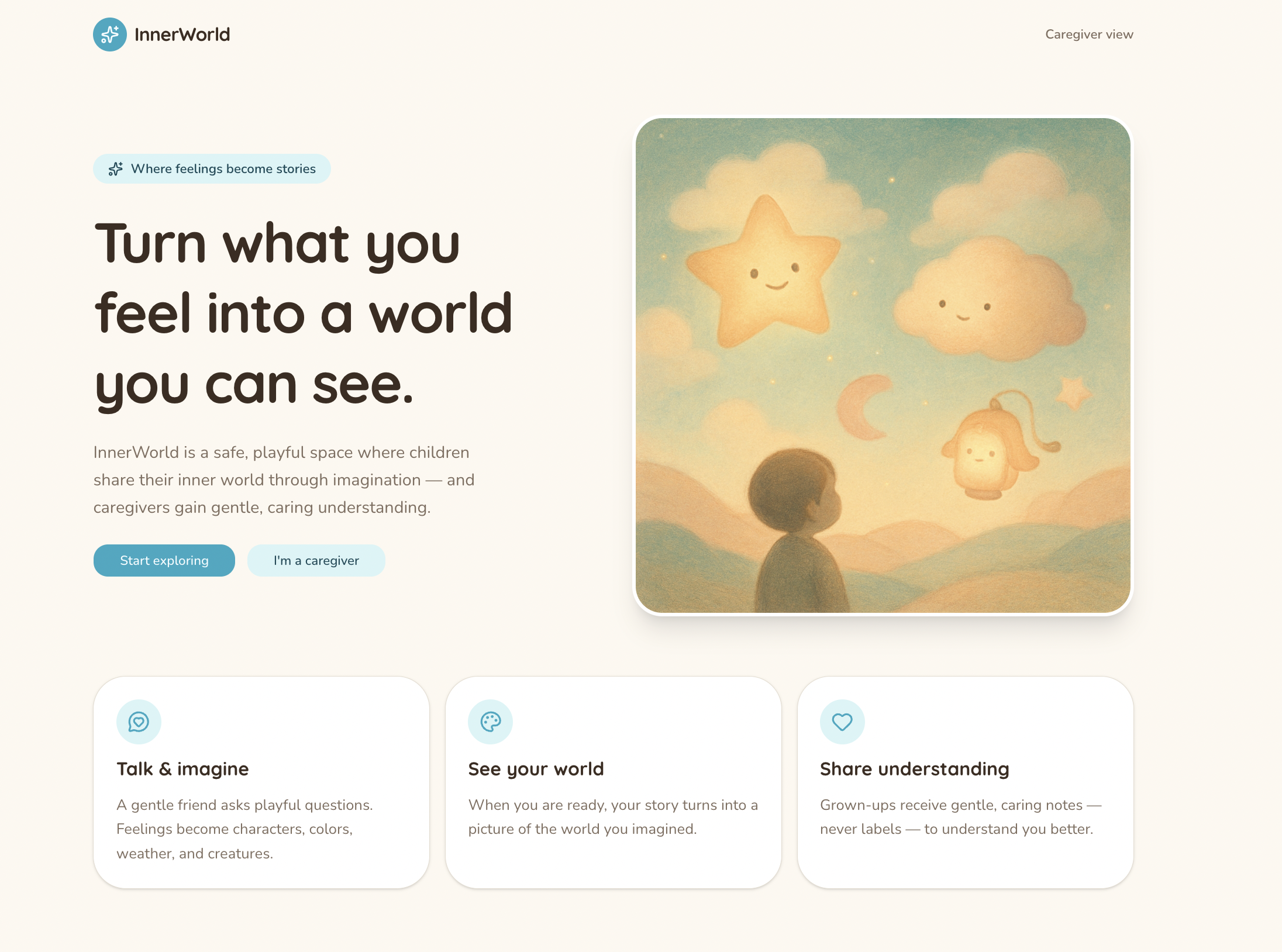
home page
-
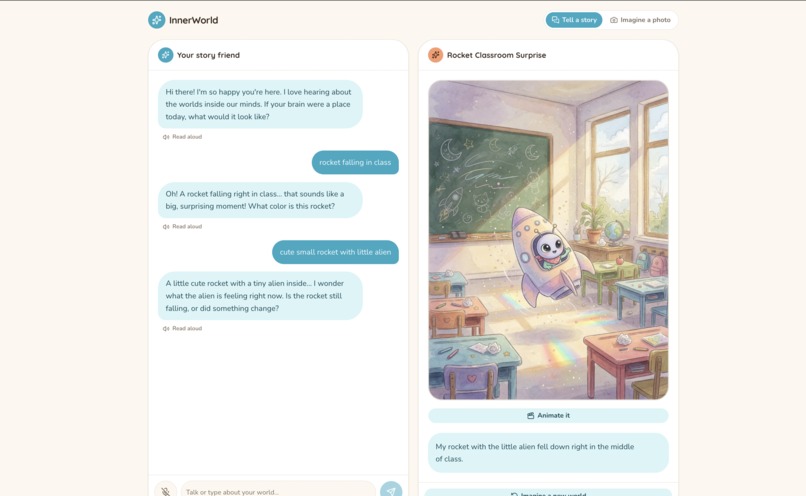
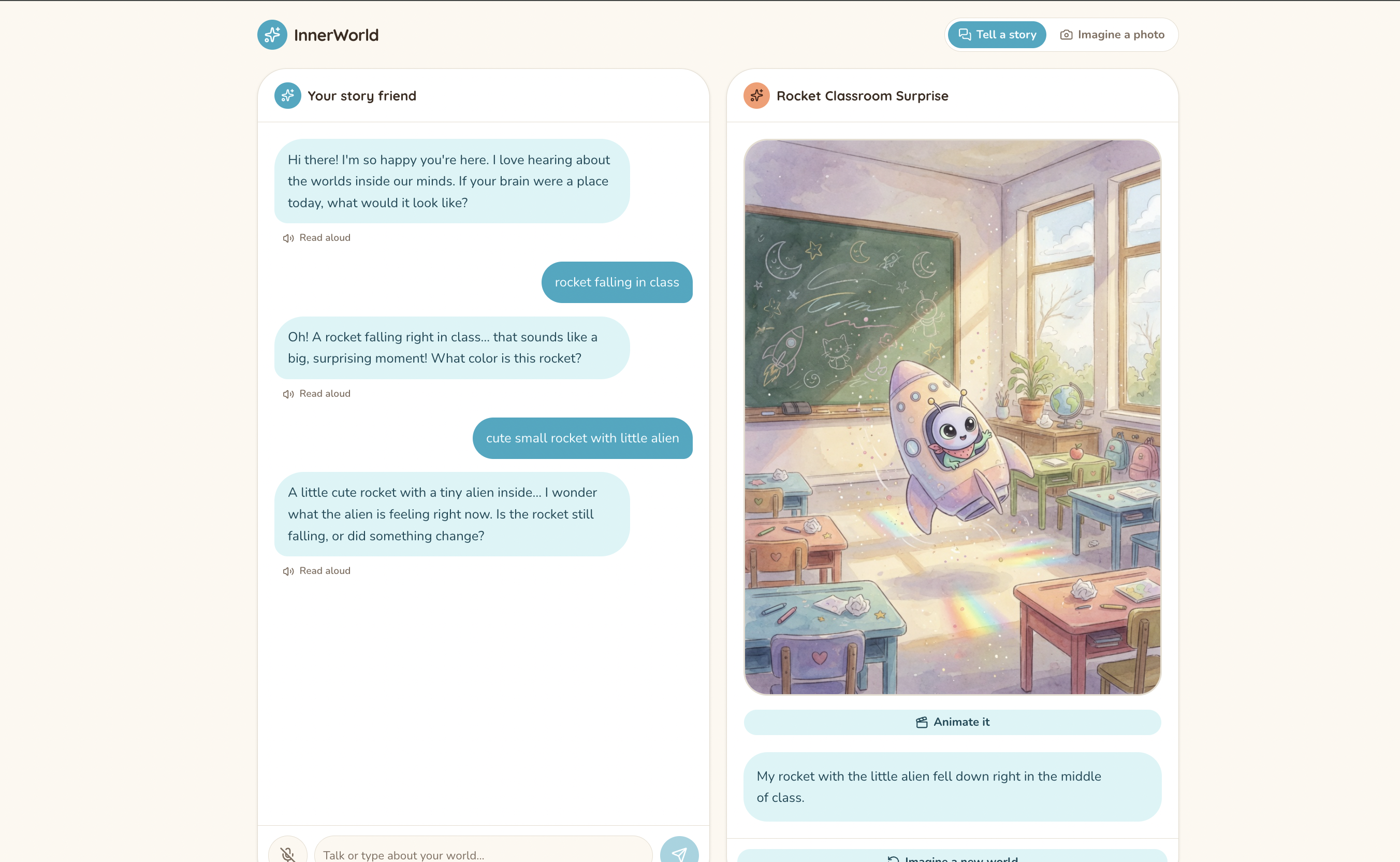
child describing his imagination and the image being generated
Inspiration
Healthcare is built around a simple assumption:
Patients can explain how they feel.
For millions of neurodivergent children, that assumption is wrong.
Children with ADHD, anxiety, autism, and other neurodevelopmental differences often experience rich, complex internal worlds but lack the vocabulary, confidence, or communication tools to express them. They are asked questions like:
- "How are you feeling?"
- "What's bothering you?"
- "Can you describe your symptoms?"
Many simply cannot answer in the way adults expect.
As a result, parents guess. Therapists infer. Clinicians interpret. Decisions about a child's care are often made without the child being able to fully communicate their own experience.
This is a patient agency problem hiding in plain sight.
The children who most need to be heard are often the ones with the fewest tools to express themselves.
We built InnerWorld because we believe every child deserves a voice in their own care, even when words aren't enough.
What it does
InnerWorld is an AI-powered visual communication platform that helps neurodivergent children express their emotions, experiences, and challenges through imagination.
Instead of forcing children to communicate in a format designed by adults, we meet them where they already are: stories, imagination, metaphors, characters, and visual thinking.
A child might say:
"Homework feels like monkeys jumping around while fireworks explode."
Or:
"School feels like a giant dragon chasing me."
Rather than dismissing these statements as childish imagination, InnerWorld recognizes them as meaningful forms of communication.
Using conversational AI and image generation, we transform these descriptions into immersive visual worlds. The child can literally see their thoughts and feelings brought to life.
But the image is only the beginning.
Our Imagination-to-Insight Engine identifies recurring themes, emotional signals, stressors, coping mechanisms, and communication patterns that can help caregivers better understand what the child is experiencing.
The result is a system that gives children a new language for self-expression and gives caregivers a clearer window into the child's world.
Why this matters
The challenge isn't that children don't have feelings.
The challenge is that many children don't have the language to communicate them.
This often leads to:
- Delayed recognition of emotional distress
- Miscommunication between children and caregivers
- Difficulty tracking changes over time
- Reduced patient participation in care decisions
Children are frequently expected to adapt to healthcare systems built for adults.
We believe healthcare should adapt to children instead.
InnerWorld turns imagination into a communication interface, allowing children to actively participate in conversations about their own well-being.
How we built it
We built InnerWorld as a multi-stage AI system designed to transform imagination into understanding.
Step 1: Expression
Children describe their feelings, experiences, or thoughts through voice or text.
Step 2: Exploration
An AI interviewer asks thoughtful follow-up questions to better understand the child's internal world without leading or judging them.
Step 3: Visualization
Using generative AI, the child's imagination is transformed into a visual scene that reflects their emotional and cognitive experience.
Step 4: Interpretation
Our Imagination-to-Insight Engine analyzes recurring themes, symbols, emotional cues, and stressors.
Step 5: Communication
Caregivers receive structured, understandable observations that help facilitate conversations and support decisions.
Tech Stack:
- Next.js
- React
- Tailwind CSS
- Grok Image Generation API
- Large Language Models
- Vercel
Challenges we ran into
One of our biggest challenges was avoiding the trap of building "just another AI image generator."
At first glance, generating imaginative scenes from a child's story seems like a creative application.
But the deeper problem we wanted to solve was communication.
We had to continuously ask ourselves:
What value exists beyond the image?
The answer became the foundation of the product.
The image is not the destination.
The image is the bridge.
The real innovation is helping children communicate experiences that would otherwise remain invisible.
We also faced the challenge of ensuring that generated insights remained supportive and observational rather than diagnostic. Our goal is not to replace clinicians, but to help them hear the child's voice more clearly.
Accomplishments that we're proud of
We're proud that InnerWorld addresses a problem that is both deeply important and frequently overlooked.
Most healthcare innovation focuses on diagnostics, treatment, and efficiency.
We focused on communication.
We built a system that:
- Gives children a voice in their own care
- Creates an emotionally engaging experience
- Translates imagination into meaningful understanding
- Bridges the gap between children and caregivers
- Demonstrates a new model of patient agency
Most importantly, we built something that starts with the child's perspective instead of the healthcare system's expectations.
What we learned
This project fundamentally changed how we think about patient agency.
Agency is not only about giving patients information.
Agency is also about giving patients the ability to be understood.
We learned that communication barriers are often invisible until you design for people who experience them every day.
We also learned that AI's greatest impact may not come from replacing human relationships, but from strengthening them.
Sometimes the most meaningful healthcare innovation is helping one person understand another.
What's next for InnerWorld
We envision InnerWorld becoming a long-term communication layer for neurodivergent children and their care teams.
Future plans include:
- Longitudinal emotional tracking
- Therapist and clinician dashboards
- Personalized coping and reflection tools
- Voice-first experiences
- Drawing-based expression modes
- Pattern recognition across months and years
- Family collaboration features
Our long-term vision is to create a future where every child can participate meaningfully in conversations about their own health, regardless of how they communicate.
Because patient agency should not depend on a person's ability to find the right words.
And for millions of children, imagination may be the most powerful language they have.
Built With
- base-ui
- css
- neon
- next.js-16.2.6
- react-19
- shadcn/ui
- tailwind-css-v4
- typescript
- xai

Log in or sign up for Devpost to join the conversation.