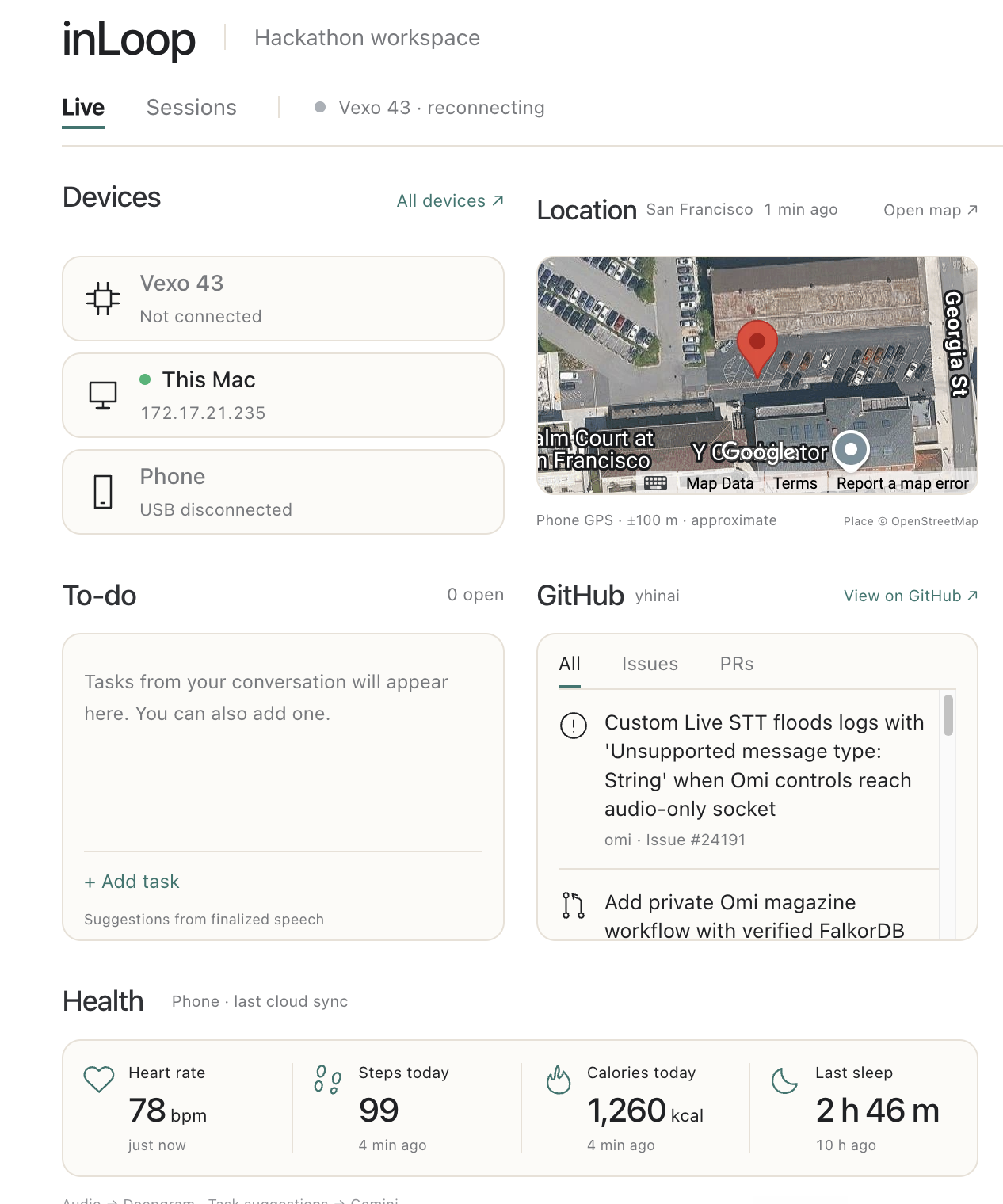
What it is
inLoop is a local, Mac-hosted workspace for a wrist-worn wearable (the Vexo band, with Omi phone-app audio also supported). You wear the band, talk normally, and inLoop:
- Transcribes your speech live and shows it as streaming captions.
- Saves every finalized sentence to a local journal and readable daily notes.
- Pulls out action items ("I'll send the deck tomorrow") with Gemini, and links each one back to the exact quote that produced it.
- Tags speech with where you were using GPS from a connected Android phone, plus Health Connect readings.
- Lists your open GitHub issues and PRs next to all of that, so the dashboard shows what you said, what you owe, and what's waiting on you.
- Lets you drive your Mac by tilting your wrist using the band's motion sensors (experimental).
Everything runs on one Mac. There's no hosted backend, so recordings, transcripts, tasks and GPS fixes stay in local files and a local SQLite database.
How it works
Vexo band ──BLE/USB──┐
                     ├──► bridge (:8787) ──► Deepgram Nova-3  (or local Whisper)
Omi phone app ───────┘         │
                               ▼
                    JSONL journal (source of truth)
                     ├──► daily Markdown notes
                     ├──► terminal caption viewer (./omi captions)
                     └──► inLoop web app (:8790)
                              ├─ Gemini task extraction
                              ├─ phone GPS + Health Connect (ADB)
                              └─ GitHub issues/PRs (gh, read-only)
1. Capture
vexo_source.pyconnects to the band over Bluetooth (the main path) or USB serial (fallback), using the MIT-licensedvexo-open-kitSDK as a git submodule.- Audio is raw PCM16, mono, 16 kHz. The bridge rejects anything else.
- Only one wearer at a time. A file lock stops two capture processes from fighting over the band.
2. Recognition
- Deepgram Nova-3 is the default and can run directly or through an optional Pipecat pipeline in its own process.
- Local Whisper (MLX on Apple GPU) is an explicit offline fallback.
- Switching backends is deliberate (
./omi backend deepgram|whisper). It never silently falls back from cloud to local. - Optional speaker diarization plus local voice verification (Sherpa-ONNX, WeSpeaker model) tell your voice apart from other people's without assuming "Speaker 0" is you.
3. Storage and delivery
storage.pycommits each final transcript to an append-only JSONL journal before anything else sees it, then writes the daily Markdown.- Caption clients get bounded queues. Slow readers reconnect and replay instead of silently dropping text.
- Raw audio is not recorded by default.
4. The inLoop app (inloop_app.py + web/)
- A small aiohttp server on
127.0.0.1:8790serves a vanilla JS dashboard with no build step. - Tasks: finalized transcript batches go to
gemini-3.5-flash-litewith a strict JSON schema. The prompt says to treat transcript text as data, to invent nothing, and to quote the exact supporting substring. Tasks are only accepted if theirsource_idmatches a real segment. - Location: satellite map (Leaflet / Google Maps, with 3D if a browser key is set). Each speech moment matches the last GPS fix recorded at or before it.
- Health: Health Connect readings from the phone, each with its own measurement timestamp.
- GitHub: polls the
ghCLI every 2 minutes for open issues and PRs involving the user. Credentials never reach the browser. - Export: sessions, tasks and GPS can be exported from
/api/export.
5. Wrist motion control (experimental)
./omi motionshows live accelerometer, gyro, roll/pitch and the band's built-in gestures (tap, double-tap, tilt)../omi motion --controlmoves the real Mac pointer after a three-pose calibration (neutral / right / down). Tilt to move, return to neutral to stop, and toggle scroll mode or precision mode. Escape pauses everything.- Gemini Decision 1 experiment: raw 6-axis motion windows go to Google's new classification-only
gemini-decision-1model to label movements (swipe, circle, shake…) and screen direction. With four personal reference strokes it got 6/6 held-out trials right, against 1/6 without references (median ~400 ms per call). The docs say clearly that this is a tiny sample, not a validated gesture classifier.
Using it
./omi start                                   # start the capture + recognition service
./omi source vexo --band 43 --transport ble   # attach the Vexo band
./omi captions                                # terminal caption viewer
./inloop                                      # open the dashboard at 127.0.0.1:8790
./omi status                                  # health of phone, audio, recognizer, saving
./omi verify --phrase "silver otter carries"  # end-to-end check through captions + notes
Dev checks: ./omi dev test -q (offline, no mic, no cloud keys), ./omi dev faults (8 fault scenarios), and ./omi dev smoke --backend deepgram (real cloud).
Tech stack
| Layer | Tools |
|---|---|
| Hardware | Vexo wristband (BLE / USB), Omi phone app, Android phone over ADB |
| Speech | Deepgram Nova-3, Pipecat (optional), MLX Whisper (fallback), Sherpa-ONNX speaker ID |
| AI | Gemini 3.5 Flash Lite (task extraction), Gemini Decision 1 (motion classification) |
| Backend | Python (aiohttp, Bleak, pyserial, PyAV), SQLite, JSONL journal |
| Frontend | Vanilla HTML/CSS/JS, Leaflet, Google Maps JS / 3D |
| Integrations | GitHub via gh CLI, Health Connect, Tailscale for phone ingress |
About 7.5k lines of Python app code and 30+ offline test files. CI runs the unit tests plus shell syntax and diff checks.
Honest limits
- One wearer, one Mac. No multi-tenant identity.
- Choosing Deepgram sends nearby audio to Deepgram. The docs ask you to tell people nearby.
- Latency numbers cover Mac and provider stages only, not BLE, phone or tunnel delays.
- Motion control and gesture classification are early experiments. Tap reliability hasn't been measured.
- Some paths and settings are tied to the author's machine (e.g.
/Users/alhinai/..., GitHub loginyhinai).
Built With
- deepgram
- gemini
- pipecat
- vexo
