-
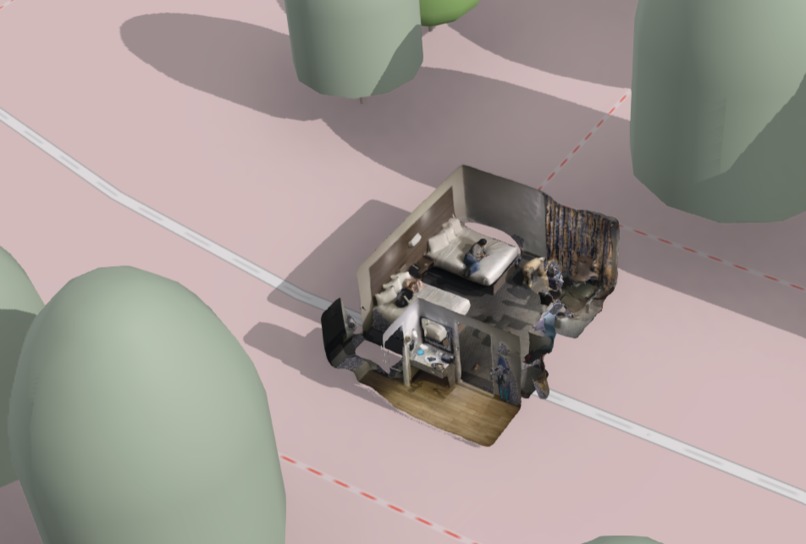
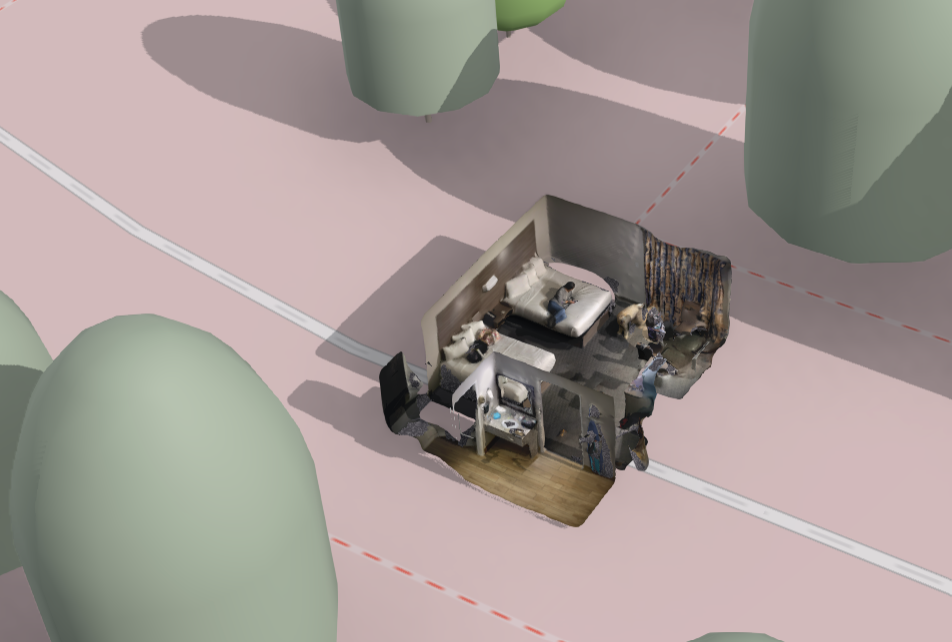
A scan of a hotel room inside our Web App.
Inspiration
As an ESRI intern, I rent a house owned by an ESRI employee. Summer in Redlands presents a real challenge, as temperatures can reach up to 105 degrees during the day. However, since the electricity bill here in California is really expensive, my landlord doesn't allow me to change the AC temperature, as the thermostat is set to around 78 degrees, and this AC unit doesn't really cool the house down. That's why I have this idea, because I hate hot weather, but need a smart way to escape the heat without having to waste our money on electricity. I hope with the web app our team made, next time in the future, there will be a better way to make housing plans at a place with less solar radiation.
What it does
Our application can import 3D GLB files into our map viewer. Our app allows users to see how their model (whether it is a room, a building, or a tree) is affected by sunlight and solar radiation when placed at the location of their choosing, at the time of their choosing. This can allow users to gain analysis and precise insights for smarter design and energy-efficient planning.
How we built it
By utilizing ArcGIS Pro, we were able to generate a feature layer containing information regarding yearly solar radiation trends. With React, we were able to generate our web application, and with the ArcGIS Javascript SDK, we made a map view, with the necessary implementations we desired. We leveraged the National Weather Service API to access monthly temperature data for specific coordinates. Our team also created a custom uploading script to allow users to upload their custom GLB models.
Challenges we ran into
Exporting from ArcGIS Pro to our web application was a challenge. We tried publishing a geoprocessing tool for our solar radiation analysis, but we had to pivot to sending a feature layer and integrating that instead.
Accomplishments that we're proud of
Our teamwork and collaboration, as well as our communication. Our custom scripts for uploading models, and the feature layers we integrated to our application. We were fascinated by our solar radiation analysis.
What we learned
We learned how to integrate ArcGIS Pro with ArcGIS online, as well as how to use the ArcGIS JS SDK to our benefit. We learned how to reduce our scope given our deadline and our capabilities.
What's next for Inlight
We plan to implement a mobile app for iOS that can connect to our web application, so users can scan their room and send their model more easily.
Built With
- arcgis-js-sdk
- arcgis-pro
- esri
- national-weather-service(api)
- react
- tailwind-css
- typescript


Log in or sign up for Devpost to join the conversation.