INKALIVE — Draw It. Say It. Play It.
The next great game designer might be holding a crayon.
What if a child's drawing could jump off the page, become a playable 3D hero, and explore a world shaped by their own words?
That's the idea behind INKALIVE: a family-friendly, AI-powered adventure built for Amazon Fire TV, with a smartphone as its creative companion.
Instead of choosing from a fixed catalog of characters and levels, players bring their own imagination into the living room. They draw it. They say it. Then they play it.
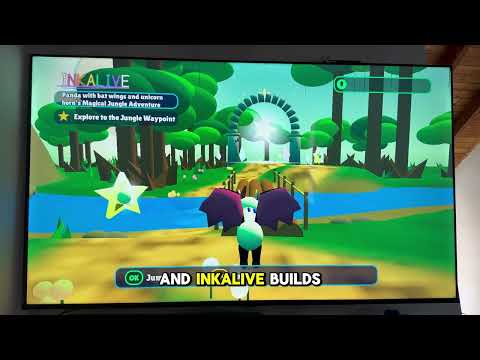
🎬 Watch our official demo — INKALIVE on Fire TV
Inspiration
Childhood imagination is limitless. Most video games, however, ask children to enter worlds designed by someone else and play as characters someone else created.
We wanted to turn that relationship around.
A drawing on paper is personal. Its uneven lines, strange eyes, colorful spots, and impossible anatomy are not flaws—they are the parts that make it special. What if those details could survive the journey from paper to screen? What if a child could describe a jungle, castle, or floating island and actually explore a version of that idea?
INKALIVE was built around a simple belief: children should be creators in the games they play, not just players in worlds they are given.
We also wanted the experience to belong in the living room, where families can watch, collaborate, laugh, and explore together. Amazon Fire TV gave us that shared screen; the phone gave us a camera, microphone, and natural creative input.
What it does
INKALIVE turns three everyday actions into one connected adventure.
🎨 DRAW IT — Your imagination becomes the hero
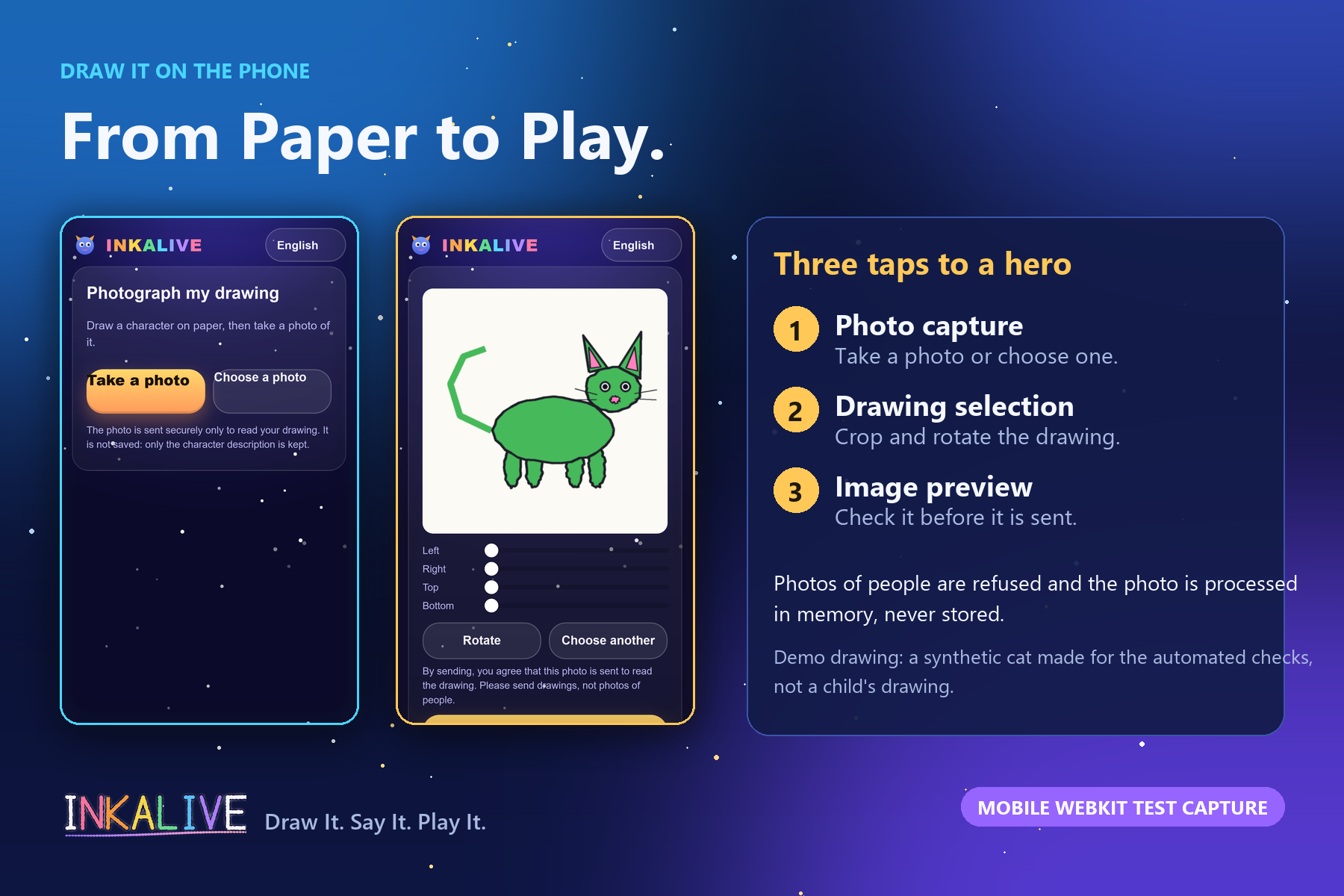
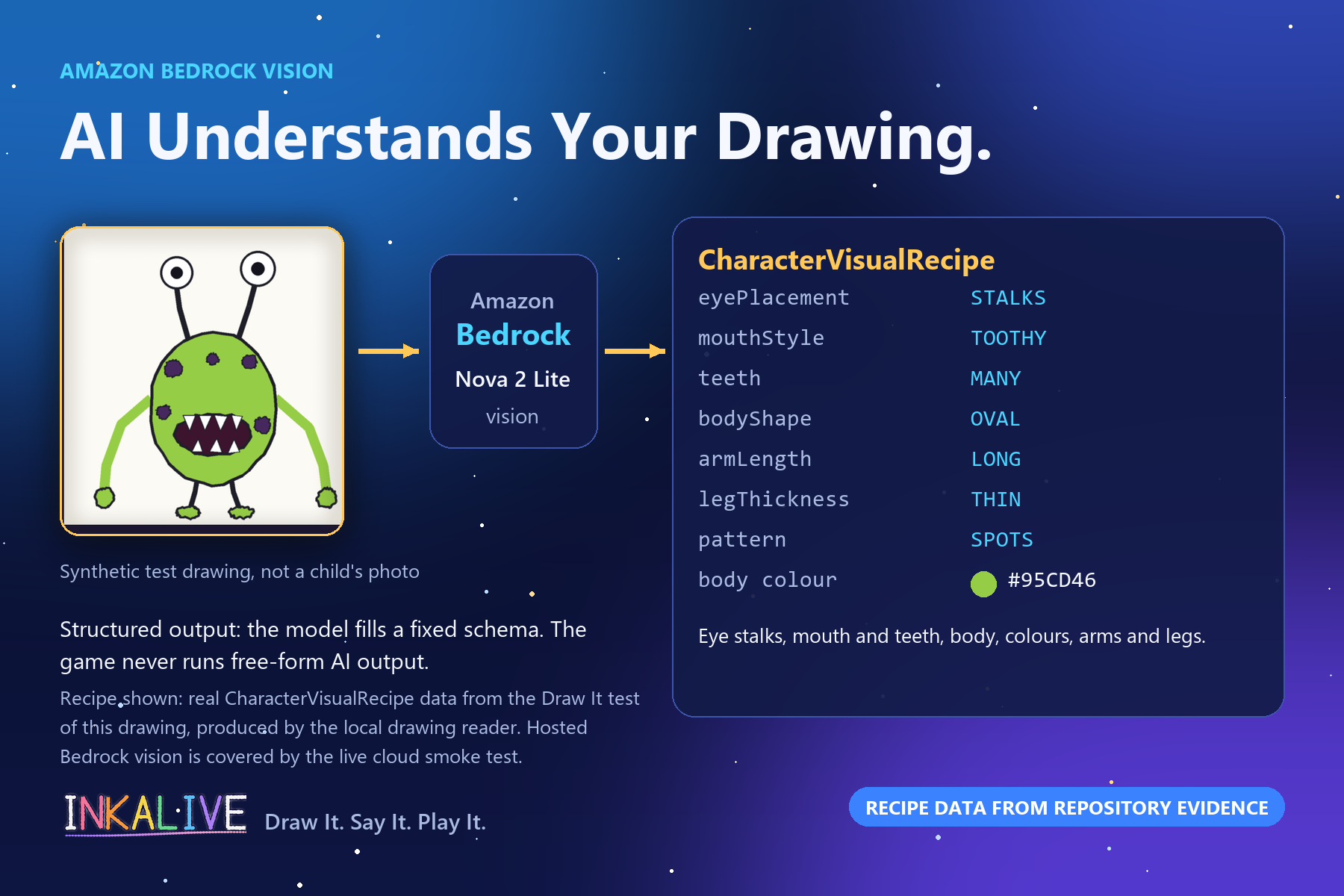
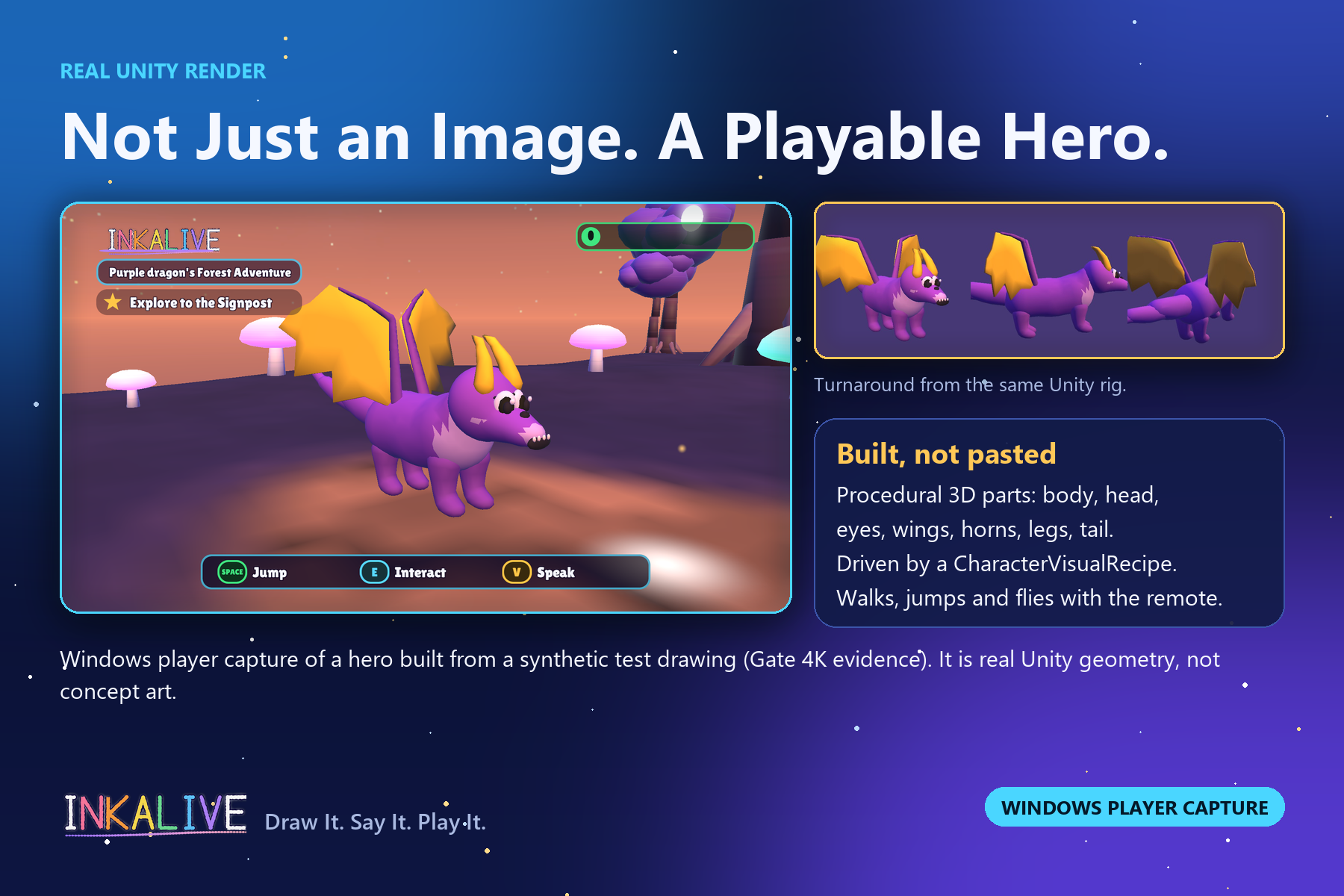
Draw a creature on paper. Open the INKALIVE smartphone companion, capture the drawing, and let AI interpret its distinctive traits.
Amazon Bedrock Nova 2 Lite analyzes the image and produces a structured visual description. A procedural character builder in Unity translates supported features into a real, playable 3D character. The creation flow lets the player review and adjust the interpretation before bringing the character into the game.
This isn't just a generated picture: the result becomes a character you can move and play with using the Fire TV remote.
🎙️ SAY IT — Your words change the adventure
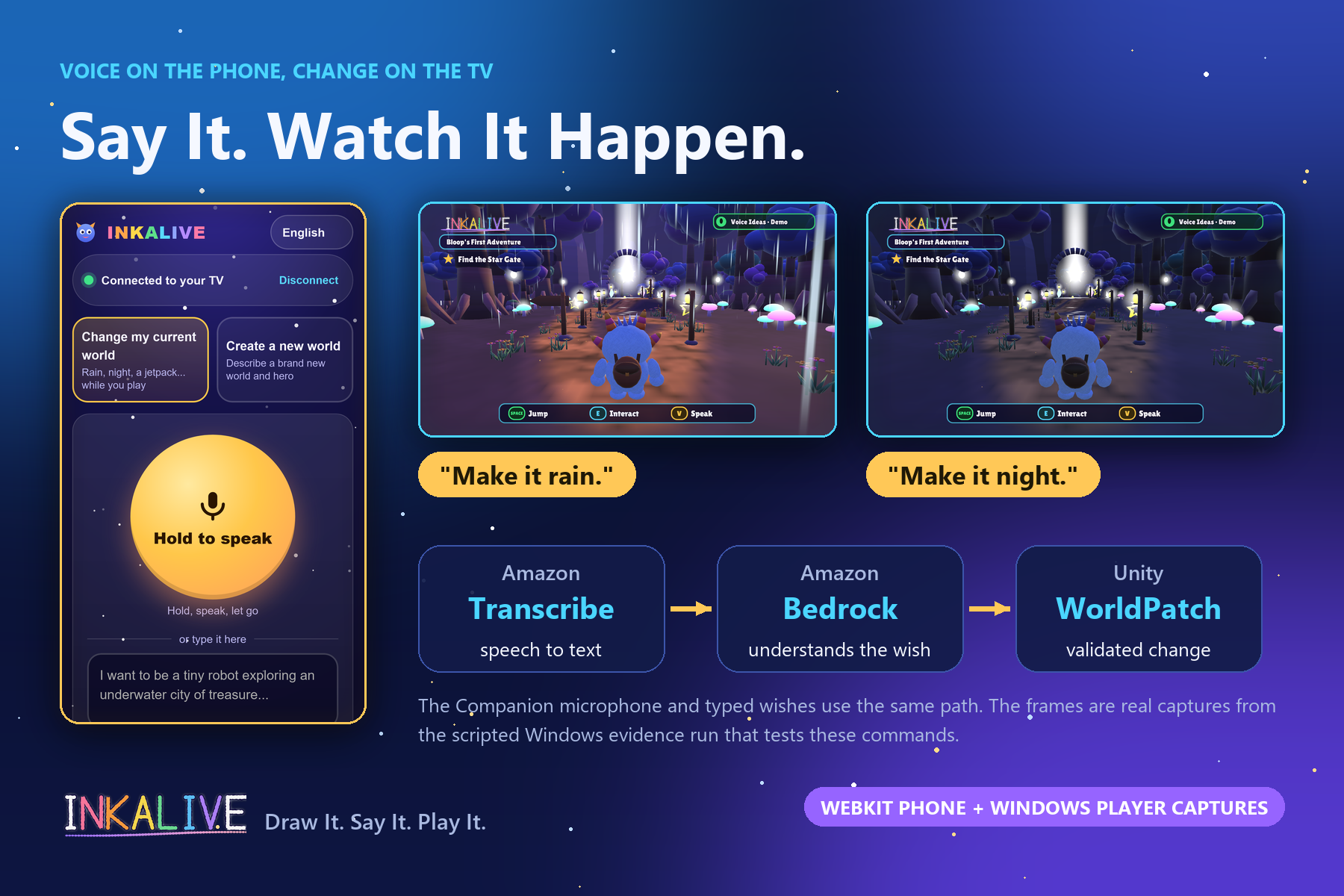
The phone becomes a voice-powered creative companion. Players can ask for changes such as:
- “Make it rain.”
- “Make it night.”
- “Give me a jetpack.”
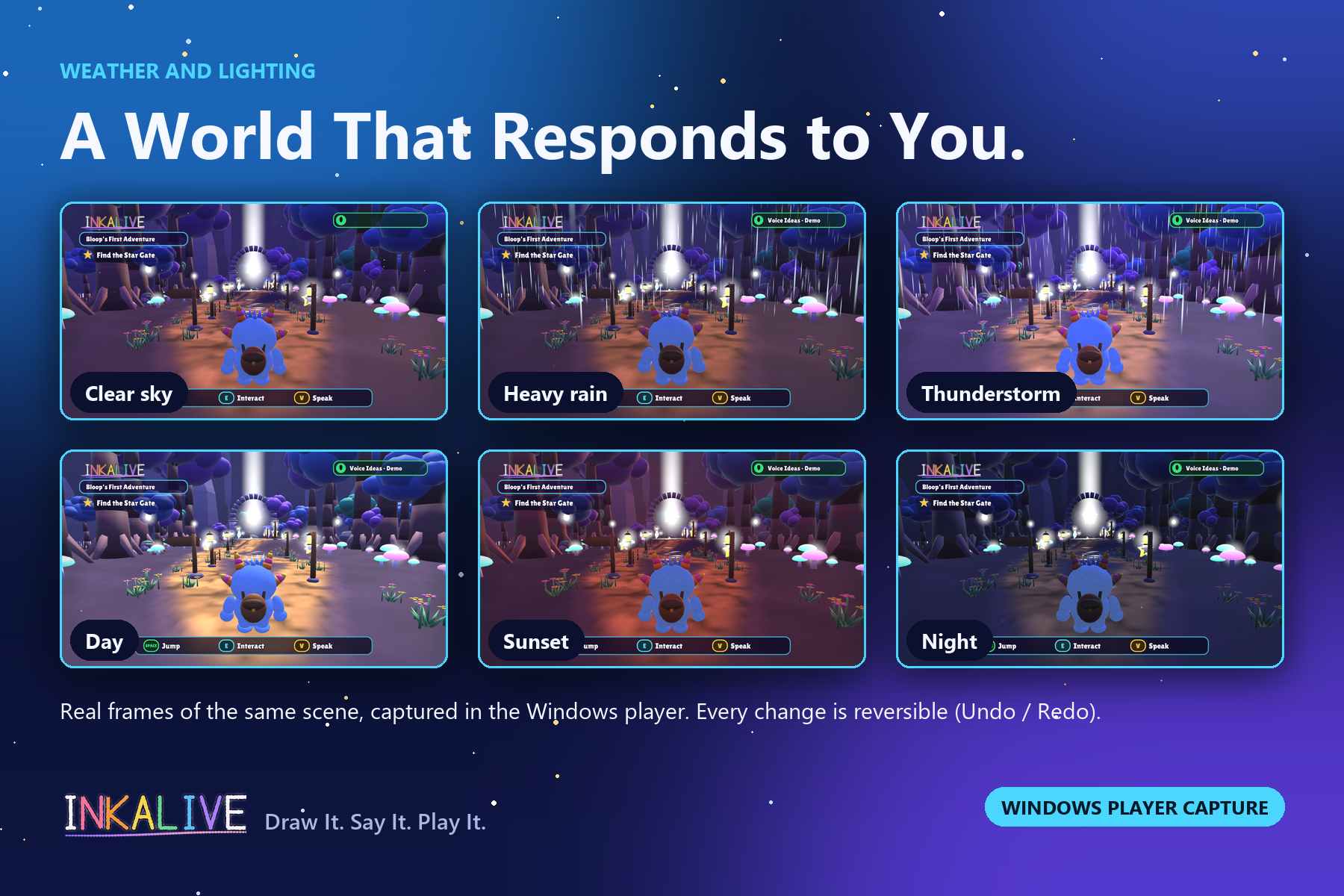
Amazon Transcribe handles speech recognition, and Amazon Bedrock interprets creative intent. INKALIVE converts supported requests into validated game-world operations—such as weather, lighting, or character abilities—that the Unity engine executes visibly.
Players can continue experimenting, and supported changes can be reversed using undo/redo. Natural language is the input; actual gameplay is the outcome.
🎮 PLAY IT — Explore what you imagined
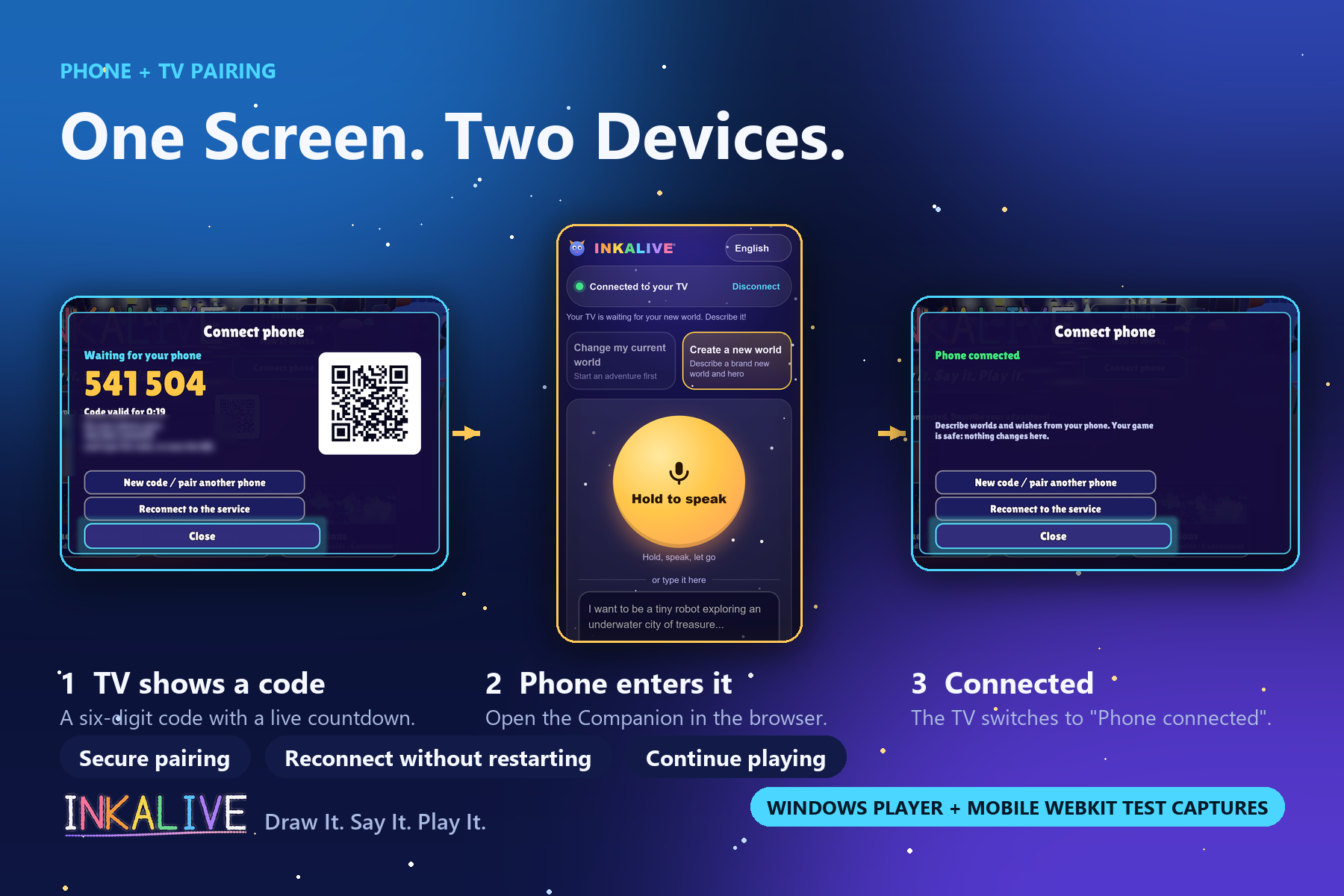
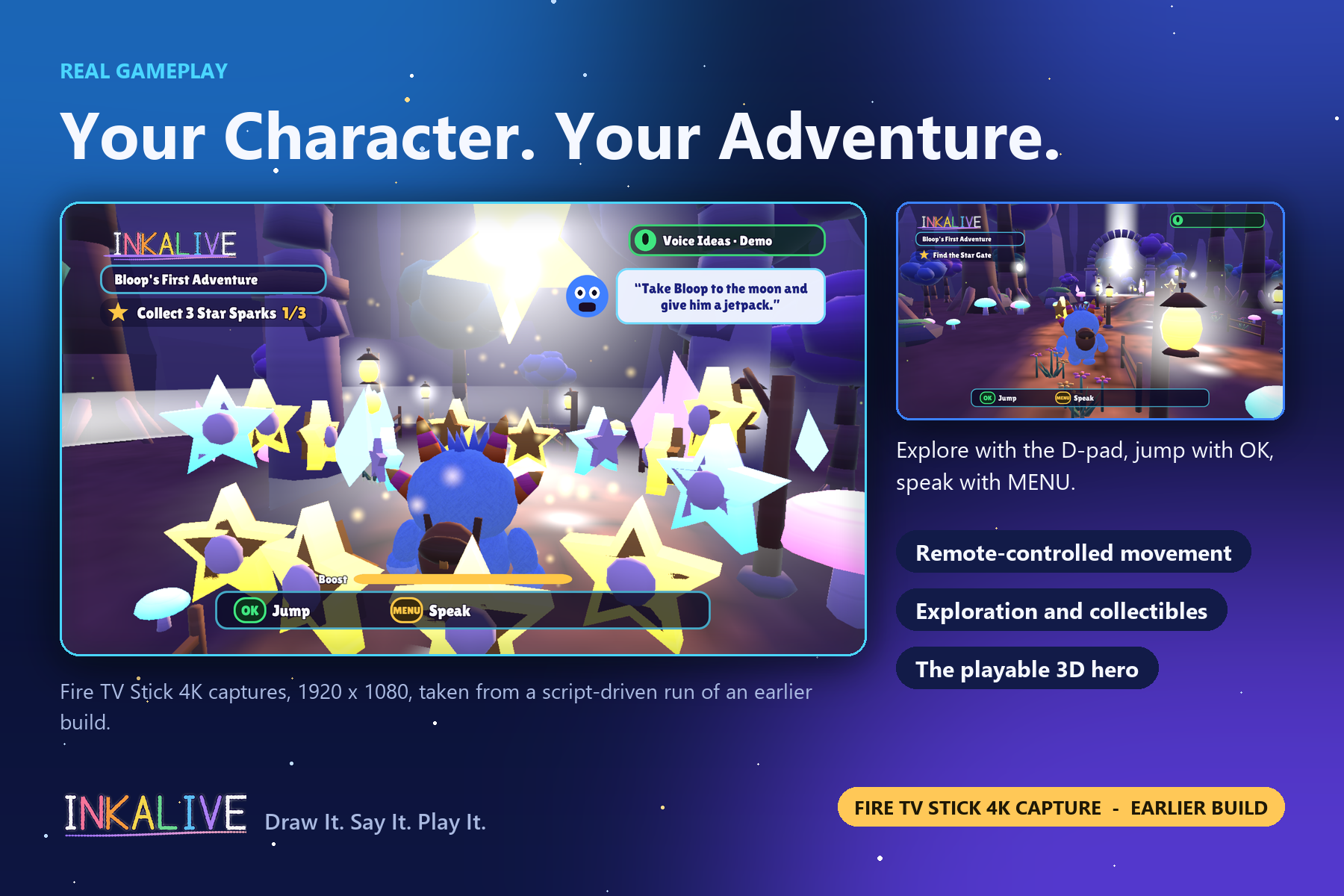
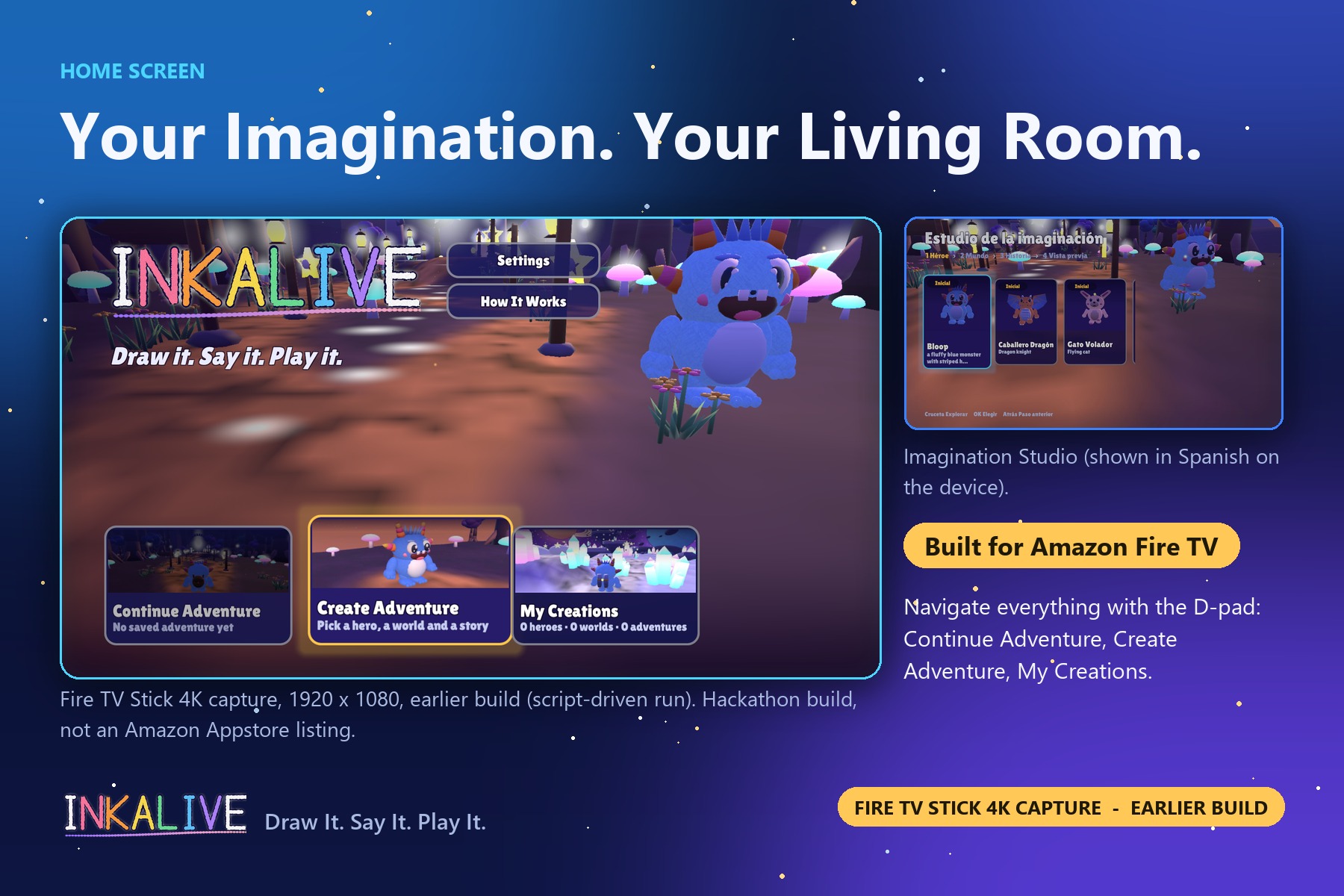
Launch INKALIVE from the Fire TV apps menu, connect a smartphone using a QR code or short-lived pairing code, create a hero, and explore with the Fire TV remote.
A connected phone is a creative tool, not a second controller that must always stay awake. The game remains playable if the phone temporarily disconnects, and the interface provides a way to reconnect without restarting the adventure.
Characters and supported adventure state can be saved so players can return to their creations.
🌍 WORLD ENGINE — More than renamed levels
We didn't want “jungle,” “volcano,” and “castle” to mean the same terrain with different colors.
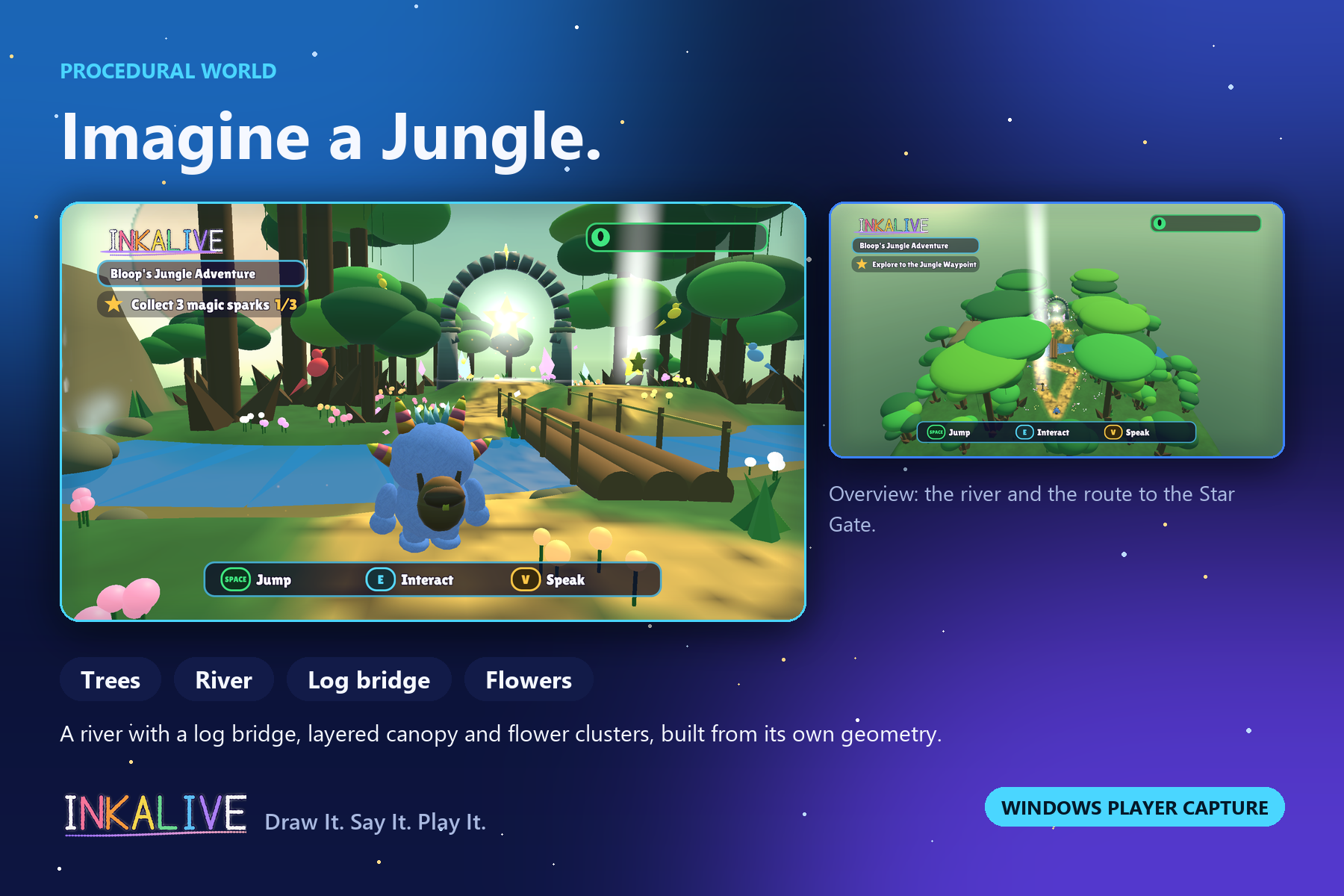
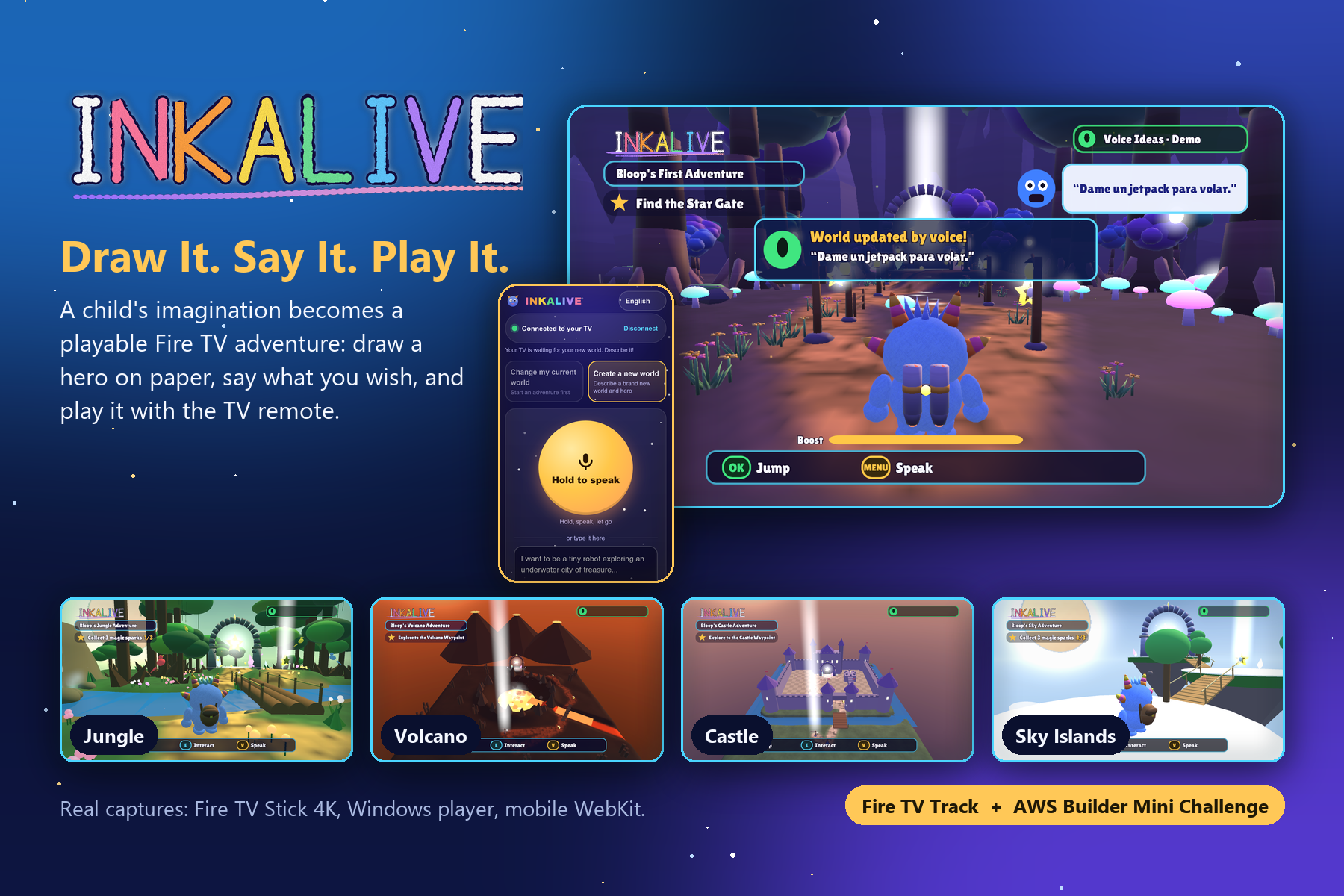
INKALIVE's procedural world system uses a bounded, validated world specification and distinct geometry-building components. Its world families include:
- Jungle: vegetation, tropical terrain, waterways, and traversal features.
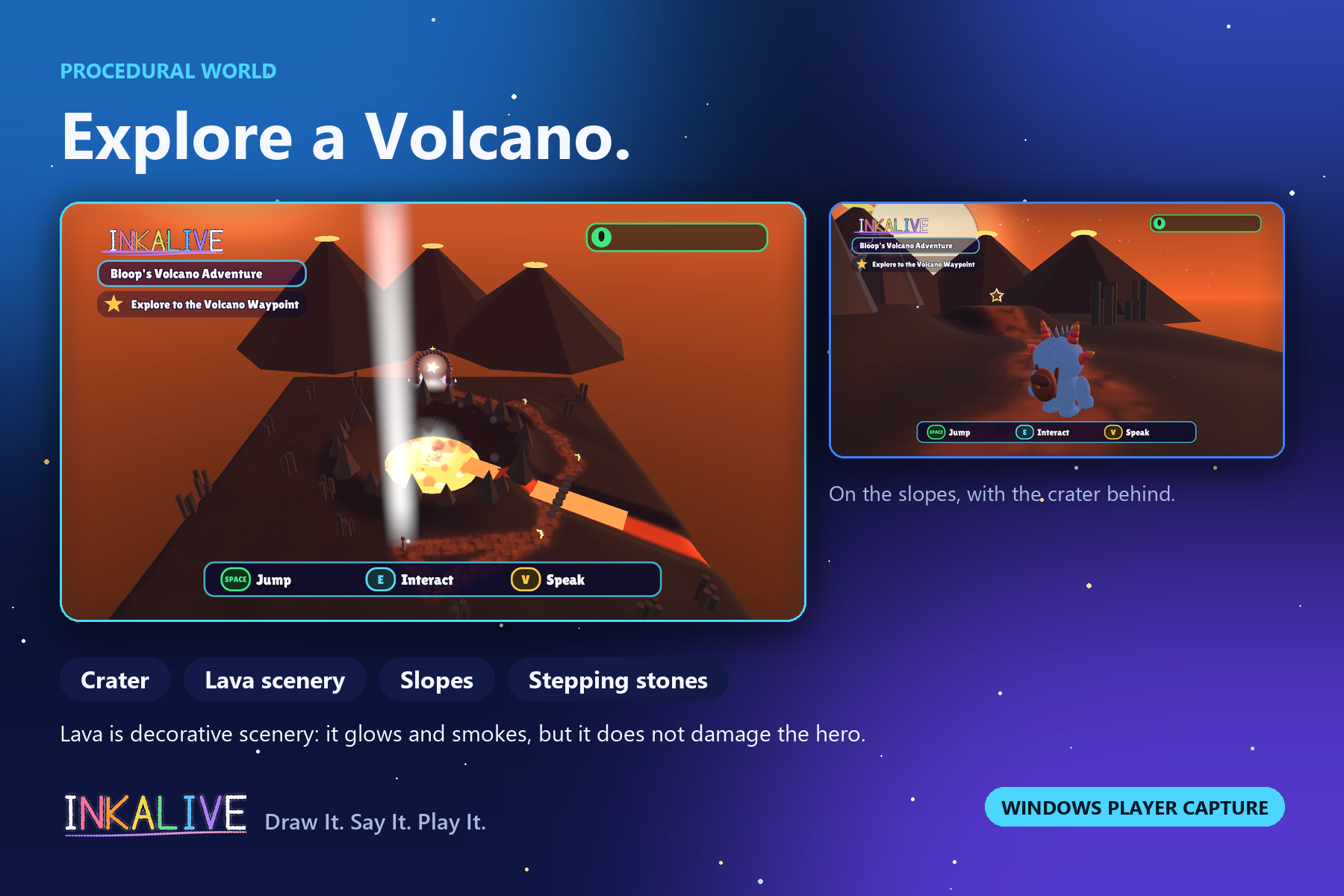
- Volcano: crater geometry, volcanic slopes, lava scenery, and stepping-stone routes.
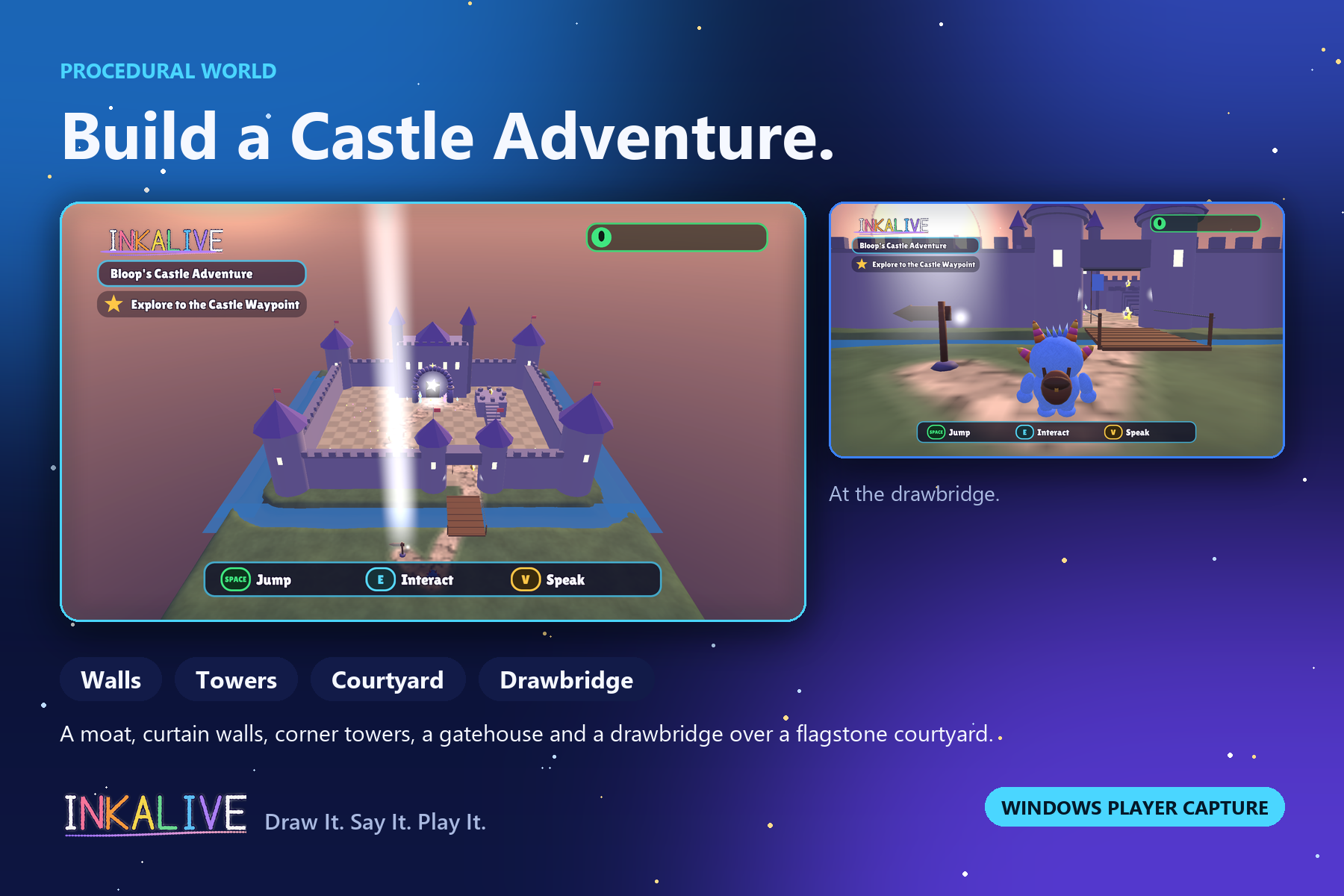
- Castle: walls, towers, courtyards, gateways, and bridges.
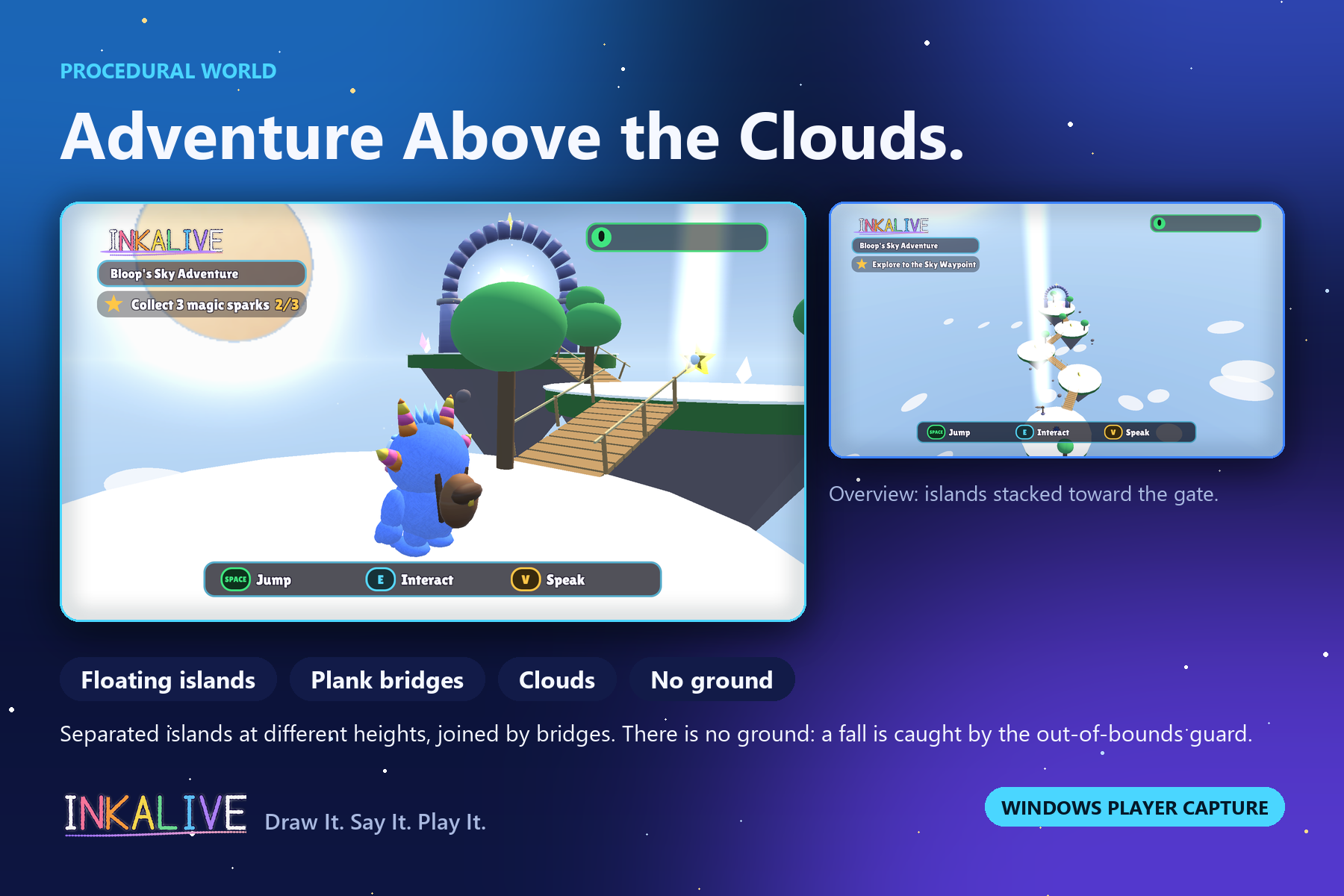
- Sky Islands: elevated land masses connected by traversable bridges.
Players can describe the setting they want, and the engine composes a supported interpretation with meaningful structural differences.
This is structured, procedural 3D world composition—not a claim of unlimited free-form 3D mesh generation. Some elements remain intentionally simplified: for example, wildlife may be scenic, water can be traversable, and lava is currently decorative.
How we built it
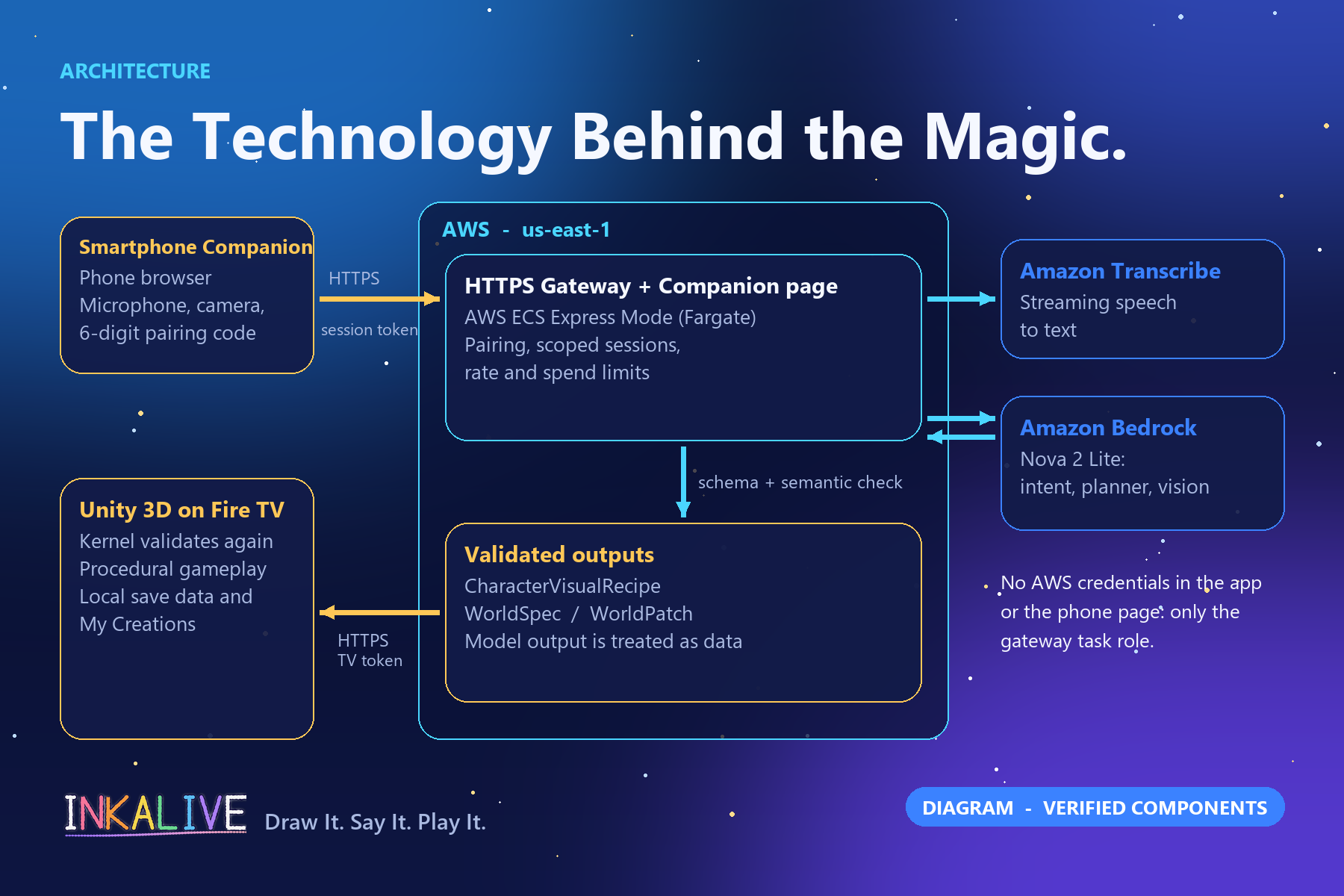
INKALIVE combines a real Fire TV game, a browser-based smartphone companion, and a secured AWS backend.
The core journey:
Drawing or voice on the phone → HTTPS gateway on AWS → Amazon AI interpretation → validated recipe or command → Unity world and character systems on Fire TV.
Technology stack:
- Amazon Fire TV / Fire OS: the actual living-room game experience.
- Unity 3D and C#: procedural character assembly, world geometry, animation, controls, physics, and local persistence.
- Amazon Bedrock — Nova 2 Lite: image understanding and natural-language planning.
- Amazon Transcribe: spoken requests converted into text.
- AWS ECS Express Mode: hosted HTTPS gateway and smartphone-to-TV communication.
- iPhone Safari / mobile web: drawing capture, world prompts, voice input, and device pairing.
The AI does not execute arbitrary code or directly manipulate Unity internals. It returns constrained, versioned data such as character recipes and world modifications. Our application validates that data, applies supported operations, and enforces bounded resource usage.
We added short-lived, single-use pairing codes, authenticated sessions, rate limiting, server-side AWS roles, and explicit recovery flows. The goal was to make a creative experience feel simple while keeping the underlying system controlled and secure.
Challenges we ran into
1. Preserving the soul of a drawing. Our earliest character translation made a distinctive alien look like a generic smiling blob. Its eye stalks, teeth, limb proportions, and body markings disappeared. We expanded the visual recipe, improved interpretation and review controls, and developed procedural geometry for those recognizable features. The lesson was clear: fidelity matters more than generic cuteness.
2. Making worlds genuinely different. Early world variants relied too heavily on shared layouts and cosmetic changes. We redesigned the world generator around different topologies and modular structures, then tested traversal, repeatability, and collision behavior.
3. Turning voice commands into visible action. Recognizing “make it rain” is not enough if nothing changes on screen. We traced requests through interpretation, validation, delivery, and execution, then improved precipitation, lightning, time-of-day lighting, and reversible world edits.
4. Making two devices feel like one product. Real Safari behavior exposed connection loss and photo-picker interruptions that desktop simulations alone did not reveal. We strengthened pairing recovery, protected the drawing-creation flow, and made reconnection accessible from the TV interface.
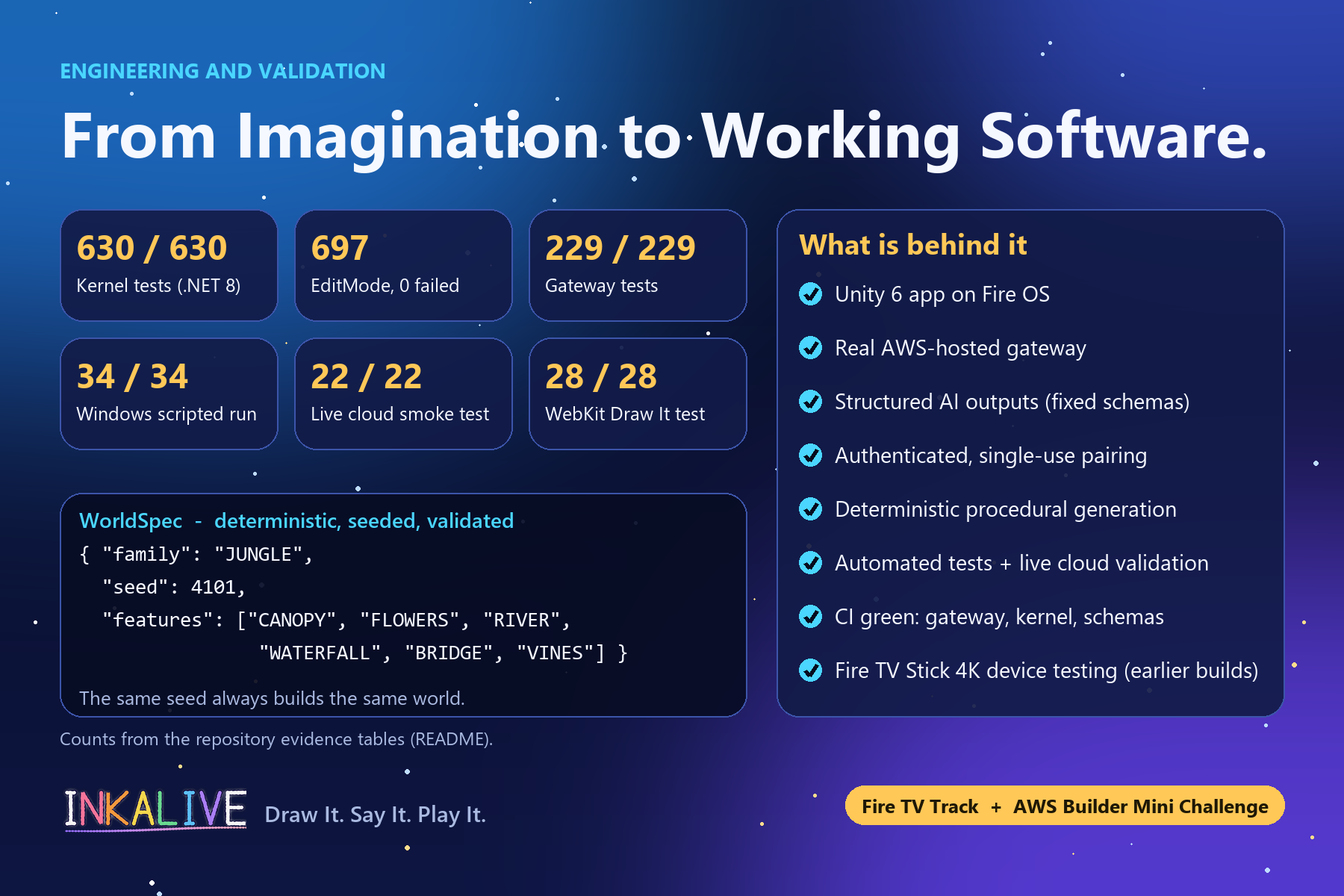
5. Shipping on real hardware. Fire TV performance, Android packaging, network behavior, cloud deployment, and secure session handling each introduced constraints different from the Windows development environment. We used automated tests, live cloud checks, and hands-on device testing to focus on actual usability.
Accomplishments that we're proud of
Our proudest achievement is the complete idea-to-play loop: a real paper drawing, interpreted through AI, transformed into a procedural 3D character, and brought into a Fire TV adventure.
We also built distinct procedural world families, voice-driven weather and lighting effects, smartphone pairing and reconnection, local adventure persistence, and an AWS-hosted creative gateway—with hundreds of automated tests and dedicated Windows-player and cloud integration checks.
Just as importantly, we avoided making the AI a black box with unrestricted control. INKALIVE uses AI to understand imagination and a deterministic game engine to make that imagination playable.
Our GitHub repository contains the source and documentation for authorized hackathon reviewers. A Fire TV APK release and installation guide are provided for evaluation.
What we learned
We learned that the most impressive AI feature is not necessarily the most complicated model call. It's the moment when a person recognizes their own idea in the result.
We learned to design around the capabilities of a living-room device—not just around what works on a development PC. We learned that reliable pairing, clear feedback, safe execution, and recovering from interruptions are part of the magic, not merely infrastructure details.
Above all, we learned that AI becomes more meaningful when it gives people authorship.
What's next for INKALIVE — Draw It. Say It. Play It.
We want to keep improving drawing fidelity, expand the vocabulary of procedural worlds and interactive objects, refine Fire TV performance, and make creative collaboration even more intuitive and accessible.
The long-term vision is simple: a living-room adventure in which every drawing, every spoken idea, and every shared moment can become part of the story.
We are building toward a world where children don't just ask, “What game can I play?”
They ask, “What world can I imagine today?”
Built for the Amazon Developer Hackathon 2026
Primary track: Fire TV
Mini challenge: AWS Builder
🎬 Watch the official demo · 💻 Source & documentation · 📦 Fire TV build
INKALIVE — Draw it. Say it. Play it.
Built With
- amazon-bedrock
- amazon-ecs
- amazon-fire-tv
- amazon-nova-2-lite
- amazon-transcribe
- amazon-web-services
- android
- artificial-intelligence
- c#
- computer-vision
- css3
- docker
- fire-os
- github-actions
- html5
- javascript
- procedural-generation
- python
- rest-api
- speech-recognition
- unity

Log in or sign up for Devpost to join the conversation.