Inspiration
Tired of aimlessly searching through your files, manually sifting through information and insights? Although valuable, this process can be incredibly tedious and time-consuming.
Guess what? We've been there too, and we thought that we could do better! Introducing Inhouse: a new type of human-file interface!
Spoiler alert: It does much more than retrieve information for you.
What it does
- Give me the details about the airplane ticket I booked for Toronto.
- Extract action items I need to work on from this morning's meeting notes.
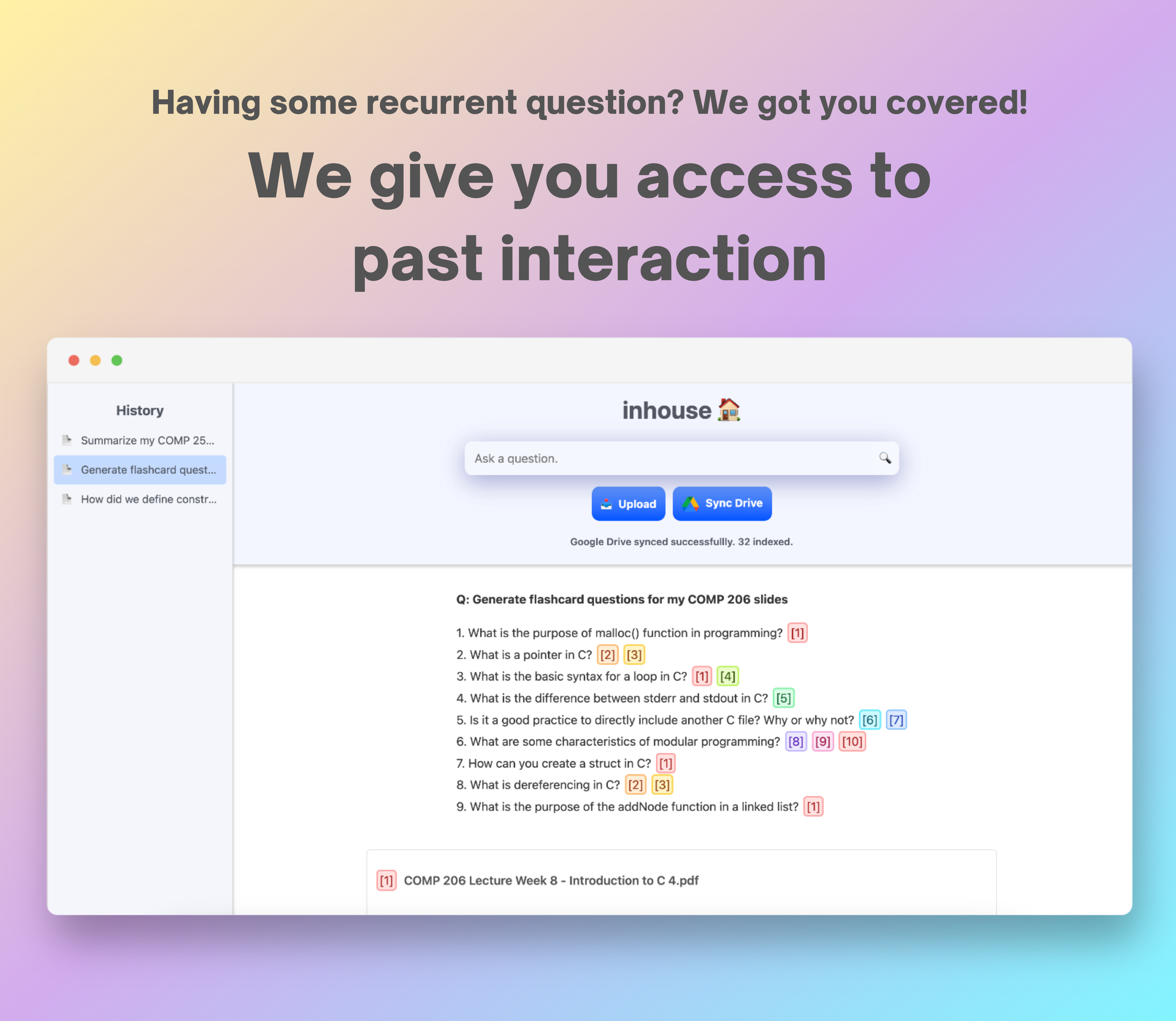
- Generate flashcards questions from my history class notes.
- Can you suggest improvements to make to my resume?
Those are all examples of questions you can ask our app!
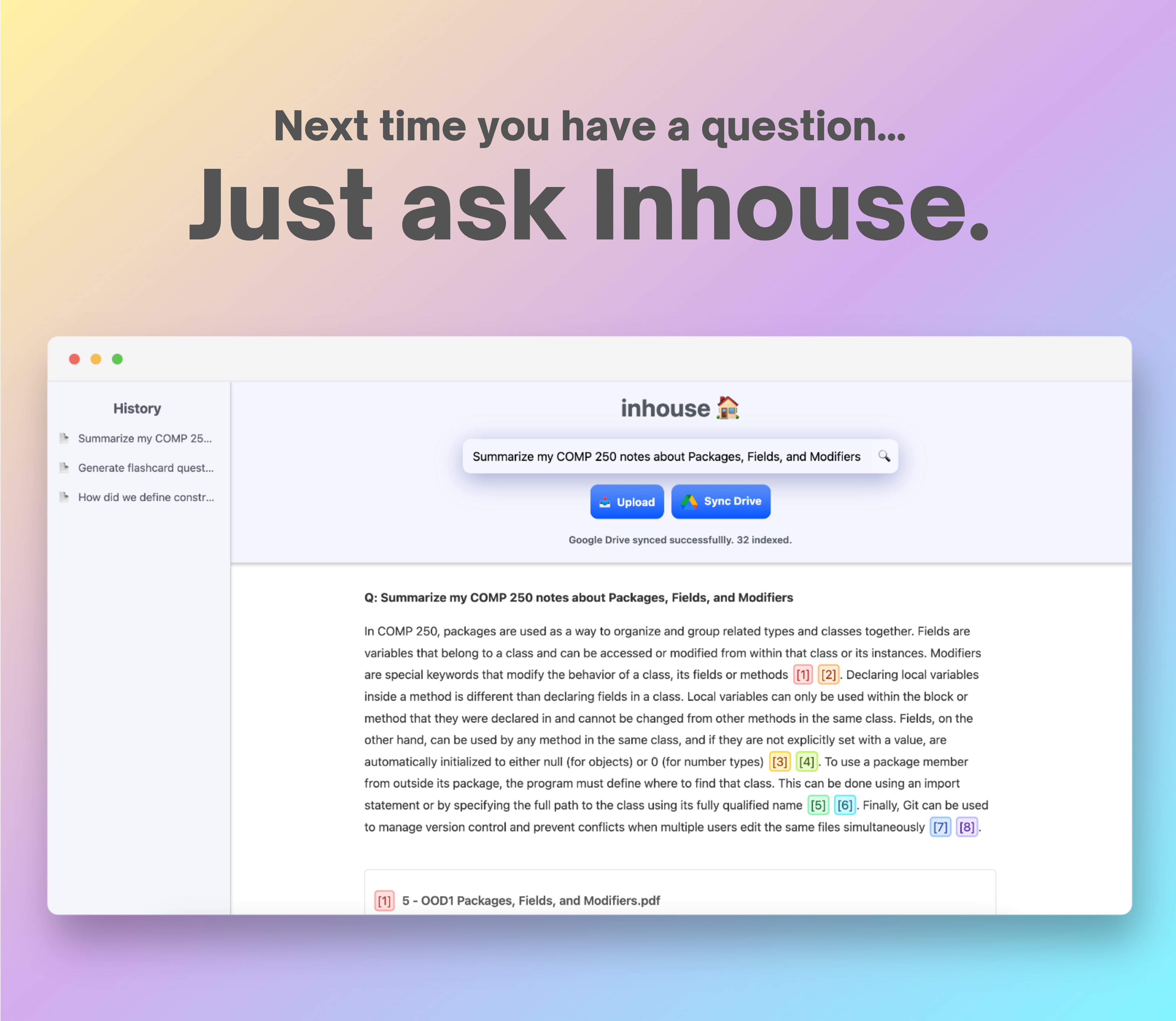
Inhouse is a user-friendly and intuitive document assistant that helps you improve your productivity. Inhouse integrates seamlessly with your Google Drive, allowing you to ask questions about your documents using natural language. It answers your questions effortlessly and provides sources from your documents, making knowledge retrieval a breeze.
So, whether you're a student tackling assignments, a professional managing projects, or simply striving to make the most of your day-to-day tasks, Inhouse is your ultimate productivity companion. Embrace a new era of human-file interaction, where intelligence and efficiency converge to make you more productive!
How we built it
Inhouse was meticulously crafted to deliver a seamless user experience. We integrated a user-friendly Svelte frontend with a robust Flask API, creating a reliable and efficient platform. The addition of MongoDB ensures secure storage for authentication details, conversational histories, and user documents.
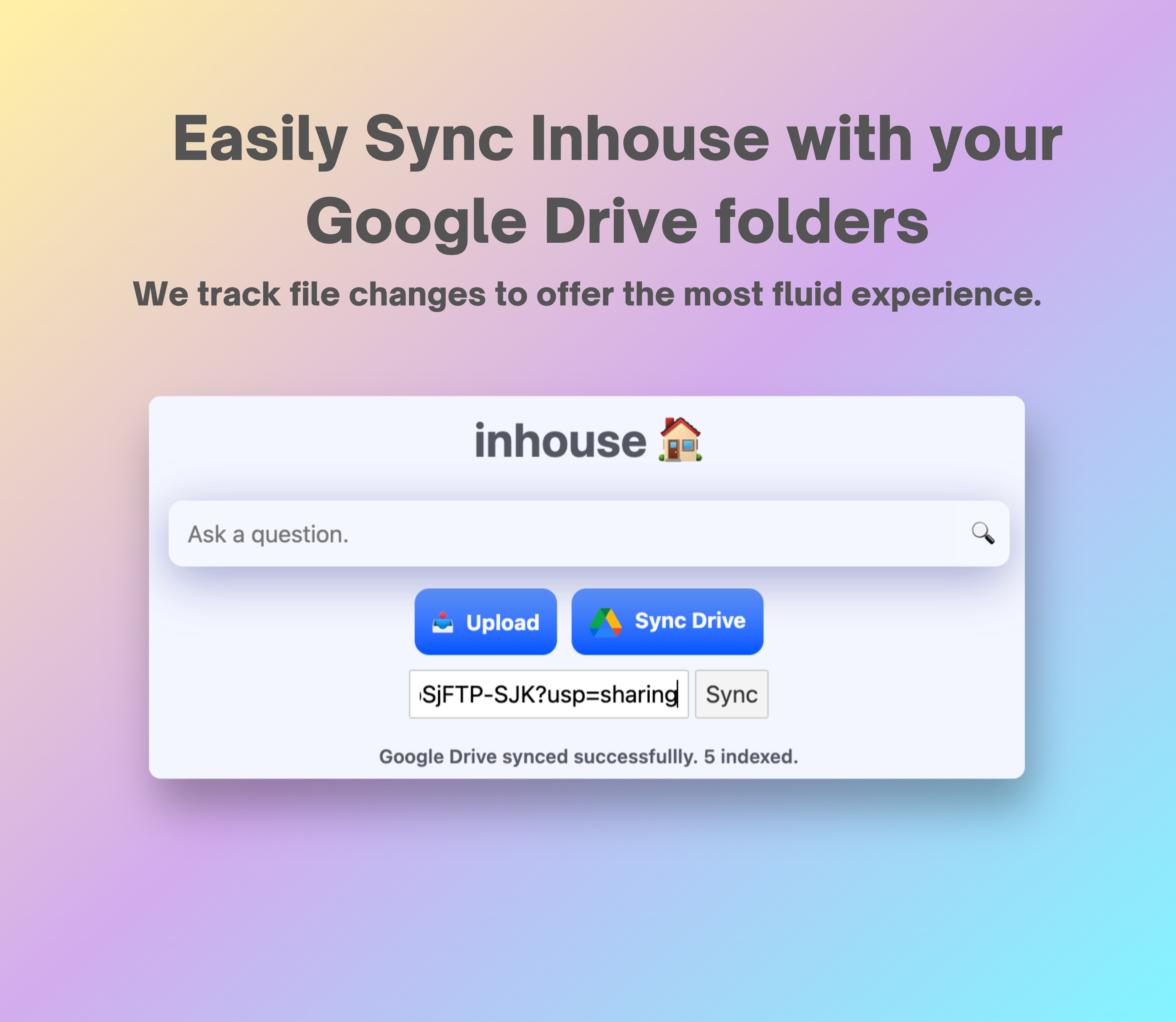
Inhouse is integrated with the Google Drive API, allowing seamless synchronization of the user's files in our database. This integration ensures that your documents and data are always up-to-date and readily accessible within the app.
To enhance performance, we implemented concurrent programming for faster and more efficient file uploads. And to achieve an impressive level of conversational intelligence, we leveraged OpenAI's gpt-3.5-turbo model, carefully trained with selected prompts and contextualized with past conversations.
Challenges we ran into
Developing Inhouse came with its fair share of challenges since we almost exclusively worked with technology we've never used before. One of the main challenges we faced was to deliver the best possible user experience while providing the best possible quality answers. Setting the boundaries between these two aspects was a big dilemma at first. To tackle this challenge, we came up with a multi-staged backend process that utilizes multiple models to process data and extract useful information in an efficient manner.
Accomplishments that we're proud of
We're proud to have created a visually appealing product that (we believe) can add significant value to people's lives. We've also learned a lot along the way!
What we learned
We learned to use various frameworks such as Google Cloud, MongoDB, OpenAI API, etc... It was the first time we'd launched a complete application from A to Z, right through to deployment!
Note: The application may take a while to work the first time (depending on the number of files uploaded)! This is because it generates embeddings for all your documents at the same time as you perform your first search.
Built With
- flask
- google-cloud
- modal
- mongodb
- openai
- python
- railway
- svelte


Log in or sign up for Devpost to join the conversation.