-
-
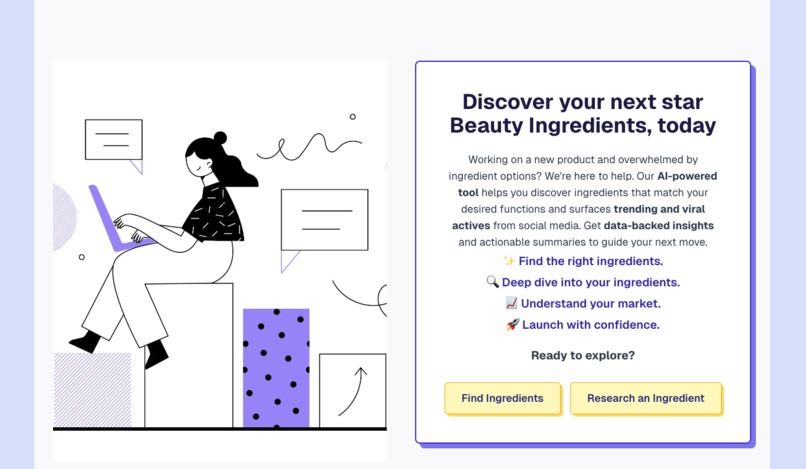
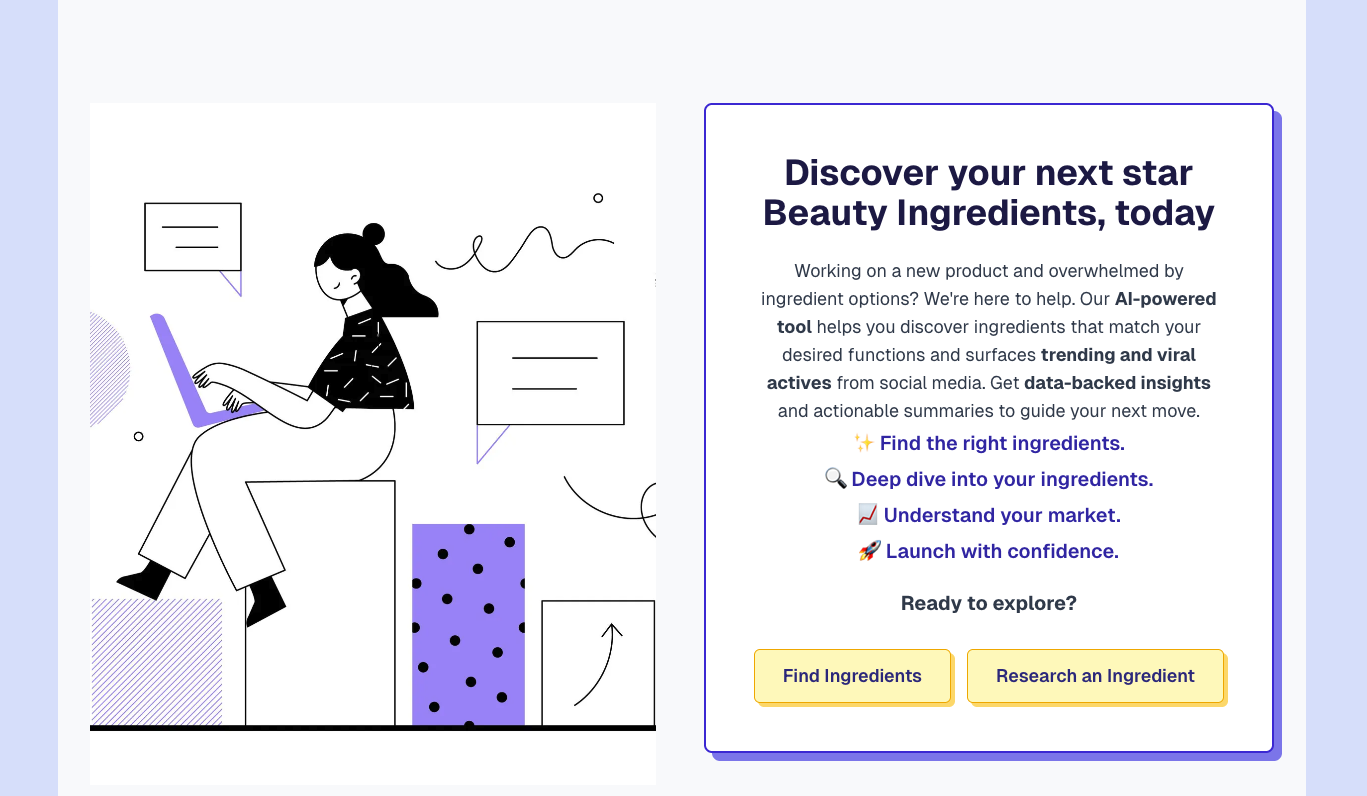
Homepage
-
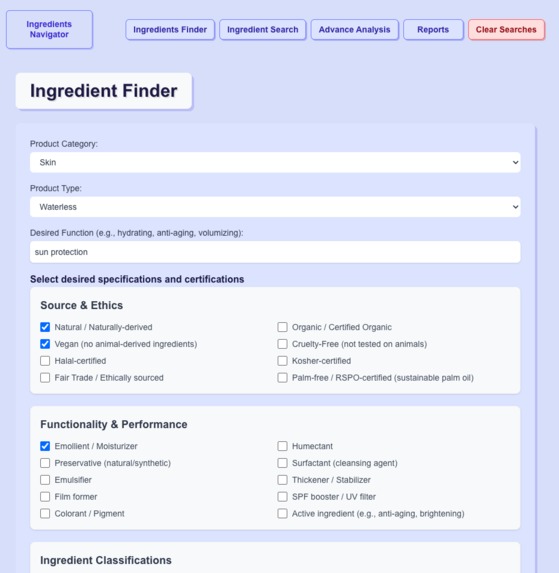
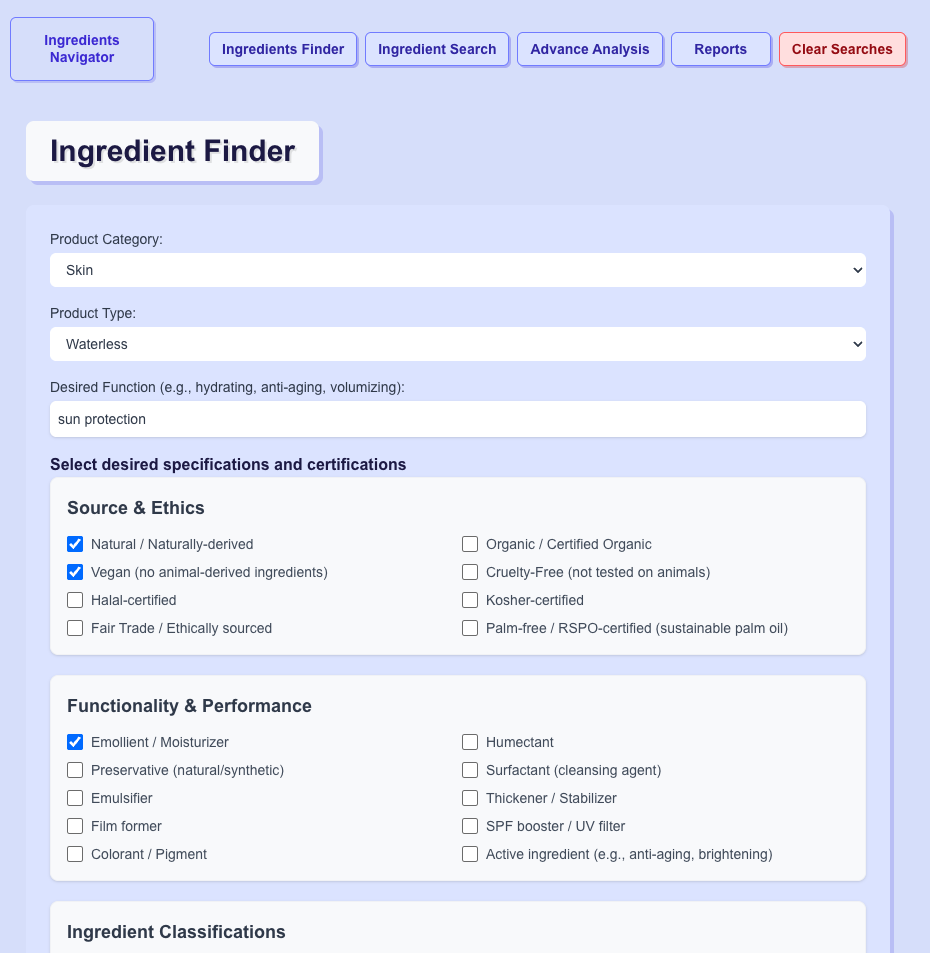
Ingredient finder form
-
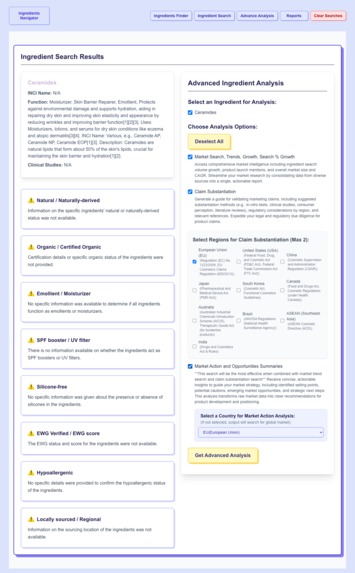
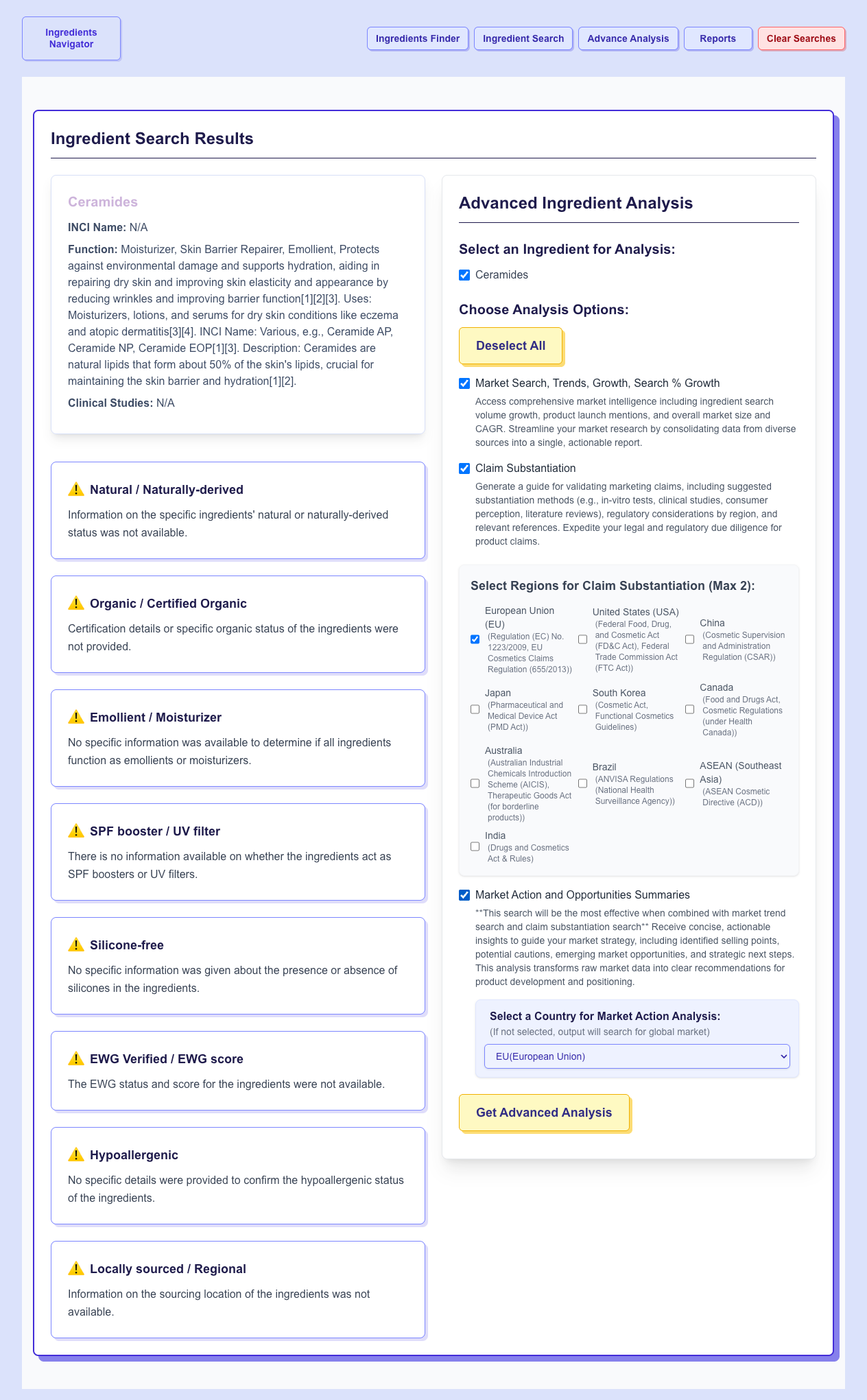
Ingredient report + analysis options page
-
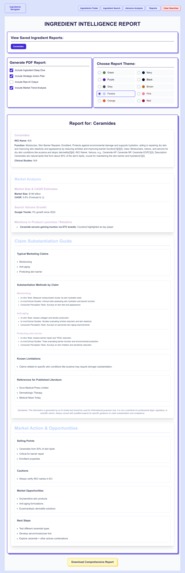
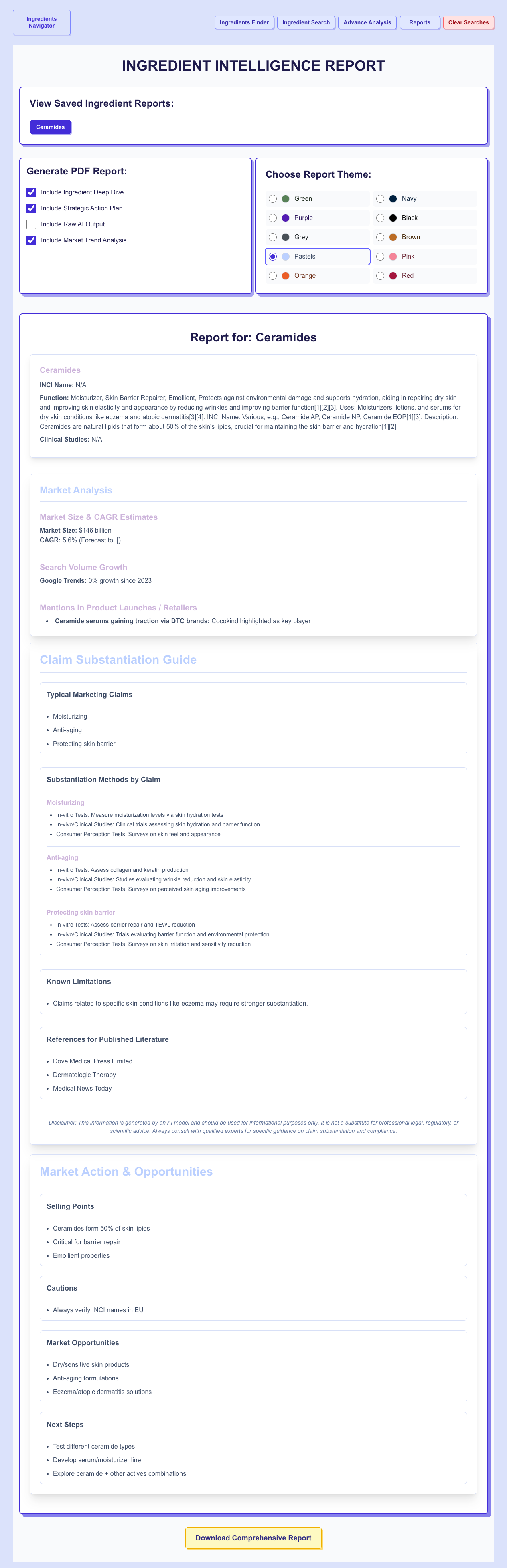
Report page
My Inspiration: Solving the Beauty Industry's Data Gap
Working with beauty brands, I've identified a significant pain point: the critical absence of accessible, reliable resources for researching cosmetic ingredients. Small and niche businesses, despite their growing influence, struggle to uncover essential data on ingredient performance, market trends, claim substantiation, and regulations. Valuable statistics are often paywalled or simply unknown, creating a major hurdle for product development. Ingredients databases are also often gated by memberships.
This insight has inspired me to create Ingredient Navigator. My vision was to create an AI-powered, guided platform that demystifies ingredient research. Leveraging advanced AI, it surfaces everything from viral actives to market opportunities, providing comprehensive, actionable intelligence. Ingredient Navigator empowers beauty brands of all sizes to bypass traditional barriers, make data-driven decisions, and confidently bring innovative products to market.
What it does
- Guided ingredient finder - Guide users to find ingredients matching their desired function, brand story, certifications, and other requirements such as vegan, cruelty-free.
-Guided ingredient deep dive - Guide user to discover more about an ingredient they are looking for, whether it's certified, vegan, or what kind of ingredient function is it.
Deep Dive Analysis
- Market Trends & Growth: Uncover search volume growth, product launch mentions, market size, and CAGR.
- Claim Substantiation: Generate guides for validating marketing claims, including recommended methods, regulatory considerations by region, and relevant references.
- Market Action & Opportunities: Receive actionable insights, identified selling points, potential cautions, and strategic next steps, enhanced by integrated market trend and claim substantiation data.
- Comprehensive Reporting: View and download detailed reports for each analyzed ingredient.
- Customizable PDF Reports: Generate professional PDF reports with selected sections and themes.
How we built it
Application: Javascript, NextJS, TailwindCSS, OpenAI, Perplexity AI
The brain of the application is powered by Perplexity AI. Our backend API routes communicate directly with Perplexity's SONAR and SONAR-Reasoning models via the OpenAI client library.
Challenges we ran into
One of the challenges I ran into was structuring and creating JSON schemas for the structured AI's responses. which was important because I wanted to present the generated ingredient data to the user in a meaningful and digestible format on the frontend, I had to ensure the AI's output was a predictable structure. This involved a lot of documentation review, a lot of questions to the AI chatbots for guidance, and trial and error. Ultimately I was able to produced JSON schema for all AI responses.
Secondly, managing the variability in AI response length and detail proved challenging; some responses were significantly more detailed than others just from information available, and the extra filtered option that I offer, that can make the query much more complex. Through trial and error, I refined the max_tokens settings and crafted prompts to be as precise as possible. While this approach enabled a functional prototype, I'm eager to explore methods in the future that allow for more detailed and statistical information.
This project also marked my first time integrating an AI API into a web application, which presented a steep but rewarding learning curve. It quickly became apparent how crucial data cleaning is, and the absolute necessity of defining exactly what information is desired from the AI. The process underscored that prompt engineering demands extreme precision and clarity to achieve reliable and relevant outputs.
Finally, my last challenge was with the report generation time. The current process can be quite lengthy, leading to a long loading period for the user. A key area for future improvement will be optimizing this speed or implementing a more engaging intermediate experience to prevent users from simply staring at a loading screen.
Accomplishments that we're proud of
I'm incredibly proud of the rapid development and core functionalities I was able to implemented for this prototype, especially considering I only discovered the hackathon a week ago through a friend's recommendation of Perplexity AI as a research tool. To have successfully built out all the essential features that I sat out to do in such a short timeframe is a significant achievement.
My most proud feature is that I implemented a two-layer AI prompting system: one layer for initial ingredient search, and a second for intelligently searching and validating filters on top of that. Secondly, the Market Action and Opportunities Summary feature. This analysis truly shines because it waits, and take in information from claim substantiation search and market trend research as well as the ingredient information into one prompt and generate a market action and opportunities report.
Beyond the technical execution, I'm most proud of this project's potential to empower users with access to crucial ingredient data. Ingredient Navigator could change how individuals who aren't chemists or directly affiliated with large chemical companies can access and understand ingredient information. The reference feature of Perplexity AI is invaluable, because it allow users to trace information back to its source, especially with information from scientific papers that might otherwise remain inaccessible to the broader public. This direct access to verifiable scientific insights is a core part of what makes Ingredient Navigator so impactful.
What we learned
This project gave ma an opportunity to work with Large Language Models (LLMs), significantly enhancing my understanding of their capabilities and the importance of data cleaning necessary for effective AI integration. Furthermore, I gained extensive insights into workflow design, particularly how to intuitively guide users towards their goals and optimize complex AI prompt flows for consistent and meaningful outputs.
Beyond the technical skills, the experience was a masterclass in working under intense time pressure. It also sharpened my focus on adding tangible value. Initially, the application was a simple ingredient finder, but I quickly realized generic AI chatbots could do the same thing. This prompted me to push beyond raw data retrieval, learning to process and contextualize information to deliver deeper, actionable insights. Successfully managing the project's scope was another key lesson; after an exponential growth in ideas during the first three days, I learned the importance of disciplined planning and adhering to a defined feature list to meet the deadline.
What's next for Ingredients Navigator
I fully intend to continue working on this application into creating a reliable tools for the beauty and personal care industry, and in the future I'd work to do the following:
- Enhanced AI Reliability: Continue refining AI prompts and data sourcing to ensure information is consistently from highly reliable and authoritative sources.
- Chemical Database Integration: Explore connections to external chemical databases for accessing trade names, detailed clinical study data, and deeper scientific insights.
- Advanced Regulatory Guidance: Expand regulatory search capabilities and provide more structured, guided workflows for navigating complex compliance processes in product development.
- Additional Guiding Workflows: Implement more interactive and guiding elements to simplify intricate aspects of product development, making the process more intuitive for users.
Built With
- javascript
- nextjs
- openai
- perplexityai
- react
- tailwindcss

Log in or sign up for Devpost to join the conversation.