-
-
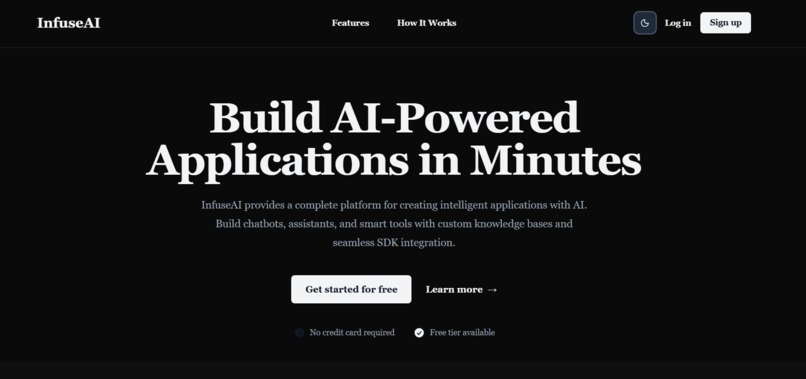
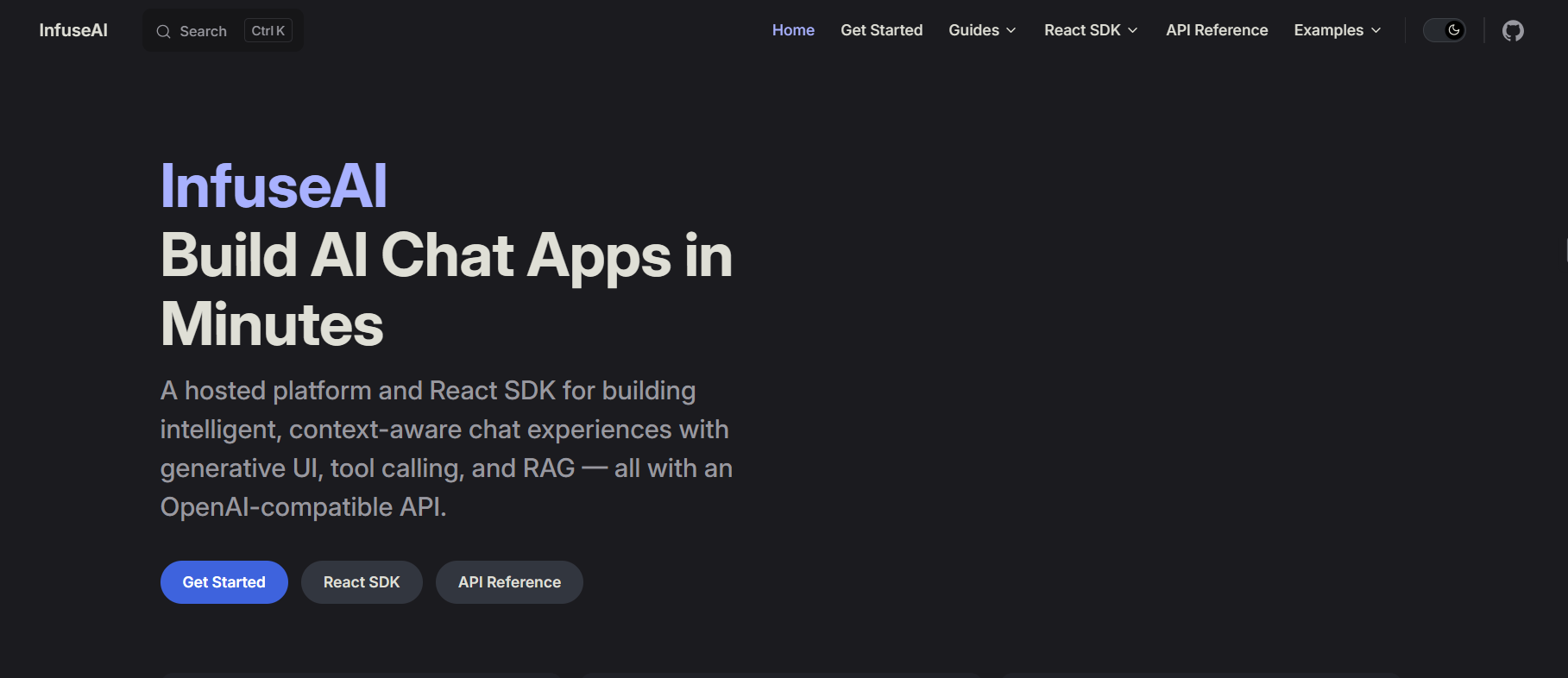
Landing Page
-

Authentication/Login/Signup Page
-

Dashboard Page
-
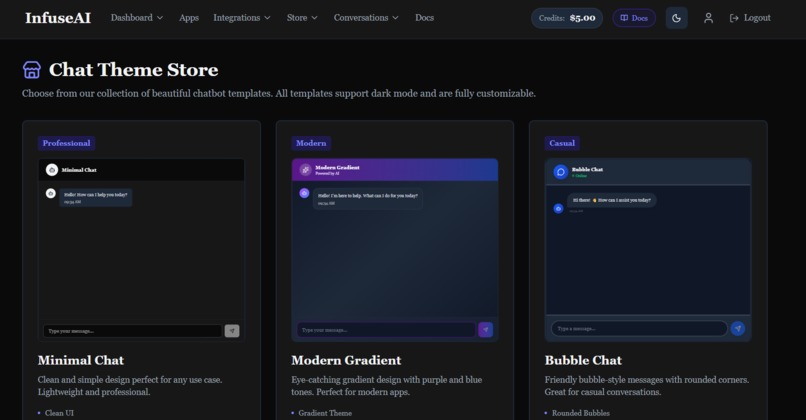
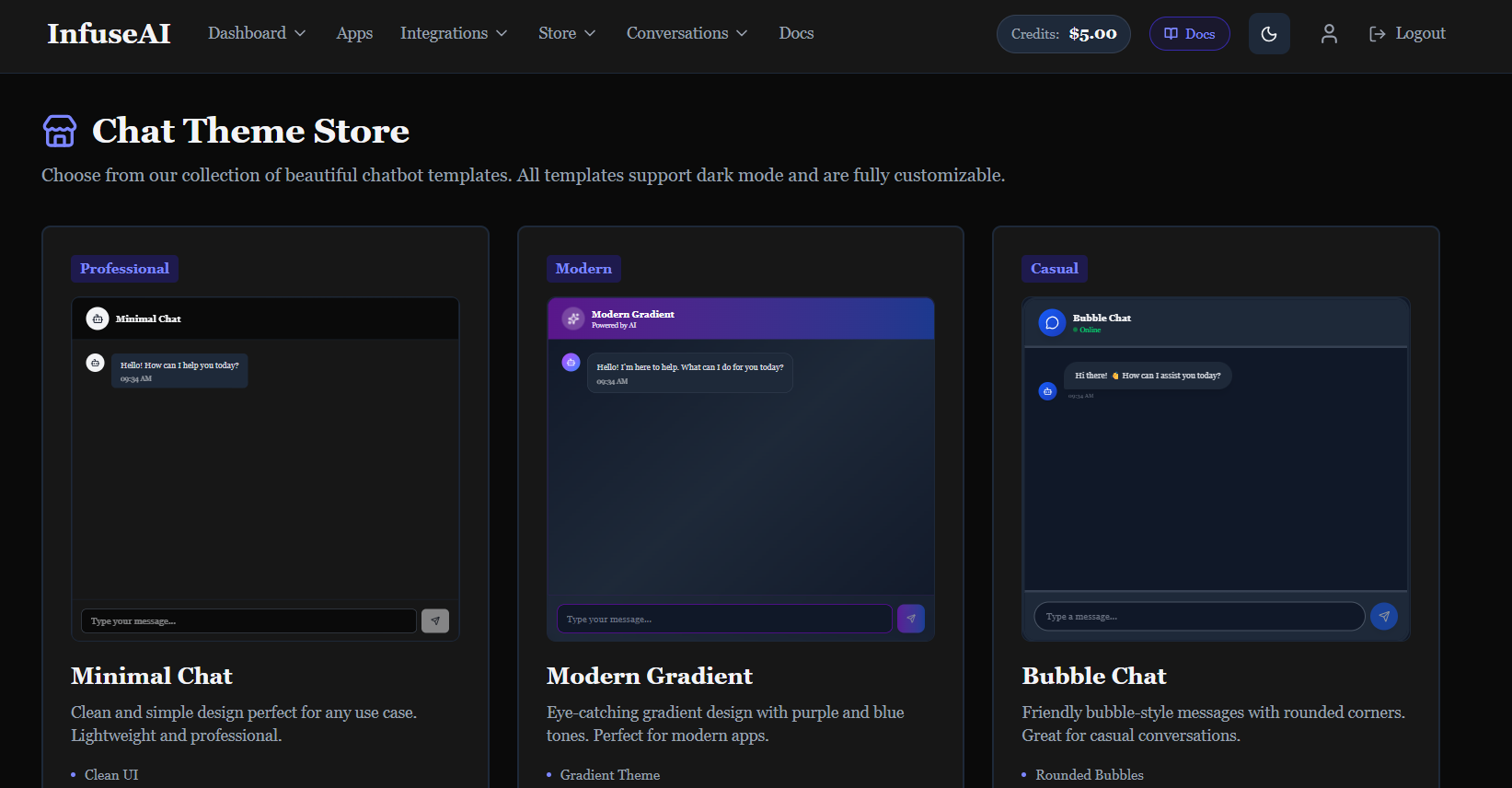
ChatThemeStore
-
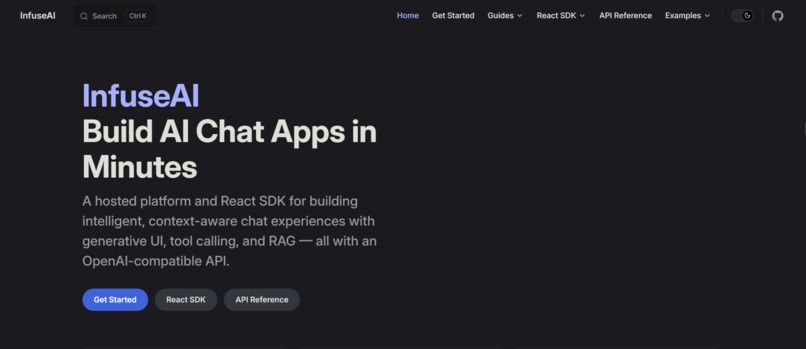
Documentation
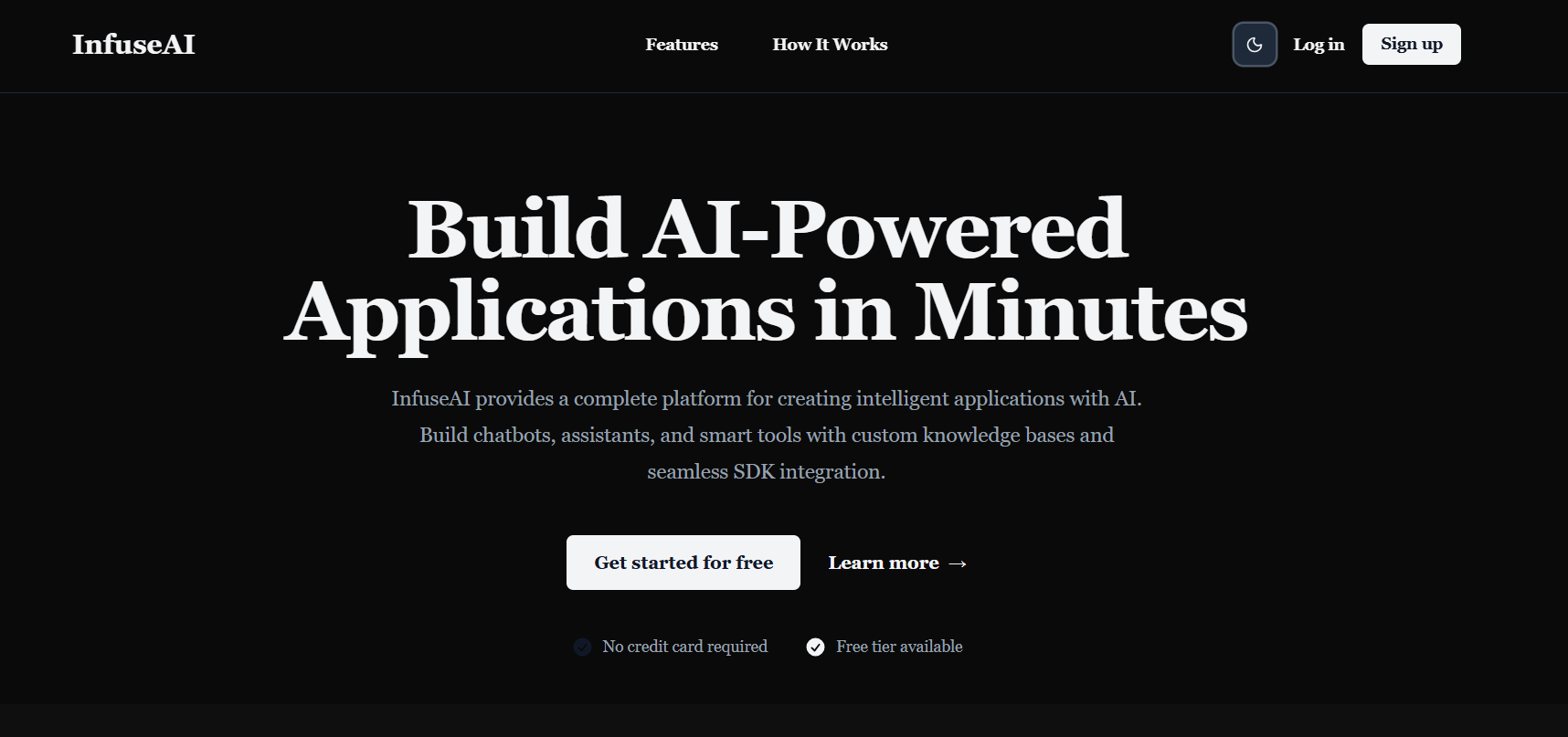


Inspiration
As AI adoption grows, many teams want to build AI assistants on top of their own knowledge bases such as documents, policies, research papers, and internal documentation. However, building such systems usually requires significant infrastructure work: vector databases, embeddings pipelines, LLM orchestration, and backend APIs.
While exploring Retrieval-Augmented Generation (RAG), I realized that most developers struggle not with AI models themselves, but with the complexity of building reliable production systems around them.
InfuseAI was created to simplify this process. The goal was to build a platform where developers can turn their knowledge bases into AI-powered applications without worrying about infrastructure.
What it does
InfuseAI is a production-ready platform for building and deploying custom AI applications powered by private knowledge bases.
The platform allows developers to:
- Upload documents (PDF, Markdown, Text)
- Automatically convert them into embeddings
- Store them in a vector database
- Retrieve relevant knowledge using semantic search
- Generate grounded responses using LLMs
- Deploy embeddable AI chat assistants
InfuseAI also provides a developer-friendly SDK and management dashboard to create, manage, and deploy AI apps with minimal setup.
How we built it
InfuseAI was built as a full-stack AI platform combining modern web technologies with scalable AI infrastructure.
Frontend
- Next.js 16
- React 19
- Tailwind CSS
- Framer Motion for UI interactions
Backend
- Next.js API routes
- MongoDB for application data and analytics
- Firebase for authentication and storage
AI Infrastructure
- Pinecone as the vector database
- Gemini for generating embeddings
- Groq and Together AI for LLM inference
Workflow Automation
- Kestra for orchestrating analytics pipelines and background tasks
Developer Experience
- A TypeScript SDK that allows developers to query AI applications and embed chat widgets directly into their websites.
The system uses a Retrieval-Augmented Generation (RAG) pipeline where documents are chunked, embedded, stored in Pinecone, and retrieved during queries to generate context-aware responses.
Challenges we ran into
One of the biggest challenges was designing a reliable and efficient RAG pipeline. Proper document chunking, embedding quality, and retrieval accuracy significantly affect the quality of responses.
Another challenge was integrating multiple AI providers while maintaining a clean abstraction layer so the system could switch models without breaking the application logic.
Handling different document formats such as PDFs, Markdown files, and plain text also required building a robust ingestion pipeline.
Additionally, designing a platform that is both powerful and simple for developers to use required careful API and SDK design.
Accomplishments that we're proud of
- Successfully built a production-ready RAG platform that developers can use immediately.
- Designed a full dashboard system for managing AI applications and knowledge bases.
- Created a developer-friendly SDK that simplifies AI integration.
- Implemented multiple chatbot UI templates for easy embedding into applications.
- Built a scalable architecture that supports multiple AI providers and vector databases.
- Integrated modern AI development tools like Cline CLI, Kestra, and CodeRabbit to streamline development.
What we learned
Through building InfuseAI, we gained deeper understanding of:
- Retrieval-Augmented Generation (RAG) systems
- Vector embeddings and semantic search
- Designing scalable AI architectures
- Integrating multiple LLM providers
- Building developer-first AI platforms
- Workflow automation for AI pipelines
We also explored how AI-assisted development tools can significantly accelerate development while improving code quality.
What's next for InfuseAI
The next step for InfuseAI is to expand the platform into a complete AI application infrastructure layer.
Planned improvements include:
- Support for more document formats (CSV, Notion, Google Docs)
- Advanced RAG techniques like hybrid search and reranking
- Fine-tuned domain-specific models
- Multi-tenant enterprise support
- Real-time analytics dashboards
- No-code chatbot builders for non-developers
- Agent-based workflows for complex AI automation
The long-term vision is to make InfuseAI a universal platform where developers can build, deploy, and scale AI applications powered by their own knowledge with minimal effort.
Built With
- ai
- analytics-workflows
- api
- ci/cd
- css
- firebase
- gemini
- groq
- javascript
- kestra
- llm
- metadata)-ai-&-apis-google-gemini-api-(text-embeddings)-groq-api-(llm-inference)-together-ai-api-(alternative-llm-providers)-workflow-automation-kestra-(data-pipelines
- mongodb
- next.js
- node.js
- pinecone
- rag
- react
- scheduled-jobs)-developer-tools-cline-cli-(ai-assisted-development)-coderabbit-(ai-powered-code-reviews)-deployment-&-cloud-vercel-(hosting
- storage
- tailwind
- together
- typescript
- vectordatabase
- vercel

Log in or sign up for Devpost to join the conversation.