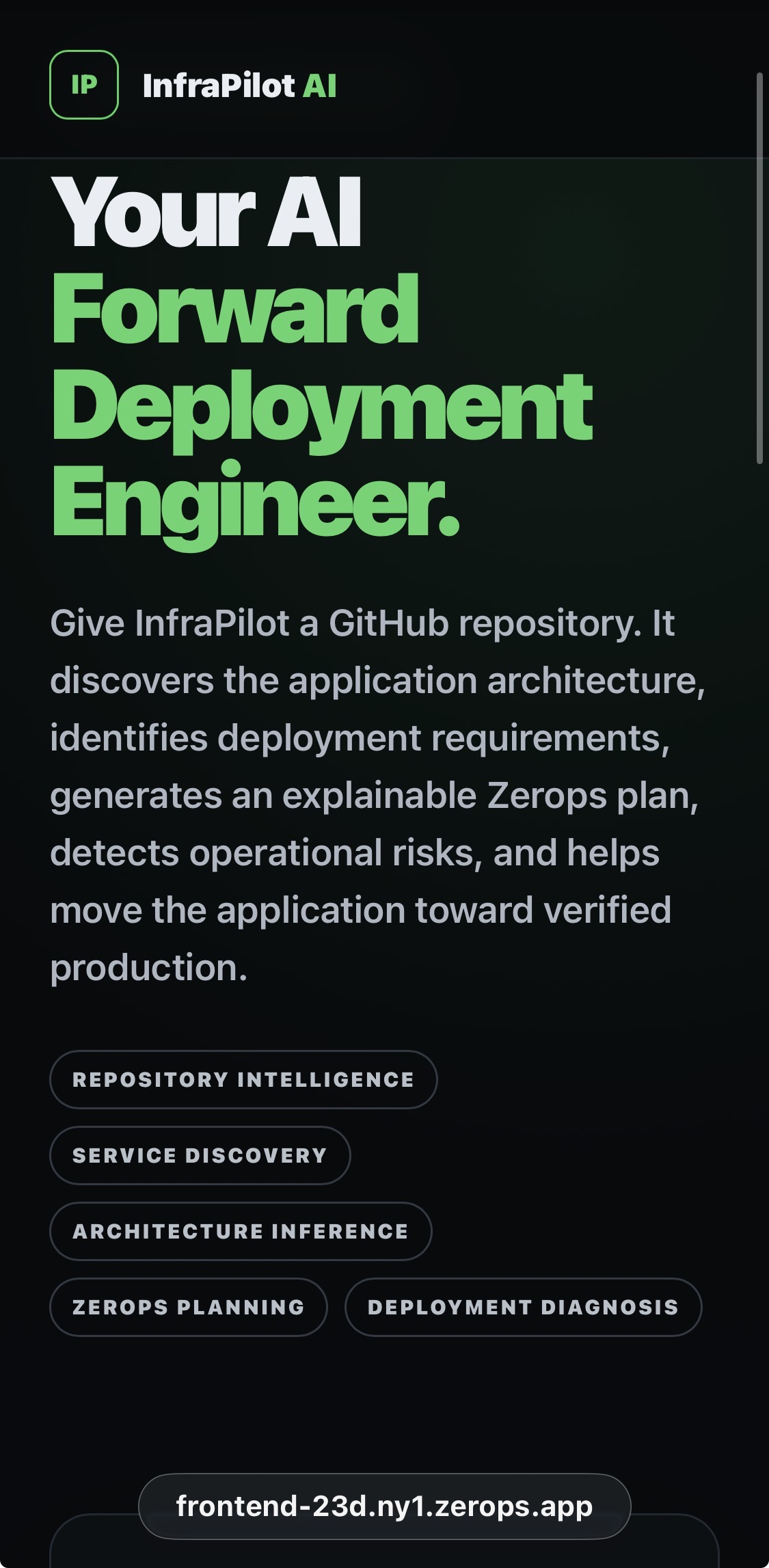
InfraPilot AI — Your AI Forward Deployment Engineer
Inspiration
Deploying an application is often where a great idea turns into a frustrating engineering problem.
A project may work perfectly on a developer’s laptop, but production introduces an entirely different set of challenges: incorrect environment variables, missing dependencies, unhealthy services, database connectivity problems, container configuration issues, readiness checks, and deployment-specific YAML errors.
We built InfraPilot AI around a simple question:
What if every developer had an AI Forward Deployment Engineer that could understand their repository, reason about its architecture, prepare it for deployment, and help diagnose failures?
Instead of forcing developers to manually inspect dozens of files and deployment logs, InfraPilot AI aims to turn deployment into an intelligent, explainable workflow.
The project was especially inspired by the experience of deploying multi-service applications on Zerops. We wanted to go beyond simply generating configuration files and create an AI system that actually understands how the pieces of an application fit together.
⸻
What it does
InfraPilot AI is an AI-powered deployment intelligence platform that acts like a Forward Deployment Engineer for your repository.
A developer provides a GitHub repository, and InfraPilot AI analyzes the project to understand what is required to deploy it successfully.
It can identify components such as:
- Frontend applications
- Backend APIs
- Background workers
- Databases
- Runtime environments
- Dependencies
- Environment variables
- Ports
- Health and readiness endpoints
- Deployment relationships between services
From this information, InfraPilot AI builds an architecture model of the repository and evaluates its deployment readiness.
The platform focuses on several core capabilities:
Repository Intelligence
InfraPilot AI examines repository structure and important configuration files to understand the technologies and services being used.
Architecture Inference
Rather than treating a repository as a collection of unrelated files, InfraPilot AI attempts to determine how the services communicate and depend on one another.
For example:
Frontend → FastAPI API → PostgreSQL
while a separate:
Worker → PostgreSQL
may perform asynchronous processing.
Deployment Readiness Analysis
The system evaluates whether the repository appears ready for production deployment and produces a readiness score.
Potential issues such as missing configuration, environment variables, service definitions, health checks, or deployment requirements can be surfaced before deployment.
Zerops Configuration Assistance
InfraPilot AI can reason about the discovered architecture and help generate or validate deployment configuration such as zerops.yaml.
Deployment Diagnosis
When something fails, InfraPilot AI is designed to help developers understand why instead of leaving them to search through logs blindly.
The goal is not simply:
“Deployment failed.”
It is:
“Here is the likely cause, the affected service, and what you should investigate or change.”
That transforms deployment troubleshooting from trial-and-error into an AI-assisted engineering workflow.
⸻
How we built it
InfraPilot AI uses a multi-service architecture designed to resemble a real production application.
Frontend
We built the user interface using React and Vite, providing developers with a dashboard for repository analysis, architecture insights, deployment readiness, and diagnostics.
API
The backend is powered by Python and FastAPI.
The API coordinates repository analysis, deployment intelligence, readiness evaluation, and communication between the different parts of the system.
AI Intelligence Layer
AI is used to move beyond simple static file detection.
Repository information can be transformed into structured context that allows the system to reason about:
- Application architecture
- Service responsibilities
- Deployment dependencies
- Configuration requirements
- Potential deployment risks
- Recommended fixes
Worker
A dedicated Python worker handles background processing so longer-running repository and deployment analysis does not have to block the main API.
Database
PostgreSQL provides persistent storage for analysis and application data.
Zerops Deployment
We deployed the application as multiple services on Zerops, including:
Frontend → API → Database
alongside a background worker.
The deployment configuration defines service runtimes, build commands, environment variables, networking, and health/readiness behavior.
This made Zerops more than simply the place where InfraPilot AI is hosted—it became an important part of the engineering problem InfraPilot AI was created to solve.
⸻
Challenges we ran into
One of our biggest challenges was inferring architecture from repositories that were never designed to describe themselves explicitly.
A developer understands that one directory contains a frontend, another contains an API, and another process is a worker. An automated system has to infer those relationships from package files, source code, environment variables, ports, framework conventions, and configuration.
Another challenge was translating repository intelligence into useful deployment recommendations.
Detecting that a project uses Python is easy.
Determining that it contains a FastAPI service that should expose a particular port, requires specific environment variables, communicates with PostgreSQL, and needs a readiness endpoint is much more interesting.
Deploying InfraPilot AI itself also surfaced real infrastructure challenges around:
- Multi-service configuration
- Build environments
- Runtime commands
- Service networking
- Environment variables
- Health checks
- Frontend/API communication
- Database connectivity
Those challenges ultimately improved the project because many of the problems we encountered were exactly the problems InfraPilot AI is intended to help other developers solve.
⸻
Accomplishments that we’re proud of
We’re proud that InfraPilot AI evolved beyond a simple “generate my deployment YAML” tool.
The project combines several concepts into one workflow:
Repository Understanding → Architecture Inference → Readiness Analysis → Deployment Configuration → Failure Diagnosis
We are also proud that InfraPilot AI itself uses a realistic distributed architecture rather than existing only as a prototype.
Building and deploying the frontend, FastAPI backend, worker, and database gave us firsthand experience with the exact deployment complexity our product is designed to reduce.
Most importantly, InfraPilot AI demonstrates how AI can participate in infrastructure engineering as a reasoning partner, rather than just a code generator.
⸻
What we learned
Building InfraPilot AI reinforced an important lesson:
Deployment is not just a configuration problem. It is a context problem.
To deploy software intelligently, a system needs to understand the repository, architecture, dependencies, infrastructure requirements, runtime behavior, and potential failure points together.
We also learned that AI infrastructure tools become much more useful when their recommendations are explainable and actionable.
Developers don’t only need an AI system to say:
“Change this configuration.”
They need to understand:
What is wrong? Why does it matter? What should I change?
Working with Zerops also gave us deeper experience with multi-service cloud deployment, service dependencies, environment configuration, health checks, static frontend hosting, Python services, workers, and managed databases.
⸻
What’s next for InfraPilot AI
Our vision is to evolve InfraPilot AI from a deployment assistant into a complete AI Forward Deployment Engineer.
Future versions could continuously observe the entire deployment lifecycle:
Repository → Architecture → Deployment → Runtime → Diagnosis → Optimization
We plan to explore features such as:
- Automatic architecture diagrams
- Deployment log intelligence
- AI-powered root-cause analysis
- Deployment configuration repair
- GitHub integration
- Pull-request deployment reviews
- Infrastructure security checks
- Cost optimization recommendations
- Runtime health monitoring
- Deployment history and comparison
- Automated rollback recommendations
- Multi-cloud deployment intelligence
- Agentic remediation workflows
A particularly exciting direction is self-healing deployment infrastructure.
Instead of stopping at:
“Your API deployment failed.”
InfraPilot AI could eventually reason:
“The API failed because the database connection variable is missing. I found the expected configuration, identified the affected service, and prepared the recommended fix.”
The long-term goal is simple:
Developers should spend more time building products and less time fighting infrastructure.
InfraPilot AI is our first step toward making an intelligent Forward Deployment Engineer available to every developer.
Built With
- ai-agents
- cloud-deployment
- css3
- devops
- fastapi
- generative-ai
- git
- github
- github-api
- html5
- infrastructure-automation
- javascript
- llm
- openai-api
- postgresql
- pydantic
- python
- react
- repository
- rest-api
- sqlalchemy
- uvicorn
- vite
- yaml
- zerops

Log in or sign up for Devpost to join the conversation.