-
-
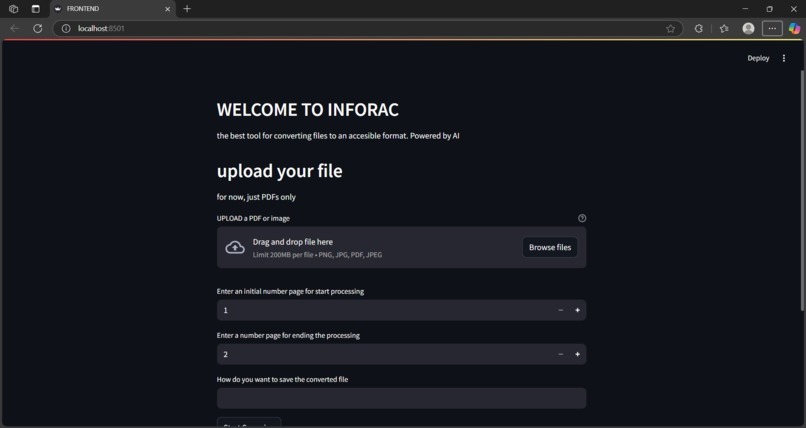
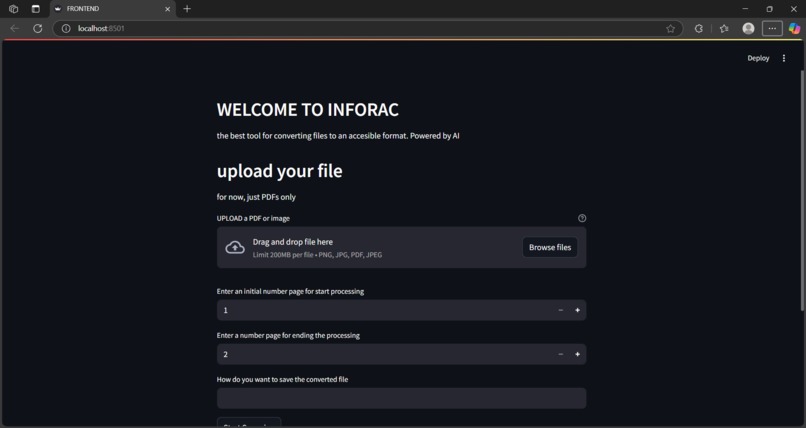
INFORAC Web Interface
Inspiration
Our journey with Inforac began when one of our team members volunteered at a local organization supporting visually impaired students. We witnessed firsthand the profound frustration experienced by a blind engineering student who couldn't access mathematical textbooks because screen readers failed to interpret the formulas. This experience revealed a critical gap in accessibility technology that disproportionately affects people with print disabilities—especially in Spanish-speaking regions where accessible resources are even scarcer.
The urgency became clearer when we learned that less than 10% of published materials worldwide are available in accessible formats—according to the World Intellectual Property Organization (WIPO)—with even fewer in non-English languages. A survey conducted by the National Federation of the Blind found that 67% of PDFs encountered by users with disabilities are partially or completely unreadable, effectively excluding millions from equal access to education and professional opportunities.
What it does
Inforac automatically transforms any document into an accessible version tailored to the user’s needs. It applies international accessibility standards (WCAG) and leverages GPT-4o to restructure complex or poorly scanned documents. Users can customize output settings like font size, contrast, spacing, and language. The result is content that is not only compliant, but truly inclusive and readable, helping bridge the information gap for people with disabilities.
How we built it
We built the web application using Streamlit to provide a simple, intuitive interface. Documents are processed with the PyMuPDF library, which extracts each page as an image. These are then analyzed using GPT-4o Vision, which generates accessible, restructured content based on both WCAG compliance and user preferences. The content is compiled, converted into a downloadable file format, and returned to the user—streamlining what used to be a complex, manual process.
Challenges we ran into
Building Inforac came with several challenges:
- AI generation accuracy: GPT-4o may produce outputs that don’t strictly comply with WCAG standards, requiring additional validation and refinement.
- Mathematical notation: Converting complex equations into screen-reader-compatible formats (like MathML) demanded extensive testing.
- Complex layouts: Multi-column documents, tables, and diagrams posed difficulties in content extraction and restructuring.
- Performance optimization: Processing large files initially caused delays, which we addressed by refining how we handle image extraction and batching.
Accomplishments that we're proud of
We’ve launched a restricted beta program with 10 early users—most of whom are individuals with visual disabilities—and their feedback has been overwhelmingly positive. Several users described the experience as “liberating” and “finally something made for us.” This pilot phase has been invaluable in helping us understand real-world needs, and we’re actively collecting more feedback to shape a tool that truly serves its community. These insights are already informing our development roadmap and setting the foundation to scale Inforac in alignment with our long-term vision: making accessibility the default standard, not a luxury.
What we learned
- Accessibility is layered: Technical standards like WCAG are important, but understanding the real-world experiences of people with disabilities is essential.
- Language matters: Accessibility gaps widen dramatically in languages other than English.
- AI is a powerful ally: With the right guidance, models like GPT-4o can democratize access to information.
- Empowerment over dependence: The best tools give users control, not just charity.
What’s next for Inforac
We’re focused on scaling Inforac into a sustainable and user-centered platform. Our next steps include:
- Integrating direct user feedback: We’ll be adding an in-app feedback input box to expand the beta program and better understand user needs in real time.
- Persistent user preferences: Users will soon be able to save their accessibility settings, allowing GPT-4o to consistently adapt outputs to their personal preferences.
- Cloud scalability: We plan to allocate more cloud computing resources to improve processing speed and reliability as demand grows.
- Sustainable monetization: Once the platform is robust enough to support hundreds of users simultaneously, we’ll introduce a $5/month subscription model to sustain operations while keeping access affordable.
- Long-term mission: Our vision is to expand Inforac’s capabilities beyond visual accessibility, adapting content for users with cognitive and other disabilities. We aim to license the tool to private companies, public institutions, educational centers, and nonprofit organizations committed to inclusion.

Log in or sign up for Devpost to join the conversation.