-
-
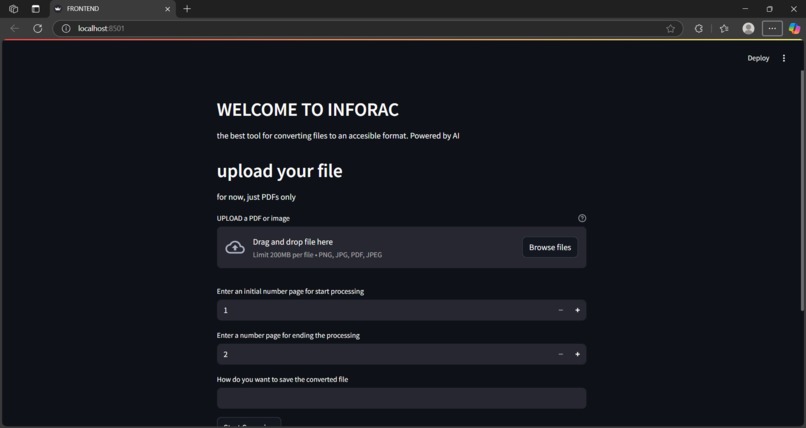
Inforac Web Interface – Users can upload a PDF or image, define a page range, and convert content into an accessible format powered by AI.
Inspiration
I was born with a visual disability. From a very young age in school, I struggled to read books efficiently. I started using a magnifier until it no longer helped. After that, I had to rely on others to read to me — and I paid for that help for nearly five years.
Eventually, I learned how to use tools like OCR and screen readers, which opened access to books and online content. But even with all that, a major problem still remained: most digital documents are not screen-reader compatible because of how they are structured.
To address this, the Web Content Accessibility Guidelines (WCAG) were created — a global standard to ensure digital content is accessible to all. However, according to Google Accessibility and the World Intellectual Property Organization (WIPO), over 90% of the content online today still fails to meet those standards.
This becomes even worse when trying to digitize physical materials. OCR systems can’t fully convert printed content into accessible versions — especially when it comes to describing images or interpreting math or scientific formatting. And in many places, scanning a textbook in a foundation for the blind takes weeks or months, with long waiting lists and classes moving forward without adapted materials.
But with the rise of generative AI, we now have a chance to transform any document — image, text, or even complex scientific content — into an accessible version that meets WCAG standards, within seconds.
Inforac was born out of that opportunity, and out of lived experience.
💡 What it does
Inforac takes any PDF or image-based document and automatically converts it into an accessible version, tailored to a user’s specific disability.
Users can also define personal preferences, such as simplified language, larger font size, specific color contrasts, or structured bullet points. The system then uses AI to reshape the content based on their needs.
Think of it as a “document reshaper” for accessibility — fast, personalized, and inclusive.
How we built it
We built the MVP using the following technologies:
- Python, as the core programming language
- Streamlit, to build the web interface
- PyMuPDF, to extract and process content from PDFs
- Shuttle, to manage file uploads and workflows
- OpenAI GPT-4o API, to transform and adapt content in real time
🚧 Challenges we ran into
- GPT models didn’t always follow instructions accurately; they sometimes overwrote or misrepresented the original content
- GPT lacks deep understanding of WCAG or accessibility compliance
- Extracting clean text from image-based PDFs required multiple trials
- Adding image descriptions (alt-text) proved difficult
- Debugging and optimizing the pipeline to maintain speed while ensuring accuracy
🏆 Accomplishments that we're proud of
- Built a working MVP that converts real-world documents into accessible formats
- Implemented a system where users can input preferences like: “I have retinitis pigmentosa, avoid red-green contrast”
- Built a product rooted in empathy and lived experience, not just tech
- Designed for scalability and integration into schools, NGOs, and public institutions
📚 What we learned
- Accessibility is not a feature — it's a right
- Technology should adapt to the user, not the other way around
- Even small changes in formatting, language, or layout can dramatically improve usability for marginalized users
- Originally, we thought Inforac would only serve people with visual impairments, but we discovered it can help people with a wide range of disabilities — especially in developing countries, where accessible educational materials are rare or non-existent. With Inforac, these materials can be generated in seconds, in any language, and adapted to individual needs.
🚀 What's next for Inforac
- Strengthen website security with user authentication
- Build a system to manage user profiles and preferences at scale
- Deploy the official version of the platform at inforac.com
- Gather feedback from early users and expand features based on their needs
- Train the language model to better understand accessibility standards
- Present Inforac to NGOs, universities, and schools for institutional adoption
Built With
- openai
- python
- streamlit


Log in or sign up for Devpost to join the conversation.