-
-
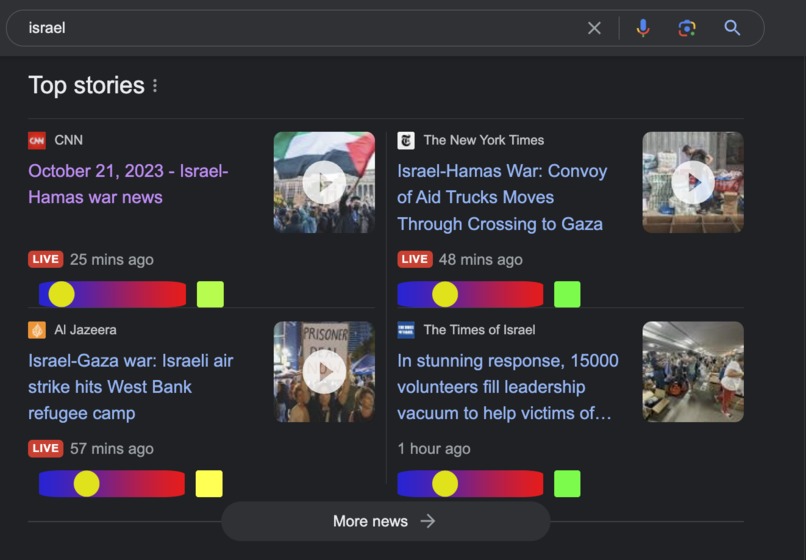
Users can gauge news sources through the extension
Inspiration
While driving up to HackHarvard, we discussed how media bias and fake news affect views on divisive current events. Especially recently, with multiple conflicting stories, it was hard to tell what was true and blatantly false. We aim to provide readers with informed insight into what they're reading by giving the user preemptive information and background on the source, where it leans politically, and it's reliability.
What it does
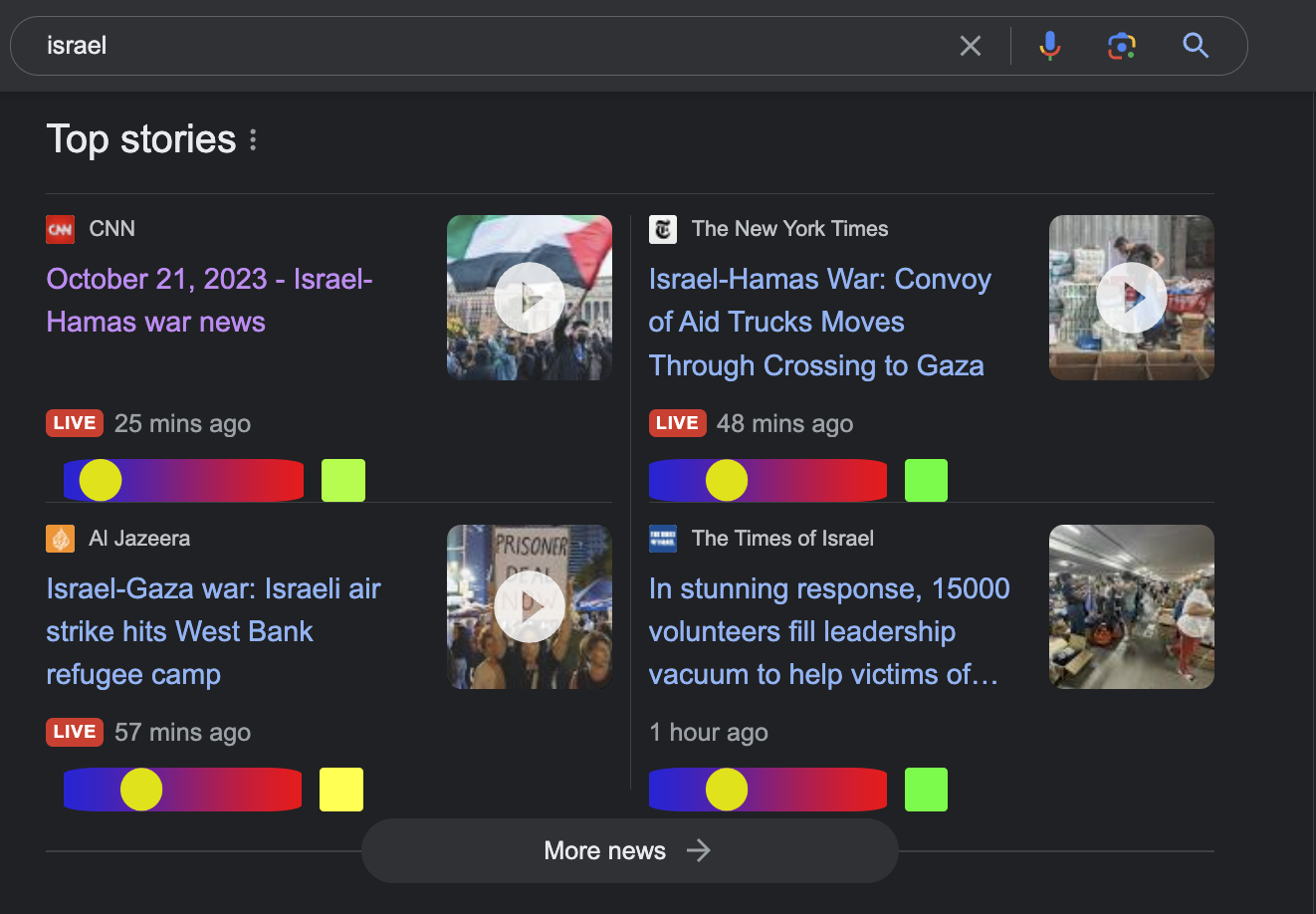
The extension app scans the page that a user is looking at and searches for URL links that a user could potentially click on. If the link contains a news source, it provides a bar and a color: the bar represents where the source leans on the political scale (blue for left and red for right). Meanwhile, the color grade represents the reliability of the score (with red being the lowest and green (with a tinge of blue) being the highest). The user can also click on these resources to open up text, which provides insight into the given ratings and a brief description of the source.
How we built it
The 'dataset_creation' portion of the project focuses on the web scraping of data from mediabiasfactcheck.com, combined with the list of US news domains, to create an aggregate JSON file containing the information we need for quick information retrieval. This information is then stored within the extension, which scans the current page for links. If the extension finds a match with a link, it inserts the desired resources to display to the user.
We utilized bs4 for web scraping. We utilized HTML, CSS, and JS to develop the extension.
Challenges we ran into
Something difficult to manage was choosing data to pull from, in terms of providing the user with data. Eventually, we chose a relatively reliable source to measure news sites' bias and reliability and decided to take the time to scrape through it and build up data to work with for this problem. In this way, by having data to interact with we can develop our app and build around the concept without having to worry as much about the optimization of measuring bias and reliability accuracy.
Accomplishments that we're proud of
We're proud of the intuitive interface we've developed for our extension and the way in which we've built around our concept. By providing simple images for users to quickly understand the sources they're looking at, they can steer clear of sources (or go in with a skeptical mindset) of more dubious sources, or understand more about the political perspective from which an article is written. It's integrated well into the user interface, without adding too much clutter and giving the informed insight needed.
What we learned
We learned methods of web scraping data, as well as how to weave an extension app into the user browsing interface. In this hackathon, we've developed a scripting extension, which gathers information and inserts/deletes content in order to enhance the user experience. We learned about the HTML document model and how to interact with it through JavaScript.
What's next for InfoInsight: Navigate News with Confidence
Going forward, we would want to move away from a model that relies on a single source of expert advice to filter our data. Part of the reason why misinformation occurs is not only because of malicious actors but also as a result of mistakes by those considered authority sources. At the beginning of the project, we looked into developing models to understand the reliability of a website, through language and sources utilized, and possibly developing a more algorithmically complex model to understand factors, such as bias and reliability of a source.


Log in or sign up for Devpost to join the conversation.