Inspiration
Measuring how the value of goods changes in an economy is a central component to understanding current and future economic conditions. Inflationary pressures, which influence the value of assets over time, are a source of uncertainty for consumers and businesses. Statistical agencies have relied so far on a multitude of methods to understand the dynamics of growth and inflation. We would like to explore an alternative way of forecasting inflation using a Long Short-Term Memory (LSTM) model. Using deep learning techniques can provide additional features that traditional econometric modeling may fail to capture. To this day, Long Short-Term Memory (LSTM) models have proven to be particularly effective in machine learning problems involving pattern recognition in long sequences of data.
What it does
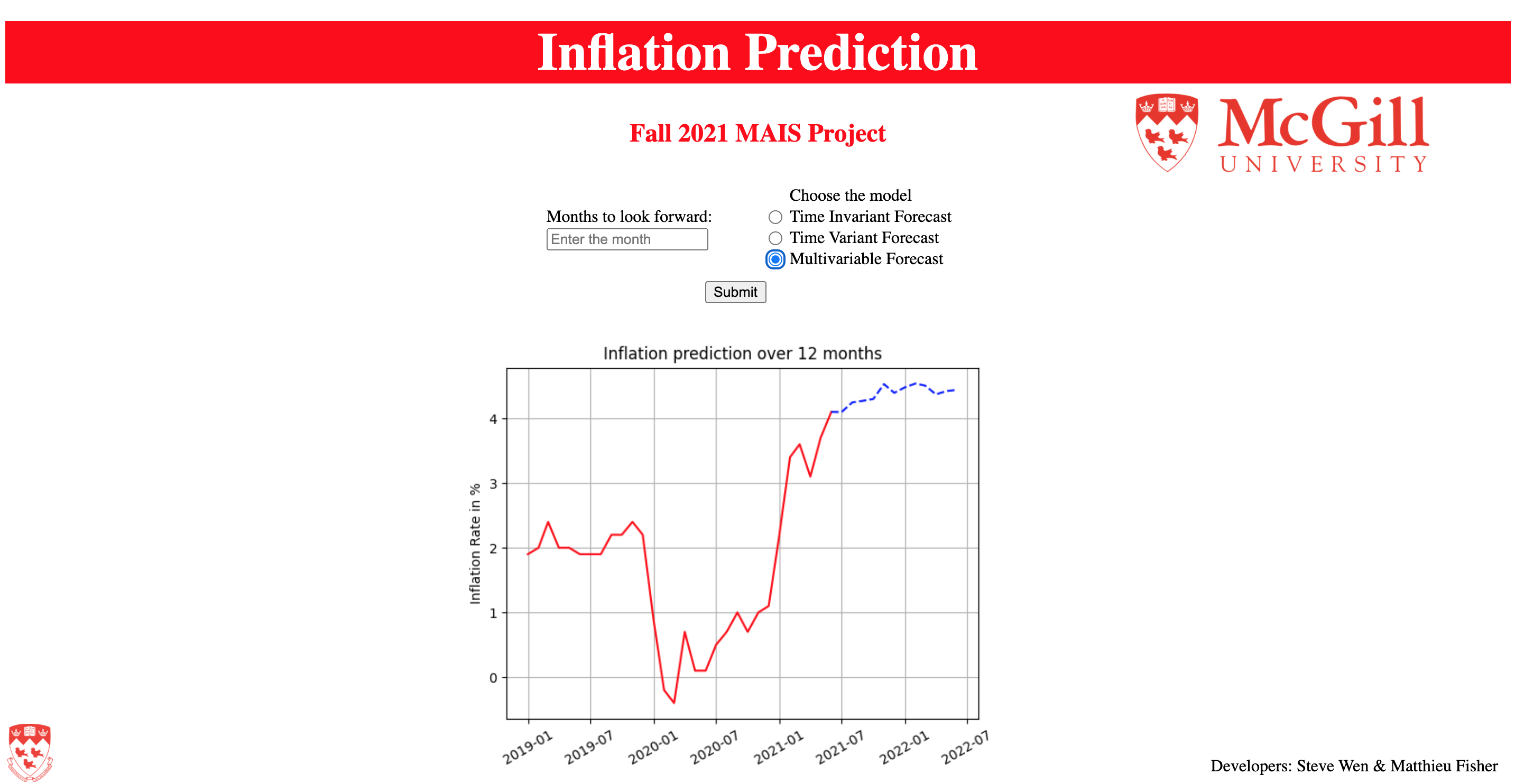
Our model is to forecast the inflation rate of Canada based on several general assumptions of economics.
How we built it
We began this project by preprocessing the data. This includes standardization of the data and the random shuffle specifically for the time-invariant model. We next train the LSTM model by tuning on different hyperparameters and then apply the K-fold validation. After more research, two other models, time-variant and multivariate are deployed to get a deeper understanding of the inflation phenomena.
Challenges we ran into
It is more sophisticated to implement the multivariate LTSM model than we expected. Much work was put into it to get it run.
Accomplishments that we're proud of
Built a WebSite that is accessible by all.
What's next for Inflation Prediction
The multivariate model departs from what is actually happening in the real world a lot. However, it should be more consistent with the real case scenario than the CPI-based model. More work needs to be done on that


Log in or sign up for Devpost to join the conversation.