

Inspiration
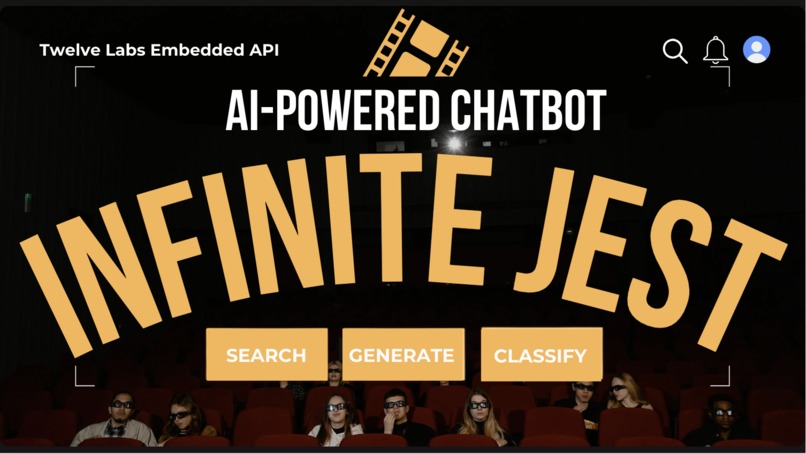
The inspiration behind Infinite Jest stemmed from the desire to enhance user interaction with video content through advanced AI technologies. With the growing volume of video data, it has become increasingly difficult to extract meaningful information quickly and efficiently. By leveraging Retrieval-Augmented Generation (RAG) and advanced video understanding capabilities from Twelve Labs, we aimed to create an engaging and informative Q&A chatbot that provides users with precise and relevant answers to their queries about movie and TV show trailers.
Business Case
- Market Size: The global video streaming market size was valued at USD 50.11 billion in 2020 and is expected to grow at a compound annual growth rate (CAGR) of 21.0% from 2021 to 2028 .
- User Engagement: Video content generates 1200% more shares than text and images combined .
- Revenue Potential: Businesses leveraging video content for marketing see 49% faster growth in revenue compared to non-video users .
- Operational Efficiency: Implementing AI-driven video analysis tools can reduce manual content tagging and analysis time by up to 80%, leading to significant cost savings and increased productivity .
Social Case
- Accessibility: Over 85% of internet users in the United States watch video content monthly, highlighting the need for accessible and efficient ways to interact with video content .
- Information Overload: With YouTube users alone uploading 500 hours of video per minute, there's a critical need for tools that help users find relevant information quickly .
- User Satisfaction: AI-powered tools like RAG chatbots can enhance user satisfaction by providing quick, relevant, and engaging responses, improving overall user experience and retention .
- Educational Impact: Enhancing video content interaction can significantly benefit educational platforms, allowing students to extract key information from lectures and tutorials efficiently, fostering a better learning experience .
By addressing these business and social cases, "Infinite Jest" not only provides a solution for efficient video content interaction but also demonstrates the significant impact AI-driven technologies can have on various aspects of society and industry.
What it does
Infinite Jest is an advanced AI-powered chatbot specifically designed to enhance user interaction with a library of movie and TV show trailers. Here’s a detailed breakdown of its functionalities:
Video Embeddings Creation:
- The chatbot leverages the Twelve Labs Embed API to generate embeddings for each trailer in the library. These embeddings are rich, multidimensional representations of the video content, capturing visual, audio, and textual elements.
Storage in Vector Database:
- The generated embeddings are stored in a vector database, which is optimized for efficient retrieval. This database allows the system to quickly find and retrieve relevant video segments based on user queries.
Natural Language Processing:
- Users interact with the chatbot through natural language queries. The chatbot is capable of understanding and processing these queries to determine what the user is looking for.
Retrieval-Augmented Generation (RAG):
- When a user asks a question, the RAG mechanism is activated. The chatbot uses the query to search the vector database for the most relevant video snippets.
- The system retrieves the top matching video embeddings that contain the information related to the query.
Response Generation:
- Once the relevant video snippets are retrieved, the chatbot uses a sophisticated language model to generate an accurate and insightful response. The response is based on the context provided by the video embeddings, ensuring relevance and precision.
- For instance, if a user asks, "What is Deadpool's first line in the trailer?" the chatbot will locate the segment of the trailer where Deadpool speaks first and provide the exact line.
- Another example query could be, "Describe the action scenes in the Deadpool & Wolverine trailer." The chatbot would analyze the relevant action scenes and generate a detailed description, highlighting key moments and sequences.
User-Friendly Interface:
- The chatbot is designed with a user-friendly interface that allows for easy navigation and interaction. Users can effortlessly type their questions and receive responses in real-time.
- The interface may also include features such as quick response buttons, video playback options for retrieved snippets, and a summary of related content to enhance user engagement.
Example Use Cases:
Query 1: "What is Deadpool's first line in the trailer?"
- Response: "Deadpool's first line in the trailer is, 'This is what happens when you turn on the wrong movie.'"
Query 2: "Describe the action scenes in the Deadpool & Wolverine trailer."
- Response: "The action scenes in the Deadpool & Wolverine trailer are intense and fast-paced. They include a high-speed chase, a dramatic fight on top of a moving vehicle, and a showdown with explosive stunts. The scenes are characterized by quick cuts, dynamic camera angles, and a mix of hand-to-hand combat and weaponry."
By integrating these advanced AI capabilities, "Infinite Jest" provides users with a powerful tool to interact with video content, making it easier to extract and understand key information from trailers quickly and accurately.
How we built it
Example Implementation for "Deadpool & Wolverine" Trailer: User Query: "What does Deadpool say during the fight scene with Wolverine?"
Enhanced Response Generation Steps:
Curated Dataset: Use a high-quality dataset containing transcripts and scene descriptions from "Deadpool & Wolverine" and similar movies. Fine-Tuning: Fine-tune the language model on this curated dataset to better understand the context and dialogue style of the movie. Contextual Embeddings: Use embeddings that capture the context of the fight scene and the specific dialogue spoken by Deadpool. Detailed Prompts: Create detailed prompts that guide the model to generate responses specific to the fight scene and Deadpool's dialogue. Evaluation and Feedback: Continuously evaluate the generated responses using automated metrics and human feedback to improve accuracy and relevance. Generated Response: "During the fight scene with Wolverine, Deadpool quips, 'Nice manicure, did you get those done at a salon?' This line exemplifies Deadpool's signature humor, adding a touch of levity to the intense battle."
By implementing these strategies, the quality of the generated responses can be significantly enhanced, resulting in more accurate, relevant, and contextually appropriate interactions with the RAG chatbot.
Video Embedding: We used the Twelve Labs Embed API to convert video trailers, such as "Deadpool & Wolverine," into embeddings, capturing various aspects such as visuals, sounds, and text. For example, key scenes from the Deadpool trailer were broken down into embeddings representing Deadpool's iconic lines and action sequences.
Vector Database: We stored the video embeddings in a Pinecone vector database for efficient retrieval. The database allows us to quickly access specific moments from trailers based on the user's queries. https://app.pinecone.io/organizations/-NzxQScTdvCIcKmJ6tle/projects/b28c0665-fc9b-4352-8c45-8a0a95ecdbe3/indexes/sample-movies/browser
Backend Processing: A backend service built using Python and integrated with Twelve Labs API handled query processing, video embedding retrieval, and response generation. For instance, when a query about Deadpool's witty remarks is received, the system retrieves relevant embeddings and constructs a coherent response.
User Interface: The frontend was built using Streamlit to provide a simple and interactive interface where users can ask questions and view responses. Users can input queries like "Show me the funny scenes from Deadpool & Wolverine" and receive the relevant video snippets.
RAG Integration: We implemented the Retrieval-Augmented Generation approach to enhance the language model’s responses with context retrieved from the vector database. For example, when asked about the relationship dynamics in the Deadpool & Wolverine trailer, the chatbot combines retrieved embeddings with generated text to provide detailed answers.
Challenges we ran into
Challenges we ran into
Limited Time Span of the Hackathon:
- The hackathon's limited time span posed significant challenges. Infinite Jest aimed to develop a fully functional prototype, but due to time constraints, couldn't get the Retrieval-Augmented Generation (RAG) mechanism to work perfectly.
Embedding Quality:
- Ensuring that the video embeddings accurately captured the essential elements of each trailer was challenging and required fine-tuning. For instance, differentiating between Deadpool's humorous and serious moments needed precise adjustments.
- Infinite Jest faced issues with three out of the 20 videos that did not upload correctly onto Twelve Labs, causing delays and necessitating adjustments to the workflow.
Efficient Retrieval:
- Optimizing the retrieval process to quickly find the most relevant video snippets from the vector database was complex. This was especially important for action-packed trailers like Deadpool & Wolverine, where key scenes are crucial for accurate responses.
Response Generation:
- Integrating the retrieved embeddings into the language model to generate coherent and contextually accurate responses required careful handling of the model’s input and output. For example, generating detailed descriptions of action scenes in the Deadpool trailer needed a balanced integration of visual and audio cues.
Understanding Vector Databases:
- As a team of one, Infinite Jest had limited knowledge about vector databases initially. Understanding how they work and effectively utilizing them to store and retrieve video embeddings added an extra layer of complexity to the project.
Time Management and Resource Allocation:
- Given the time constraints, managing resources and prioritizing tasks was crucial. Infinite Jest had to make strategic decisions about which features to focus on and which ones to scale back to ensure a functional prototype could be delivered within the limited timeframe.
Accomplishments that we're proud of
User Interface: Developing a proof-of-concept idea for an intuitive and user-friendly interface with Streamlit that allows users to interact seamlessly with the chatbot. Users can easily navigate and ask specific questions about trailers, like "What is Wolverine's role in the Deadpool trailer?"
Scalable Solution: Building a solution that can efficiently handle a growing library of video content and provide quick and accurate responses to user queries. Our system can manage detailed queries about any trailer in the database.
Project Naming: The name "Infinite Jest" was chosen to encapsulate the vision of this project, reflecting its depth and complexity.
Industry Insight: Learning that 80% of the internet's content is video, which underscores the importance of advanced video understanding technologies.
Exploration of New Technologies: Before this project, my experience was mainly with text-to-video tools like Pika or Runway ML. Engaging with Twelve Labs' platform has been particularly inspiring.
Innovative Potential: Discovering the innovative potential of Twelve Labs' technology, which they aptly describe as "Control-F but for videos," resonated deeply and highlighted the transformative impact on video content interaction.
What we learned
Multimodal AI: Gained in-depth knowledge about using multimodal AI models to analyze and understand video content, particularly complex trailers like Deadpool & Wolverine.
RAG Implementation: Learned the intricacies of implementing Retrieval-Augmented Generation for enhancing language models with contextual information. This was crucial in generating detailed and accurate responses to user queries.
Efficient Retrieval: Improved our understanding of optimizing vector databases for fast and accurate data retrieval. This ensures that users get quick responses, even for detailed questions about specific scenes in trailers.
What's next for Infinite Jest
Expand Video Library: Incorporate a larger library of movie and TV show trailers to provide more comprehensive coverage. This will include more blockbuster trailers and indie films. Add more advanced features such as sentiment analysis, detailed scene descriptions, and user personalization. For example, providing insights into the emotional tone of specific scenes in the Deadpool & Wolverine trailer.
Performance Optimization: Further optimize the embedding and retrieval processes to improve response times and accuracy. This will ensure that users always get the most relevant and timely responses. Implement mechanisms to gather user feedback and continuously refine the chatbot’s performance and user experience. This will help tailor responses more closely to user expectations and improve the overall quality of the chatbot.
To increase the accuracy and relevance of results for the RAG chatbot using the "Deadpool & Wolverine" trailer (or any other video content), you can implement several strategies. Here are detailed future steps to achieve this:
1. Enhance Data Quality
Improve Video Embeddings:
- Higher Quality Videos: Ensure that the videos used to create embeddings are of high resolution and quality, capturing finer details.
- Detailed Annotation: Manually annotate key scenes and events in the videos to improve training data for embedding models.
- Multiple Modalities: Use multimodal data (audio, visual, text, and conversation) to create comprehensive embeddings.
2. Advanced Model Training
Fine-Tune Pre-trained Models:
- Domain-Specific Fine-Tuning: Fine-tune pre-trained language and vision models on domain-specific data related to movies and trailers to improve context understanding.
- Transfer Learning: Utilize transfer learning to adapt models to specific tasks such as scene detection, dialogue understanding, and action recognition.
3. Optimize Search and Retrieval Algorithms
Refine Vector Search:
- Improved Indexing: Use more sophisticated indexing techniques in the vector database to enhance search efficiency.
- Semantic Search: Implement semantic search capabilities to better understand and match user queries with relevant video content.
- Contextual Retrieval: Use context-aware retrieval mechanisms that consider the surrounding scenes and dialogues for more accurate results.
4. Enhance Natural Language Processing
Improve Query Understanding:
- NLU Enhancements: Continuously improve the natural language understanding (NLU) components to better interpret and process user queries.
- Context-Aware Queries: Implement context-aware query processing to maintain the context of previous interactions and provide more relevant responses.
5. Expand Knowledge Base
Integrate External Data Sources:
- Movie Databases: Integrate external movie databases (e.g., IMDb, TMDb) to enrich the chatbot’s knowledge base with detailed movie information, actor bios, and related content.
- User Feedback: Incorporate user feedback mechanisms to learn and adapt from user interactions, refining responses over time.
6. Enhance User Interface and Experience
Improve UI/UX:
- Intuitive Interface: Develop a more intuitive and user-friendly interface to facilitate seamless interactions.
- Real-time Feedback: Provide real-time feedback and suggestions to users based on their queries to improve engagement and satisfaction.
7. Implement Continuous Learning and Evaluation
Monitor and Evaluate Performance:
- Regular Evaluation: Conduct regular evaluations of the chatbot’s performance using metrics such as accuracy, relevance, user satisfaction, and response time.
- A/B Testing: Implement A/B testing to compare different versions of the chatbot and identify the best-performing configurations.
- Feedback Loop: Establish a continuous feedback loop to gather insights from users and iteratively improve the system.
8. Incorporate Advanced Features
Personalization:
- User Profiles: Create user profiles to personalize responses based on user preferences and history.
- Recommendation Systems: Integrate recommendation systems to suggest related content and enhance user engagement.
Contextual Awareness:
- Scene Context: Utilize the context of scenes to provide more accurate answers (e.g., understanding the sequence of events in a fight scene).
- Temporal Context: Consider the temporal context of user queries to maintain continuity in conversations.
Example for "Deadpool & Wolverine" Trailer:
User Query: "What does Deadpool say during the fight scene with Wolverine?"
Future Steps Implementation:
- Enhanced Video Embeddings: Use high-quality embeddings capturing both the fight scene and the dialogue.
- Advanced NLP: Improve NLU to accurately parse the query and focus on spoken words during the fight scene.
- Optimized Retrieval: Retrieve the specific video segment using context-aware retrieval that considers the fight scene and Deadpool's dialogues.
- Detailed Response Generation: Generate a detailed response incorporating the exact dialogue and contextual information from the scene.
Generated Response: "During the fight scene with Wolverine, Deadpool quips, 'Nice manicure, did you get those done at a salon?' This remark highlights Deadpool's characteristic humor even in intense situations."
By following these future steps, the accuracy and relevance of the RAG chatbot's responses can be significantly enhanced, providing users with more precise and contextually appropriate information.
Built With
- twelvelabs


Log in or sign up for Devpost to join the conversation.