-
-
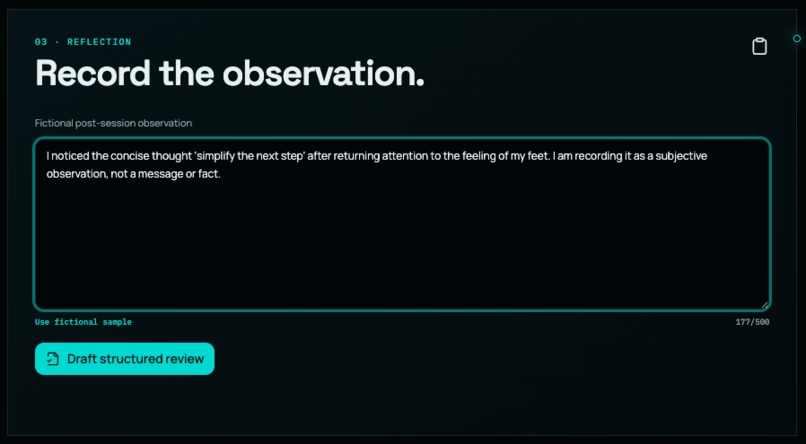
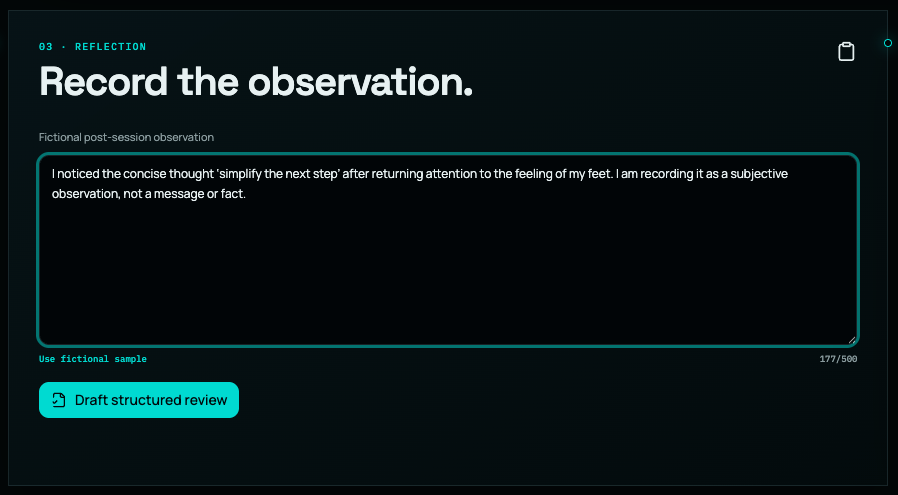
A fictional participant records a direct observation before the agent structures it for review.
-
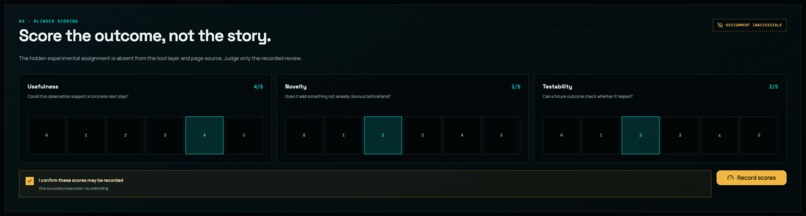
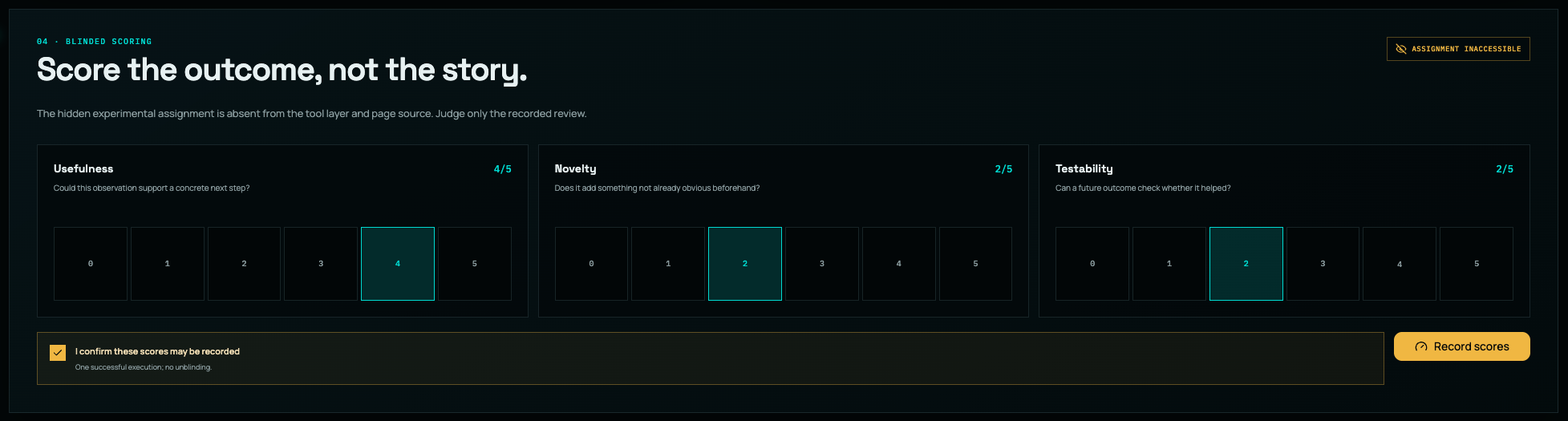
Blinded scoring protects the hidden condition while the person reviews usefulness, novelty and testability.
-
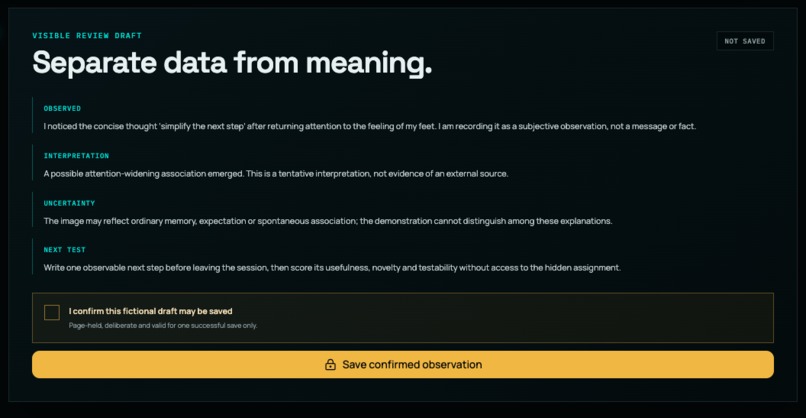
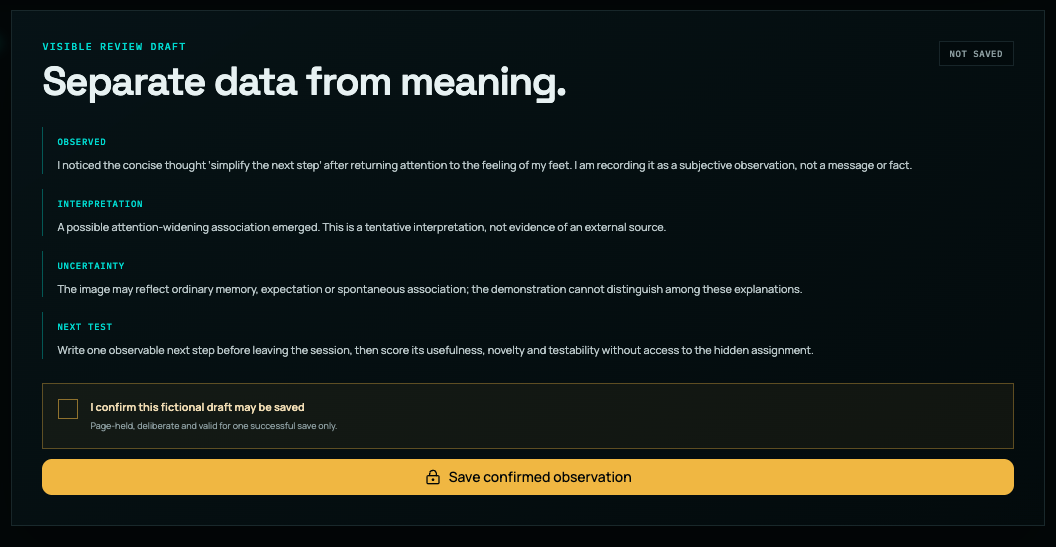
The agent separates observation, interpretation and uncertainty; saving requires visible human confirmation.
-
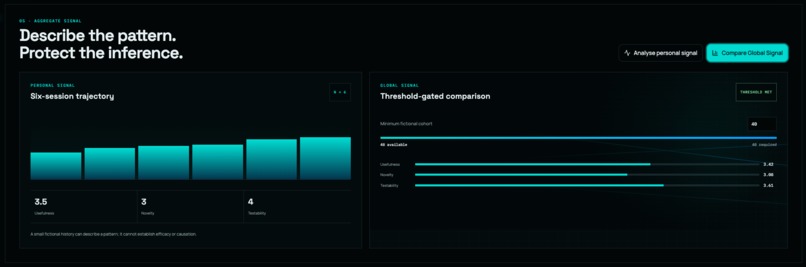
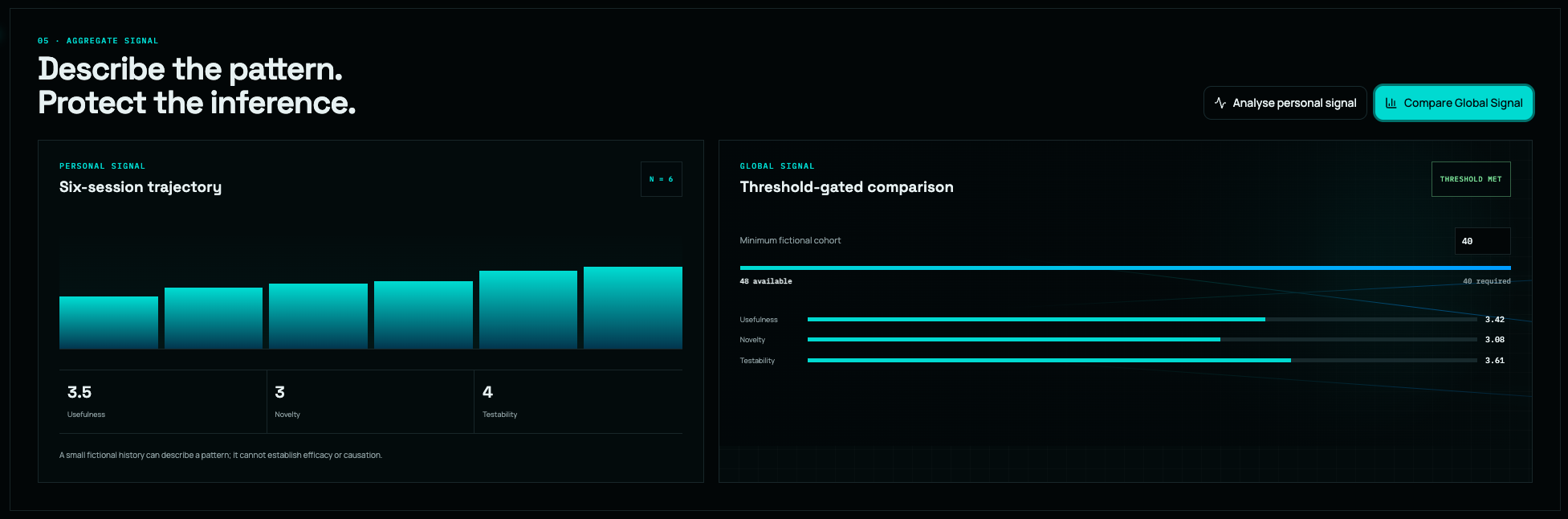
Read-only personal and cohort signals show aggregate patterns without exposing raw reflections or claiming efficacy.
-
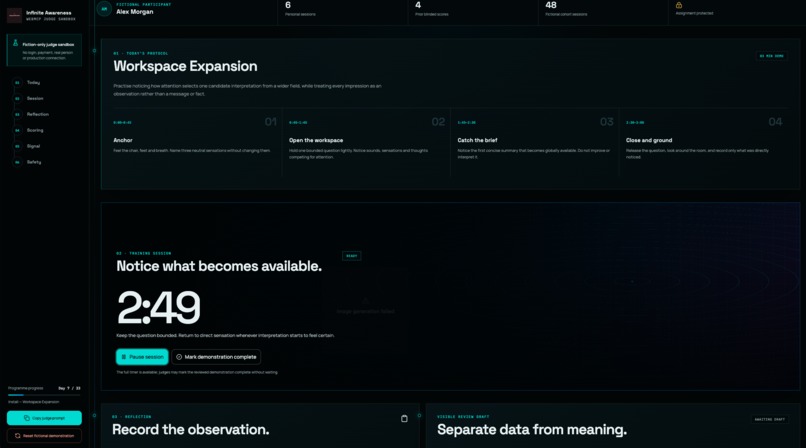
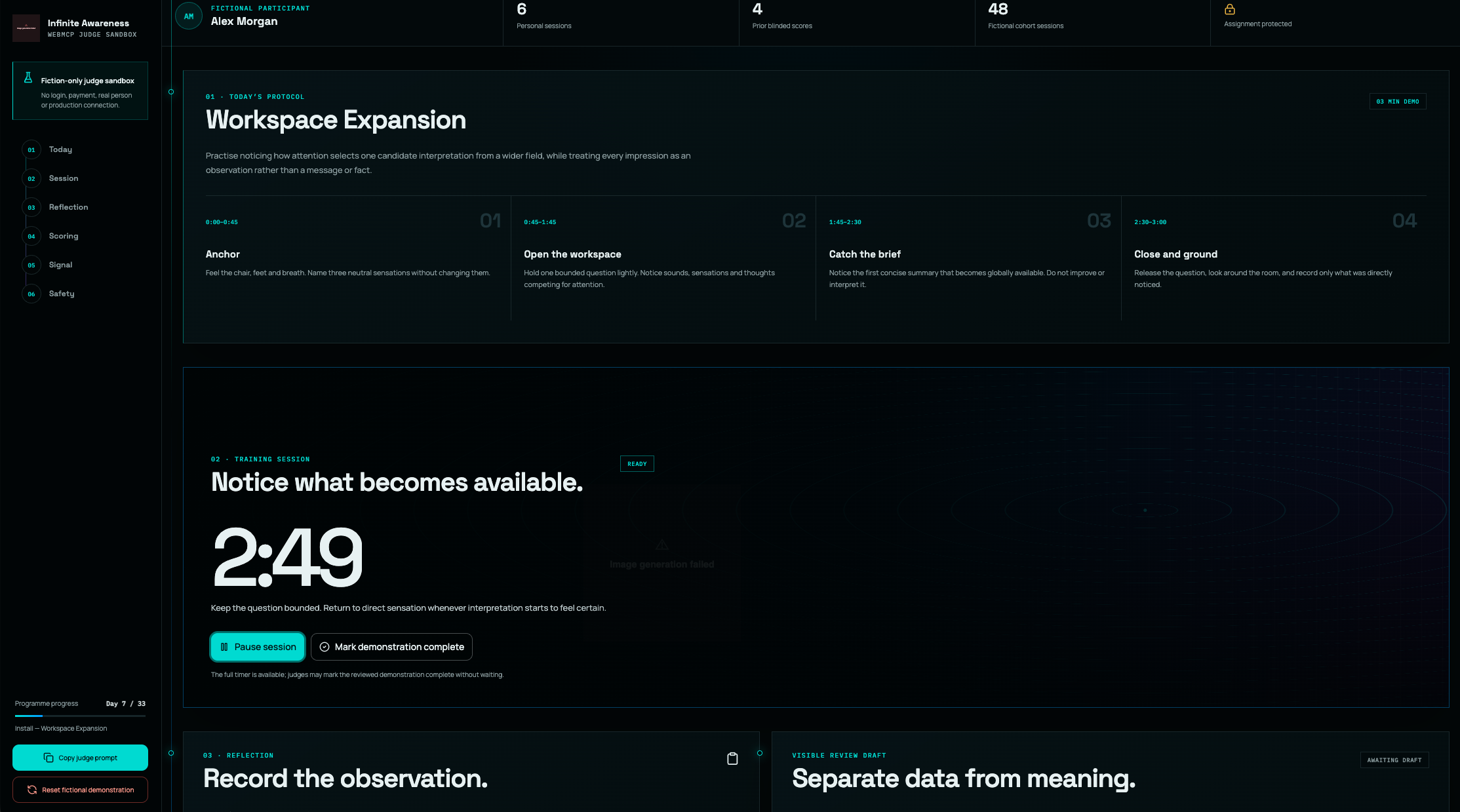
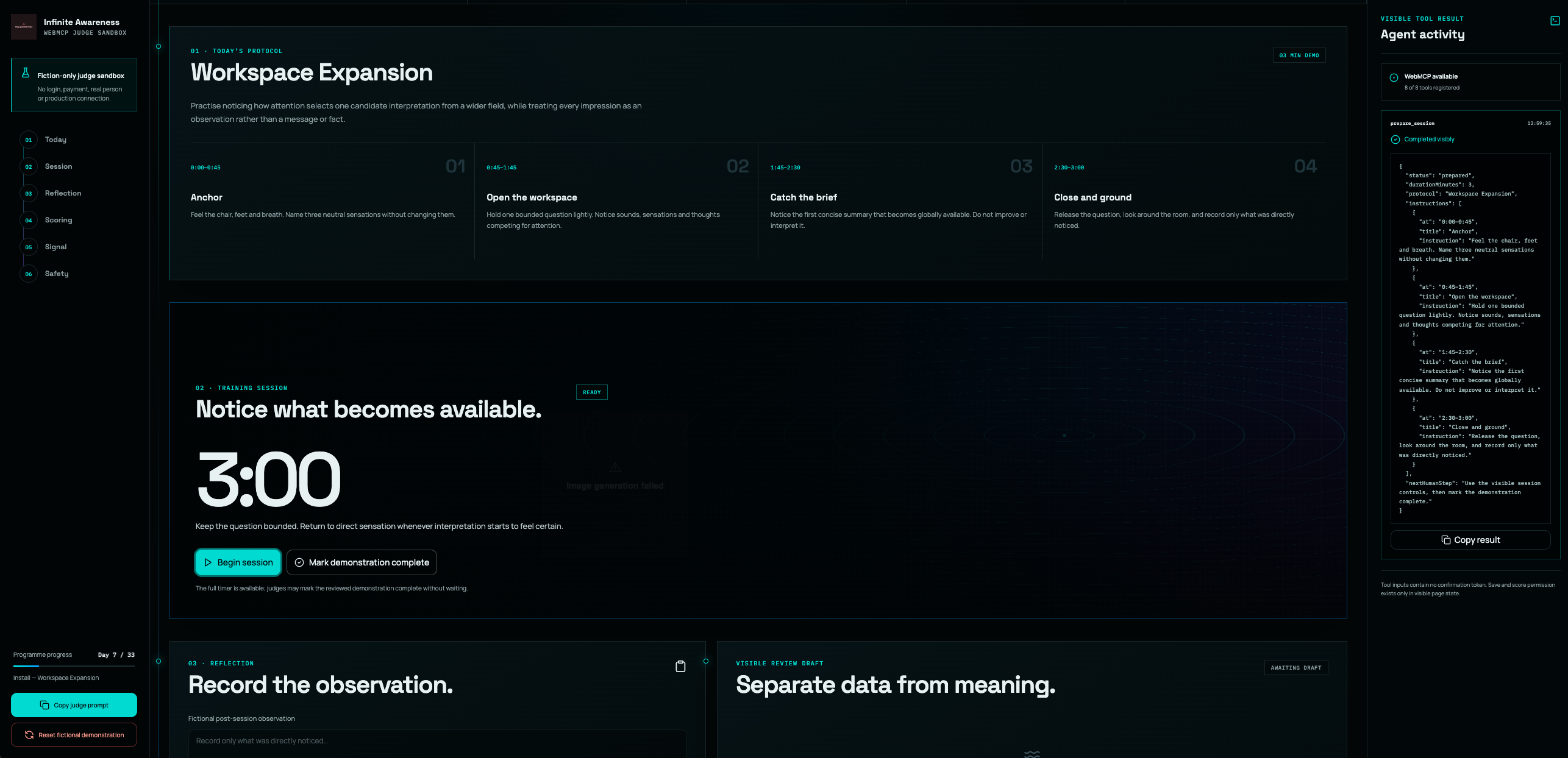
The prepared three-minute session updates the same visible page state shared by participant and agent.
-
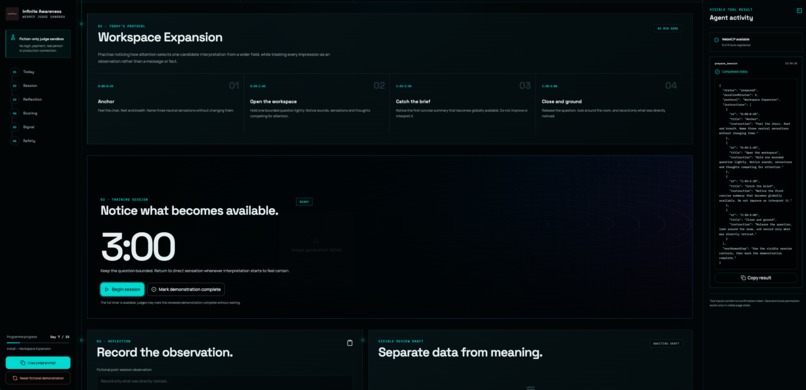
The initial session: a fixed three-minute protocol ready for WebMCP preparation, with later stages still locked.
-
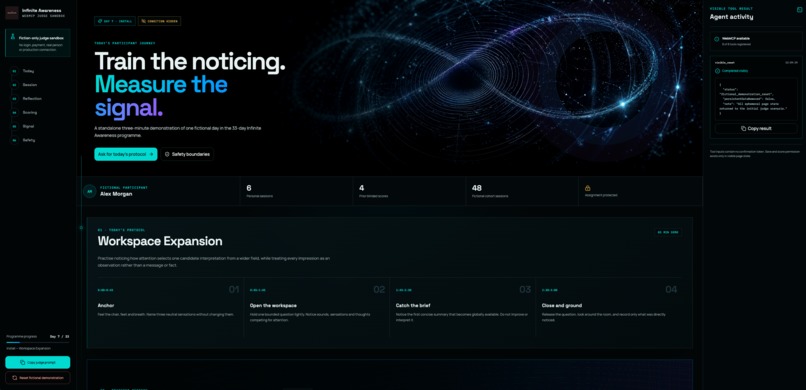
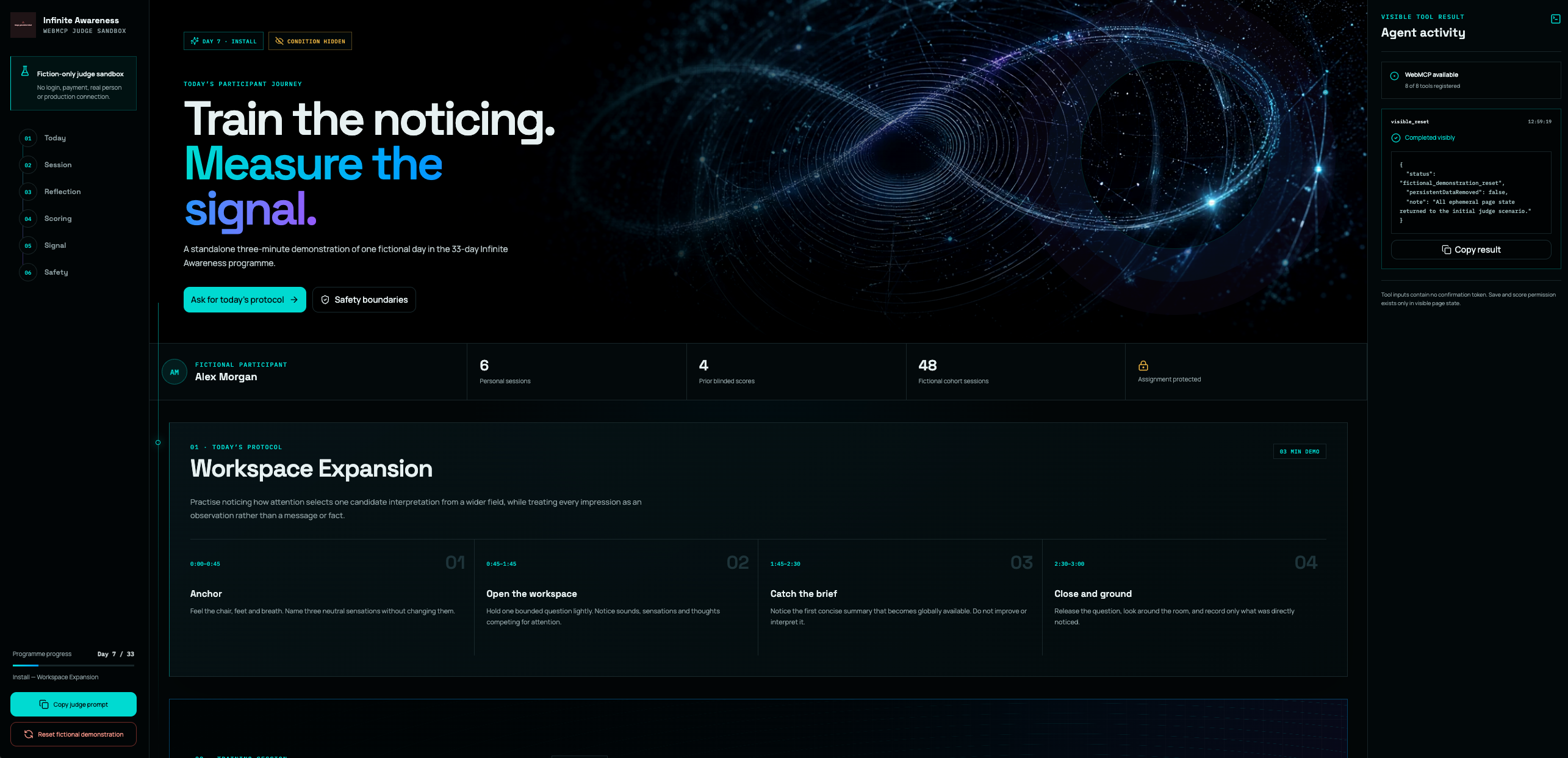
Judge Sandbox overview: eight registered WebMCP tools, fictional data and a protected hidden condition.
-
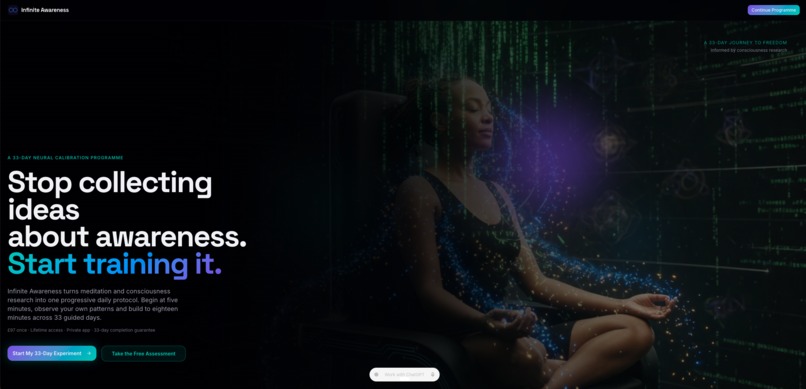
The main Infinite Awareness experience—the human-facing 33-day programme that inspired the isolated Agent Lab.
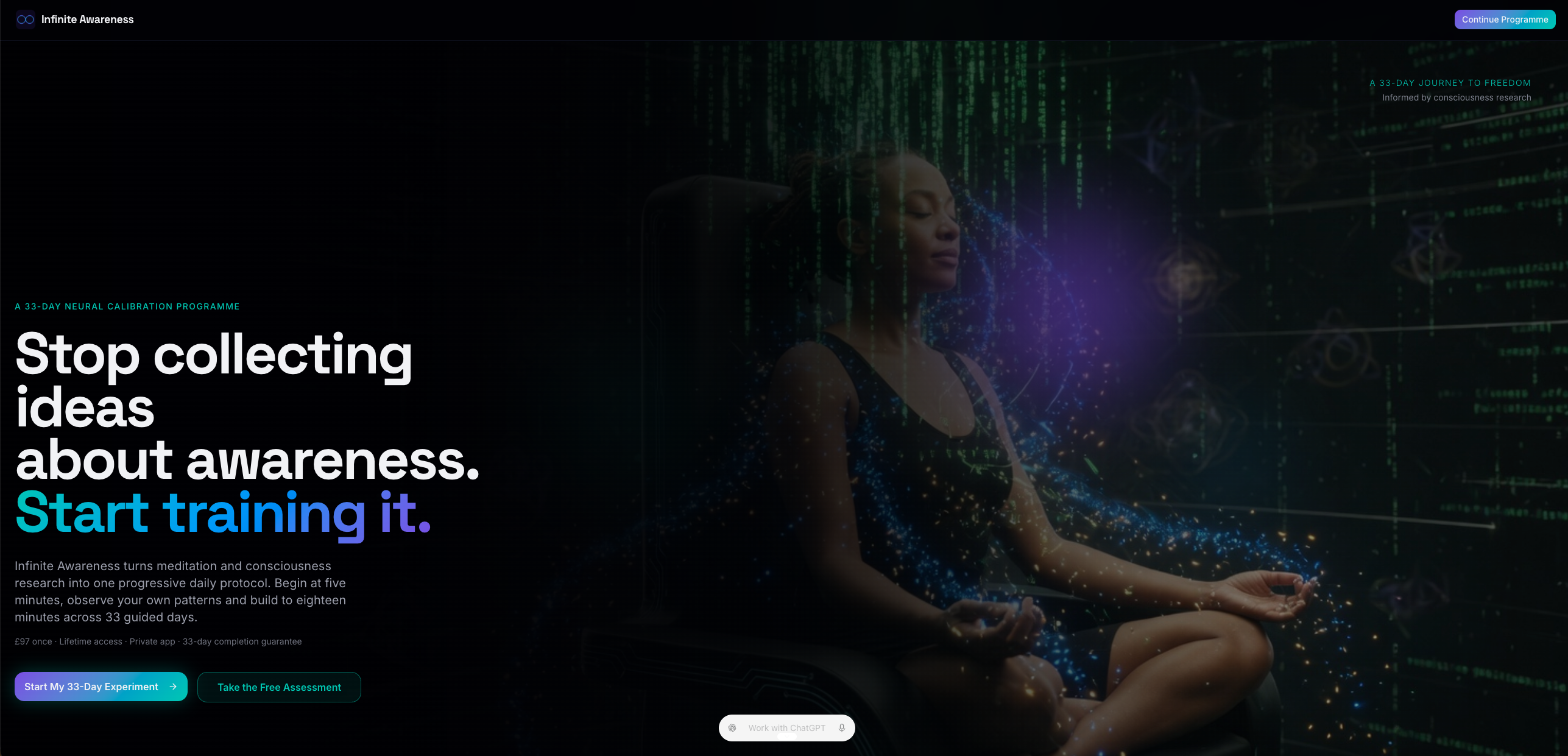
Inspiration: Infinite Awareness began with a simple problem: people can collect ideas about meditation, consciousness and self-awareness for years without turning those ideas into a repeatable practice they can examine for themselves. The existing Infinite Awareness application addresses that gap through a structured 33-day programme combining progressive awareness sessions, journaling, forecasting, blinded outcome scoring and personal analysis. The programme is designed as structured educational self-observation rather than treatment or proof of efficacy.
The WebMCP Challenge presented a new question: 'What should an AI agent be allowed to do inside this experience—and what must remain human?' An agent cannot meditate, experience awareness or decide what an observation means for somebody. It can, however, organise the experiment, retrieve the correct protocol, structure an observation, protect the scoring method and analyse privacy-conscious trends. That division of responsibility became the foundation of the Infinite Awareness Agent Lab.
What it does: The Agent Lab is an isolated, fiction-only WebMCP demonstration. A participant can open the live page in a compatible browser and ask an agent to help run an awareness experiment using natural language.
The page exposes eight structured WebMCP tools:
Read-only tools:
1 get_today_protocol retrieves the fictional participant’s current day, purpose, instructions and safety guidance.
2 analyse_personal_signal returns aggregated fictional personal trends without exposing raw reflections.
3 compare_collective_signal compares the participant’s aggregates with a fictional cohort after checking a fixed minimum sample threshold.
4 explain_safety_boundary explains the educational scope, consent rules, privacy boundary and stop guidance.
Guarded tools:
5 prepare_session prepares the correct shortened demonstration session but cannot complete the human practice.
6 draft_observation turns a fictional participant’s words into a structured draft without saving it.
7 save_confirmed_observation saves the reviewed draft only after a visible human confirmation.
8 score_blinded_outcome records usefulness, novelty and testability scores without revealing whether the session was an intention or control condition.
Every tool call creates a visible, structured update on the page so the participant can verify what the agent did.
Why WebMCP?: A normal chatbot would need the participant to paste information into a conversation or depend on fragile screen interpretation. WebMCP allows the website to expose narrow, typed actions directly from the live page. The agent can discover the available tools, understand their input schemas and work with the same visible application state as the participant. No separate plugin or remote MCP server is required for the demonstration. This makes the experience both easier and safer. The agent receives only the information needed for the current task, while the website continues enforcing progression, validation, privacy and consent.
Human and agent collaboration: The agent provides structure, consistency and analysis. The person retains experience, consent and interpretation.
The agent can:
- Retrieve and explain the protocol.
- Prepare the correct session.
- Structure an observation for review.
- Preserve the blinded scoring sequence.
- Calculate and compare fictional aggregate signals.
The person must:
- Decide whether to practise.
- Have the actual experience.
- Review the agent’s proposed draft.
- Explicitly confirm anything being saved.
- Review and confirm outcome scores.
- Decide what the resulting information means.
The central principle is: 'An agent can organise the experiment. Only a person can have the experience.'
Existing project and new challenge work: Infinite Awareness existed before the challenge as a 33-day commercial awareness-training application built over a month and a half with AI and human collaboration.
The work added during the challenge is the WebMCP-powered Agent Lab, including:
- Eight registered WebMCP tools.
- An isolated
/agent-labexperience. - Fictional participant and cohort data.
- Structured tool results displayed in the interface.
- One-time visible human confirmations.
- Privacy-conscious personal and collective analysis.
- Blinded scoring protections.
- Safety and educational-scope boundaries.
- WebMCP discovery, execution and confirmation tests.
- Judge instructions, submission documentation and demonstration materials.
The challenge extension is intentionally isolated from the existing production application. It does not connect to production customers, journals, payments, course records or private data.
How we built it: The tools are registered from the top-level page using document.modelContext.registerTool(...).
Each tool has a narrow JSON input schema, a clear description and an explicit read-only or guarded behaviour. The execution handlers reuse one shared page state so tool results and human interactions remain synchronised.
The confirmation bridge was especially important. Saving and scoring initially required a confirmation identifier in the public tool input. Testing in ChatGPT’s browser showed that this identifier was held inside the page and was not available to the agent.
We redesigned the bridge so the public tools accept only their genuine task inputs. Their execution closures independently validate the current page-held confirmation. Each confirmation is consumed after one successful use and cannot be replayed.
Challenges: The largest challenge was making the agent useful without allowing it to overstep.
We needed to ensure that:
- An agent could not save an unreviewed reflection.
- A confirmation could not be reused.
- Scoring could not happen before the observation was saved.
- The intention or control condition remained blinded.
- No raw reflections appeared in personal or cohort analysis.
- The demonstration made no medical, psychological or efficacy claims.
- The pre-existing application remained clearly separated from the new challenge work.
Accomplishments: The public challenge repository passes all eight bundled tests, TypeScript validation, the production build and GitHub CI. The live sandbox was also verified for clean non-WebMCP fallback behaviour and native WebMCP discovery in ChatGPT’s in-app browser.
ChatGPT successfully discovered all eight tools. Direct save and scoring calls failed before confirmation, succeeded exactly once after visible confirmation and failed when confirmation reuse was attempted. The blinded condition remained hidden throughout.
What we learned: WebMCP tool design is not simply about exposing functions. Tool descriptions, input schemas, visible page state, confirmation handling and verifiable results are all part of the user experience. We also learned that human control works best when it is enforced by the application rather than left to an instruction in a prompt. The agent can request an action, but the page itself determines whether the required human review has happened.
Human-led, AI-assisted creation: Like the experience it enables, this project was built through human-agent collaboration. I defined the purpose, methodology, safety boundaries and final decisions, while AI tools helped implement, test and refine the WebMCP extension.
That process reinforced the principle at the heart of the project: AI should expand human capability without quietly taking away human agency.
What’s next: The Agent Lab now has a stable public home, a reviewed MIT-licensed repository and a compliant 2:55 demonstration video.
After the challenge, I want to make the Agent Lab freely available so more people can explore structured awareness, reflection and self-observation without surrendering their privacy, judgement or control to an algorithm.
AI may become one of the most consequential changes in human history. As it increasingly shapes how we work, communicate and understand ourselves, we need experiences that use it to strengthen human agency rather than replace it.
Infinite Awareness Agent Lab is one practical demonstration of that future: the agent provides structure, but the person retains the experience, the meaning and the choice.
Built With
- chatgpt
- css3
- html5
- javascript
- manus
- mysql
- openai
- react
- trpc
- typescript
- vite
- webmcp

Log in or sign up for Devpost to join the conversation.