-
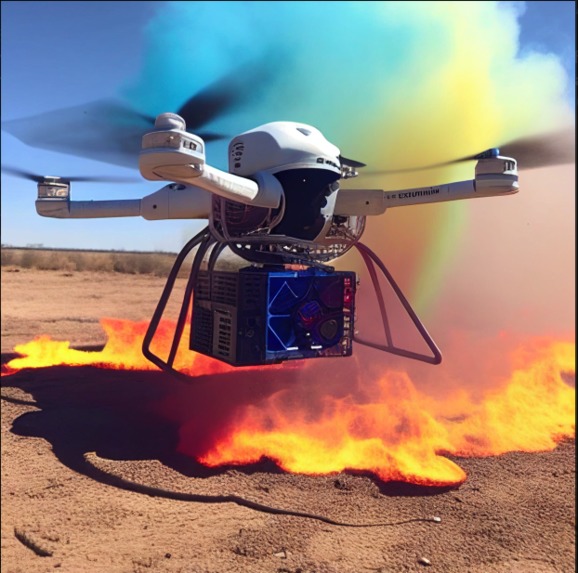
Thermal-Imaging Concept
-
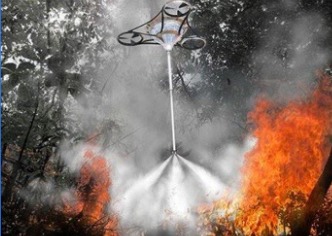
Fire-Extinguishing Concept
-
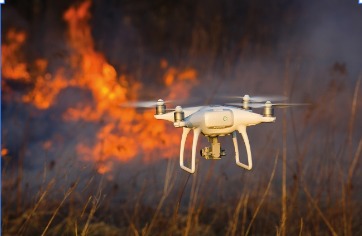
Infrared-Holography Concept
-
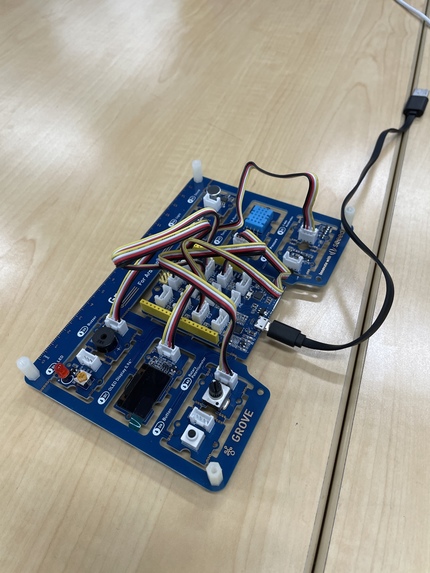
Arduino Circuit


Inspiration
As MSU students and members of the Greater Lansing community, we have often witnessed fire emergencies (ex. an apartment complex in Meridian Twp. near MSU recently caught fire. link -Police and firefighters rescued people stranded on the third-floor balcony "with nowhere to go, with flames shooting up." )
This affected us deeply as we empathize with our EMTs and fire-responders and all that they do for our communities even as the odds are stacked against them. Fires and related situations can be catastrophic, and some are extremely difficult to control (such as forest wildfires). This is a hazard for our responders, and leads to them getting into situations where they are unaware of their surroundings, the intensity of the fire, the smoke density inside, and oxygen levels.
It is also a fact that fire-fighting techniques, equipment, and resources in most US cities and towns is old and out-dated. Our goal is to new technologies and provide a variety of solution using our project for these services to ensure personnel safety, assist fire-fighting efforts, and ensure no innocent lives are lost.
What it does
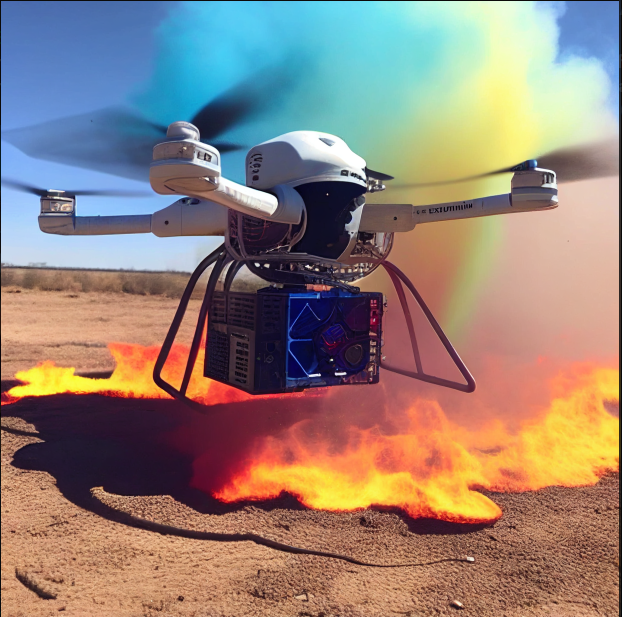
Our project proposes and demonstrates how we can use unmanned aerial vehicles (UAVs) as an asset for fire-extinguishing efforts. Our concept consists of multiple drones. built with a coating of fire-resistant aramid fibers, with specific functions (heat detection, locating civilians, monitoring oxygen and smoke density, fire-extinguishing) that work together to assist fire-fighters and victims stuck in the fire. With the help of computer vision and employing CV and Folium Python libraries, the drones are able to learn from existing footage of fires, as well as keep pushing data into a database which helps it in learning from previous data of how to keep working better.
The central control of the system is an enhanced neural network that is set up in our fire-engine, where fire-fighters can continuously understand and get information of what's going on inside.
How we built it
Our demo consists of a simplified version of what we propose the drone would have the capability to do. We have a circuit where we are pulling data and using it to understand what the situation in the fire looks like for our personnel. We also have designed a program to plot the hot-point for our fire where we are using our drones to understand where the fire started so that fire-fighters can understand how they can stop the fire from spreading and can contain it quicker with the help of our aerial fire-extinguishers.
Drone Communication:
Using UgCS commander link that is communicating through link.
The drones have a machine learning model that analyzes and learns from the existing fire and helps improve how to deal with the situation using Assistant for Understanding Data through Reasoning, Extraction and sYnthesis (AUDREY) will give firefighters suggestions as to what to do based on conditions of the fire.
All of them are putting the data into a database and on it is the machine learning model running.
A central unit of firefighter is controlling it with an enhanced neural network (CNN).
The drone that is going in has oxygen and heat temp sensors that help the firefighters going in the conditions. link
Flying Mechanism
The developed platform is designed based on CAROS (Climbing Aerial RObot System), so that it can pass through collapsed structures by climbing walls in case of fire disaster.
Central Control
We are using CNN (Convolutional Neural Network) as a control system to communicate amongst the 3 different type of drones we have and instruct them for their function.
Challenges we ran into
We faced challenges on how we can build our idea and have a final deliverable. But we persevered, and were able to build a basic circuit of what we are trying to do with our drone network using the Grove kit available to us, as well as plotting our co-ordinates using Folium for understanding the center of the fire, and used C++ to demonstrate how the code for our circuit will operate.
Accomplishments that we're proud of
We have a working demo that we were able to build as well as code that can actually be used to fulfill what we are trying to create. We were able to build our idea from scratch, as well as contribute to our community, and our brave fire-fighters by amalgamating social good with technology.
What we learned?
Our idea is a big-step forward for the nation as we work to enhance our emergency-response services. Even though we faced challenges, if we are able to build our idea forward, we can make a long-lasting actual impact that can save lives. We learned a lot of use of technology for social good, as well as gained new skills in hardware building, and artificial intelligence.
What's next for Inferno-Proelia?
We built the basic ideas for our project and have deliverables for each aspect. However, we want to build a product where all of these ideas connect with each other and work together to fulfill our goal. We have presented our idea with limited time and resources and can build the "next big thing" for America for the greater good as we work forward on this. We plan to involve resources from the Burgess Institute of Entrepreneurship, the US Department of Homeland Security, and the East Lansing Fire Department to keep working on our project.
Built With
- arduino
- audrey
- c++
- computer-vision
- folium
- infrared-holography
- machine-learning
- neural-networks
- python
- thermal-imaging
- ugcs


Log in or sign up for Devpost to join the conversation.