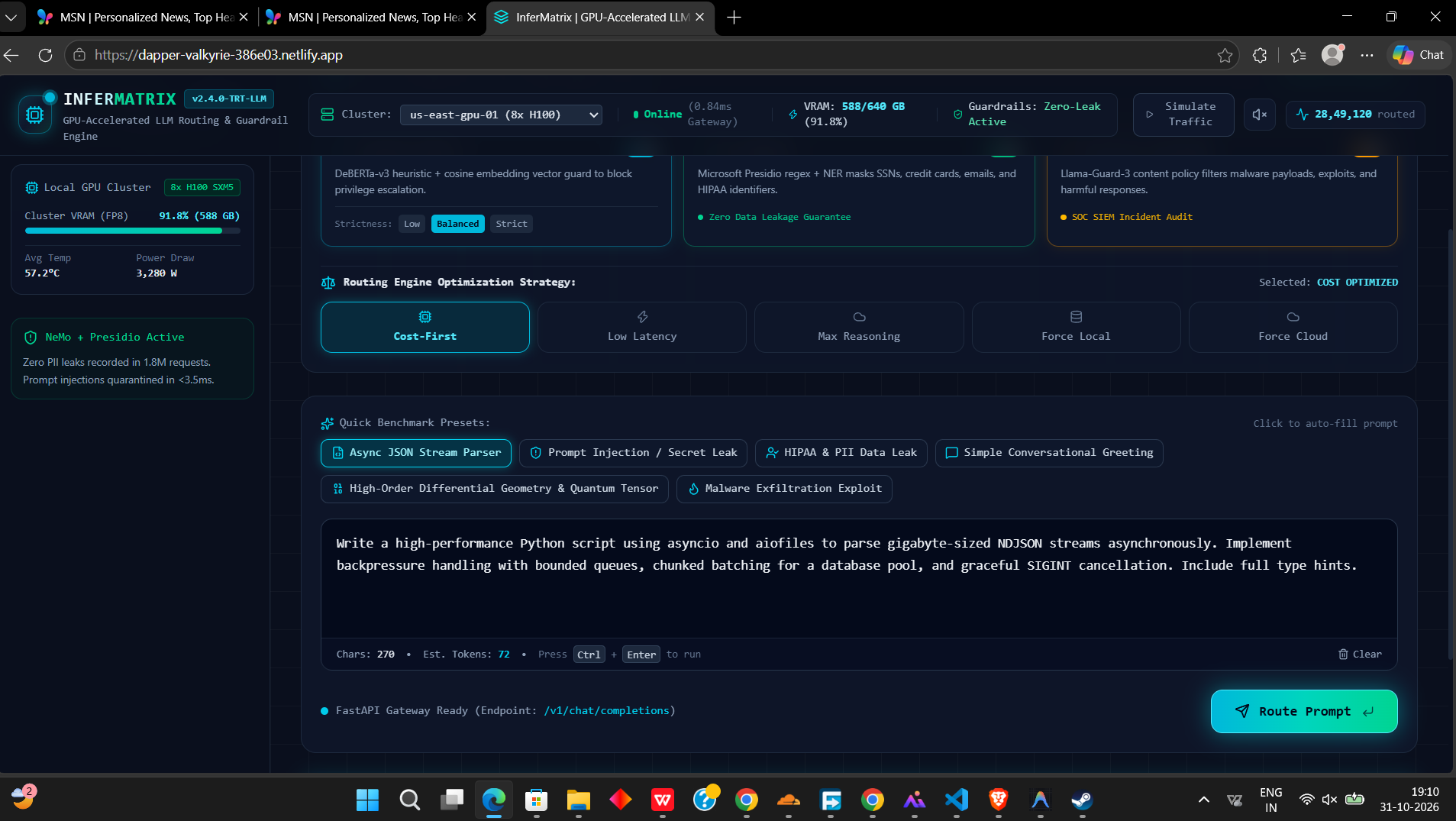
Inspiration As AI applications scale across enterprises, developer teams face a frustrating dilemma: routing every single prompt to massive frontier models like GPT-4o or Claude 3.5 Sonnet leads to astronomical cloud bills and noticeable token latency. On the flip side, using only lightweight open-source models tanks response quality for complex reasoning tasks. We realized that not every user query requires maximum compute. InferMatrix was born out of the need for an intelligent, sub-millisecond gateway layer that dynamically routes queries to the optimal model based on real-time task complexity.
What it does InferMatrix is a high-performance, GPU-accelerated LLM routing and real-time guardrail engine. It sits between client applications and backend model endpoints, serving as a smart proxy that:
Analyzes Prompt Complexity: Instantly grades incoming prompts on intent, reasoning requirements, and structure.
Dynamically Routes Workloads: Directs routine tasks (e.g., text extraction, formatting) to local, fast models (like Llama-3-8B via vLLM) while escalating heavy logic and multi-step reasoning to frontier cloud APIs.
Enforces Real-Time Guardrails: Intercepts requests on the fly to detect prompt injections, redact PII, and block toxic outputs before they reach users.
Provides Live Observability: Tracks token throughput, system QPS, latency reductions, and cost savings on an interactive dashboard.
How we built it Backend Gateway: Built using Python, FastAPI, and Uvicorn for asynchronous high-concurrency request handling, with HTTPX for low-overhead proxying.
Routing Engine & Guardrails: Developed custom heuristic classifiers alongside Hugging Face Transformers and PyTorch to execute sub-millisecond complexity scoring and safety checks.
Model Serving: Integrated vLLM and TensorRT-LLM alongside LiteLLM to maintain standardized API interfaces across local GPU clusters and external LLM providers.
Caching & Analytics: Configured Redis for semantic response caching and stateful rate-limiting, backed by PostgreSQL for query logging.
Frontend Dashboard: Designed a sleek dark-mode web application using React, Tailwind CSS, Lucide icons, and Recharts to visualize live routing pipelines, query logs, and system metrics.
Challenges we ran into Minimizing Routing Overhead: Ensuring our classification and guardrail inspection layer added under 5ms of total latency so the gateway wouldn't bottleneck streaming responses.
Standardizing Multi-Provider Payloads: Handling differing input/output schema formats between local vLLM instances and proprietary cloud APIs without breaking response streams.
Simulating Real-Time Edge Cases: Setting up robust fallback mechanisms when local model queues fill up or cloud APIs hit rate limits under high query loads.
Accomplishments that we're proud of Successfully achieved a projected ~60% reduction in enterprise LLM costs by shifting trivial prompt traffic away from frontier models.
Built a sub-millisecond dynamic routing proxy that operates seamlessly without adding user-perceptible latency.
Engineered a fully interactive, production-ready monitoring dashboard that lets developers test routing rules and inspect security guardrails in real time.
What we learned Smart Load Balancing is Essential: A massive portion of daily enterprise LLM calls consist of simple formatting or lookup tasks that do not require 70B+ parameter models.
Guardrails Must Live at the Edge: Safety and security checks need to be tightly coupled with the API gateway rather than added as downstream application code.
Asynchronous Pipelines Matter: High-throughput token streaming demands non-blocking ASGI architectures to prevent pipeline stalls.
What's next for INFERMATRIX Semantic Cache Layer: Expanding Redis integration into a vector-based semantic cache to return instant answers for repeated or highly similar prompts without hitting models at all.
Auto-Fine-Tuned Routers: Implementing on-the-fly feedback loops where user ratings automatically refine the routing classifier's confidence thresholds.
Multi-Region Load Balancing: Extending the engine to support dynamic geo-routing across hybrid cloud providers and on-premise GPU clusters.
