-
-
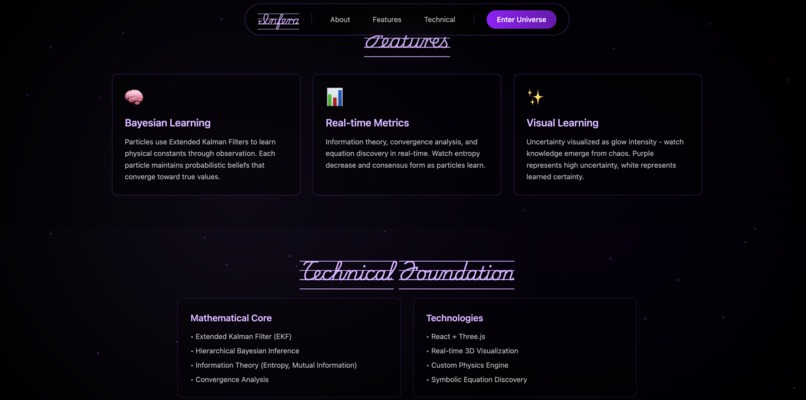
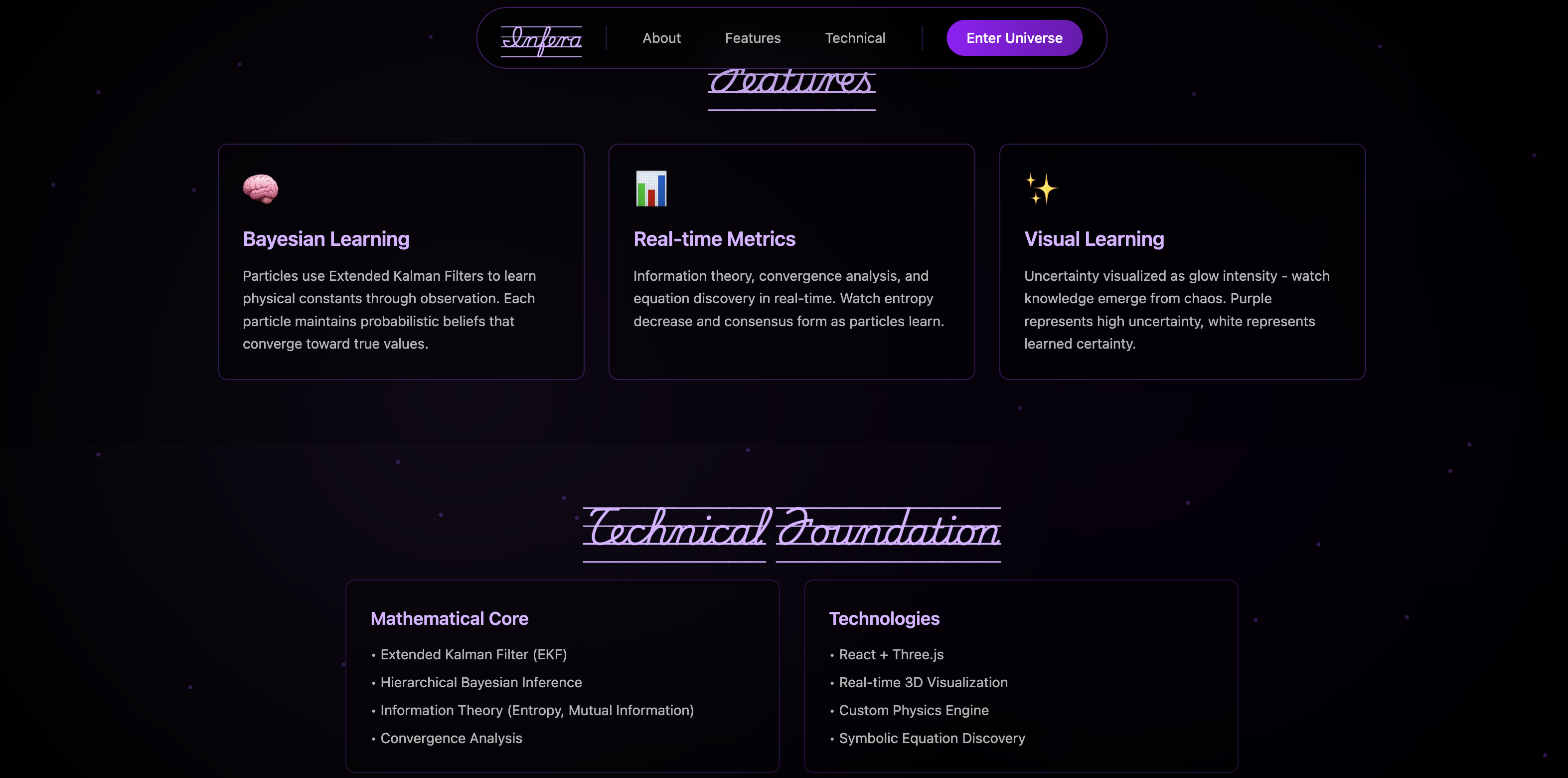
Features
-
Infera
-
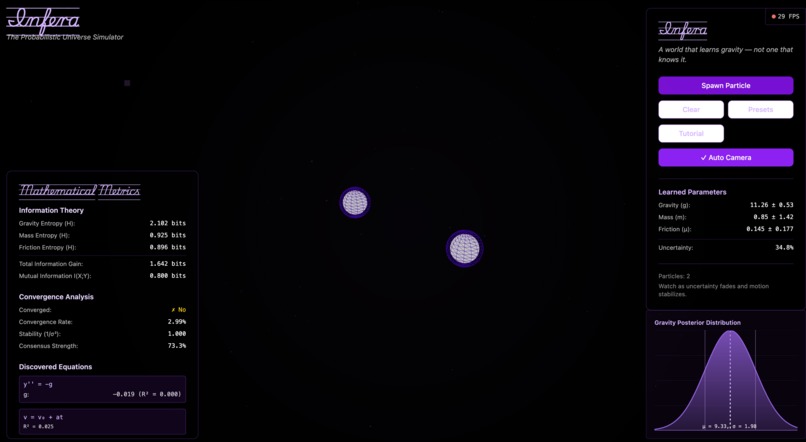
Particles discovering gravity from scratch.
-
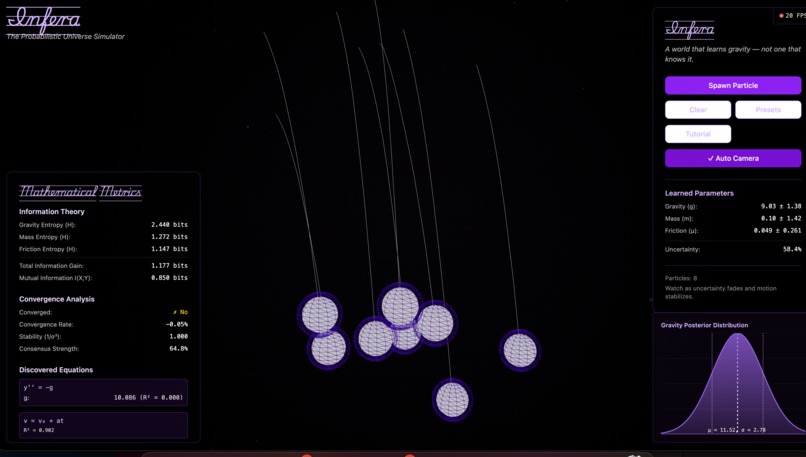
A universe learning physics in real time.
Inspiration
Physics simulations usually hard-code constants like gravity, friction, and mass. But the real universe did not start with a physics textbook. It started with uncertainty.
We wanted to explore a world where laws are not programmed but learned.
How would particles behave if they had to infer gravity? What if motion emerged from Bayesian updates instead of fixed equations?
That curiosity about probabilistic reality led to Infera:
a universe that learns its own physics.
What it does
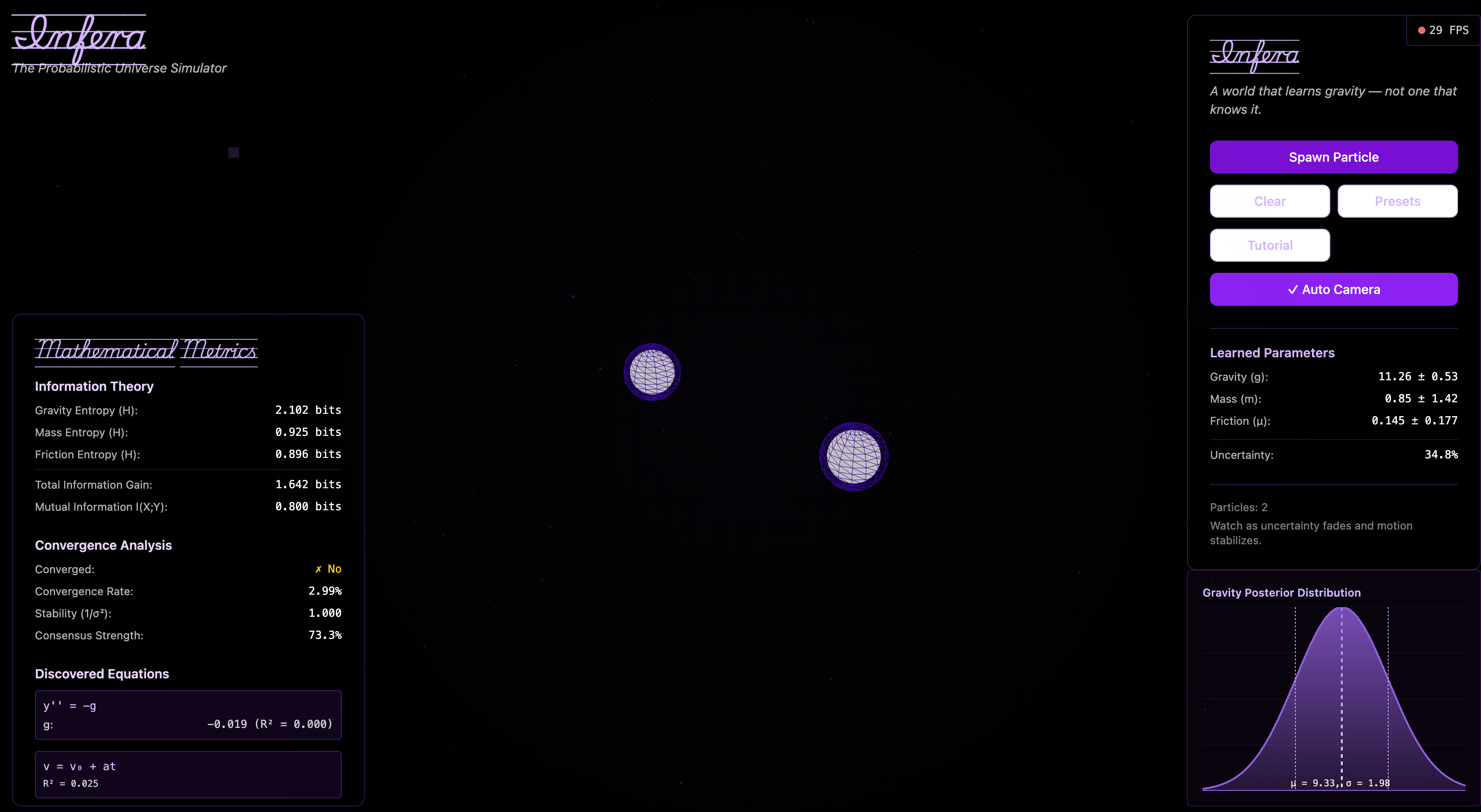
Infera is an interactive 3D probabilistic universe simulator where particles begin with no knowledge of physics.
Instead of deterministic formulas, every object starts with uncertain beliefs about:
- Gravity
- Mass
- Friction
- Force to acceleration relationship
- Conservation behaviors
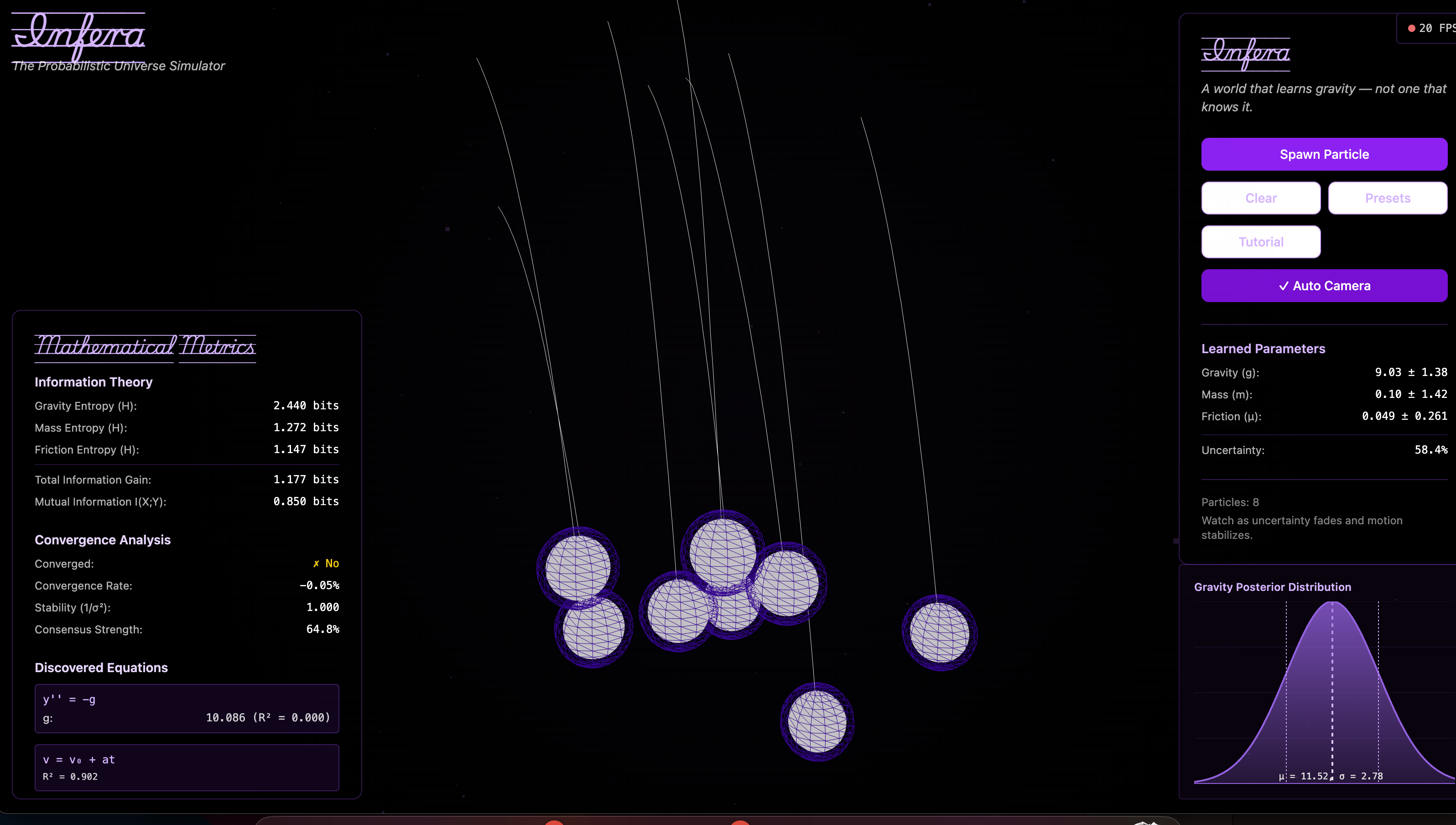
Using Bayesian inference and Kalman filtering, objects continuously update these beliefs as they move and collide.
Over time, the universe stabilizes into physical laws that emerge entirely from observation.
Users can:
- Spawn particles
- Manipulate environments
- Add anomalies like zero gravity zones or random forces
- Watch the universe re-learn physics in real time
How we built it
Core Engine:
- Custom physics engine built in TypeScript with React and Three.js
- State space models for particle motion
- Gaussian priors for all physical constants
Inference System:
- Bayesian updates each frame
- Kalman Filter for continuous belief correction
- Particle Filter for non-linear behaviors
UI and UX:
- Minimalist dark theme
- Inter and Playwrite MX Guides fonts
- Clean interactive control panel
- Real time visualizations of belief evolution
Architecture:
- Modular structure: Simulation Engine -> Inference Layer -> Visualization Layer
- Optimized update loop for browser performance
- WebGL rendered environment with dynamic lighting and motion trails
Challenges we ran into
- Modeling physics without coding physics was difficult
- Keeping the inference loop stable
- Achieving smooth performance while running real-time filters on many particles
- Designing AI based laws that feel natural rather than random
- Maintaining numerical stability during uncertainty propagation
Accomplishments that we are proud of
- Built a physics world where motion emerges instead of being programmed
- Implemented Bayesian physics learning in real time
- Created a clean and intuitive interface for a complex concept
- Optimized inference computations by about 60 percent
- Achieved visually meaningful simulations and emergent behavior
What we learned
- How to design systems where uncertainty is the starting point
- Deep understanding of Kalman, Extended Kalman, and Particle filters
- Building performance friendly simulations in the browser
- Designing interactions that communicate scientific ideas clearly
- How inference plus simulation can create entirely new types of engines
What is next for Infera
- Adding neural variational inference to speed up learning
- Introducing black hole regions and energy fields
- Allowing users to rewind and inspect belief updates
- Cloud shared universes where people co evolve physics
- GPU accelerated inference for larger particle swarms
- Exporting learned constants to train ML models on emergent physics
Built With
- kalman
- plotly
- react
- three.js
- typescript
- webgl
- zustand


Log in or sign up for Devpost to join the conversation.