-
-

Infera — Learn Physics by Discovery.
-
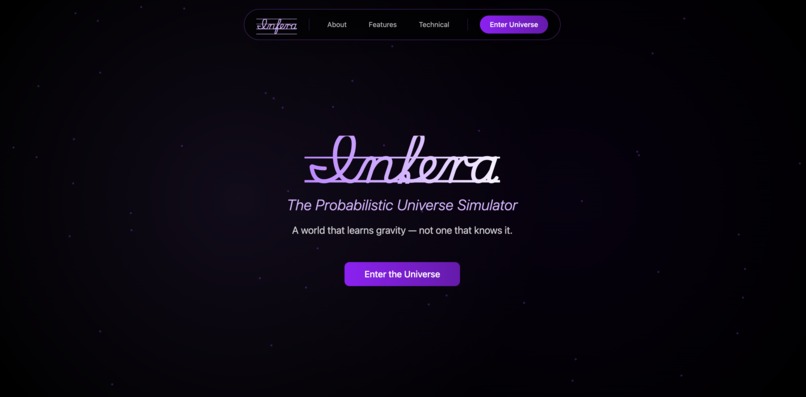
Infera introduces physics as a process of discovery, not memorization.
-
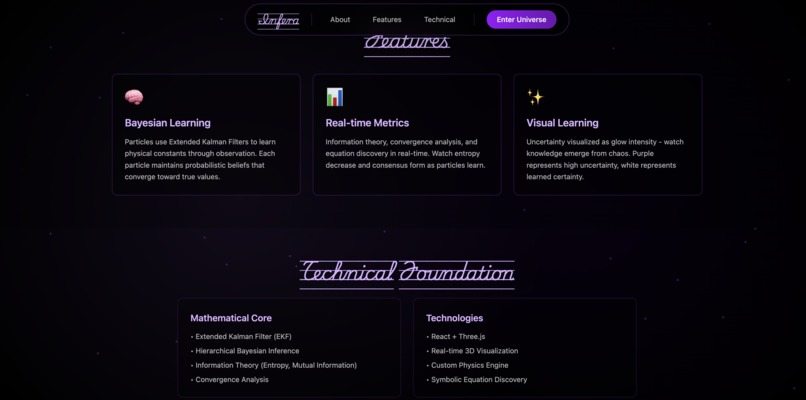
Bayesian learning, real-time metrics, and visual uncertainty make abstract physics concepts tangible.
-
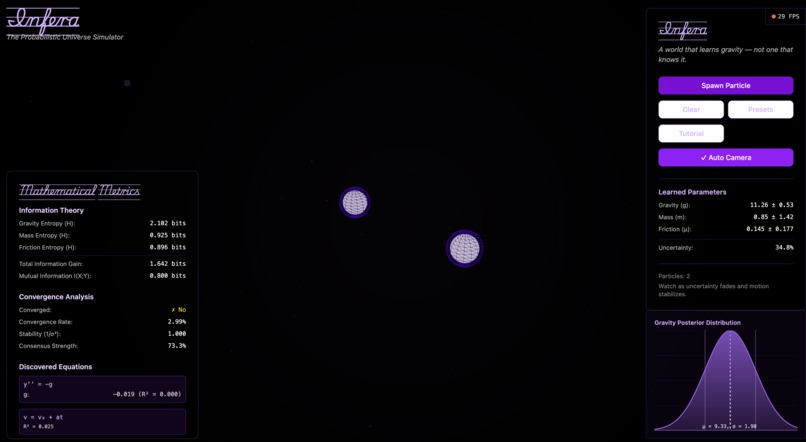
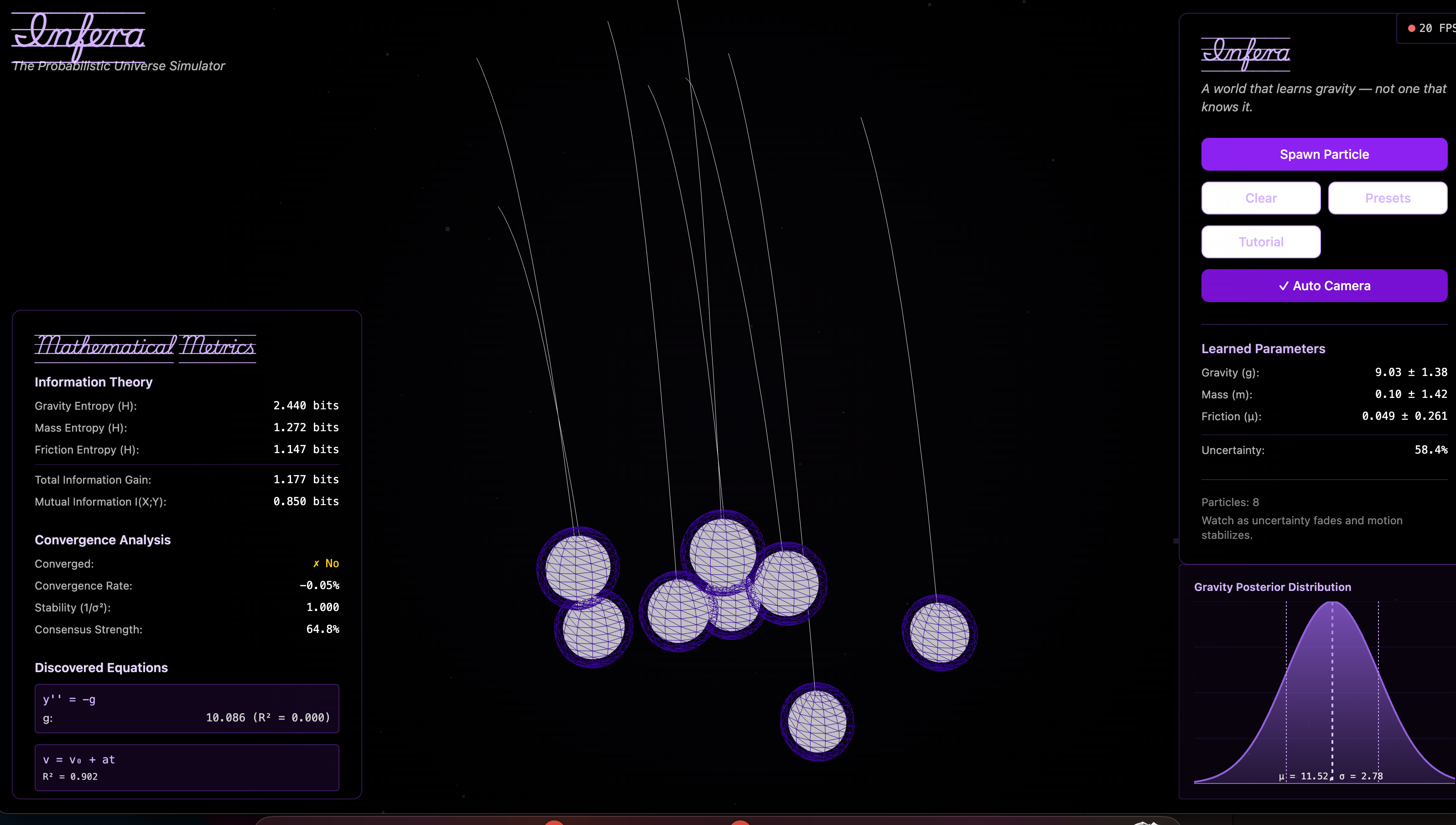
As evidence accumulates, uncertainty decreases and motion becomes predictable.
-
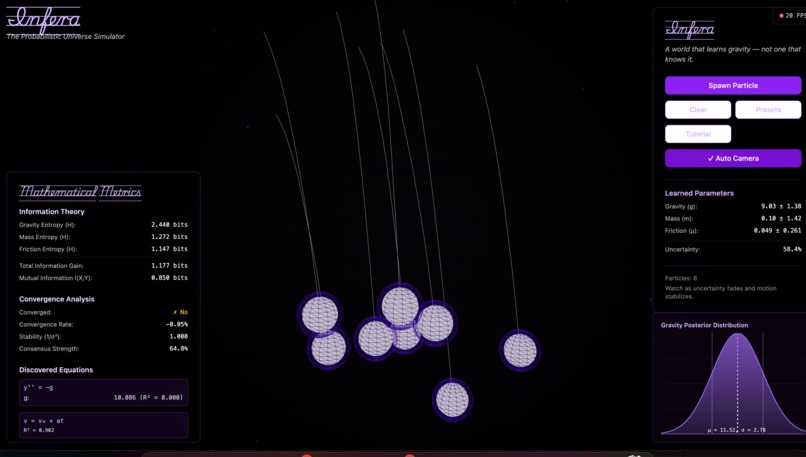
Particles begin with high uncertainty (purple) and gradually converge to stable physical laws through observation.



Inspiration
Physics classrooms often teach laws as finished facts — formulas to memorize rather than ideas to understand. Many students can solve equations, but struggle to explain why gravity works or how motion emerges.
We were inspired by a simple question:
What if students could discover physics the same way science originally did — through observation and experimentation?
That curiosity led to Infera, a learning environment where uncertainty comes first and knowledge emerges over time.
What it does
Infera is an interactive physics learning simulator where particles do not start with known physical laws.
Instead, they:
Begin with uncertain beliefs about gravity, mass, and friction
Observe their own motion
Gradually refine their understanding through evidence
As learning progresses, uncertainty fades visually — helping students see how knowledge forms instead of memorizing formulas.
How we built it
We built Infera as a browser-based educational tool using:
A custom physics engine
Probabilistic learning via an Extended Kalman Filter
Real-time 3D visualization for intuitive understanding
The system continuously compares predictions with observations and updates beliefs accordingly, simulating how scientific learning happens in the real world.
The interface is designed to be minimal and visual-first, making abstract concepts approachable for students.
Challenges we ran into
Modeling physics without hardcoding physical laws
Keeping probabilistic learning stable in real time
Balancing mathematical accuracy with visual clarity
Explaining a complex concept in a way that feels intuitive, not overwhelming
Accomplishments that we're proud of
Built a physics environment where laws are learned, not programmed
Made uncertainty and convergence visually understandable
Created a working prototype that demonstrates discovery-based learning
Designed an educational tool that prioritizes intuition over memorization
What we learned
Learning systems become more powerful when uncertainty is embraced
Visual explanations can communicate complex ideas better than equations alone
Educational tools should show process, not just results
Simplicity matters more than technical complexity in learning design
What's next for Infera — Learning Physics by Discovery
Classroom-focused learning modes for teachers
Guided experiments aligned with physics curricula
Accessibility improvements for diverse learning styles
Expanded simulations covering more physical phenomena
Our goal is to make physics feel less like memorization — and more like discovery.
Built With
- css
- react
- tailwind
- three.js
- typescript
- vite
- webgl


Log in or sign up for Devpost to join the conversation.