Inspiration
Indianapolis, just like any city, has certain problems with public safety such as the pits or suspicious activity, but people do not include them since it is associated with the friction in such traditional methods as a phone call or a lengthy form. Our vision was simple: to develop an artificial intelligence-based assistant, which can be used by citizens to report issues in a few clicks, and receive sound safety information, written in their own words.
What it does
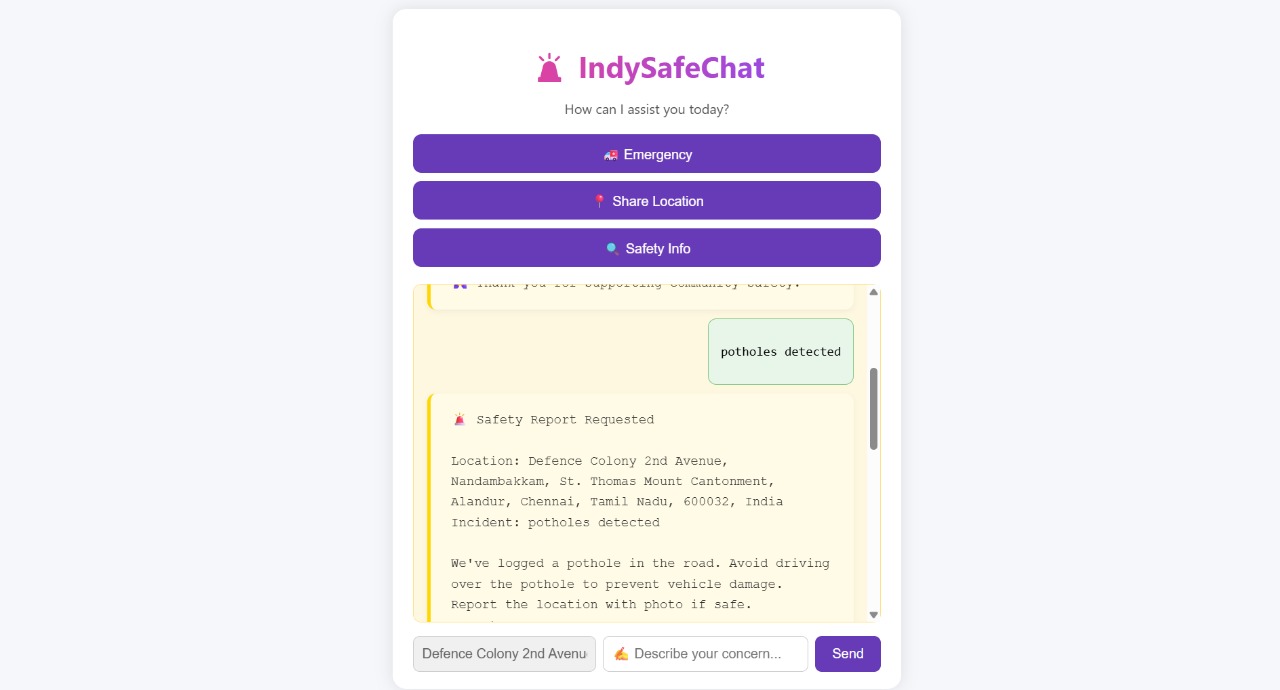
IndySafeChat is a 24hours chat bot through which people in Indianapolis can: Anonymously report public safety issues (vandalism, pot holes, gun shots, etc.). Get automatic classification of the issue and recommendations on what are the city departments to deal with the issue. Real-time safety-based tips are provided according to the character of the incident. Access web, mobile or communicating interfaces without technical knowledge.
How we built it
Flask: web framework behind the platform where user input can be taken; interaction with the model can be done. HTML/CSS/JS: Frontend chatbot Responsive, and the chat is processed dynamically. Qwen 1.5 1.8B-Chat + LoRA: Pre-trained on standard PAIPMR plus domain-specific safety and democratic data and finetuned using PEFT to give domain-specific responses. Transformers + PEFT: To load, adapt and utilize the chat model in production. Custom Prompt Engineering: We assist the model to present responses in a location, safety category, and advice format.
Challenges we ran into
Local finetuning large language models with GPU assistance and efficient execution. Writing conversational prompt that satisfies both classification, summarization, and empathy. Local tokenizer compatibilities with LoRA adapter and the templates. Writing a small and useful UI in order to quickly iterate and test.
Accomplishments that we're proud of
There has been a successful fine-tuning and deployment of a multilingual Qwen model to a very localized use-case. Constructed intercontinuous, no-login-required interface which reduces the threshold of civilian reporting. Produced a self-sufficient app, to run either locally or on an low powered server. Provided real-time safety recommendations that were generated in real-time with the help of AI.
What we learned
The methods of fine-tuning and deployment of Qwen models via PEFT and LoRA. Civic use-cases engineering. What is the technique of combining viabilities of LLM and conventional web UX. The significance of context (e.g. user location) in regulating behavior of chatbot.
What's next for IndySafeChat
Add the geolocation facility to auto-tag reports using GPS coordinates. Automated ticket generation is possible via connectivity to API of city departments. Include the support of SMS and WhatsApp, and make it more accessible. Introduce incident dashboards to the administrators in charge. Include diverse communities in Indianapolis by supporting other languages.

Log in or sign up for Devpost to join the conversation.