-
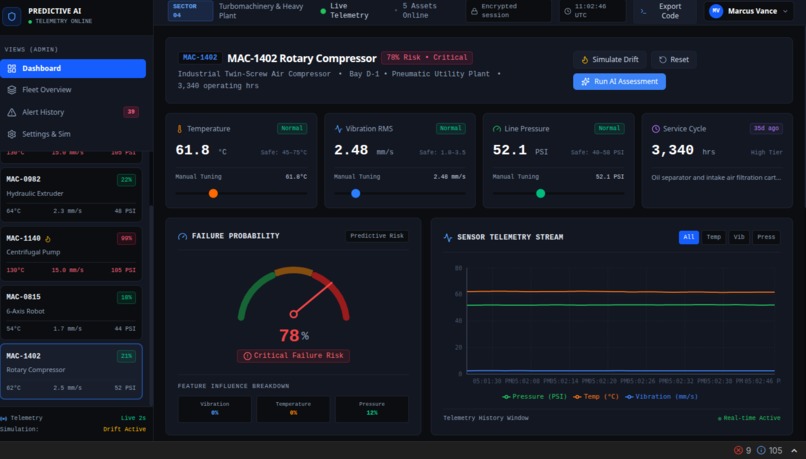
dashboard
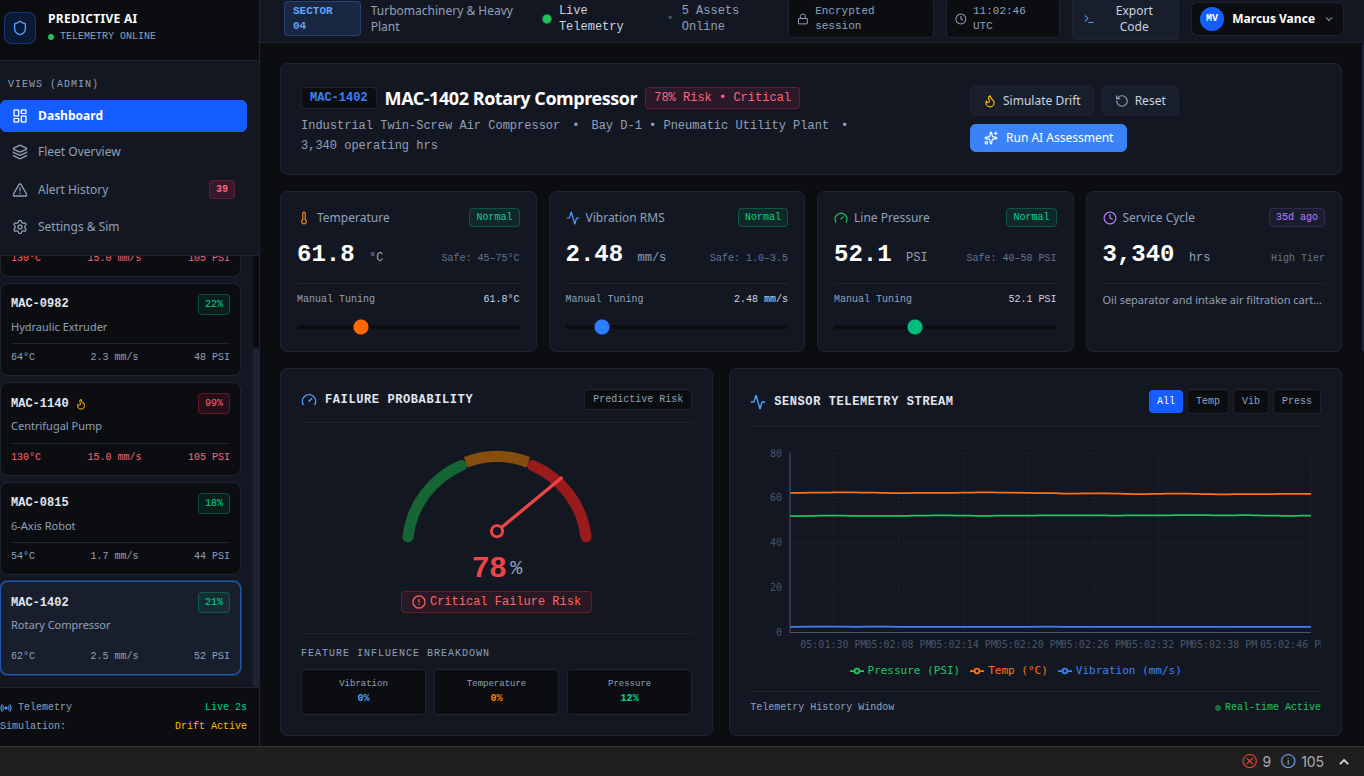
Inspiration
Factories don't lose money the moment a machine breaks — they lose it in the hours before anyone notices something is wrong. Bearings wear down, motors overheat, and by the time a worker hears the grinding or the line actually stops, the factory is already eating unplanned downtime and rushed repairs. This is especially true for smaller manufacturers in Bangladesh, where most machines run on reactive maintenance with no early-warning system at all — you fix it after it fails. We wanted to see if we could give any factory, regardless of budget, the same kind of predictive insight that only large industrial players can usually afford.
What it does
Industrial Predictive AI continuously monitors a machine's vital signs — vibration, temperature, and current draw — across a fleet of assets, the same way a heart monitor watches a patient. When readings drift outside safe operating ranges, the system sends the pattern to Gemini, which reasons over it like an experienced maintenance engineer: what's likely going wrong, how urgent it is, and what the team should do next. The result isn't just a red warning light — it's a written diagnosis and concrete recommendation in plain language, logged to an alert history so nothing gets missed. Role-based access (Admin, Technician, Viewer) keeps the system usable across a real maintenance team without everyone having equal control.
How we built it
We designed the dashboard around a dark, industrial control-room aesthetic to feel native to a factory floor rather than a generic web app. The frontend is a React single-page app with persistent state across a Dashboard, Fleet overview, Alert history, and Settings/admin view, all built and deployed through Google AI Studio's Build mode. Sensor data is simulated on a live interval to mimic real hardware streaming in, and every "Run AI assessment" action sends those readings to the Gemini API, which is called server-side via Cloud Run so the API key never touches the browser. We layered a login flow with three hardcoded demo roles on top to simulate the access control a real industrial deployment would need.
Challenges we ran into
Getting Gemini's free-text responses to reliably map onto structured UI elements — a risk percentage, a status level, a bulleted recommendation list — took careful prompt design so the model's output could be parsed consistently rather than guessed at. We also had to balance ambition against our one-hour build window: we scoped hard toward one working end-to-end flow (sensor data → AI reasoning → actionable alert) rather than spreading effort across many half-finished features. Keeping the visual design consistent while iterating through multiple feature additions (login, roles, profile menu) was its own challenge, since each new AI Studio prompt risked drifting from the established design system.
Accomplishments that we're proud of
We shipped a fully deployed, live web app with a real (not mocked) Gemini API integration doing genuine reasoning over sensor data, complete with role-based access control and a coherent industrial design language — all within the time constraints of a hackathon. The AI doesn't just classify risk; it explains its reasoning in language a floor technician could act on immediately, which was the core idea we set out to prove.
What we learned
We learned how much of "AI product design" is really prompt architecture — getting a language model to behave like a structured API endpoint while still producing genuinely useful, readable output. We also learned the value of scoping a demo tightly: a single polished flow that works reliably beats several impressive-sounding features that are half-wired.
What's next for Industrial Predictive AI
The natural next step is connecting this dashboard to real hardware — a low-cost, retrofit-only sensor unit (vibration, temperature, and current sensors on a Raspberry Pi) that we've already prototyped separately, so factories don't need to replace existing machines to adopt this. From there, we'd want to move from a rule-of-thumb prompt to a proper ML model trained on historical failure data, with Gemini layered on top purely for the human-readable explanation, and build out the Telegram-based tiered alert system so notifications reach the right person on the maintenance team automatically.

Log in or sign up for Devpost to join the conversation.