-
-
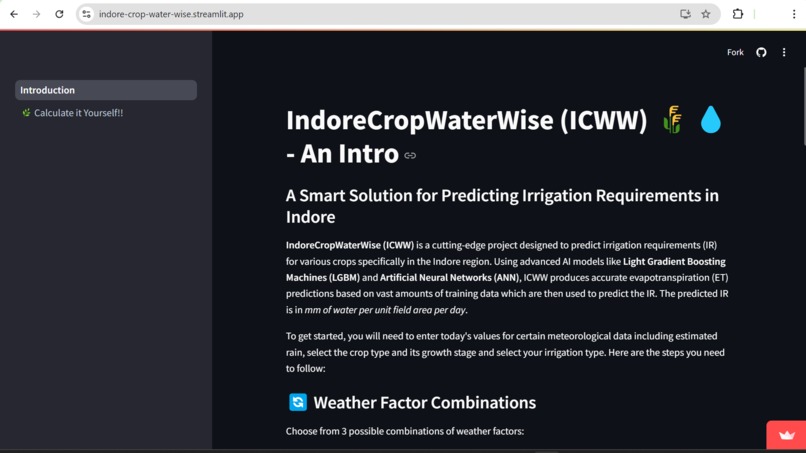
Introduction page of the app, providing all the necessary instructions to use it.
-
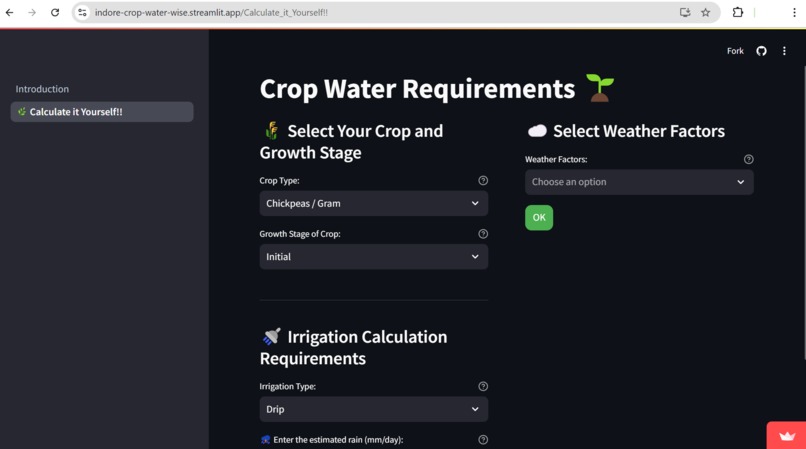
Main page of the app. Enter the required weather data and calculate the irrigation requirement for your crop.
Intrdouction - The Water Crisis in Indore
Indore, the largest city in Madhya Pradesh, is facing severe water scarcity due to the rapid depletion of groundwater resources. The groundwater level has dropped from 150 metres in 2012 to a staggering 560 feet (about 170 metres) in 2023 due to the overexploitation and unsustainable water use practices.
The Challenge - Agricultural Water Management
Agriculture plays a significant role in Indore’s water crisis, with around 48% of the city’s total water supply being used for irrigation. Aggravating the situation, inefficient irrigation practices contribute to substantial water wastage with a significant portion of water being lost through evaporation, runoff, and inefficient application methods. Hence, there is a very urgent need to implement efficient irrigation practices in Indore to tackle the increasing water scarcity, decreasing crop yields and higher water costs farmers are facing.
The Inspiration - The Personal Connection
Growing up, I was surrounded by the world of farming and irrigation, thanks to my father's work in manufacturing drip irrigation systems. My fascination with agriculture was seeded early on, but it wasn't until I witnessed the devastating water crisis and the large-scale inefficient irrigation practices in Indore that I felt compelled to take action.
The Solution - Intro to Indore Crop Water Wise (ICWW)
IndoreCropWaterWise (ICWW) is a project designed to determine the irrigation requirements of crops in Indore. It uses advanced AI models to predict how much water will be lost from the crops (Evapotranspiration). Based on these predictions, it calculates the amount of water required for irrigation each day to keep the crops healthy (Gross Irrigation Requirement).
ET0 and ETc
Reference Evapotranspiration (ET0) measures the water loss from a standard reference crop, typically a well-watered grass. It considers factors like plant height, surface resistance, and how much solar radiation is reflected. To find out how much water a specific crop needs, you multiply ET0 by a crop-specific coefficient, which gives you the crop's actual water requirement (ETc).
Calculating ET0 and ETc
The FAO-56 Penman-Monteith equation is the best method for calculating ET0 but needs extensive weather data, which is hard to get in places like Indore. Instead, ICWW uses AI models trained on 37 years of data to predict ET0 and ETc accurately, using minimal data like temperature and/or wind speed, or more complete data including humidity and pressure.
Data Collection
To train the AI models, I created a dataset from weather data for Indore (January 1, 1985, to December 31, 2022) sourced from this NASA POWER website. This data included surface pressure, temperatures, humidity, wind speed, and radiation measures. Net Radiation was calculated from certain radiation data, and daily ET0 was then computed using the FAO Penman-Monteith Equation with the remaining variables.
Artificial Neural Network (ANN)
The first AI model trained was an ANN. It was composed of three layers: an input layer, four hidden layers, and an output layer. The input layer takes the weather data (temperature, humidity, wind speed, surface pressure, net radiation), the hidden layers use non-linear functions to analyze complex patterns and the output layer provides the ET0 prediction.
Light Gradient Boosting Machine (LGBM)
The LGBM model predicts outcomes using decision trees that split data based on conditions. LGBM builds many small decision trees in sequence, each correcting the previous tree’s errors. For predicting ET0, LGBM was trained with the same weather data as the ANN model. It used default settings—a learning rate of 0.01, 100 trees, and 3 leaves per tree—which often performed similar to or better than customized settings. This approach ensured the model was both effective and computationally efficient.
Selecting Input Combinations
Both models were originally trained on 6 input combinations but taking into account ET0 prediction accuracy and data availability, the following 3 meteorological input combinations were finalised:
- Mean Temperature (C), Maximum Temperature (C), and Minimum Temperature (C):
- Mean Temperature (C), Maximum Temperature (C), Minimum Temperature (C) and Wind Speed (m/s):
- Mean Temperature (C), Maximum Temperature (C), Minimum Temperature (C), Wind Speed (m/s), Relative Humidity (%) and Surface Pressure (kPa):
Model Selection
Model performance on the testing subset was assessed using MAE, RMSE, and R². The model with the lowest MAE and RMSE and the highest R² was chosen for ET0 prediction. The LGBM model was selected for combination 1, while ANN models were chosen for combinations 2 and 3.
Model Performance
- The LGBM model used for combination 1 has an MAE of 0.697, RMSE of 0.924 and an R2 of 0.889.
- The ANN model used for combination 2 has an MAE of 0.452, RMSE of 0.570 and an R2 of 0.958.
- The ANN model used for combination 3 has an MAE of 0.373, RMSE of 0.469 and an R2 of 0.972.
Calculating GIR
After predicting the ET0, this happens:
- The ET0 is adjusted based on the crop type and growth stage to calculate the ETc - the evapotranspiration adjusted for the crop. The ETc equals the Crop Water Requirement (CWR).
- The estimated rain is used to calculate the effective precipitation - the amount of rain actually available to the crop.
- The effective precipitation is subtracted from CWR to calculate the net irrigation requirement (NIR).
- The NIR is adjusted for the irrigation efficiency which varies based on the irrigation type to calculate the Gross Irrigation Requirement (GIR). This output to the user.
Impact and Future Scope
In India, agriculture consumes about 89% of the nation’s water, yet irrigation efficiency averages only 38% due to widespread use of traditional flood irrigation methods, which result in substantial water loss. Modern micro-irrigation techniques, such as drip and sprinkler systems, offer higher efficiencies (80-95%) but still struggle with precisely determining the optimal amount of water for plants. Our ICWW project aims to address this issue by reducing water wastage and boosting crop yields through advanced AI models. This approach is scalable and can be applied to numerous regions, provided there is access to accurate meteorological data.
Next Steps
- Expand Crop Types: Incorporate additional crop varieties for broader applicability.
- Enhance Meteorological Data: Integrate region-specific data to improve ET0 predictions.
- Improve ET0 Accuracy: Collect data directly from the City Meteorological Department for precise model training.
- Forge Local Partnerships: Collaborate with agricultural bodies to deliver the tool to farmers.
- Promote Sustainability: Aim for more efficient and sustainable water use in agriculture.
Built With
- lightgbm
- numpy
- pandas
- python
- scikit-learn
- streamlit
- tensorflow


Log in or sign up for Devpost to join the conversation.