-
-
Predicting Sign Langauage
Inspiration
The inspiration for the Indian Sign Language Communicator came from witnessing the communication gap between two differently-abled communities: deaf/mute individuals, who express themselves using Indian Sign Language (ISL), and blind individuals, who rely on auditory or tactile feedback. During a visit to a special education center, I noticed that while both groups had tools to aid communication within their communities, there was no effective way for them to communicate with each other. This realization deeply moved me and sparked the idea to create an inclusive solution that bridges this gap using technology.
What it does
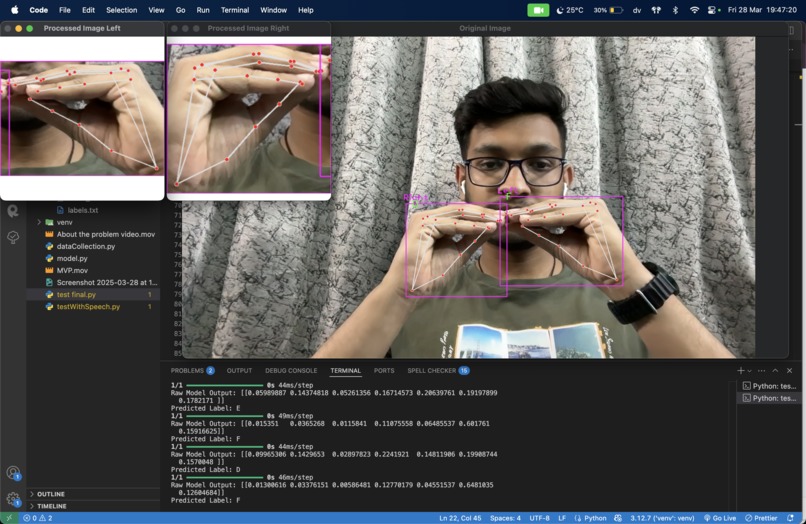
This project captures Indian Sign Language gestures using a camera, processes them through a machine learning model, and converts them into either audible speech or Braille/tactile output. This enables a deaf/mute person to "speak" to a blind person. The system also works in reverse—text or speech can be converted into vibration patterns or visual output for deaf/mute users. The goal is to create a real-time communication bridge between the two communities, promoting inclusion, independence, and mutual understanding.
How we built it
We built the system using:
- A webcam or camera module to capture sign language gestures.
- A Convolutional Neural Network (CNN) trained on a dataset of ISL alphabets and common gestures.
- Python and OpenCV for image processing and gesture recognition.
- A Text-to-Speech (TTS) engine to vocalize recognized signs.
- A Braille display or vibration feedback system for output accessible to the blind.
We focused on creating a user-friendly, real-time experience by optimizing gesture recognition and ensuring the system works under varied lighting and background conditions.
Challenges we ran into
We faced several key challenges:
- Data scarcity: Finding or building a comprehensive, high-quality dataset for Indian Sign Language was difficult.
- Gesture variability: Hand shapes, angles, and lighting conditions affected recognition accuracy.
- Real-time performance: Ensuring fast and accurate processing without lag.
- Accessibility testing: Simulating blind user experience and testing Braille/vibration feedback with limited resources.
- Hardware constraints: Integrating Braille output devices or haptic modules required careful design and testing.
Accomplishments that we're proud of
We’re proud of:
- Developing a working prototype that translates ISL to speech in real time.
- Building a machine learning model with a decent recognition rate despite a limited dataset.
- Designing the project with inclusive user experience in mind.
- Raising awareness about the communication barriers faced by these communities.
What we learned
Through this project, we learned:
- The technical intricacies of gesture recognition and image classification using machine learning.
- How to apply assistive technologies like TTS output to real-world problems.
- The importance of inclusive design thinking and empathy-driven development.
- That even small innovations can have a huge social impact when targeted at the right problem.
What's next for Indian Sign Language Communicator
Looking ahead, we plan to:
- Expand the gesture dataset to include full words, sentences, and contextual signs.
- Improve accuracy using more advanced deep learning models and pose estimation.
- Develop a mobile app version for portability and real-world usability.
- Collaborate with special education institutions and NGOs for field testing and feedback.
- Integrate with wearable haptic devices or smart glasses for hands-free interaction.
The ultimate goal is to make this tool a freely available, accessible communication platform that empowers both deaf/mute and blind individuals to connect and thrive together.

Log in or sign up for Devpost to join the conversation.