-
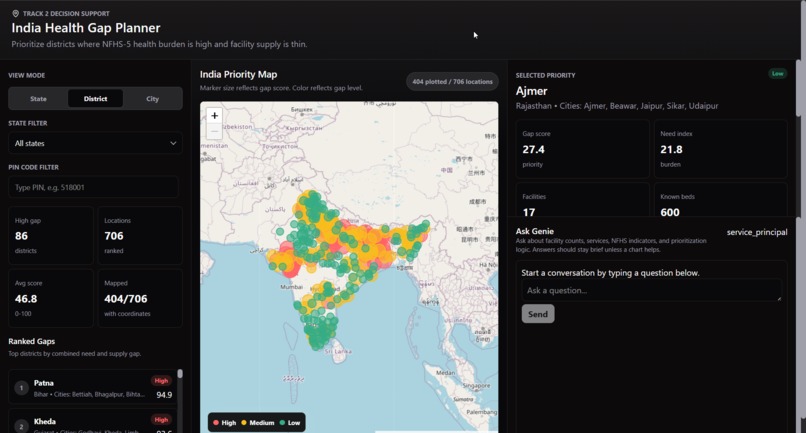
English - screen
-
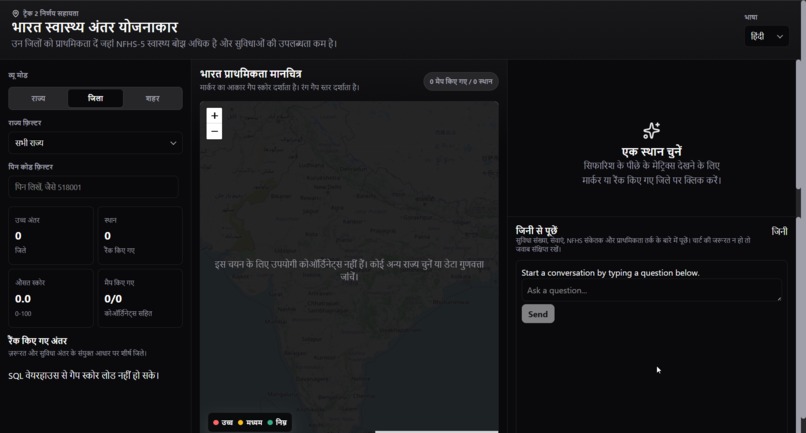
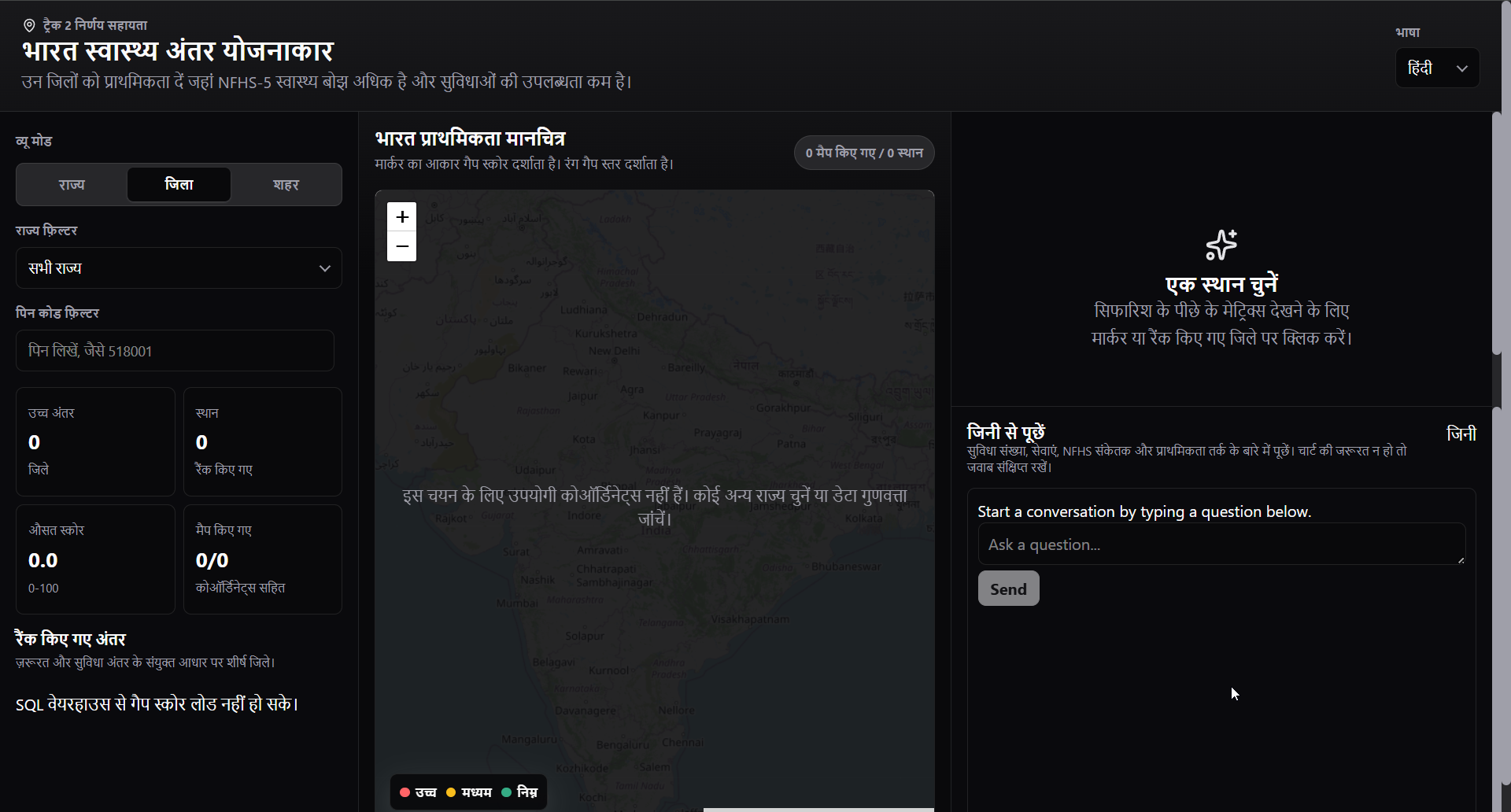
Hindi - language screen
-
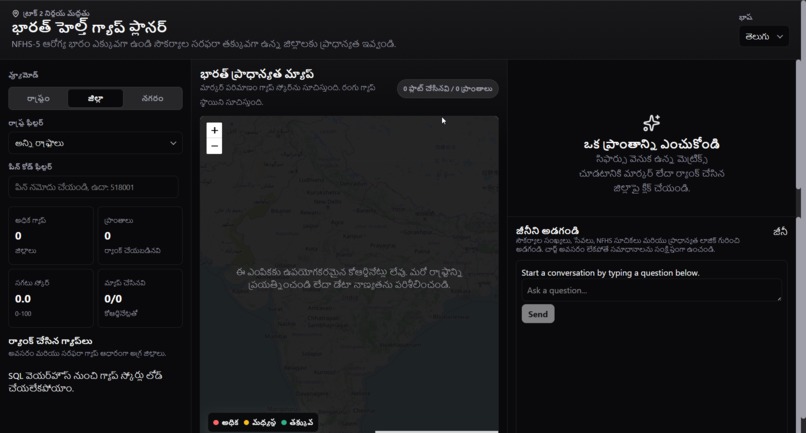
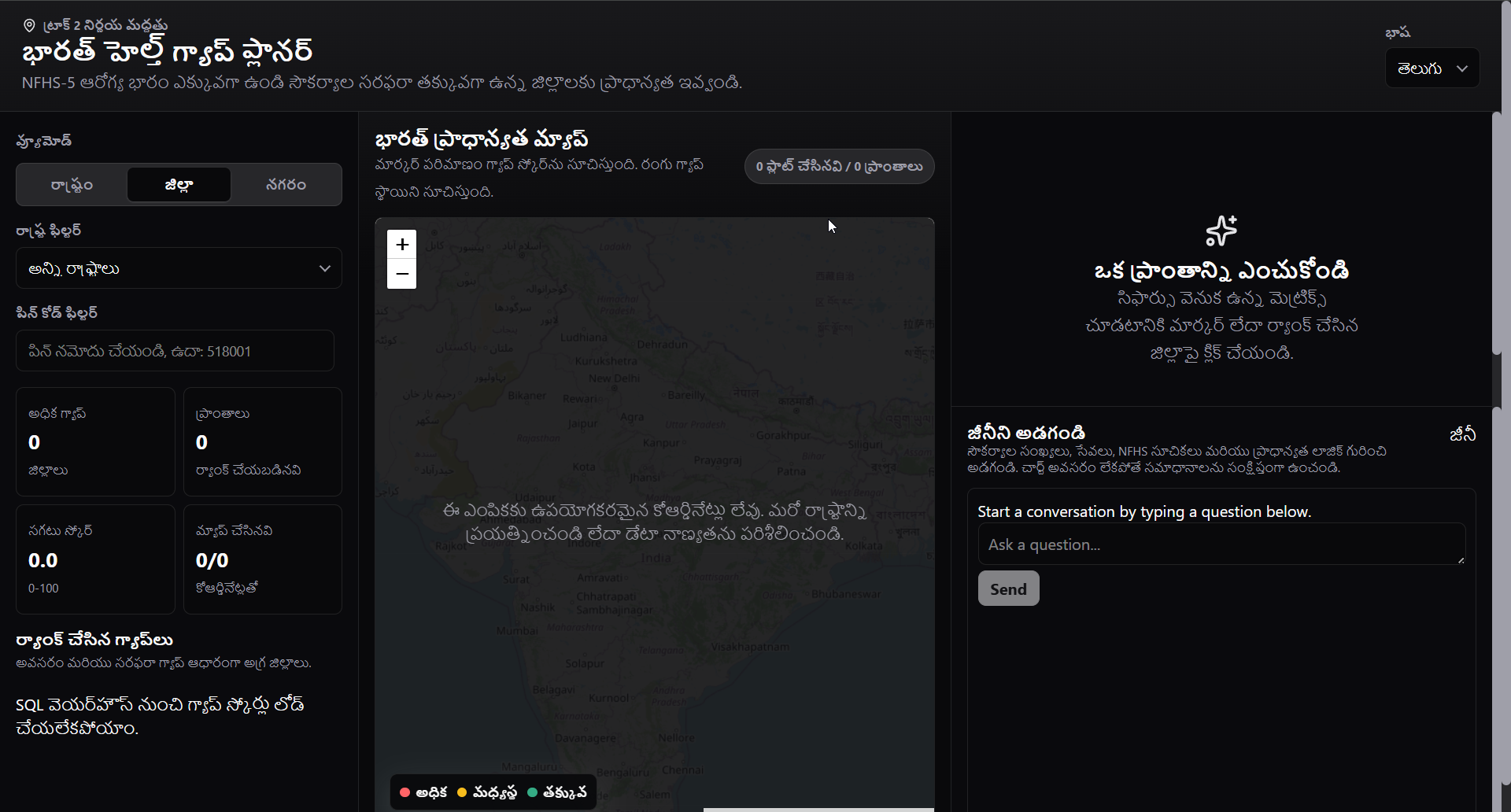
Telugu - language screen
-
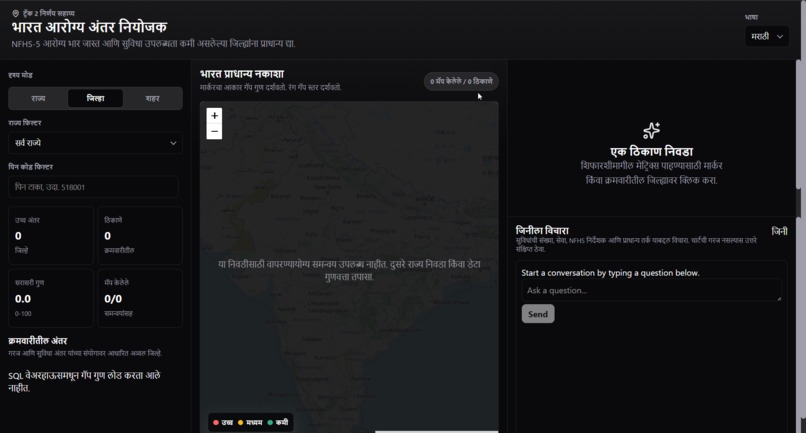
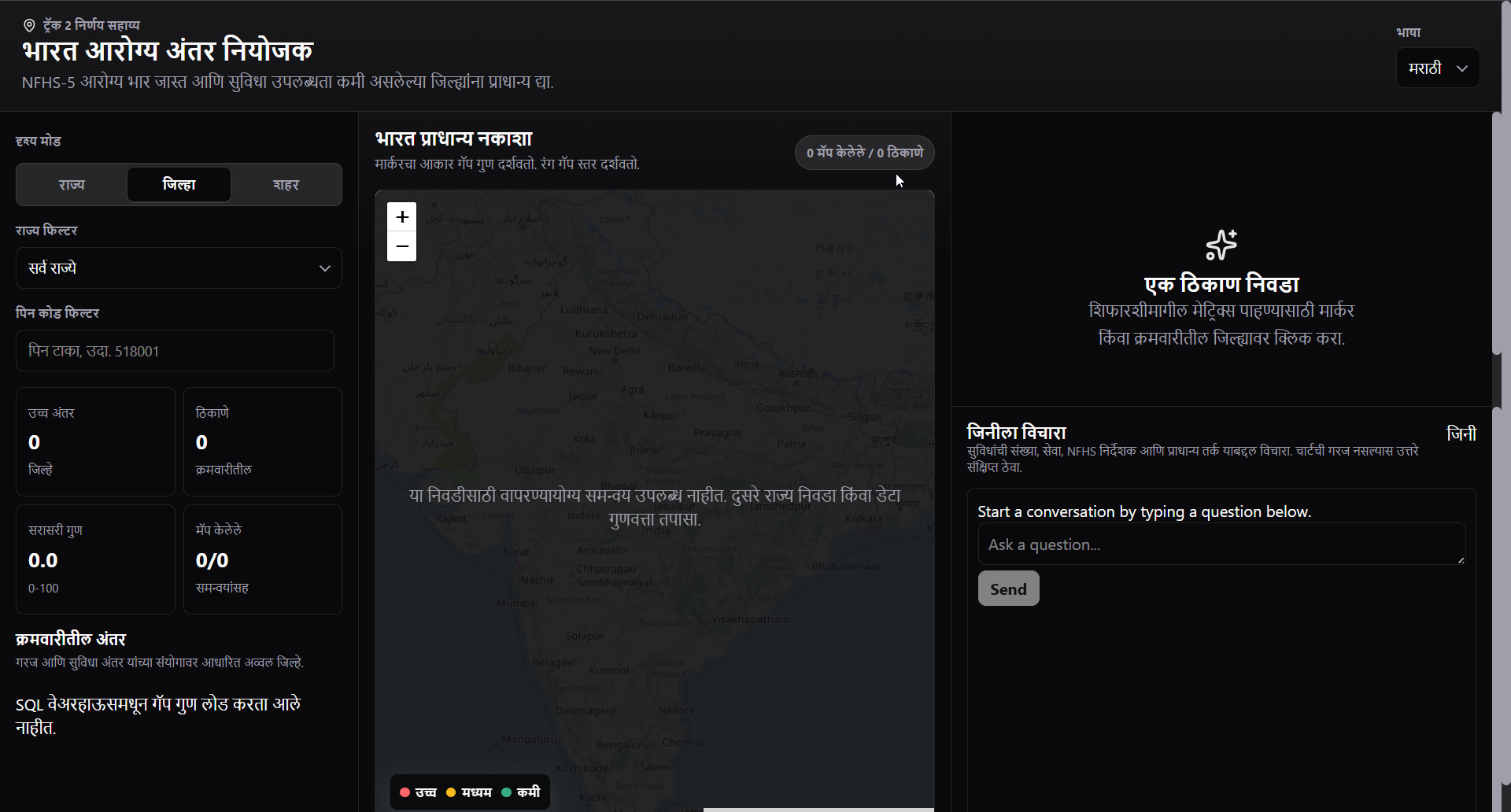
Marathi - language screen
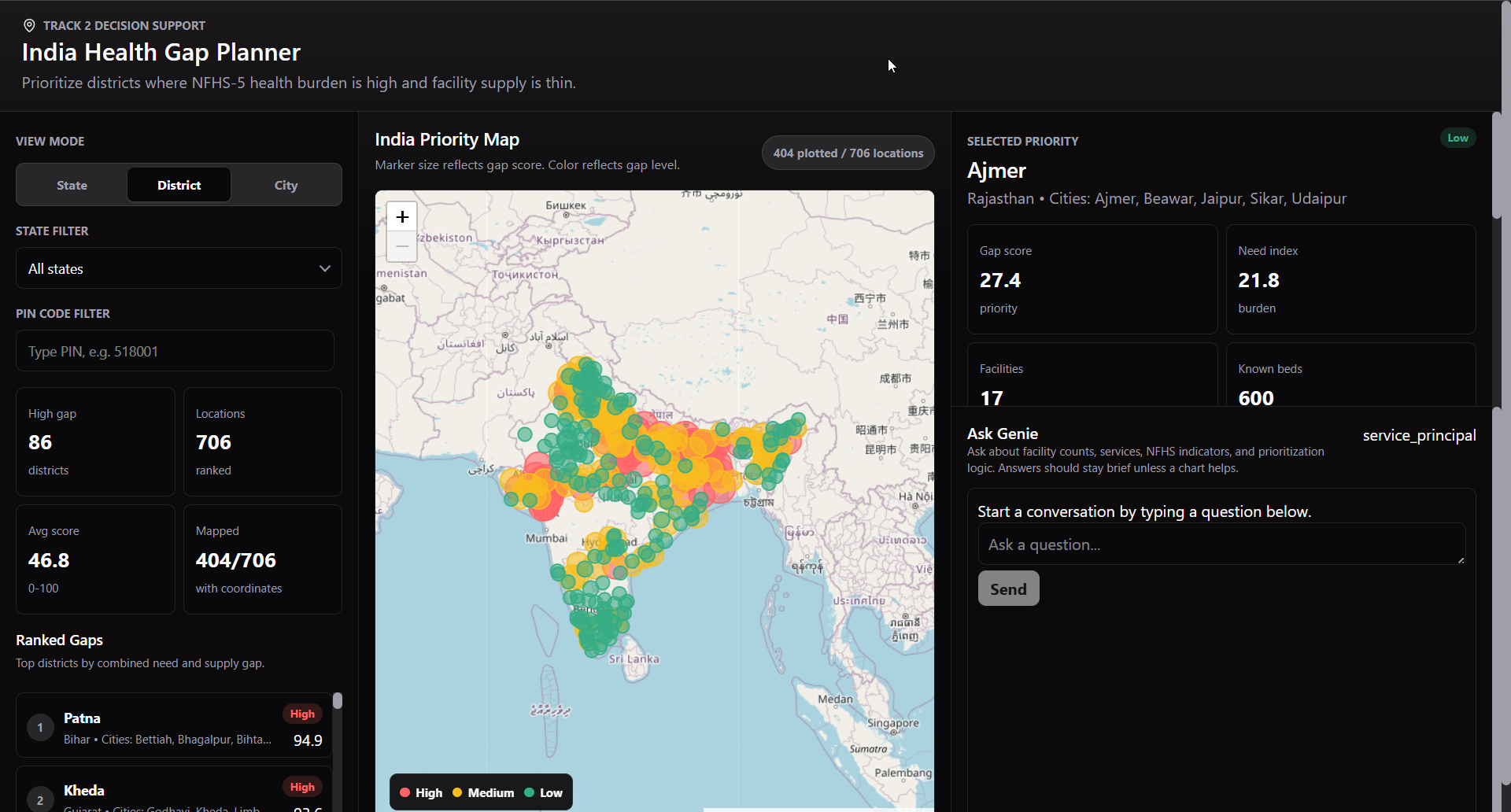
India Health Gap Planner is a decision-support app for the Track 2: Medical Desert Planner challenge. It helps planners answer a deceptively hard question: where are the highest-risk gaps in care, and how confident are we that those gaps are real?
The inspiration came from a common public health problem: limited resources are often allocated using incomplete, fragmented, or hard-to-compare evidence. A district may look underserved because facilities are truly sparse, or because the data is thin, stale, or missing coordinates. Our goal was to make that distinction visible to a non-technical planner.
The app lets a planner:
Explore an interactive India map by state, district, or city/PIN proxy. Filter by state or PIN code. See ranked care gaps based on health burden, facility supply, service coverage, and evidence availability. Click a location to inspect the score, need index, facility count, beds, doctors, diagnostics, service gaps, and decision rationale. Ask Genie natural-language questions about facility counts, services, NFHS indicators, and prioritization logic. Save planning scenarios and notes into Lakebase for follow-up review. How We Built It We built the project as a Databricks App using:
Unity Catalog and Databricks SQL for governed analytics over the provided facility, postal, and NFHS-5 datasets. Gold tables that normalize geography, clean mixed data types, and aggregate district-level planning signals. React + Databricks AppKit for the planner workflow. Leaflet for the interactive map. Databricks Genie for natural-language exploration of the curated dataset. Lakebase Postgres for persisted saved scenarios. OpenAI Codex in VS Code for rapid coding, debugging, UI iteration, and deployment troubleshooting. The gap score is designed as an explainable planning signal:
Gap Score = Health Need + Supply Shortage + Service Missingness - Evidence Confidence Penalty The Need Index summarizes health burden from NFHS-5 indicators. Supply signals include facility count, beds, doctors, diagnostics, and service capability flags. The confidence layer helps avoid overstating a gap when the underlying facility evidence is sparse or poorly geocoded.
Challenges We Faced The provided data was realistic, which meant it was messy. We dealt with:
Mixed column types across source tables. Malformed numeric values and Unicode escape issues. District, city, and PIN inconsistencies. Missing or unreliable coordinates. AppKit type generation failures caused by complex SQL enrichment. Deployment build issues while iterating quickly under hackathon time pressure. We solved these by casting raw inputs defensively, creating cleaned silver/gold layers, keeping the UI tolerant of missing values, and communicating uncertainty directly in the planner workflow.
What We Learned The biggest lesson was that a useful AI app is not just a chat box. For high-stakes planning, the app needs:
A clear workflow. Explainable scoring. Evidence drilldown. Persistence for human decisions. Explicit uncertainty language. Genie is valuable when paired with structured metrics and a map because planners can move fluidly between “show me the priority list” and “why is this district ranked this way?”
Why It Matters This project can help governments, NGOs, CSR foundations, and healthcare operations teams target interventions such as mobile clinics, diagnostic vans, maternal health campaigns, facility upgrades, and referral network improvements.
Instead of treating every red zone as equally certain, the app helps planners distinguish:
Likely real care gaps, where need is high and facility supply is low. Data-poor regions, where more verification is needed before committing resources. That distinction can prevent wasted funding and help underserved communities receive the right intervention faster.
Future Extensions Next steps include:
Facility Trust Desk for reviewing suspicious, stale, or duplicate records. Referral Copilot for identifying nearest capable facilities. Scenario Simulator to estimate impact from adding beds, staff, diagnostics, or mobile clinics. Stronger source citations from facility text for every score and recommendation. Exportable shortlists for district officials, NGO partners, and grant reviewers. Monetization The project could become a mission-driven planning platform with:
Subscription access for CSR foundations, NGOs, insurers, and health-system planners. Implementation support for public-sector programs. Paid data-quality monitoring and scenario modeling. Discounted or sponsored tiers for nonprofits and local public health teams. The core business value is helping organizations deploy scarce healthcare resources with more confidence, transparency, and measurable impact.
Language is a barrier in India, so users should be able to select language options within the app to improve accessibility and usability across diverse populations
Built With
- codex
- databricks
- databricksapp
- genie
- lakebase
- react


Log in or sign up for Devpost to join the conversation.