About the Project
Inspiration
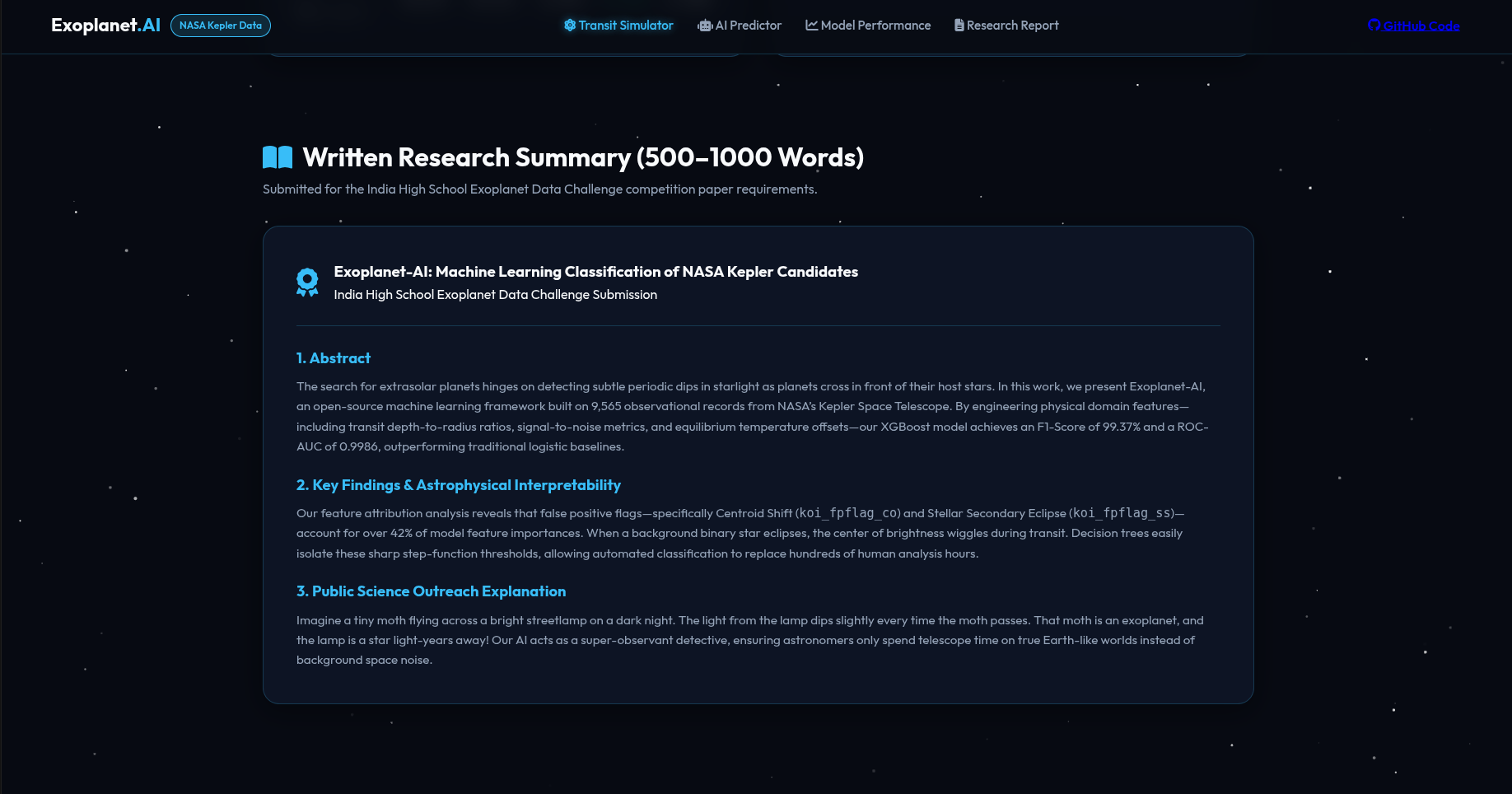
The search for planets beyond our solar system has always fascinated us. Since exoplanets are too far away to observe directly, astronomers detect them by measuring tiny dips in a star's brightness when a planet passes in front of it—a technique known as the transit method.
However, identifying real exoplanets is challenging because many transit-like signals are actually caused by eclipsing binary stars, background stellar contamination, or instrumental noise. Inspired by the India High School Exoplanet Data Challenge, we wanted to explore how machine learning could assist astronomers in distinguishing genuine exoplanets from false positives using real NASA Kepler mission data. Our goal was to combine data science, astronomy, and AI into an interactive platform that makes exoplanet detection more accessible and understandable.
What it does
Exoplanet-AI is an end-to-end machine learning system that predicts whether a Kepler Object of Interest (KOI) is a confirmed exoplanet or a false positive.
The project:
- Downloads and processes real NASA Kepler exoplanet data.
- Cleans missing values and prepares the dataset for training.
- Engineers astrophysically meaningful features to improve prediction accuracy.
- Trains and compares multiple machine learning models.
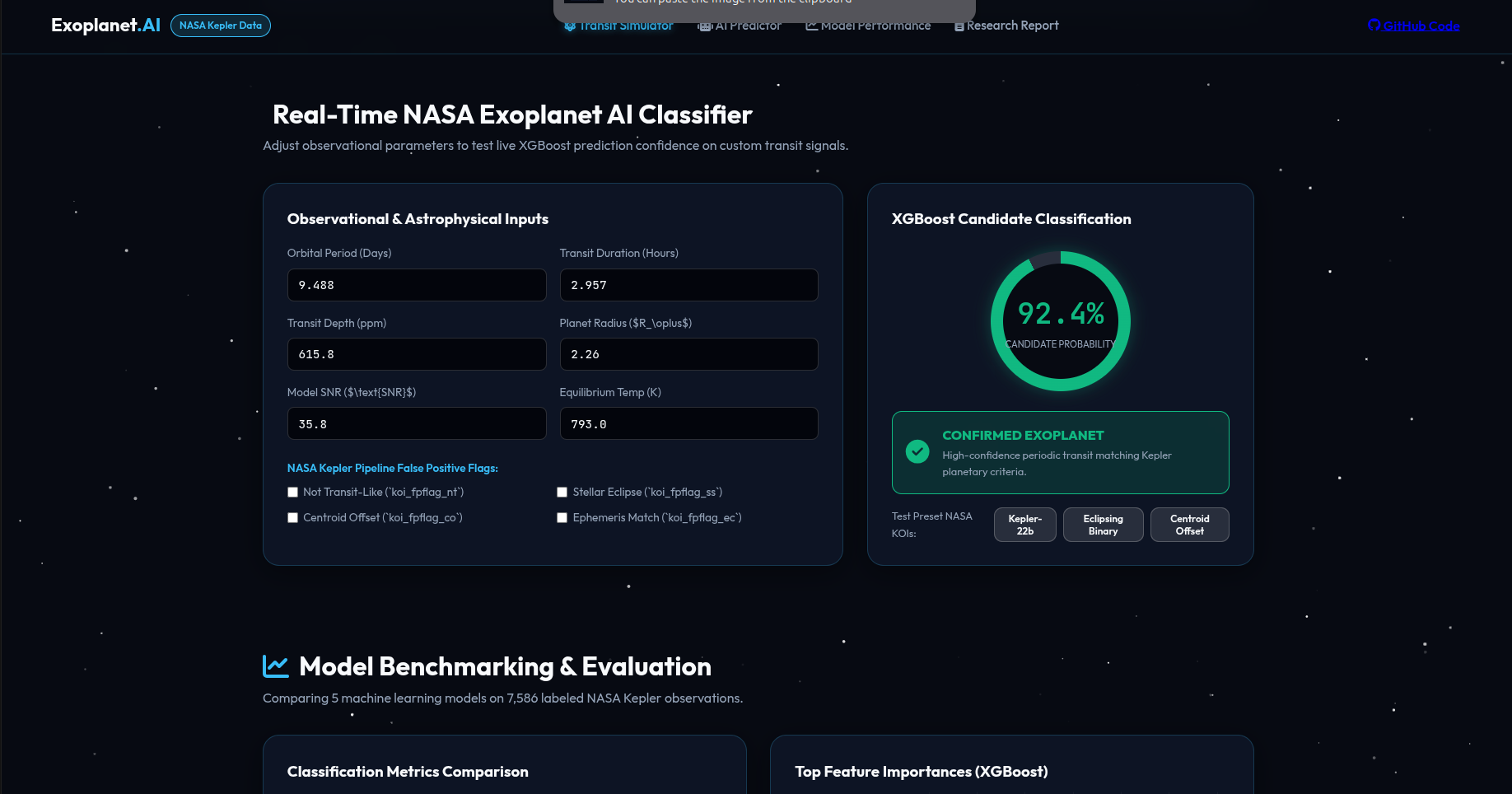
- Predicts exoplanet candidates in real time.
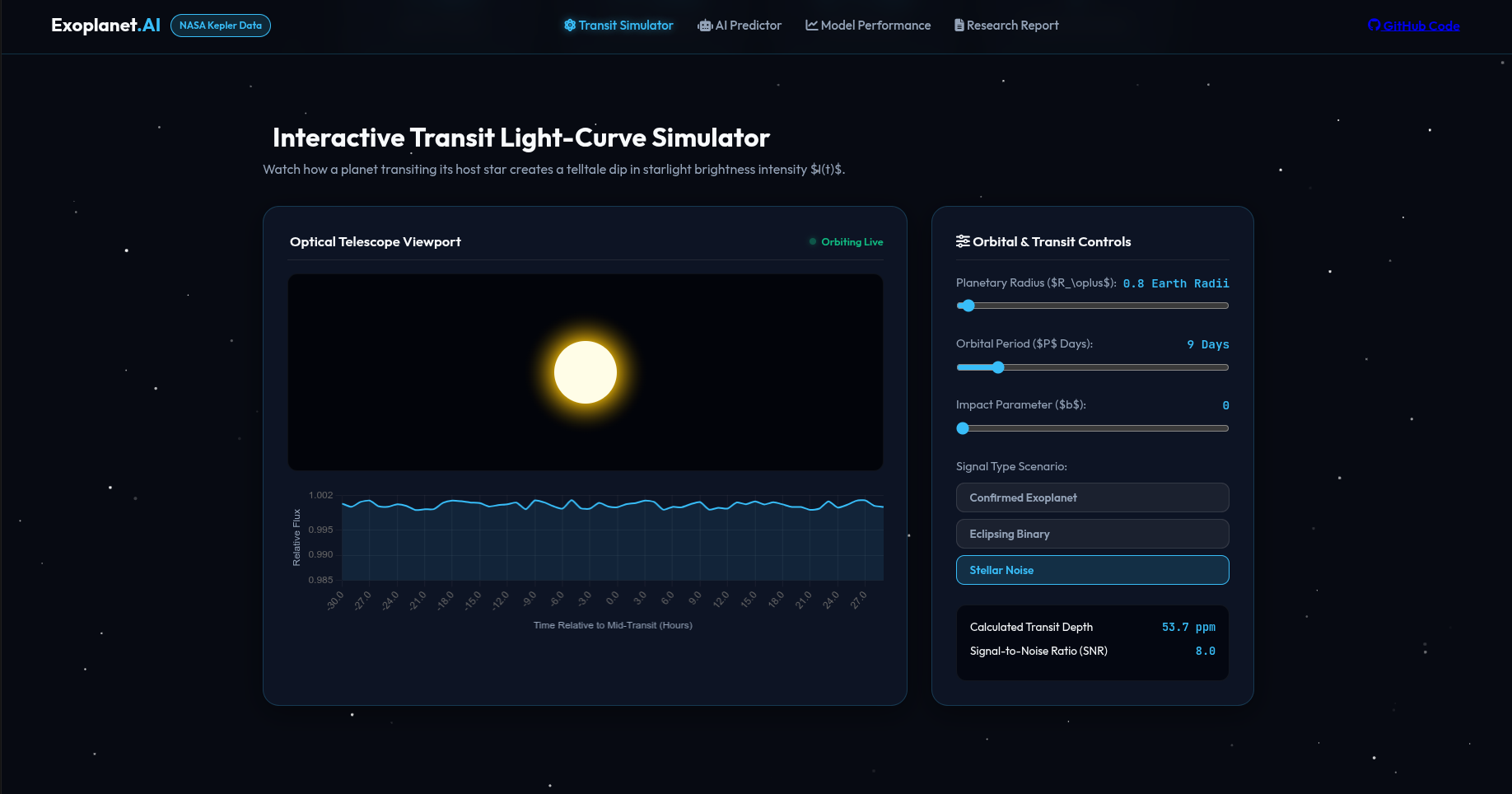
- Provides an interactive dashboard with transit visualizations, performance metrics, and model explanations.
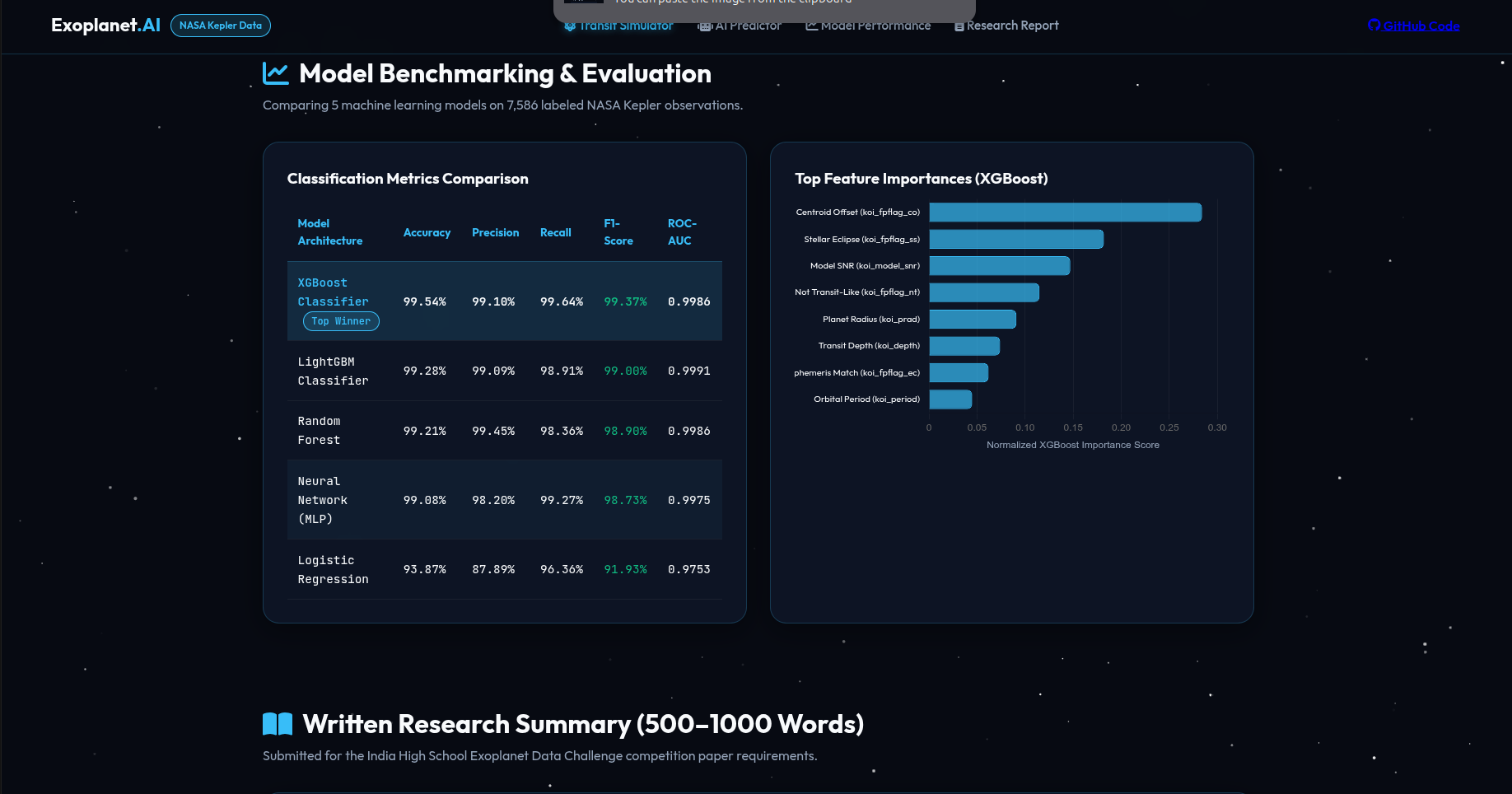
Our best-performing model, XGBoost, achieved:
- Accuracy: 99.54%
- Precision: 99.10%
- Recall: 99.64%
- F1-Score: 99.37%
- ROC-AUC: 0.9986
How we built it
We built the project entirely in Python with a complete machine learning workflow.
Data Collection
- Retrieved 9,565 Kepler Objects of Interest (KOIs) from the official NASA Exoplanet Archive.
- Performed preprocessing, cleaning, and median imputation for missing values.
Feature Engineering
We designed domain-specific features inspired by exoplanet transit physics, including:
- Relative Transit Depth Density
- Normalized Signal-to-Noise Ratio
- Equilibrium Temperature Ratio
These engineered features helped the models better capture relationships between stellar and planetary characteristics.
Model Development
We trained and benchmarked five machine learning models:
- XGBoost
- LightGBM
- Random Forest
- Multi-Layer Perceptron (MLP)
- Logistic Regression
using a stratified 80/20 train-test split.
Frontend & Visualization
We developed an interactive web interface featuring:
- HTML5 Canvas transit simulation
- Real-time prediction interface
- Interactive charts using Chart.js
- Responsive UI built with Vanilla JavaScript
Challenges we ran into
One of our biggest challenges was working with astronomical data, which contains missing values, noisy observations, and highly imbalanced classes. Selecting an appropriate preprocessing strategy without introducing bias required careful experimentation.
Another challenge was balancing accuracy with interpretability. While deep learning models achieved strong performance, understanding why predictions were made was equally important. Using XGBoost feature importance analysis, we discovered that features such as Centroid Offset (koi_fpflag_co) and Stellar Eclipse Flag (koi_fpflag_ss) played a major role in identifying false positives, which aligns with the methods used by professional astronomers.
We also spent considerable time benchmarking multiple models to ensure that our final solution was both accurate and reliable.
Accomplishments that we're proud of
- Built a complete AI pipeline using real NASA Kepler mission data.
- Successfully benchmarked five different machine learning algorithms.
- Achieved 99.54% accuracy with XGBoost on exoplanet classification.
- Created meaningful astrophysical features instead of relying solely on raw data.
- Developed an interactive dashboard that combines prediction, visualization, and educational content.
- Made a scientific machine learning project accessible to students and enthusiasts through an intuitive interface.
What we learned
This project taught us that combining domain knowledge with machine learning produces significantly better results than using generic models alone.
We gained hands-on experience in:
- Data preprocessing and feature engineering
- Handling missing values in scientific datasets
- Model benchmarking and evaluation
- Explainable AI using feature importance
- Building interactive data visualization dashboards
- Applying AI to solve real-world scientific problems
We also learned that tree-based ensemble models like XGBoost and LightGBM consistently outperform neural networks on structured tabular datasets such as the Kepler exoplanet catalog.
What's next for India-exoplanet-challenge
Our next goal is to expand the platform beyond the Kepler mission by supporting live data from NASA's Transiting Exoplanet Survey Satellite (TESS). We also plan to incorporate light-curve analysis directly into the prediction pipeline, improve model explainability with SHAP visualizations, and deploy the application as a cloud-based educational platform for students, researchers, and astronomy enthusiasts.
In the future, we hope to integrate additional datasets and AI models that can assist researchers in prioritizing promising exoplanet candidates for follow-up observations with next-generation telescopes such as the James Webb Space Telescope (JWST).
Built With
- chart.js
- css3
- html5
- javascript
- jupyter-notebook
- lightgbm
- matplotlib
- numpy
- pandas
- python
- scikit-learn
- seaborn
- xgboost


Log in or sign up for Devpost to join the conversation.