Inspiration
I've always loved building things. I'm a conscious vibe coder — someone who builds neat projects as a hobby because I genuinely want to solve real-world problems and make someone's life just a little bit easier.
But I kept hitting the same heartbreaking wall, and it's a wall the entire world of builders is facing without realizing it yet.
I'd spend weeks pouring my heart into a helpful tool, launch it online, and... nothing. When I went to ChatGPT or Perplexity and asked for "the best tools for [my exact problem]," the AIs only recommended giant, outdated corporate websites. They completely ignored my project because they didn't even know it existed.
It made me realize that traditional search is dying, and independent creators are being left in the dark. Over 80% of AI-cited sources do not overlap with top-ranked Google pages anymore. If AI search engines only recommend a handful of internet giants, the open, diverse web will die.
That was the spark for Indexer.
What It Does
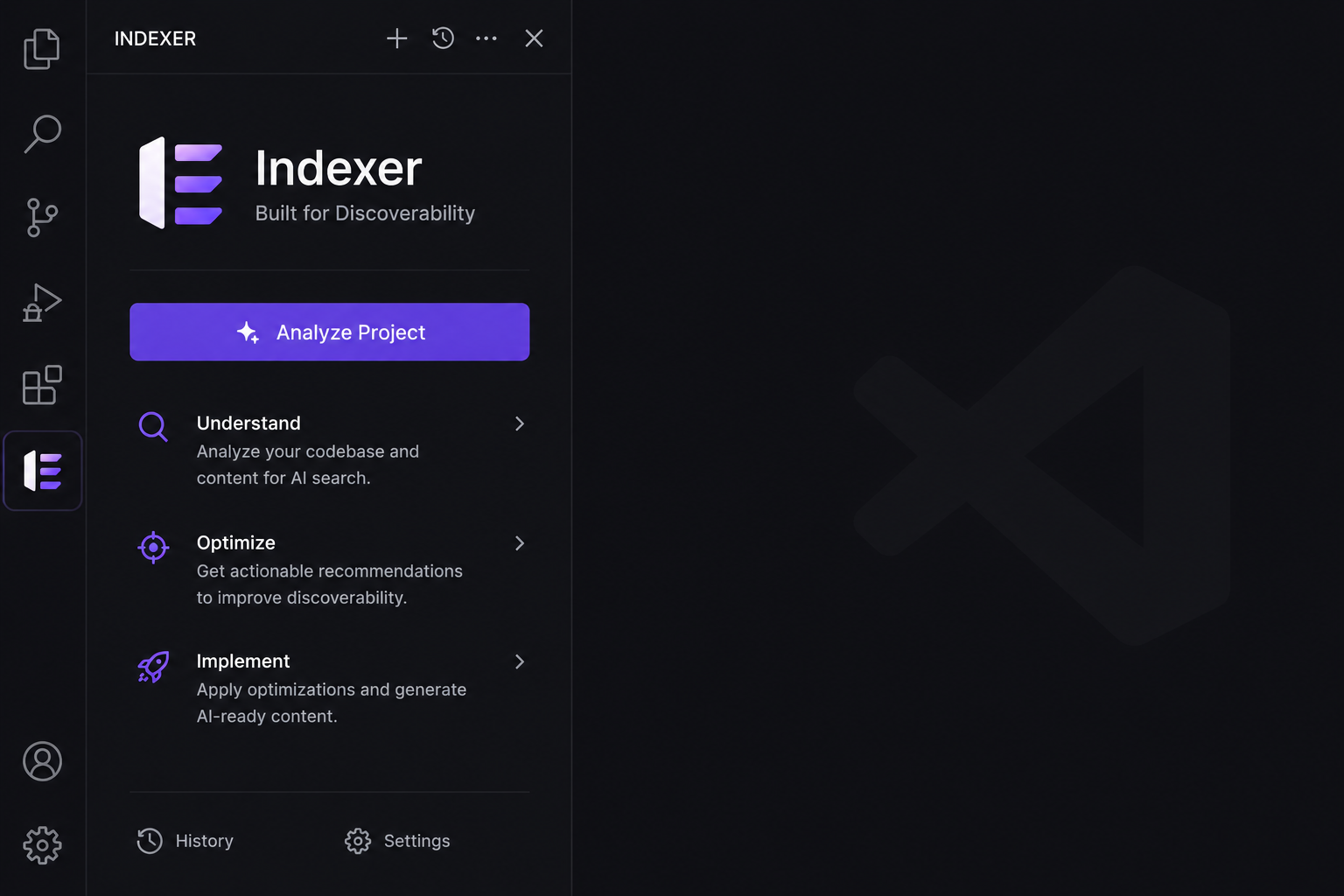
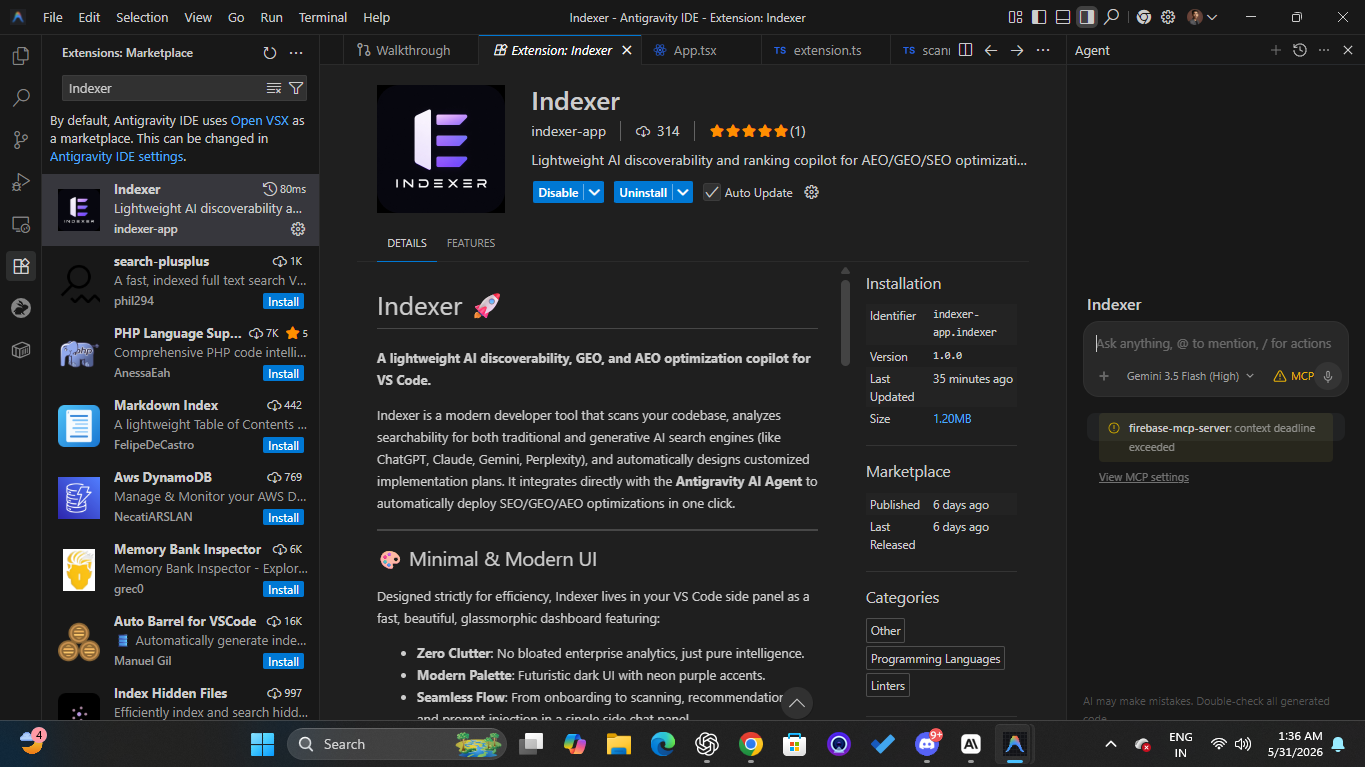
Indexer is a friendly, lightweight extension built directly into the Antigravity IDE. It scans your local codebase, identifies why AI search engines are ignoring your files, and generates custom-tailored prompts to automatically optimize your project.
Instead of dealing with complex marketing dashboards — you run an audit, click one button, and let your IDE's AI assistant instantly write the necessary files like sitemaps, structured schemas, and the crucial llms.txt crawler gateway.
The Problem It Solves
More and more people ask ChatGPT, Gemini, and Perplexity for recommendations instead of scrolling through Google links. Over 80% of AI-cited sources do not overlap with traditional Google results anymore.
If AI bots cannot digest your codebase or understand your niche, your project simply does not exist to the AI engines.
Indexer levels the playing field for everyday developers and vibe-coders using three core pillars:
- SEO — Making you visible to traditional search crawlers
- GEO — Making sure AI search engines can crawl, read, and cite your project
- AEO — Restructuring headings into conversational questions so AI systems serve your content as direct answers
Key Features
Deep Workspace Scanner Automatically detects your project framework (Next.js, React, Vite, Astro, Nuxt, or static HTML) and audits file structure, missing sitemaps, robots rules, and meta headers.
5-Question Onboarding Wizard A beautiful sidebar UI built in React that captures your target keywords, audience, niche, and goals in plain, non-technical English.
"Inject to Antigravity AI" Pipeline With one click, it writes the master Indexer Skill.md instructions into your project, copies a custom prompt to your clipboard, and opens it side-by-side in your editor — ready to use directly with the AI agent.
Challenges We Ran Into
Building an extension was a massive learning curve. I had never built an IDE tool before, and there were many moments where I felt completely out of my depth.
At 2:00 AM on a quiet night, I remember staring at my screen, feeling deeply frustrated. Getting the sidebar UI to talk securely to the editor felt like trying to learn a whole new language. I spent hours reading tutorials, copying templates, and hitting walls where buttons wouldn't click and the clipboard API kept failing inside the secure sandbox.
There were times when imposter syndrome hit hard, and I thought — "Maybe I'm not a real developer."
But I took a deep breath, simplified the code, routed the copy actions through the extension host, and built an interactive console log panel so users could actually see the scanner working. We pushed through the doubt, and it felt amazing when it finally worked.
What's Next for Indexer
This is just the beginning.
The discoverability problem for independent developers is only going to get worse as AI search becomes the default way people find tools and resources. Indexer needs to grow with that reality.
The next step is a live discoverability score — a real-time dashboard inside the IDE that tracks how visible your project actually is across ChatGPT, Perplexity, and Gemini, and shows you exactly what changed after each optimization.
After that, we want to build auto-monitoring — Indexer quietly watches in the background and alerts you when a new AI crawler standard drops or when your project's citation rate changes, so you never fall behind again.
Longer term, the vision is to make Indexer framework-agnostic and IDE-agnostic — available to every developer, not just those on Antigravity. Because the problem we're solving isn't an Antigravity problem. It's a problem every builder with a passion project faces the moment they hit publish.
No one who builds something meaningful should be invisible. That's the mission.
Built With
- claude
- css
- gemini
- html
- javascript
- markdown
- react
- tailwind
- typescript


Log in or sign up for Devpost to join the conversation.