-
-
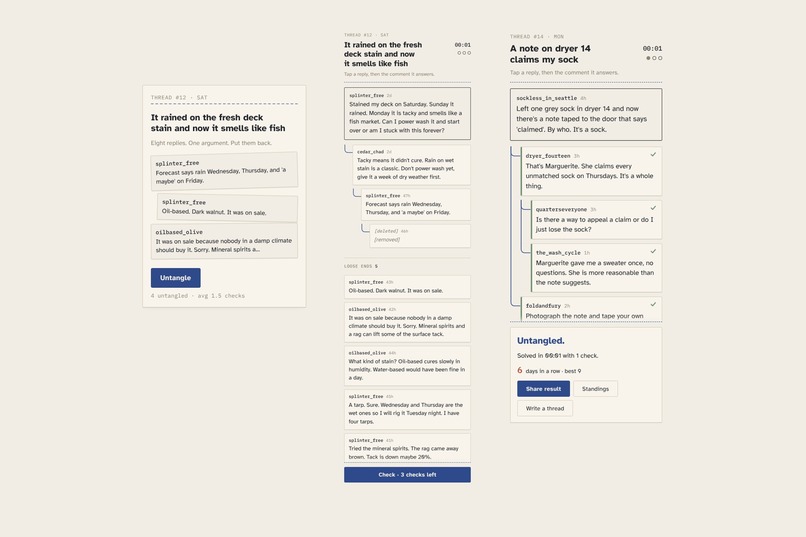
Feed card, a Saturday puzzle mid-solve, and the result sheet
-
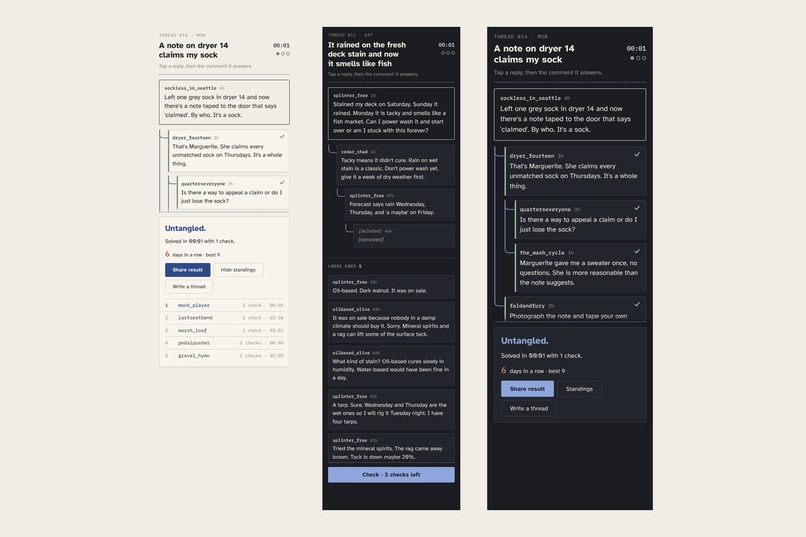
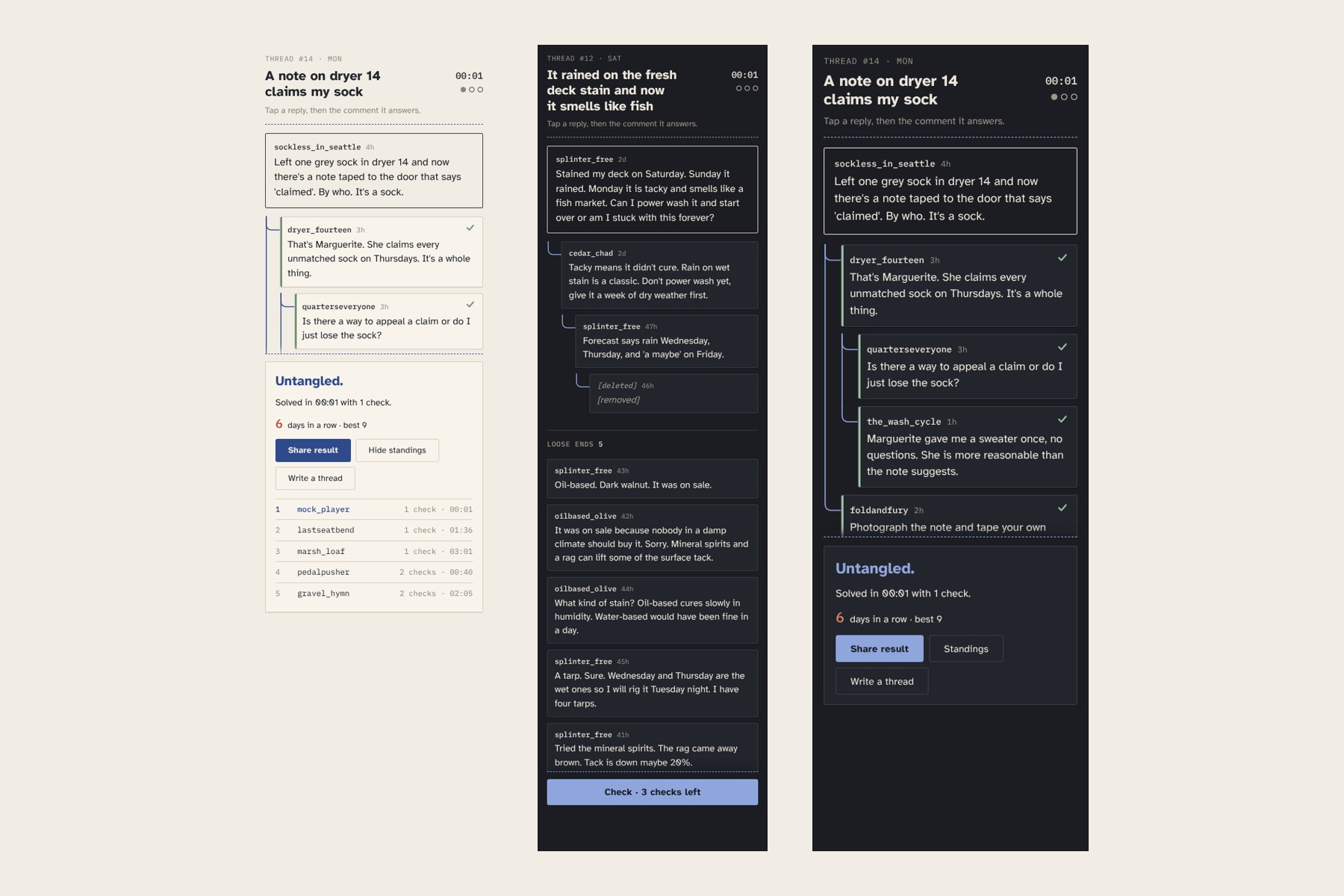
Daily standings, and the board in dark mode
Inspiration
Every Reddit user can read a comment thread at a glance: who replied to whom, who got corrected, who changed their mind. I wanted a daily puzzle that turns that instinct into the game. Most daily games are word grids. Indent is a social-reading puzzle that could only live on Reddit.
What it does
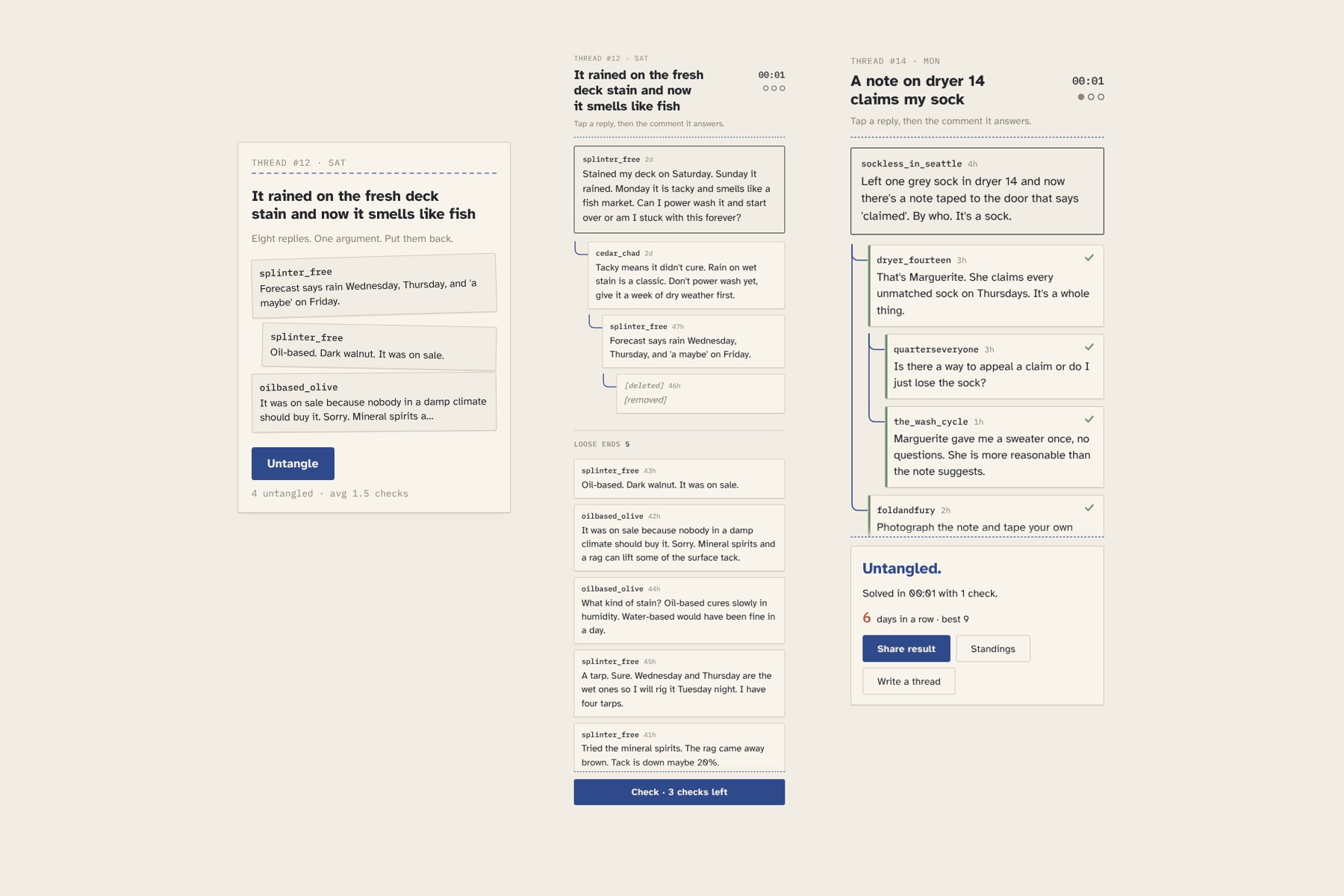
Each day Indent posts a short, made-up thread from an invented community: a sourdough starter that might be dead, a sock "claimed" in dryer 14, a deck stain that smells like fish. The replies have come loose, shown flat and shuffled. You tap a reply, then tap the comment it was answering, and it snaps onto an indent rail. You get three Checks a day; correct placements lock in. Clues are all in the text: quotes, corrections, tone, and the relative timestamps (a reply can't be older than its parent). Untangle it and a needle stitches the thread back together.
- A new puzzle is posted automatically every day. Older posts stay playable as an unranked archive.
- A weekly difficulty curve: Monday is five replies two levels deep. Sunday is nine replies four levels deep with red herrings. Saturdays include a "[removed]" reply you place by inference.
- Daily standings (Checks first, then time), streaks, and a spoiler-free "Share result" comment.
- After solving, players can write their own thread. Moderators review submissions from the subreddit menu, and approved threads take the next daily slot, credited to the writer.
- The feed card shows how many people untangled today's thread and the average Checks.
Play it at r/IndentDaily.
How I built it
Devvit Web: a React client in an interactive post (a ~2 KB inline splash card and an expanded game view) and a Hono server on Devvit's serverless runtime. Redis holds play state, per-day leaderboards (sorted sets), streaks and submissions. The Devvit scheduler posts each day's thread at 00:05 UTC, idempotently. The server owns the clock and the Check count, and correct parents never reach the client until a placement is locked. Reply order is shuffled per player per day. Game rules are pure TypeScript shared by client and server and covered by 138 unit tests. A dev harness runs the real rules against an in-memory store so the game can be played and recorded in a normal browser.
Challenges I ran into
- Writing threads that are fair. Every placement has to be deducible from the text alone. I had all 35 threads solved blind, without the answers, and most first drafts allowed two readings or had a reply timestamped older than its parent. Each was rewritten until it had one answer, and the app now rejects any thread (including player-written ones) where a reply isn't younger than the comment it answers.
- Keeping the inline card fast: the splash doesn't import the game.
- Devvit forms can't offer dynamic parent choices, so thread submission uses a short "2>1: text" format with validation for loops, depth and missing parents.
Accomplishments that I'm proud of
It feels like Reddit without using anything trademarked: the indent rails, the handles, the timestamps and the "[removed]" reply carry the identity. The look is sewing thread on newsprint, with real typography and no stock UI.
What I learned
Good daily puzzles are mostly content design. The code is small; the 35 threads and their difficulty curve took the most care.
What's next for Indent
Themed weeks written with subreddit communities, a "hard mode" with no timestamps, and per-subreddit leaderboards so communities can run their own Indent.
Built With
- devvit
- hono
- react
- redis
- typescript
- vite
