Inspiration
We saw that almost every company building customer-facing AI tools today relies on function calling, but all are constrained by limited capabilities: small context windows, slow processing, or rigid JSON structures. Companies like Notion, Supabase, and Microsoft Copilot switch providers quickly whenever a better one appears. That told us there’s room for a step-change in both performance and flexibility.
On the enterprise side, companies with massive internal data pools can’t fully leverage LLMs due to context and integration limits. That gap inspired us to build something fundamentally more powerful—an API that not only integrates with real-world tools but also thinks and acts like code, not just text prediction.
What it does
The Incredible API combines agentic models with live-code function calling to let companies:
Run massively parallel API calls with no practical limits.
Chain function calls across multiple systems to perform multi-step tasks.
Handle structured and unstructured data directly—analyzing, transforming, and acting on it in real-time.
Preload enterprise datasets for deep reasoning, beyond the context window barriers of typical LLMs.
This turns complex workflows (e.g., multi-API CRM updates, manufacturing analytics, automated trading insights) into single, natural-language commands.
How we built it
We built on top of open-source and foundation LLMs, adding a custom layer for:
Live-Code Function Calling – instead of outputting JSON specs, our models execute real code live, enabling dynamic logic and data handling.
Chained Reasoning – each function call can consume and transform the output of previous calls, letting workflows evolve intelligently.
Massively Parallel Execution – hundreds of operations can run at once, enabling batch operations like syncing entire CRMs or IoT systems.
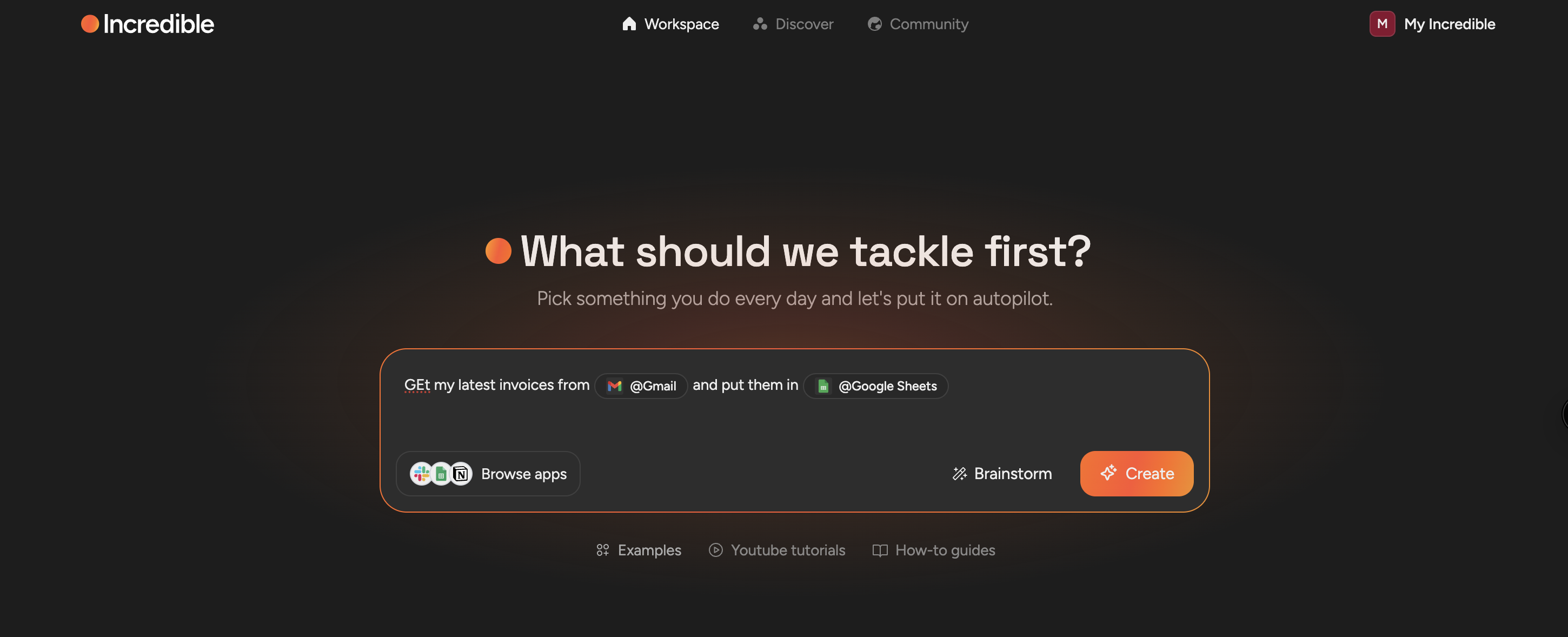
Integration Templates (MCP-like) – while not our initial focus, these templates simplify connecting to tools like Gmail, Salesforce, or Shopify for users who need them.
Challenges we ran into
Balancing speed and flexibility: Making live-code function calls both ultra-fast and fully customizable required rethinking how we handle execution environments.
Enterprise data handling: Preloading large, private datasets securely while keeping latency low demanded careful design of our data pipelines.
Messaging: We had to clearly differentiate ourselves from both LLM providers (like OpenAI) and workflow automation platforms (like Zapier) while showing that our tech enables both.
Accomplishments that we're proud of
Beating GPT-5 benchmarks in function-calling performance.
Demonstrating a single model creating entire multi-step workflows in real time.
Getting early interest from companies in trading, e-commerce, manufacturing, and CRM automation—proving broad market appeal.
Building an API that can scale from indie developers to enterprise needs without changing the core tech.
What we learned
Developers crave control: Most LLM users want raw power and flexibility first; integrations and nice UIs can come later.
Data gravity is real: Companies want to bring the model to their data, not the other way around. Preloading capabilities open huge enterprise doors.
Switching costs are low: If we stay ahead in performance and capabilities, adoption will follow naturally—loyalty depends on quality, not lock-in.
What's next for Incredible
Enterprise data layer: Let companies preload massive datasets for real-time analytics and reasoning.
Vision & multimodal support: Expand beyond text into image, document, and time-series analysis.
Integration libraries: Release a library of 500+ ready-to-use integrations once core adoption grows.
Developer-first ecosystem: Launch SDKs, CLI tools, and example templates to make building with Incredible frictionless.

Log in or sign up for Devpost to join the conversation.