Inspiration
Disabled and transgender jobseekers face a hiring process that was never designed with them in mind. Job boards optimize for keyword matching, not for whether a workplace can actually accommodate someone — and candidates are routinely forced to disclose sensitive information (a disability, a gender history) with zero visibility into how that disclosure will be used, or whether it will quietly tank their chances.
We wanted to build something fundamentally different: not another job board with an "accessibility filter" bolted on, but an operating system for inclusive employment — where accessibility and identity-safe matching are core architecture, not an afterthought. The goal was a platform where a candidate could disclose exactly as much as they choose, see transparent evidence of an employer's actual inclusion practices before applying, and get AI-explained match scores that show them why they were matched — not just that they were.
What it does
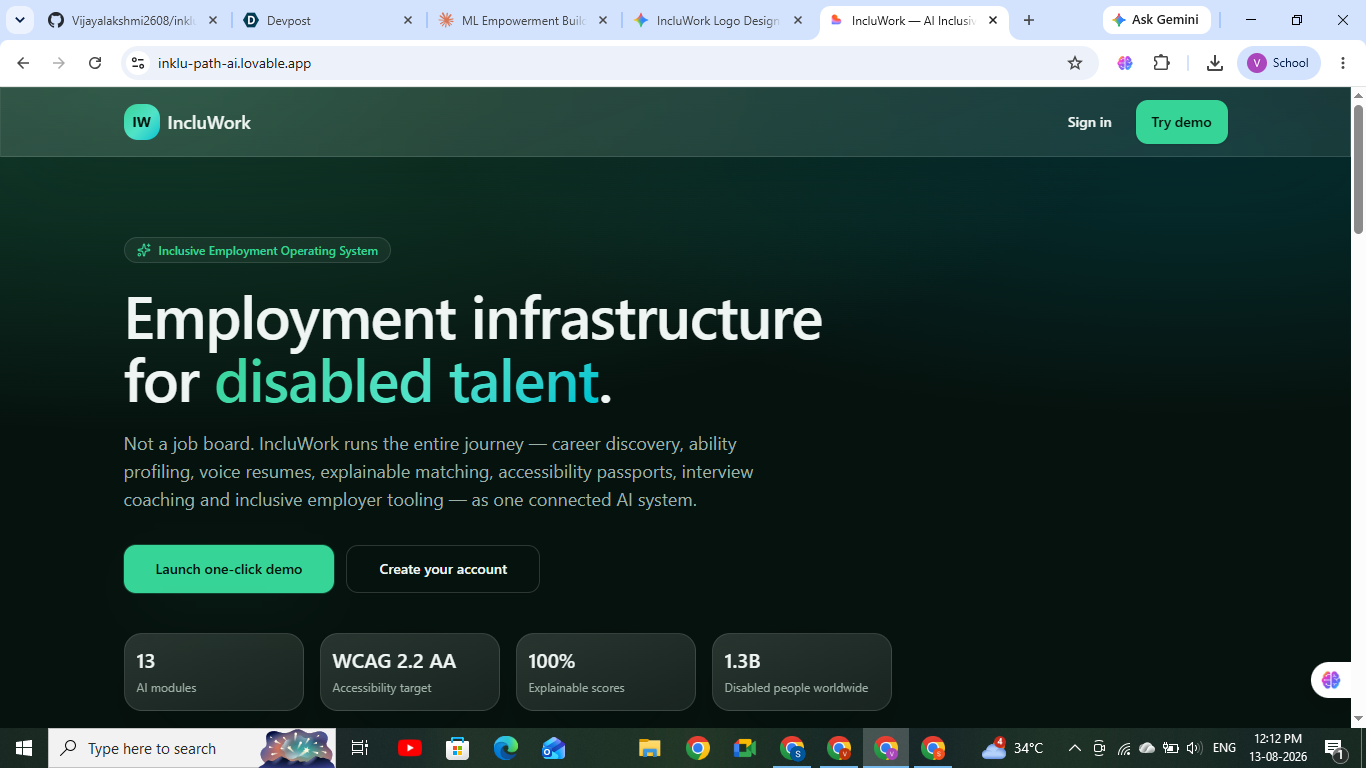
IncluWork is a full-stack, AI-powered employment platform built around one continuous journey:
Register → AI Career Discovery → AI Ability Profile → Voice Resume Builder → Intelligent Job Matching → Accessibility & Inclusion Passport → AI Mock Interview → Personalized Learning Roadmap → Applications → Employer Dashboard
Core modules include:
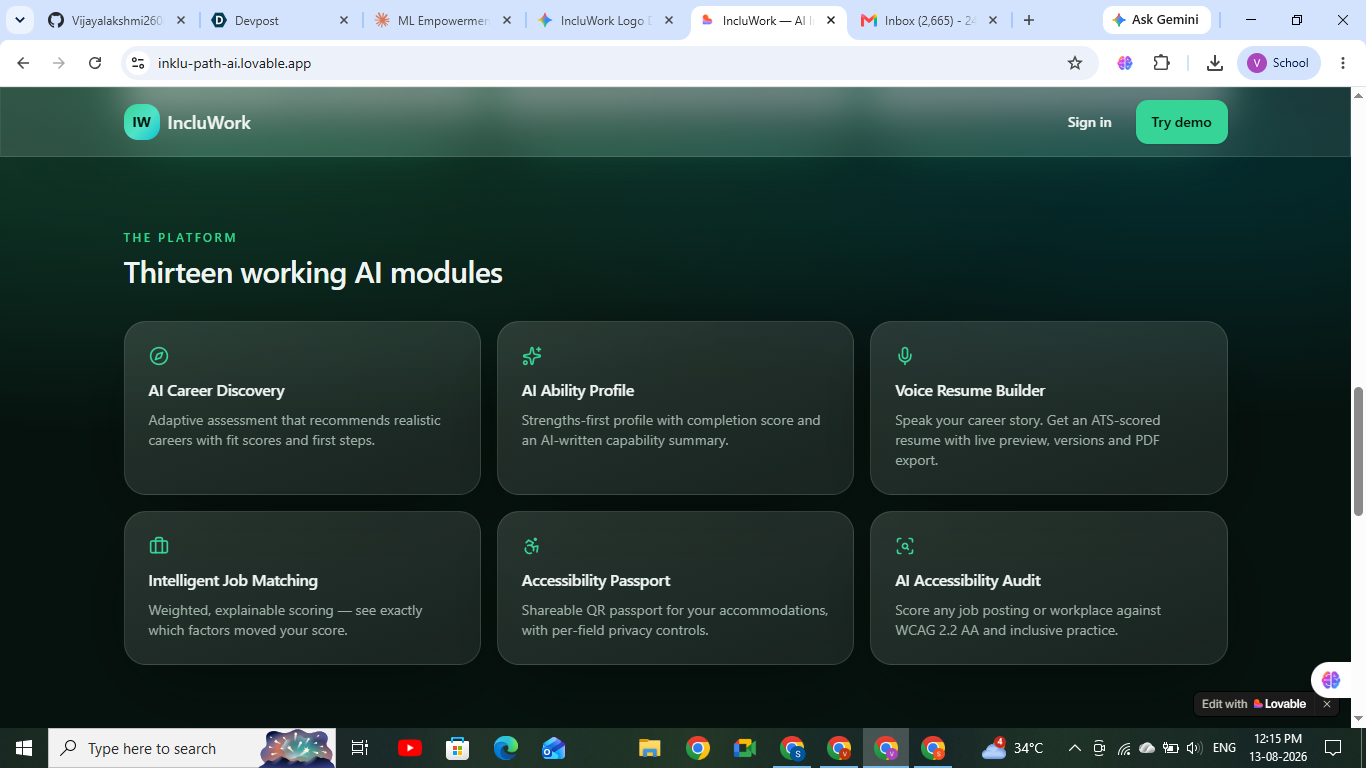
- AI Career Discovery — adaptive assessment that generates personalized career path recommendations based on strengths, interests, and constraints.
- AI Ability Profile — a structured, AI-summarized profile with a completion score, built to represent skills and needs without reducing a person to a diagnosis.
- Voice Resume Builder — voice-to-text resume creation with ATS optimization, live preview, version history, PDF export, and job-specific tailoring.
- Intelligent Job Matching — explainable AI scoring that shows why a job matched, not just a percentage.
- Accessibility & Inclusion Passport — a user-controlled, QR-code and PDF-exportable profile with selective disclosure, revocation, and privacy controls. Candidates choose exactly what to share with each employer.
- AI Accessibility Audit — evaluates job postings and workplace descriptions for accessibility and inclusive-language issues.
- Employer Inclusivity Toolkit — bias detection in job descriptions, accommodation recommendations, and inclusion analytics for employers.
- AI Interview Coach — voice-based mock interviews with real-time feedback.
- Learning Roadmap — skill-gap analysis paired with free learning resources.
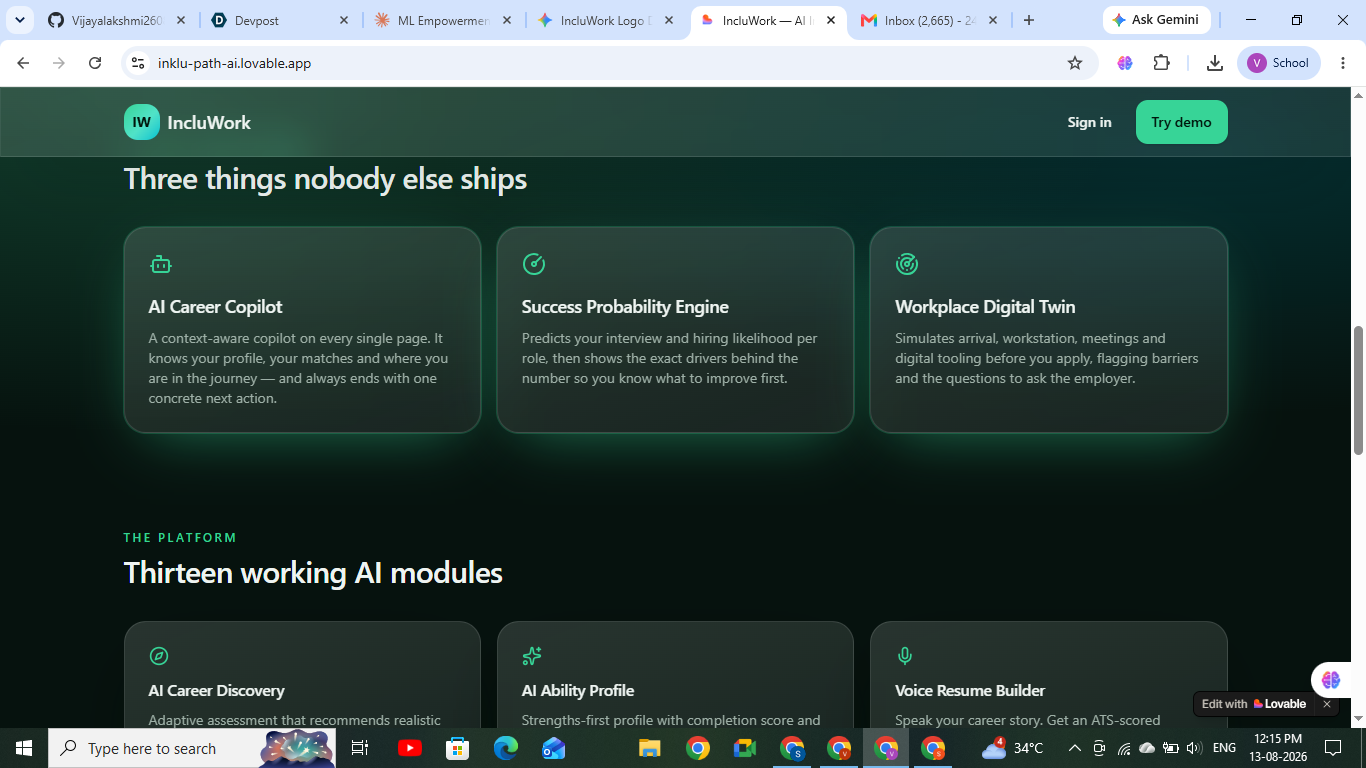
- Workplace Digital Twin / Simulator — visually simulates accessibility and trans-inclusion compatibility before a candidate applies, so there are no surprises on day one.
- Bias Buster Dashboard — surfaces inclusivity insights and flags patterns in hiring behavior.
- Career GPS — salary benchmarks, market demand, and career progression paths.
- Transgender-Friendly Employer Index — a transparent scoring system built from anti-discrimination policies, inclusive language, gender-neutral facilities, and benefits — clearly labeled as verified, reported, or unavailable, so users know exactly how confident to be in the data.
- Transgender Mentor Network — opt-in connections with participating transgender professionals.
- AI Career Copilot — a persistent, context-aware assistant available on every page of the app.
- Success Probability Engine — predicts interview and hiring likelihood with explainable, job-relevant factors only — identity and disability status are structurally excluded from the scoring model.
Every optional identity field (gender identity, pronouns, preferred name, disability details) is opt-in, private by default, and — critically — never used as an input to matching or scoring algorithms. Candidates control disclosure at a granular level and can revoke access at any time.
How we built it
Frontend: React 19 + Vite + TypeScript for a fast, type-safe SPA. Tailwind CSS for a consistent emerald-on-dark design system, with Framer Motion driving page transitions and micro-interactions so the accessibility-first product still feels polished and modern rather than clinical.
Backend & Data: Convex/PostgreSQL via Lovable Cloud, with Row-Level Security (RLS) enforced at the database layer — not just in application logic — so that sensitive fields (identity data, accommodation details) are protected even against a compromised API layer. This was a deliberate architectural choice: privacy-by-design meant privacy had to be enforced where the data lives, not just where it's displayed.
AI Layer: A provider-agnostic AI abstraction supporting Gemini, OpenRouter, and Groq via environment variables, so the platform isn't locked to a single vendor and can fail over or swap models without touching application code. Every AI-driven feature (career discovery, resume tailoring, match explanations, interview feedback, bias detection, the Success Probability Engine) was built with deterministic fallbacks — if an AI call fails or times out, the user still gets a usable, non-broken result rather than a spinner or an error state.
Build approach: We built in phases rather than trying to ship all thirteen modules simultaneously:
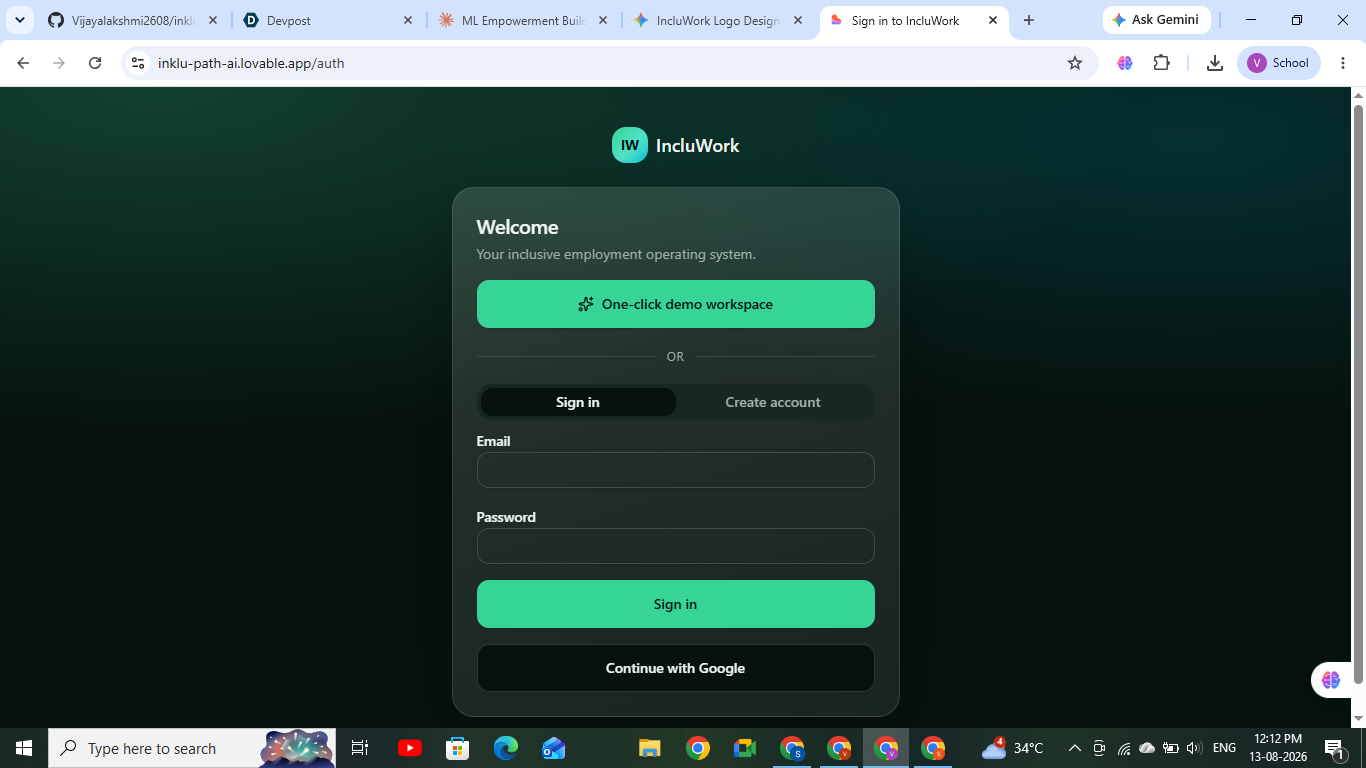
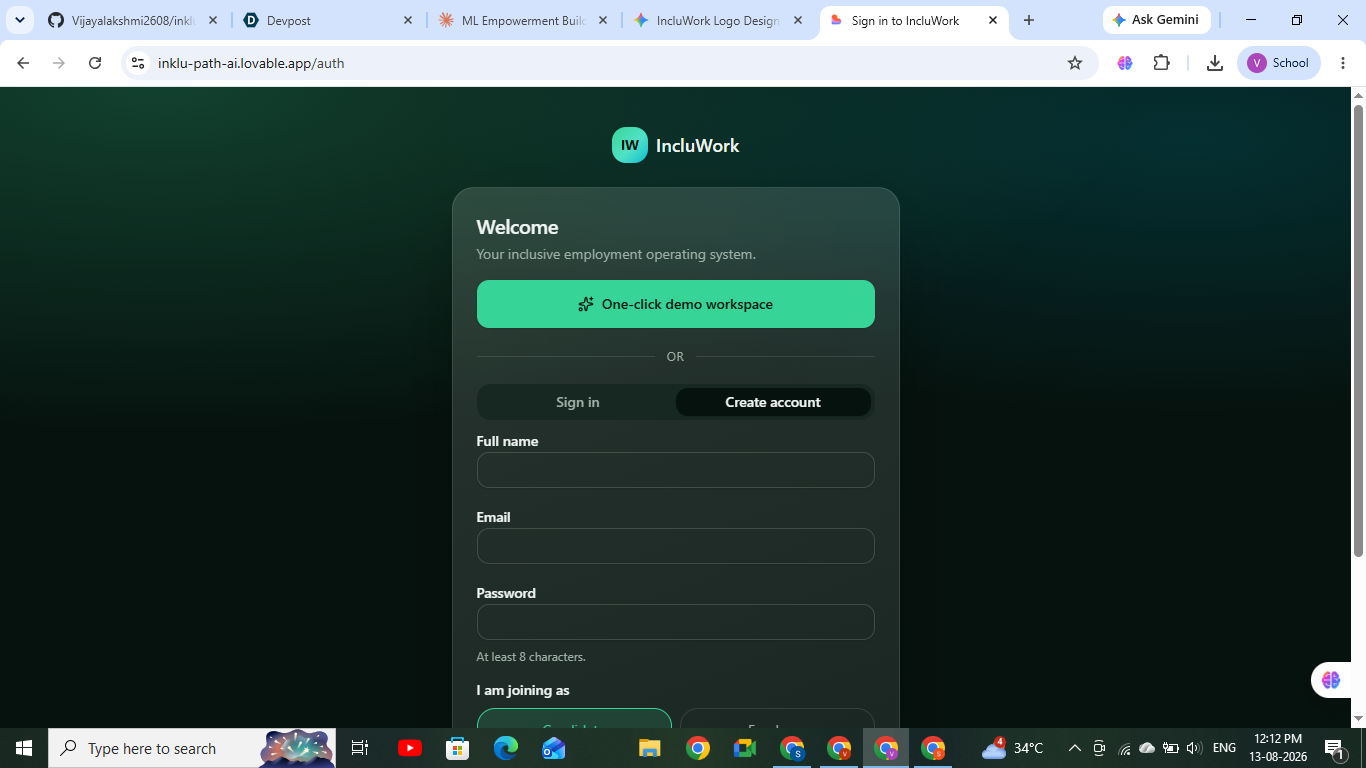
- Design system, landing page, and auth (including a one-click demo mode for fast evaluation).
- Core authenticated app shell — Dashboard, AI Ability Profile, Intelligent Job Matching (with explainable scores, Success Probability Engine, and an early Workplace Digital Twin), and Applications.
- A significant scope expansion: extending the platform from disability-focused employment support to a unified Inclusive Employment Operating System covering both disability and transgender inclusion — without removing or rebuilding any existing functionality. This meant a schema migration (optional identity fields, employer trans-inclusion index, mentor network tables), new AI flows (inclusive job-description audits, inclusion-aware match explanations, a dual-axis Workplace Simulator), and new UI surfaces (Inclusive Profile, Employer Index, Passport with selective disclosure, Mentor Network) — all layered on top of the existing auth, RLS, dashboard, and matching infrastructure.
Challenges we ran into
Extending scope without regressing existing features. Adding a second, orthogonal inclusion axis (transgender-inclusive employment) to a platform already built around disability inclusion meant every shared feature — matching, the Workplace Simulator, the Passport, the Copilot — had to be generalized to handle both without either axis diluting or overriding the other. We treated this as a strict non-negotiable: zero regressions on existing disability features while extending.
Infrastructure downtime mid-build. During the upgrade, our hosted database paused and initial attempts to resume it programmatically failed, blocking every read and write needed for the migration. We had to manually resume Cloud services, then run explicit write/read health probes before touching the schema — a good reminder that even AI-assisted development needs manual infrastructure verification steps, not just blind retries.
Keeping sensitive data structurally separate from scoring. It wasn't enough to just say identity data "shouldn't" affect hiring scores — we had to design the data model and AI prompt structure so those fields are physically excluded from the inputs the Success Probability Engine and Job Matching algorithms can even see. Policy-level promises aren't enough; the architecture has to enforce it.
Balancing depth with usability. Thirteen-plus AI modules risk becoming a maze. We used the AI Career Copilot as a connective thread across the whole journey specifically so users always have contextual guidance instead of getting lost in feature sprawl.
Accomplishments that we're proud of
- A fully interconnected user journey with no dead ends, placeholder screens, or mock data — every module is wired to real backend state.
- A privacy architecture where selective disclosure and revocation are enforced at the database level via RLS, not just hidden in the UI.
- An explainable AI layer throughout — job matches, success probability, and bias detection all surface reasoning, not just scores.
- Successfully extending the platform to cover two distinct, historically underserved communities in employment (disabled and transgender jobseekers) on a single, coherent architecture, without compromising either.
- A provider-agnostic AI layer with deterministic fallbacks, meaning the app degrades gracefully instead of breaking when an AI provider is slow or unavailable.
What we learned
- Accessibility and inclusion features are strongest when they're core data-model decisions, not UI overlays — RLS-enforced privacy and structurally-excluded scoring inputs taught us that "ethical AI" claims need to be backed by architecture, not just a privacy policy paragraph.
- Explainability is a feature users actually want, not just a compliance checkbox — showing why a match happened builds trust in a way that a bare percentage score never does.
- Scaling scope mid-build (disability-only → disability + transgender inclusion) is much safer with a clear non-negotiable rule ("preserve everything existing") than with a full rebuild — incremental, additive migrations reduce risk significantly.
- Infrastructure reliability (database pause/resume, AI provider fallbacks) matters as much as feature completeness for a platform meant to be trusted by vulnerable users.
What's next for IncluWork – Inclusive Employment OS
- Employer verification pipeline for the Transgender-Friendly Employer Index and accessibility claims, moving more employers from "reported" to "verified" status through documentation review and employee feedback loops.
- Expanding the Mentor Network with structured matching between mentors and candidates based on industry and career stage.
- Deeper Workplace Digital Twin simulations, incorporating real employee-submitted accessibility and inclusion data over time.
- Multi-language support to extend accessibility to non-English-speaking jobseekers.
- Employer-side onboarding flow to make it dramatically easier for companies to complete their Inclusivity Toolkit assessment and post accessible, bias-audited job listings.
- Longitudinal outcome tracking — measuring real hiring and retention outcomes for users, so the Success Probability Engine can be validated and improved against real-world results rather than proxy signals alone.
Built With
- accessibility
- ai/ml
- convex
- framer-motion
- gemini
- groq
- lovable-cloud
- openrouter
- pdf-export
- postgresql
- react
- row-level-security
- tailwind-css
- typescript
- vite
- voice

Log in or sign up for Devpost to join the conversation.