-
-
IncidentOps AI — Autonomous Incident Commander powered by Gemini and CALL-E
-
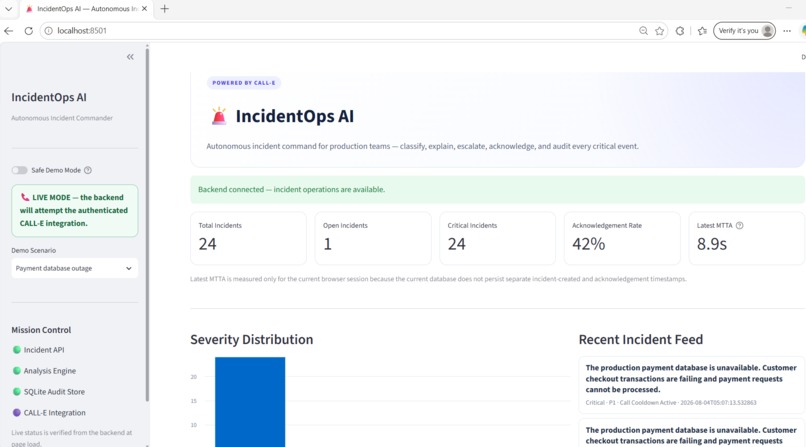
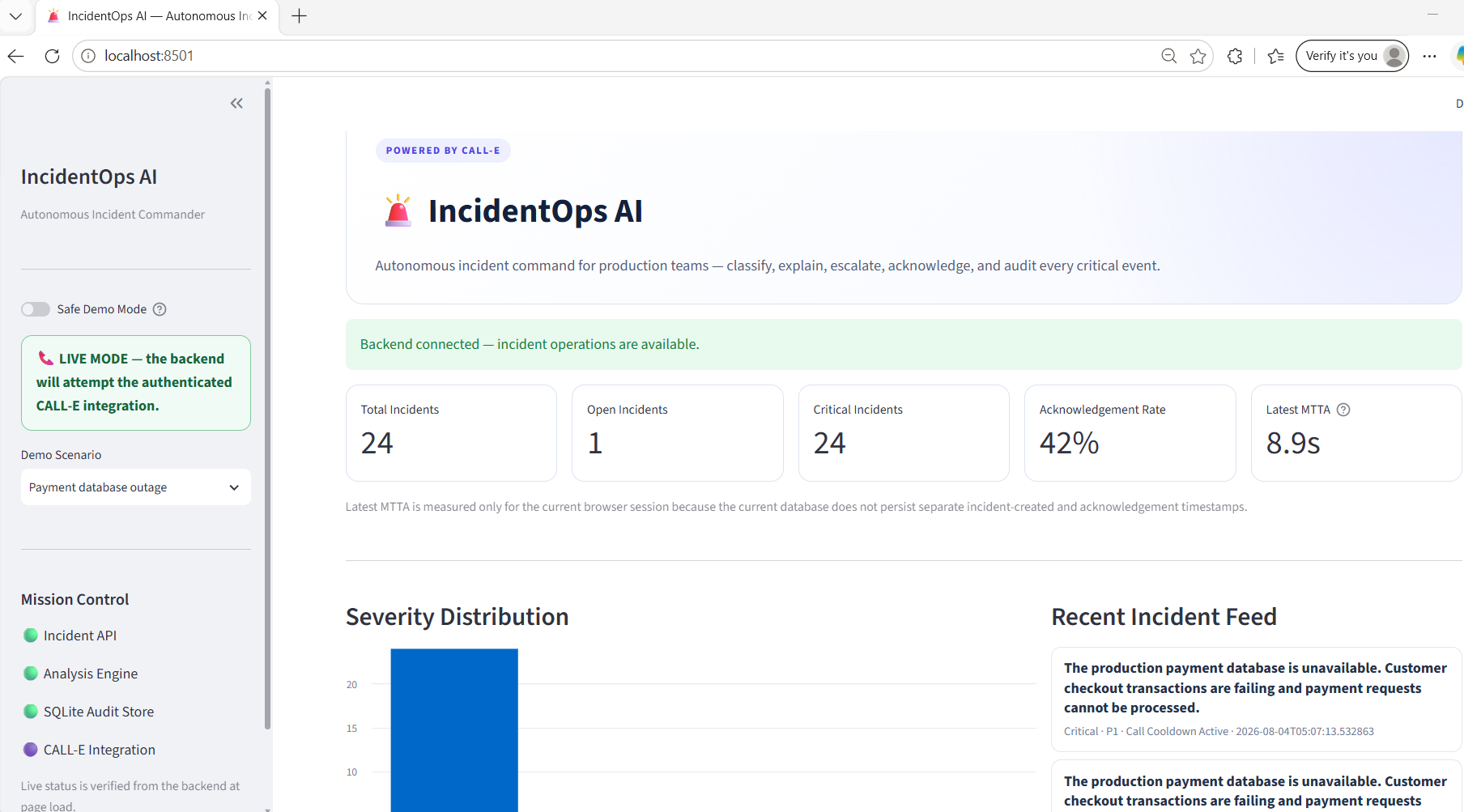
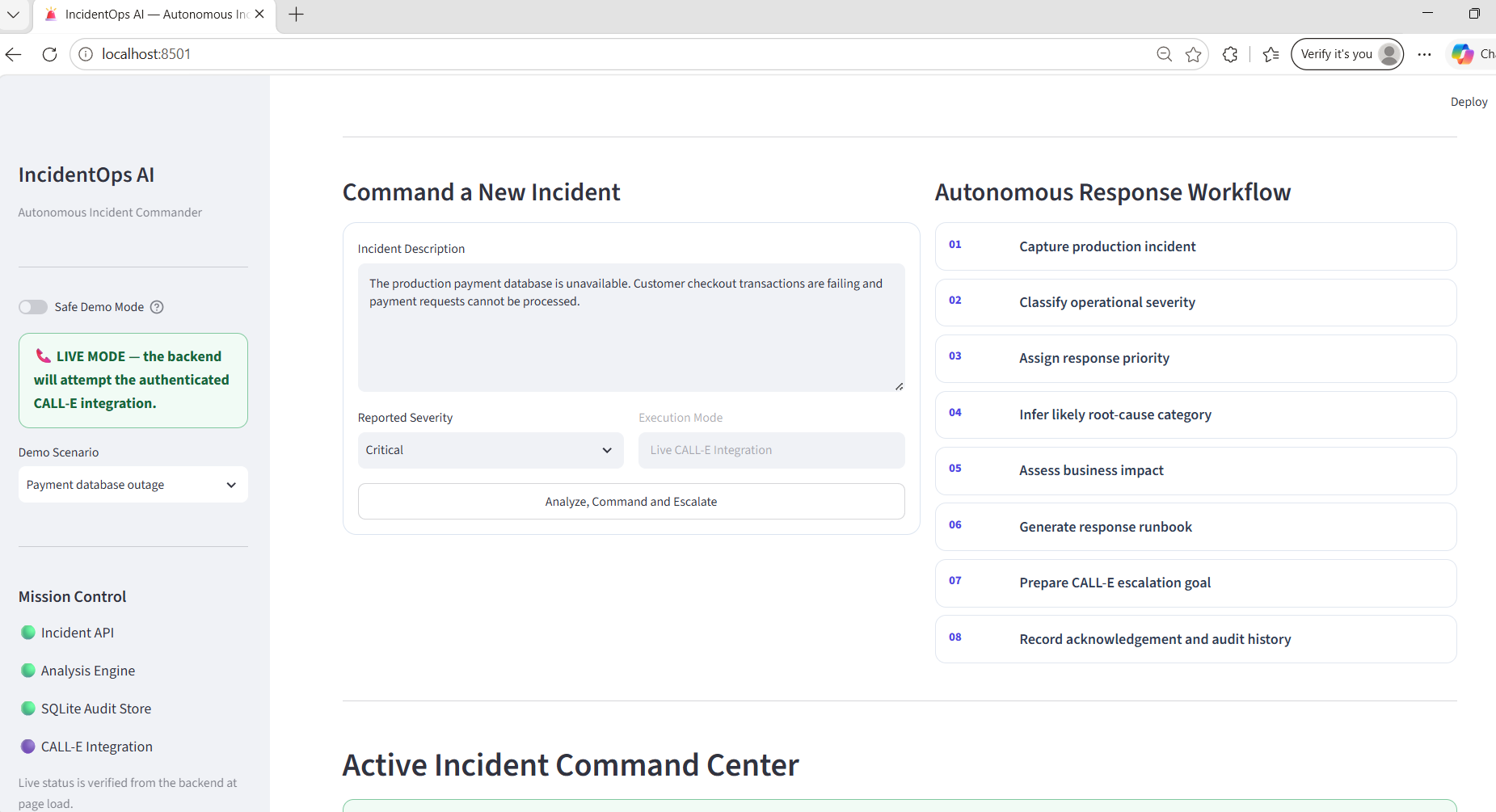
Incident command dashboard showing operational metrics, severity distribution, recent incidents, and the autonomous response workflow.
-
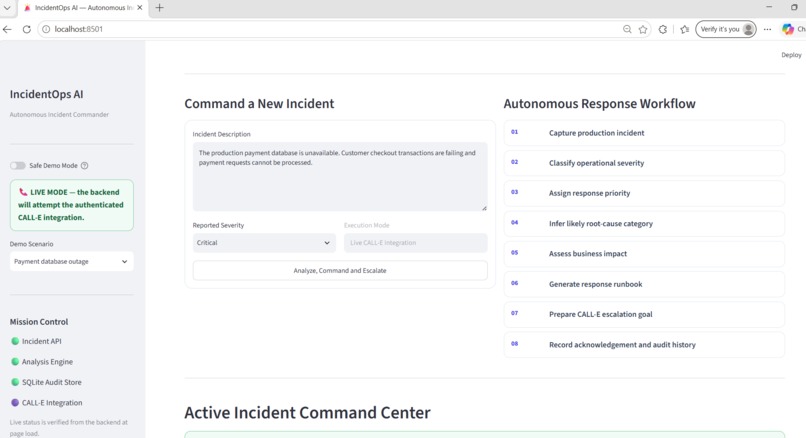
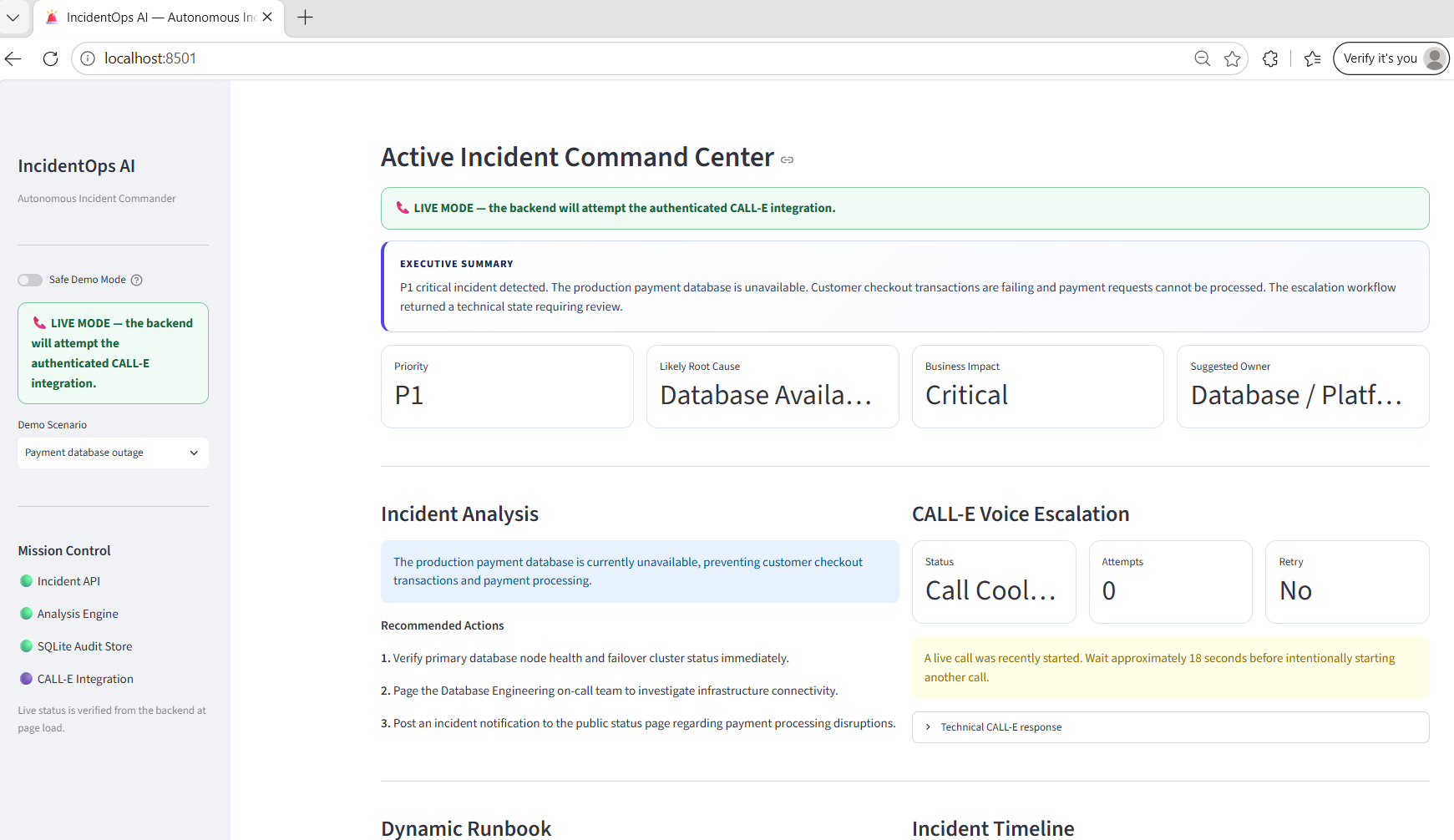
Gemini transforms an unstructured incident into priority, executive summary, root-cause hypothesis, business impact, owner, and recommended.
-
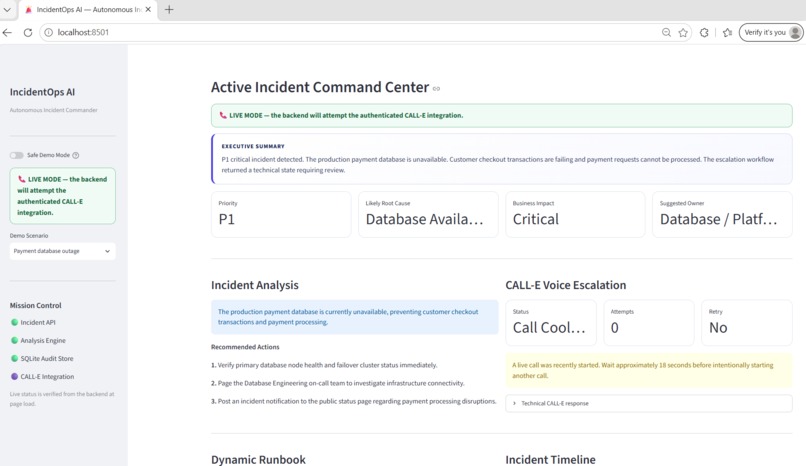
CALL-E executes an authorized live escalation call and returns the operational status, acknowledgement, ownership, evidence, and decision.
-
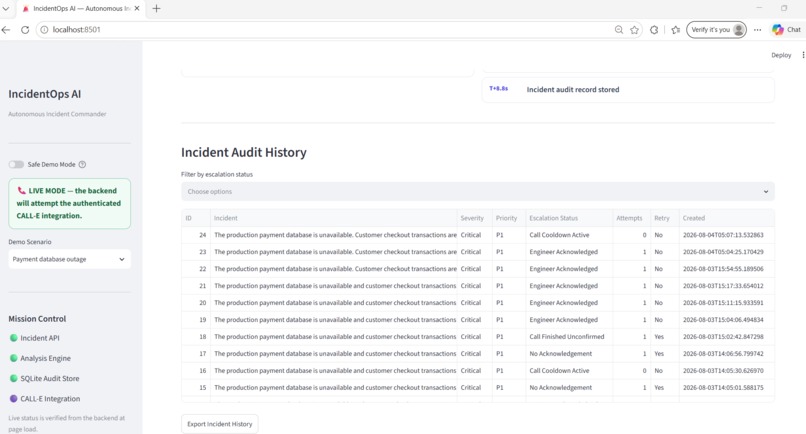
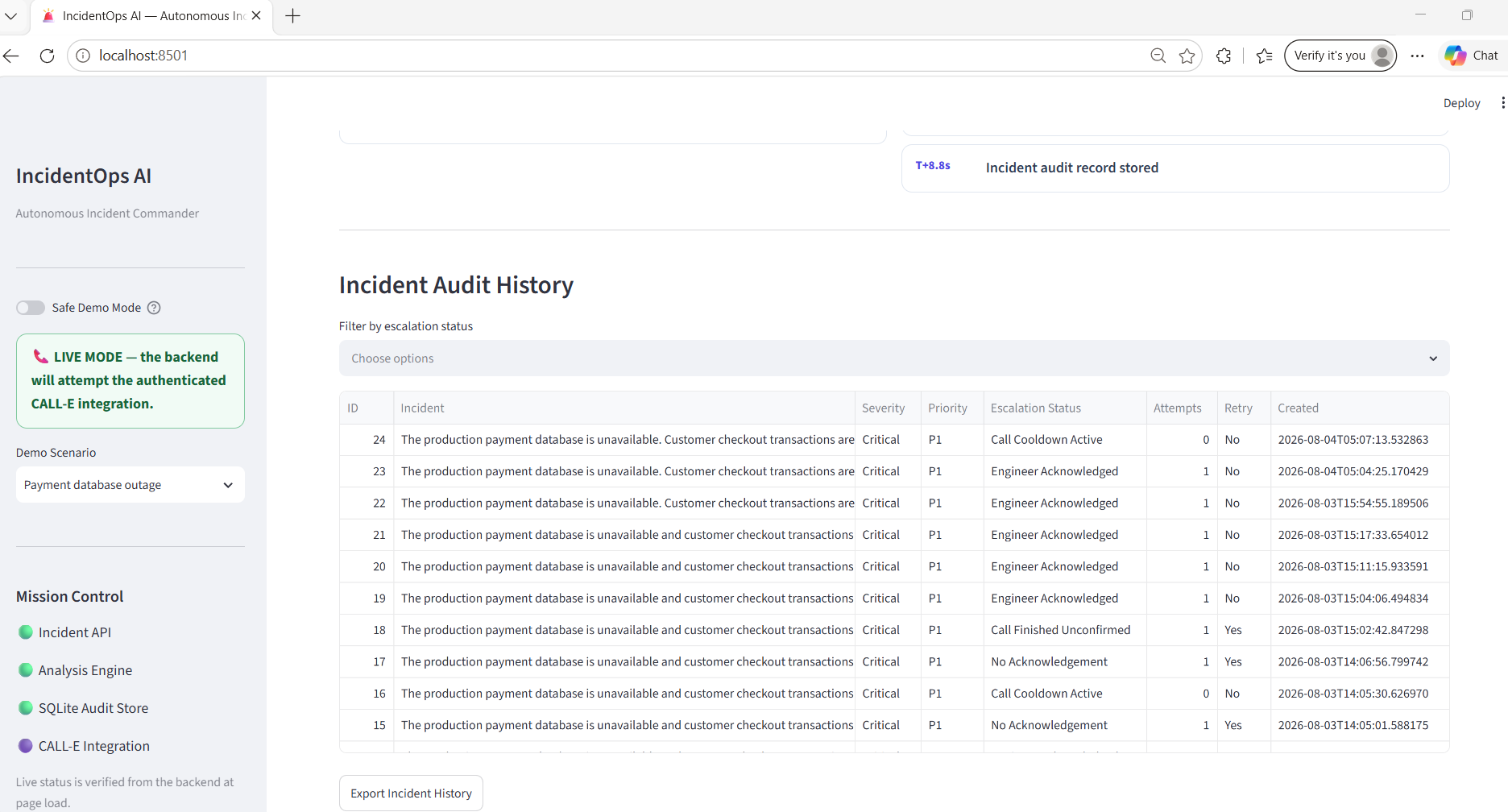
Auditable incident history with priority, escalation status, timestamps, response timeline, and CSV export.
-
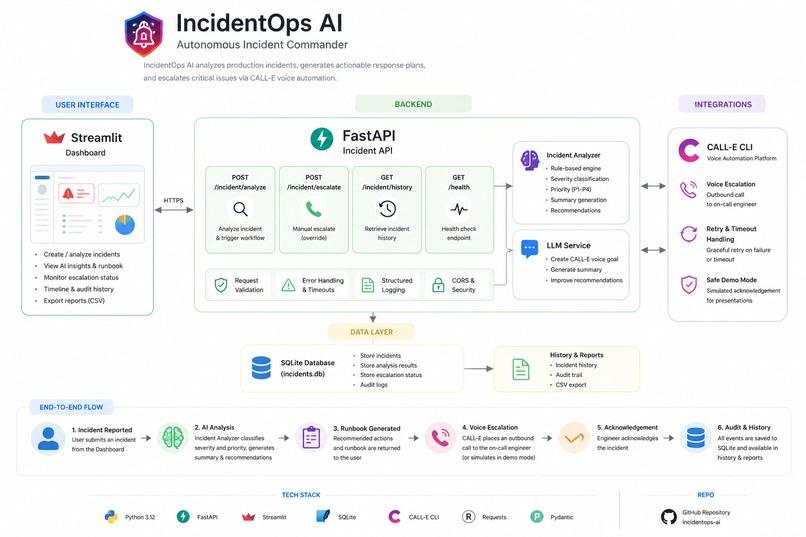
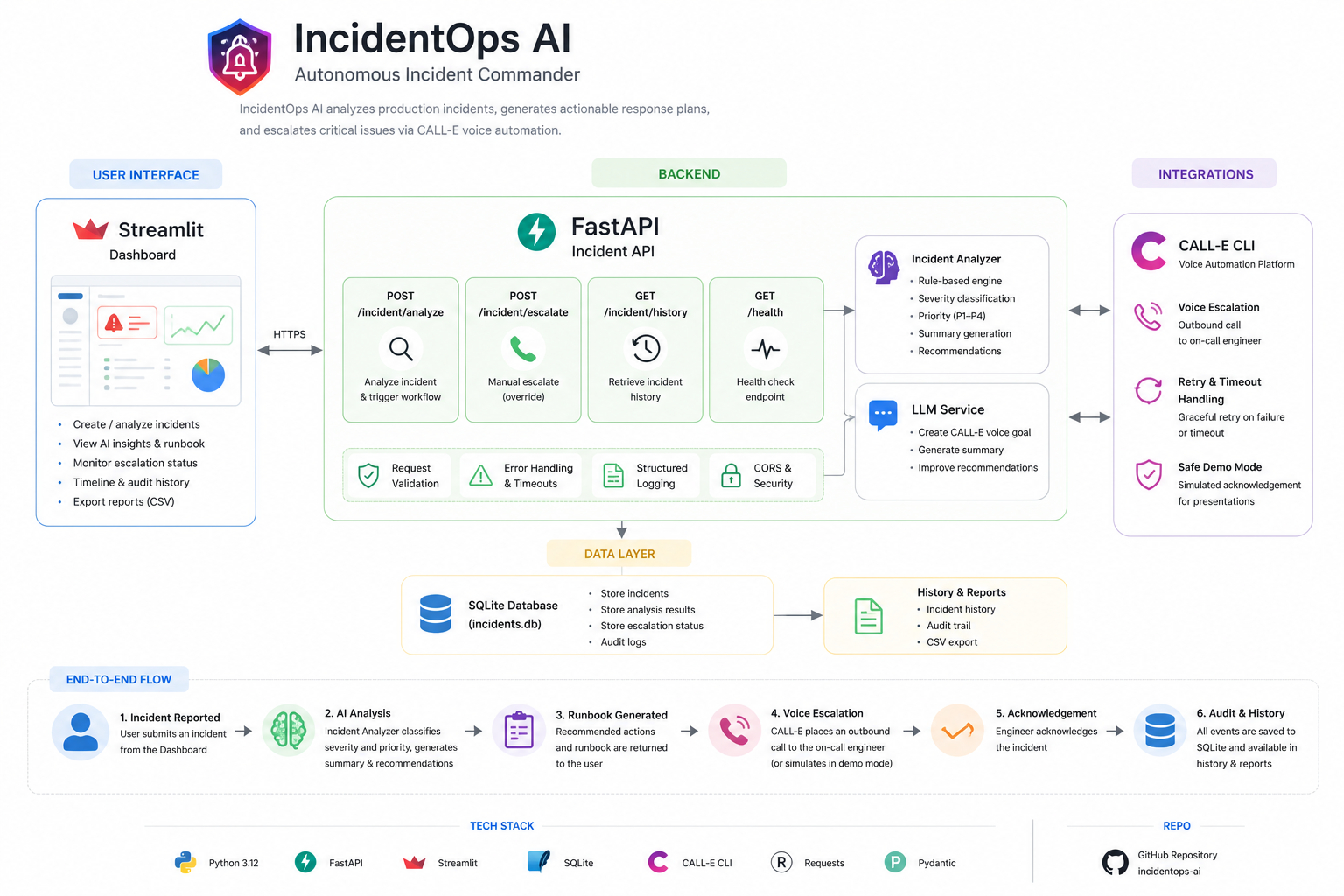
IncidentOps AI architecture: Gemini decision intelligence, deterministic guardrails, CALL-E live phone, and auditable incident tracking.
Inspiration
Production monitoring tools can detect outages quickly, but detection alone does not create operational ownership.
During a critical incident, teams still need to understand the failure, assess business impact, determine priority, identify the right engineering owner, prepare immediate response actions, contact the on-call engineer, confirm acknowledgement, and preserve the outcome for audit.
That coordination gap can increase Mean Time to Acknowledge and extend customer-facing downtime.
I built IncidentOps AI to close the gap between alert detection and incident ownership. The goal was to create an autonomous incident commander that does more than summarize an alert. It should analyze the outage, decide the escalation path, place an authorized phone call, interpret the result carefully, and record the complete response workflow.
What it does
IncidentOps AI transforms a production incident into an explainable, voice-enabled, and auditable response workflow:
Observe → Analyze → Decide → Call → Track
The system:
- Receives an incident description and severity.
- Uses Gemini to generate structured operational intelligence.
- Applies deterministic priority and escalation guardrails.
- Produces a dynamic incident-response runbook.
- Creates a goal-driven CALL-E phone task for critical P1 incidents.
- Places an authorized live outbound call or runs in Safe Demo Mode.
- Interprets acknowledgement and ownership from the returned call evidence.
- Stores the incident and escalation outcome in SQLite.
- Displays the complete workflow in an operational Streamlit dashboard.
Gemini generates:
- an executive incident summary;
- a root-cause hypothesis;
- a business-impact assessment;
- a recommended engineering owner;
- immediate response actions;
- a priority recommendation.
For P1 incidents, CALL-E contacts the authorized on-call recipient and asks them to acknowledge the incident, accept or decline ownership, state their next action, and provide a mitigation-start estimate when available.
The dashboard displays the Gemini analysis, autonomous-agent mission, response runbook, CALL-E result, incident timeline, metrics, and audit history.
How we built it
IncidentOps AI uses a lightweight Python architecture:
- Streamlit for the incident command dashboard;
- FastAPI for API and workflow orchestration;
- Gemini for structured decision intelligence;
- Pydantic for structured-response validation;
- CALL-E Python SDK for live phone execution;
- SQLAlchemy and SQLite for incident persistence and audit history;
- Pandas for reporting and CSV export.
The agent workflow is:
Production Incident
        ↓
Gemini Structured Analysis
        ↓
Pydantic Validation
        ↓
Deterministic Priority Guardrails
        ↓
Escalation Decision
        ↓
CALL-E Live Call or Safe Demo Mode
        ↓
Evidence-Aware Outcome Interpretation
        ↓
SQLite Audit History
Built With
- ai-agents
- autonomous-agents
- call-e
- devops
- fastapi
- gemini
- incident-response
- llm
- on-call
- pandas
- phone-call-automation
- pydantic
- python
- sqlalchemy
- sqlite
- sre
- streamlit
- voice-ai
- workflow-automation

Log in or sign up for Devpost to join the conversation.