Inspiration
Incident response teams make high-stakes decisions from incomplete logs, service maps, and dashboards. IncidentLens is built around one rule: a guessed root cause must never be presented as fact. The goal is a replay an on-call engineer can audit, not another confident summary they have to distrust.
What it does
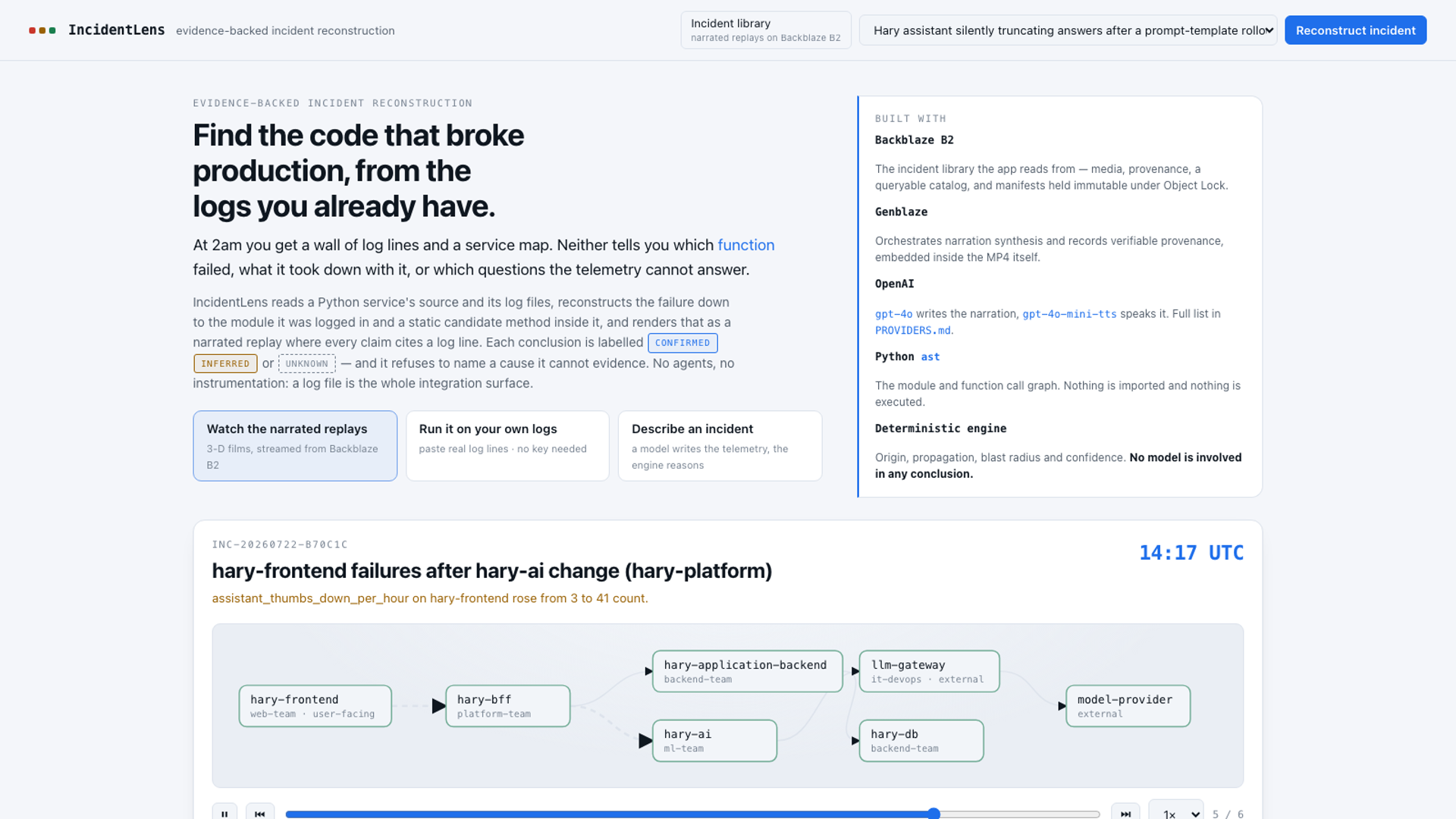
At 2am a responder gets a wall of log lines and a service map. Neither says which part of the code failed, what it took down, or which questions the telemetry cannot answer.
IncidentLens reads a Python service's source tree and its log files, then reconstructs the failure: the origin service, the propagation chain, the blast radius, the customer impact, and — using a static call graph — the module the failure was logged in plus a candidate function inside it. It renders that as a narrated 1080p replay that zooms from the service map down to the candidate function, and writes an engineer briefing alongside.
The discipline is the product. Every conclusion carries a status and a confidence:
confirmed— direct telemetry shows it happenedinferred— the evidence points this way, a human should verifyunknown— a real possibility the telemetry cannot settle
The analysis also lists what it could not see. The engine raises rather than
emit a citation it cannot resolve, and a candidate function is labelled on screen
as STATIC CANDIDATE · NO STACK FRAME. It is never presented as a runtime frame.
Integration surface is a log file. No agents, no instrumentation, no OpenTelemetry requirement.
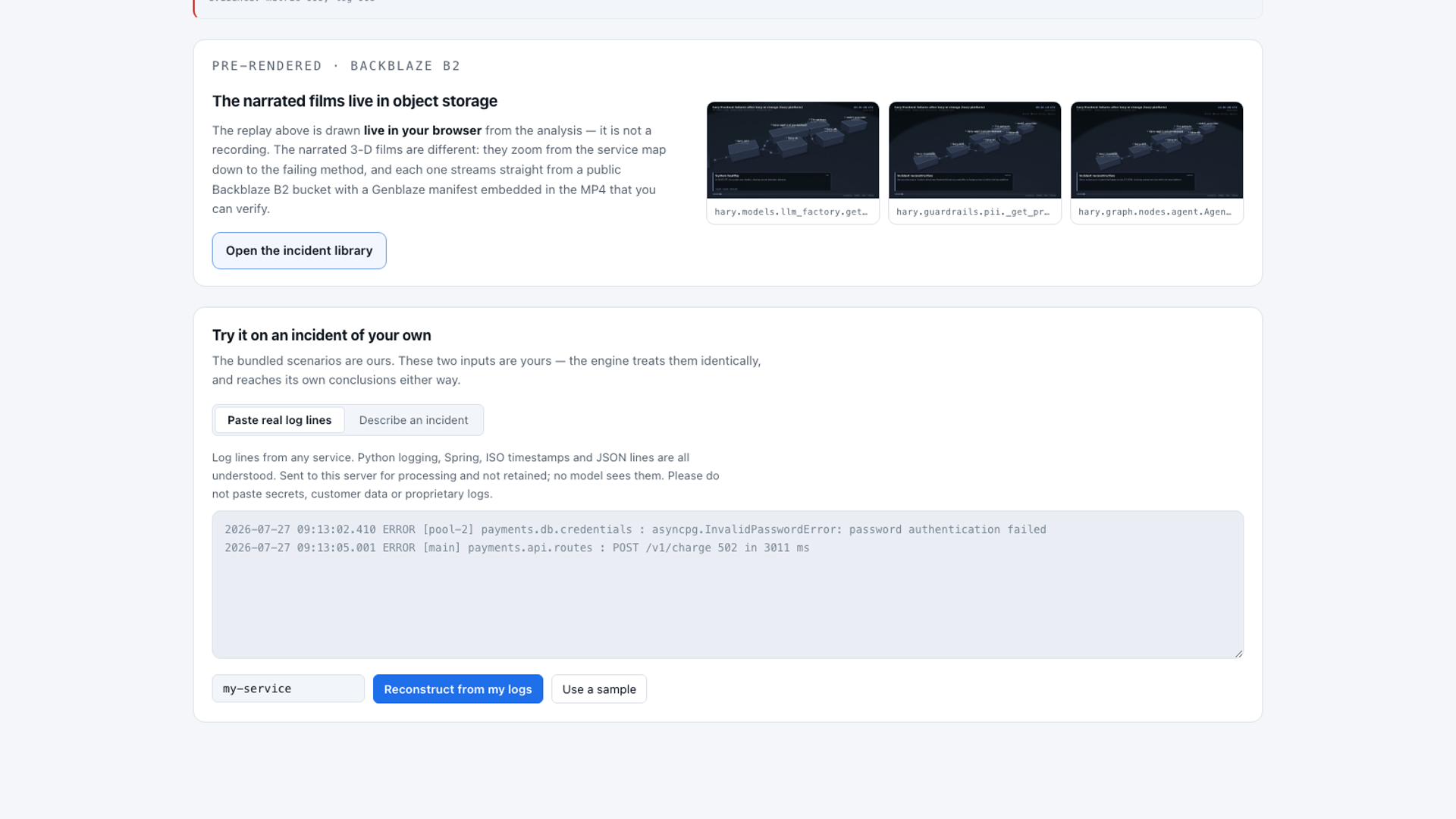
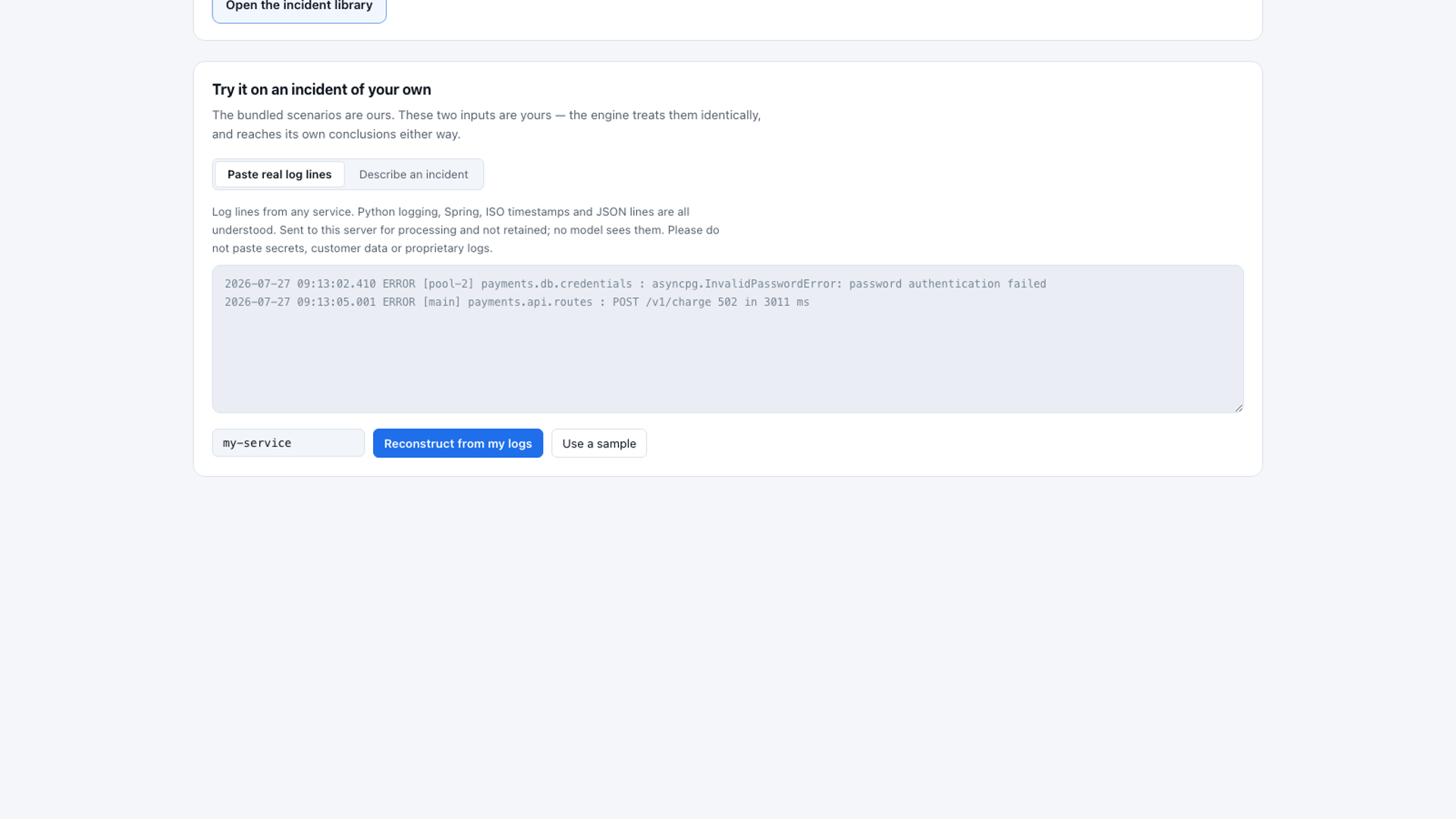
Try it: use the bundled sample or non-sensitive log lines on the home page — no account or key required. Pasted logs are sent to the hosted parser, briefly staged in a temporary file, and are not retained or sent to a model. Or describe a failure in a sentence and let a model write synthetic telemetry for the deterministic engine to reconstruct.
How we built it
IncidentLens uses FastAPI and Pydantic for the hosted API, a deterministic Python analysis engine for origin/propagation/confidence, Python ast for the static module and call graphs, and a pure-Python 3-D renderer piped through ffmpeg. OpenAI writes and speaks the narration, Genblaze orchestrates the TTS steps and provenance, and Backblaze B2 stores and serves the finished incident library.
How Backblaze B2 is used
B2 is the library the application reads from, not a dead drop it once wrote to.
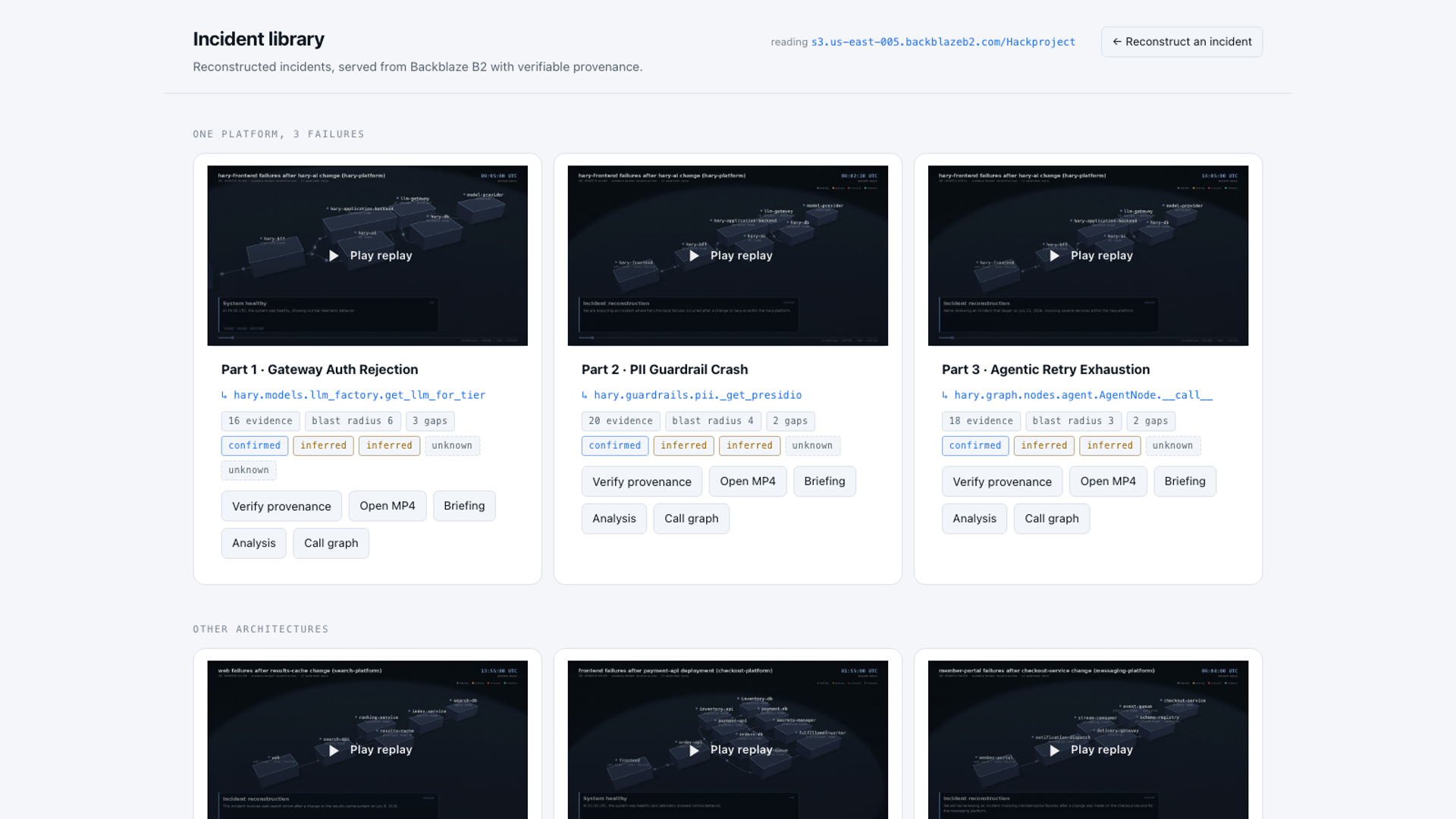
Store. Six 1080p narrated replays plus, for each incident, a poster frame, the full analysis document, an engineer briefing, a Mermaid call graph, and two Genblaze provenance manifests.
Organise. Two layers, deliberately:
Hary_Part1-Gateway-Auth-Rejection/     ← human-readable bundle, 7 objects
Hary_Part2-PII-Guardrail-Crash/
Hary_Part3-Agentic-Retry-Exhaustion/
Other-Architectures/…
incidents.jsonl                        ← the catalog the app reads
incidentlens/runs/…/manifest.json      ← Genblaze's content-addressed originals
Every object also carries queryable metadata — incident-id, origin-service,
failing-module, failing-symbol, leading-confidence — so the gallery builds
a listing from head() calls without downloading bodies. Lifecycle defaults are
applied.
Serve. GET /api/v1/incidents reads incidents.jsonl back out of B2;
/gallery streams video and posters directly from the bucket to the browser.
Because the bucket is public, the hosted service holds no B2 credentials at
all — reads are plain HTTPS over the standard library, no boto3 on the deployed
image.
Object Lock. Genblaze's canonical run manifest under incidentlens/runs/…/manifest.json is protected by 30-day GOVERNANCE retention. A read-only head_object check on the current demo manifest reports retention through August 26, 2026 at 23:20 UTC, safely beyond judging. The replay media and human-readable gallery copies remain unlocked so they can be replaced; the canonical provenance record cannot be quietly rewritten during the retention window.
How Genblaze is used
Genblaze orchestrates the speech synthesis and records verifiable provenance.
Each replay produces two manifests:
narration.genblaze.json— 14–17generatesteps, provideropenai-tts, modelgpt-4o-mini-tts, modalityaudio,prompt_visibility=private, each step carrying a SHA-256 of the audio it produced.provenance.genblaze.json— a singleStepType.INGESTstep withprovider: null, recording the finished MP4 (SHA-256, dimensions, duration, codec, tracks) plus a digest of the analysis document that produced it.
That ingest step is a deliberate choice: the video is not model-generated, so
it is recorded as provenance-tracked media rather than claimed as a generation.
Publishing goes through ObjectStorageSink with KeyStrategy.HIERARCHICAL and
manifest_lock, and the manifest is embedded inside the MP4 — extract it from
a downloaded file and it still checks out.
Scope, stated plainly. This is a single-provider, single-modality Genblaze
pipeline: openai-tts for audio, plus the non-generative ingest step. It is not
multi-provider orchestration. The narration script is written by gpt-4o
through the OpenAI SDK directly, not through Genblaze, because
genblaze-openai exposes chat() as a module function rather than a
BaseProvider, so a text step cannot currently participate in a Pipeline. That
gap is filed as
genblaze#224.
AI providers and models
| Provider | Model | Role | Via Genblaze? |
|---|---|---|---|
| OpenAI | gpt-4o |
Writes the narration script | No — direct OpenAI SDK |
| OpenAI | gpt-4o-mini-tts |
Speaks each narration beat | Yes — OpenAITTSProvider |
| OpenAI | gpt-4o-mini |
Sandbox: turns a visitor's description into telemetry | No |
| OpenAI | sora-2-pro |
A 4-second decorative title clip | No — predates the integration; no Genblaze manifest |
Selectable but unused in the demo: Anthropic claude-sonnet-5 / claude-opus-4-8
for narration, ElevenLabs, Piper, espeak-ng for voice. Full detail in PROVIDERS.md.
What uses no model at all: the incident reconstruction (origin, propagation, blast radius, confidence, evidence citations), the static AST call graph, and the 3-D renderer. Identical input produces byte-identical pixels. The language model writes prose about the analysis; it never produces the analysis.
Challenges
- Keeping model-written narration completely separate from the deterministic conclusions and evidence citations.
- Showing a useful candidate function without pretending static analysis is a runtime stack frame.
- Preserving provenance inside the MP4 while keeping the canonical manifest independently verifiable in B2.
- Genblaze's OpenAI chat helper is not currently a
BaseProvider, so the narration script remains a direct SDK call; we documented the boundary and filed genblaze#224.
What we learned
Provenance is most useful when it covers the reasoning inputs and evidence—not only the final pixels. B2 is also more compelling as an application library that the product reads back from than as a one-way upload destination. Finally, uncertainty has to be visible in the product: confirmed, inferred, and unknown are part of the user experience, not footnotes.
Honest limitations
- The scenarios are synthetic. Seven hand-built fixtures, labelled "Synthetic" in every description. They exercise real code paths; they are not real outages.
- A candidate function is a static inference, not a runtime stack frame, and the UI says so on screen. Where a module has no indexed symbols the tool degrades to module level rather than guessing.
- Manifest verification checks the manifest.
verify()confirms the manifest's own integrity. The analysis digest is recorded in the manifest; comparing it against a given analysis document is a separate step. - The live log watcher is beta — offsets are in memory, so a restart can re-fire a recent incident.
- Rendering is offline. A replay takes minutes of CPU, so the hosted service does not render; it serves pre-rendered media from B2 and reconstructs analyses live.
Built during the hackathon
The reconstruction engine and renderer predate the submission period. Built during it, specifically for B2 and Genblaze:
- The entire Genblaze integration: narration orchestration, both manifest kinds,
in-MP4 embedding, and
manifest_lock. - The B2 incident library: bundle layout, object metadata, the
incidents.jsonlcatalog, lifecycle defaults, Object Lock, and the read-back API and gallery. - The visitor sandbox (paste-your-own-logs and describe-an-incident).
- The one-platform, four-failure scenario series.
Upstream contributions
Three defects found while building this were reported with reproductions, and all three were fixed by Backblaze within 24 hours:
| Issue | What it was | Fixed by |
|---|---|---|
| #223 | Every ModelSpec in genblaze-openai left pricing=None, so estimate_cost() could only ever return None for all 11 models |
PR #230 → genblaze-openai 0.3.4 |
| #224 | Pipeline.step() silently accepted a non-provider and died later with AttributeError; no BaseProvider existed for Modality.TEXT |
PR #231 → genblaze-core 0.3.8 |
| #225 | Mp4Handler.extract() reported a caller type error as EmbeddingError, i.e. as media corruption |
PR #231 → genblaze-core 0.3.8 |
Each was reproduced against the then-current published packages before filing, with the root cause identified rather than just the symptom. This submission remains on the versions it was tested against; the fixes are in the releases above.
Links
- Live app: https://incidentlens.onrender.com
- Incident library: https://incidentlens.onrender.com/gallery
- Repository: https://github.com/Abhinav0905/Incidentlens
- Catalog, straight from B2: https://s3.us-east-005.backblazeb2.com/Hackproject/incidents.jsonl
Built With
- backblaze
- docker
- fastapi
- ffmpeg
- genblaze
- javascript
- openai
- pydantic
- python
- render


Log in or sign up for Devpost to join the conversation.