-
-
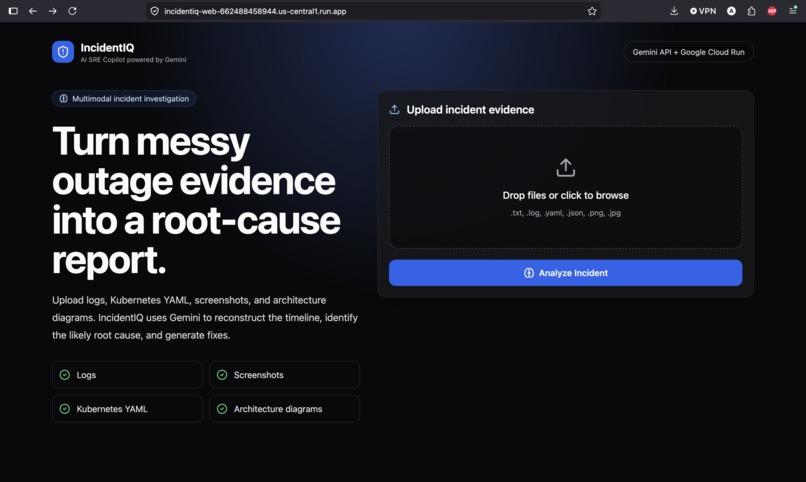
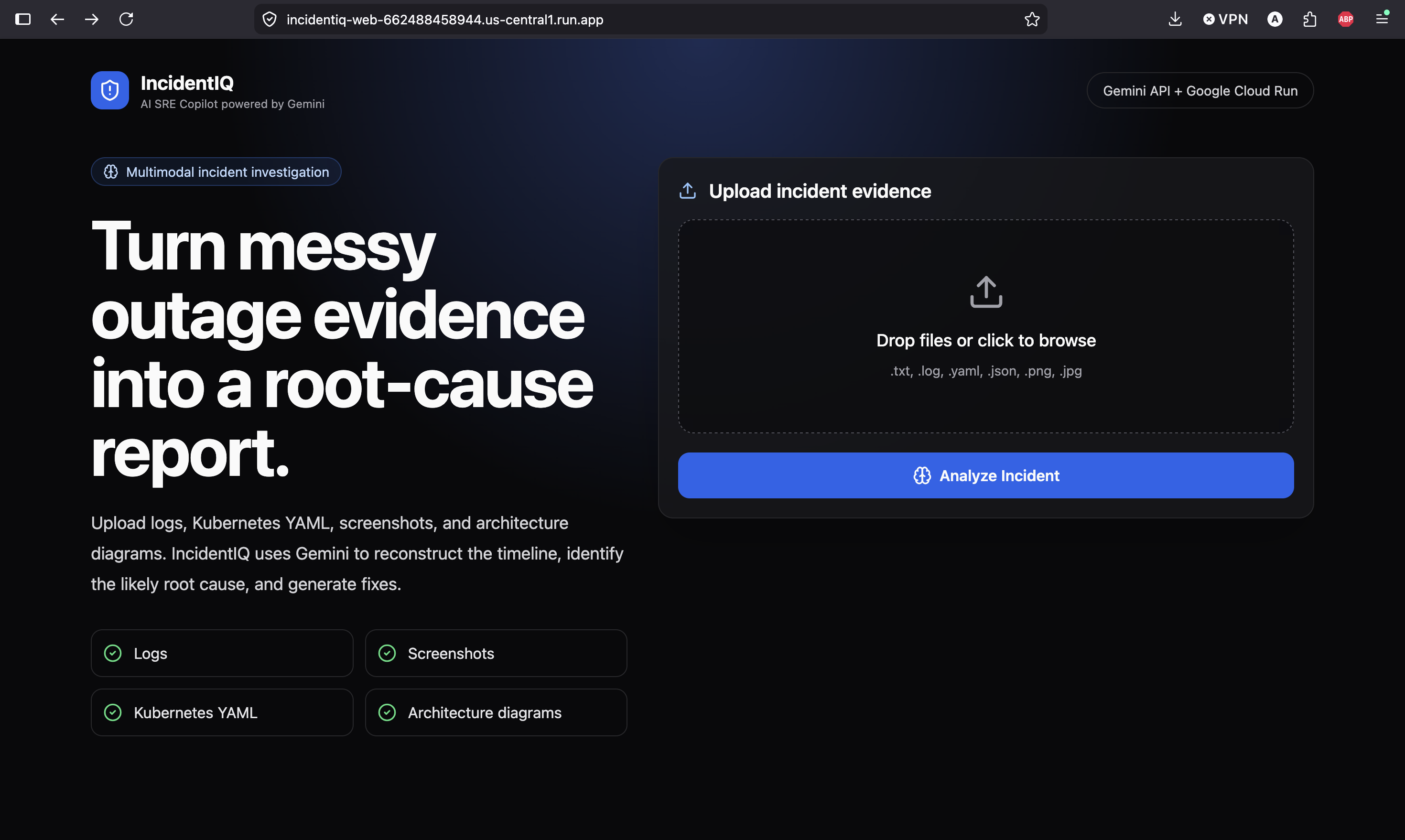
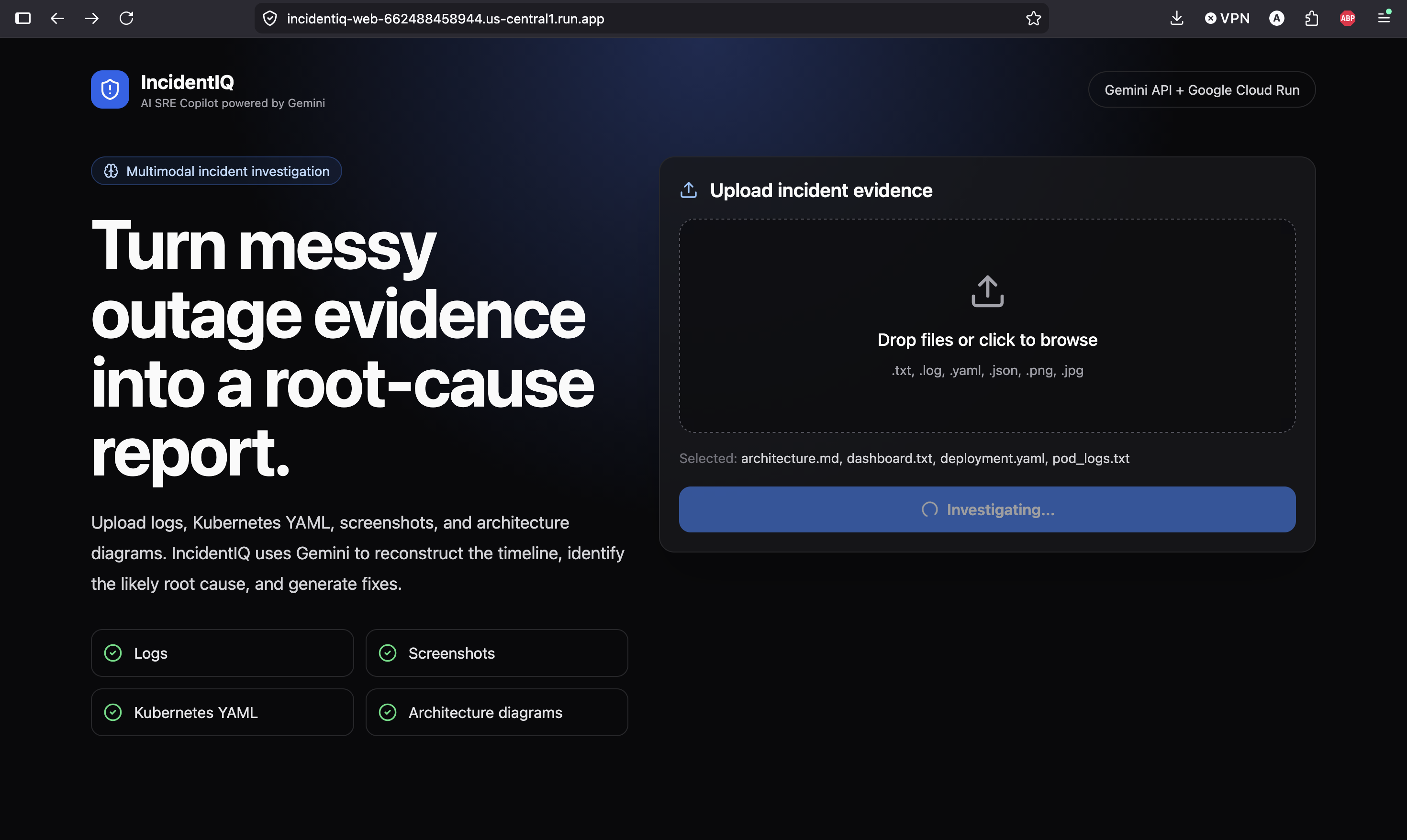
Homepage
-
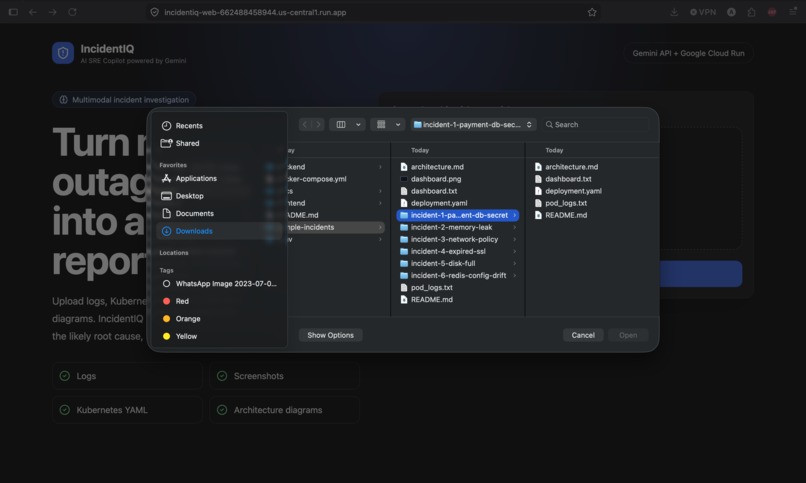
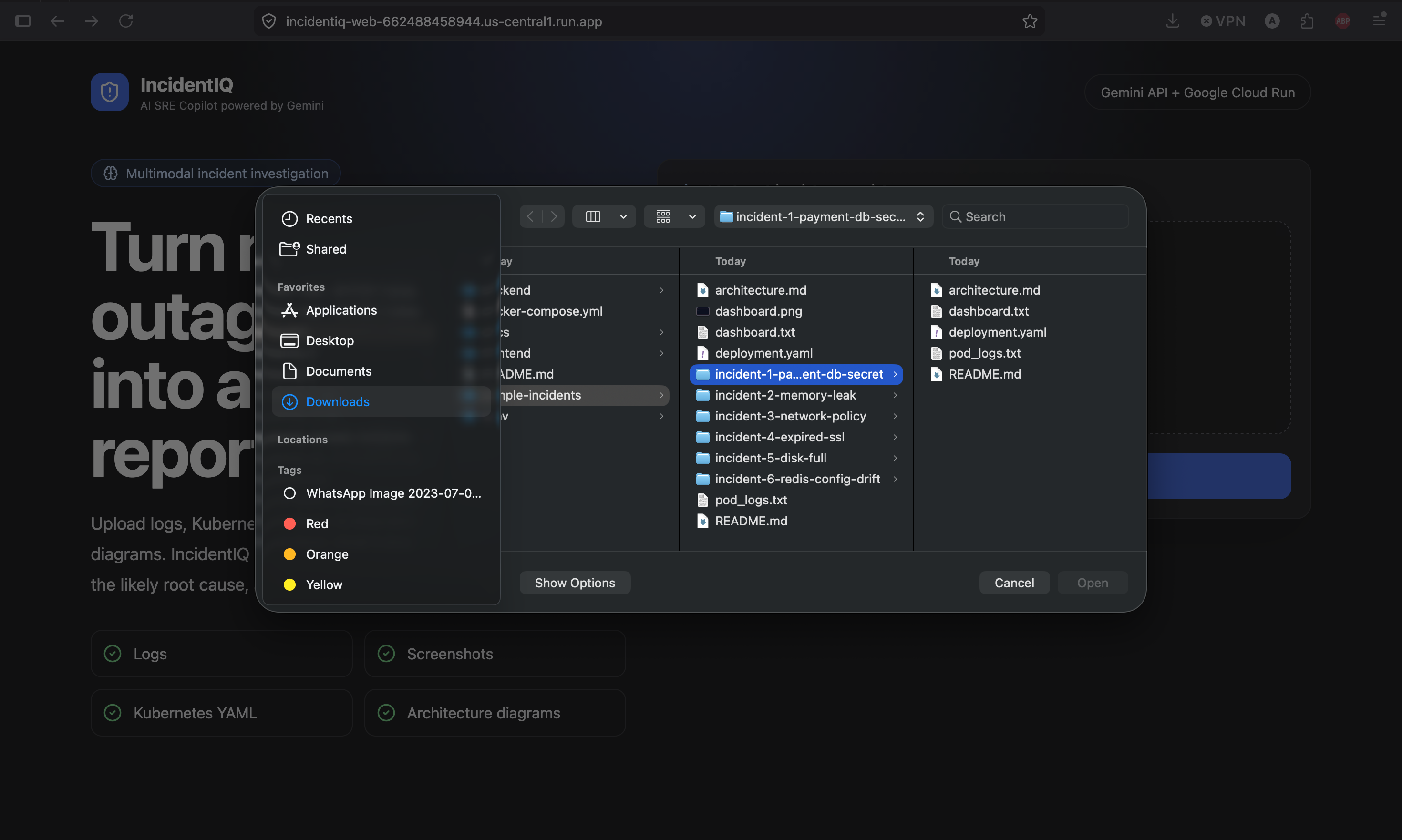
Select incident files
-
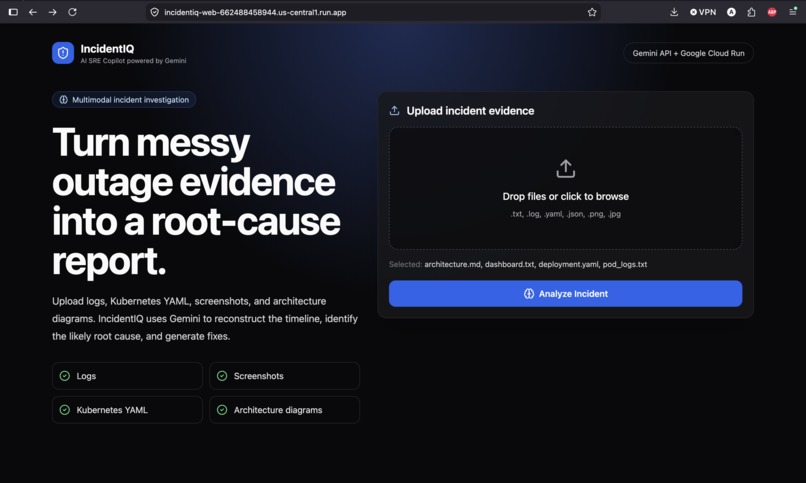
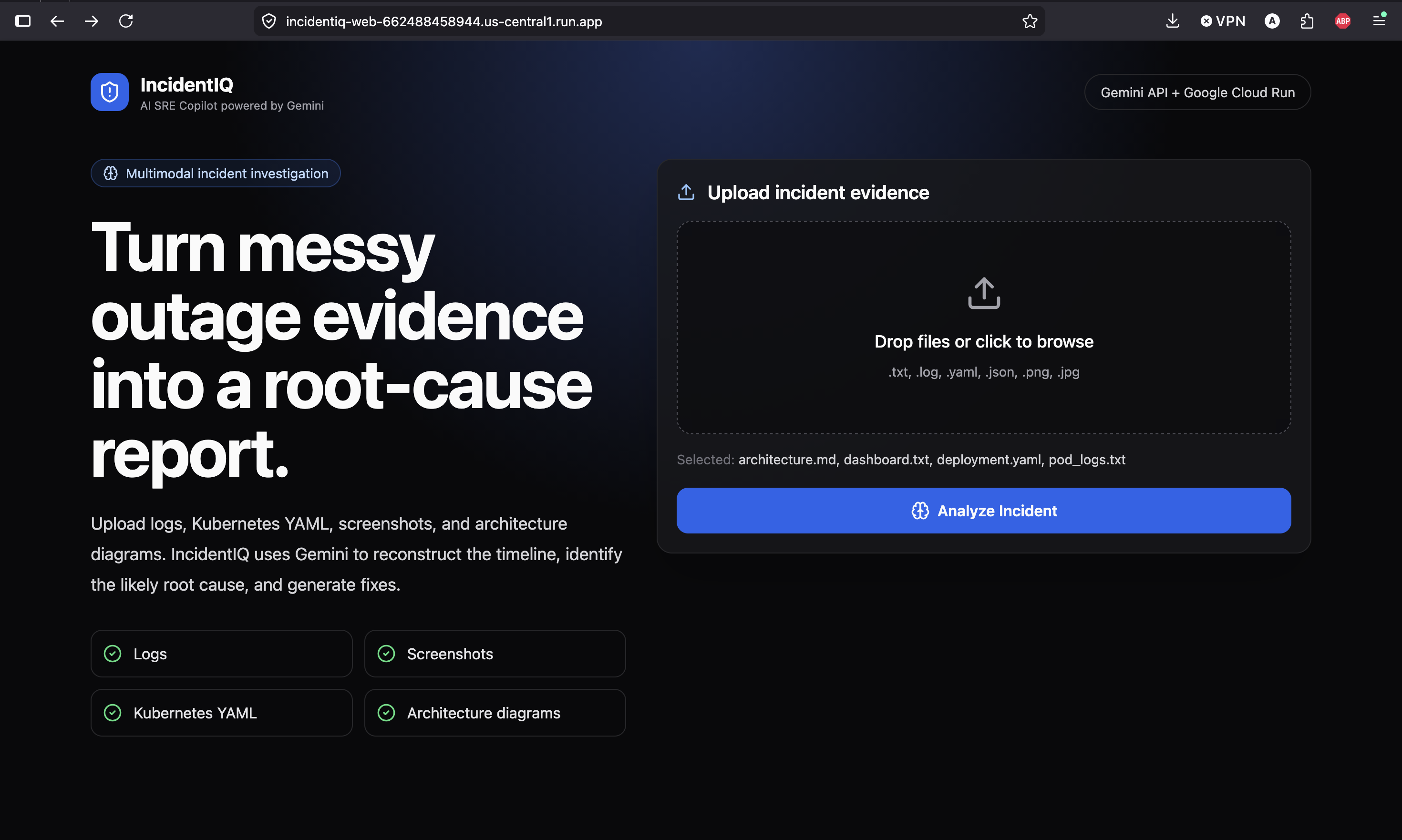
Selected incident files
-
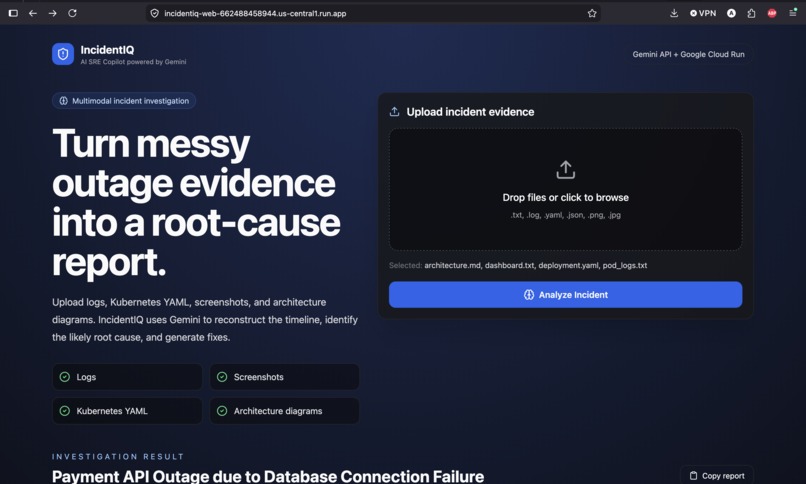
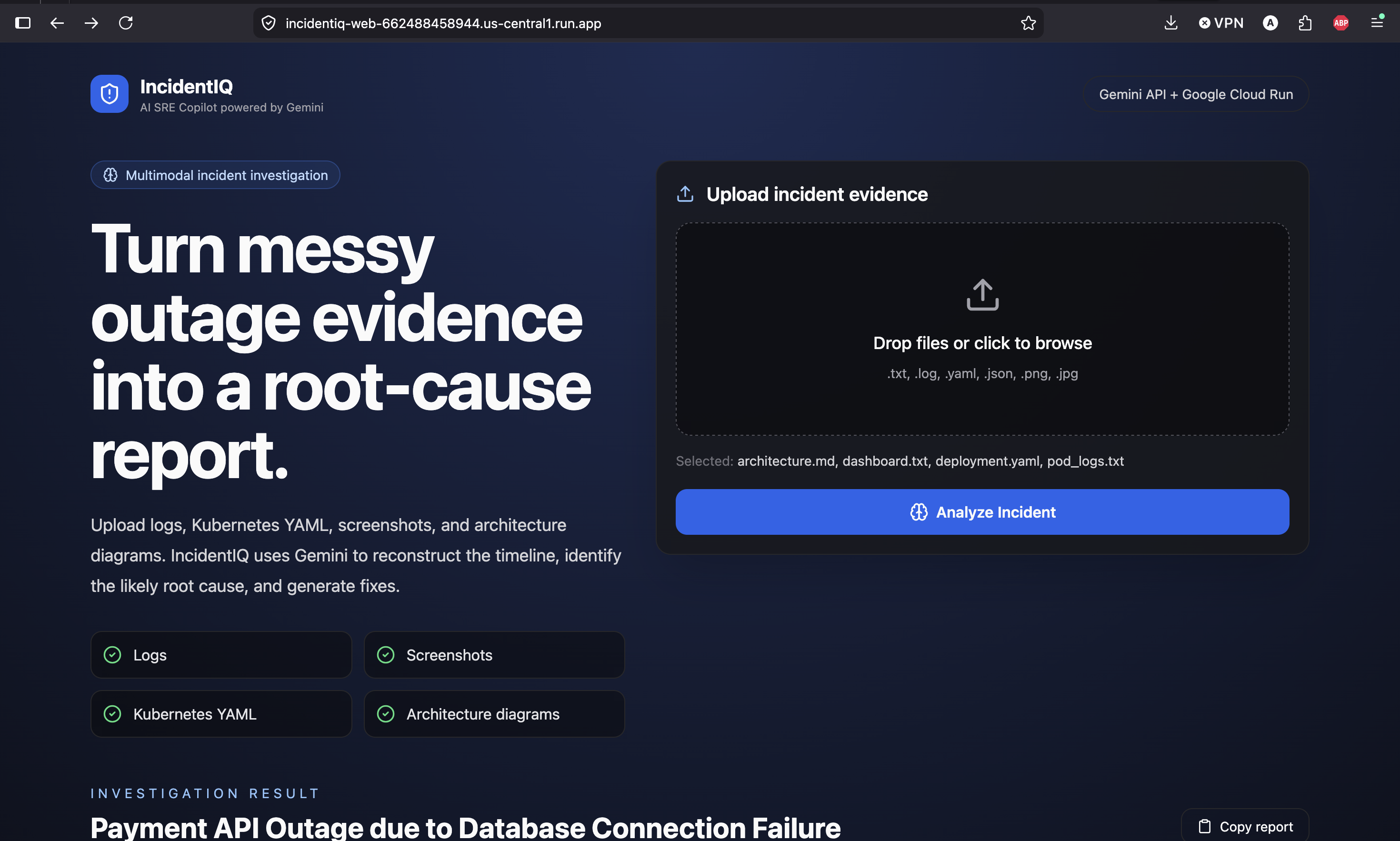
Done analyzing
-
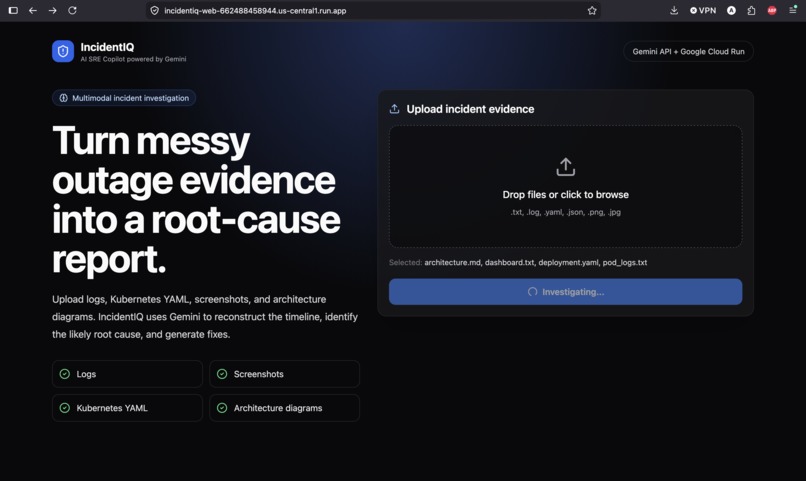
Analyzing Incidents
-
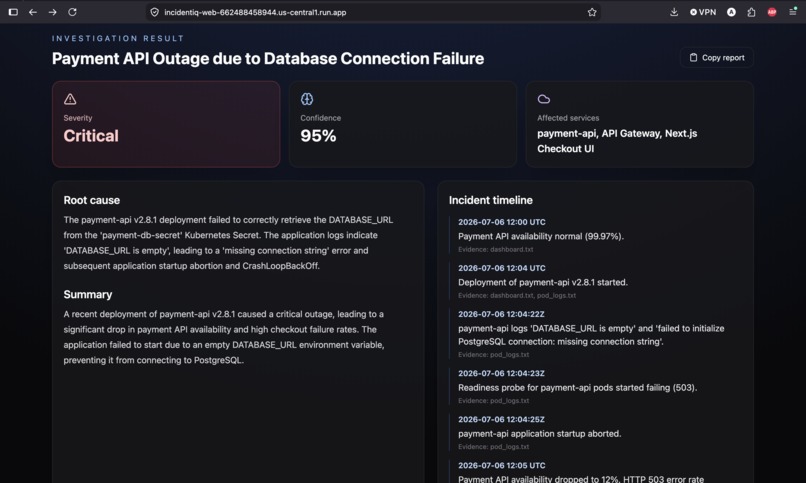
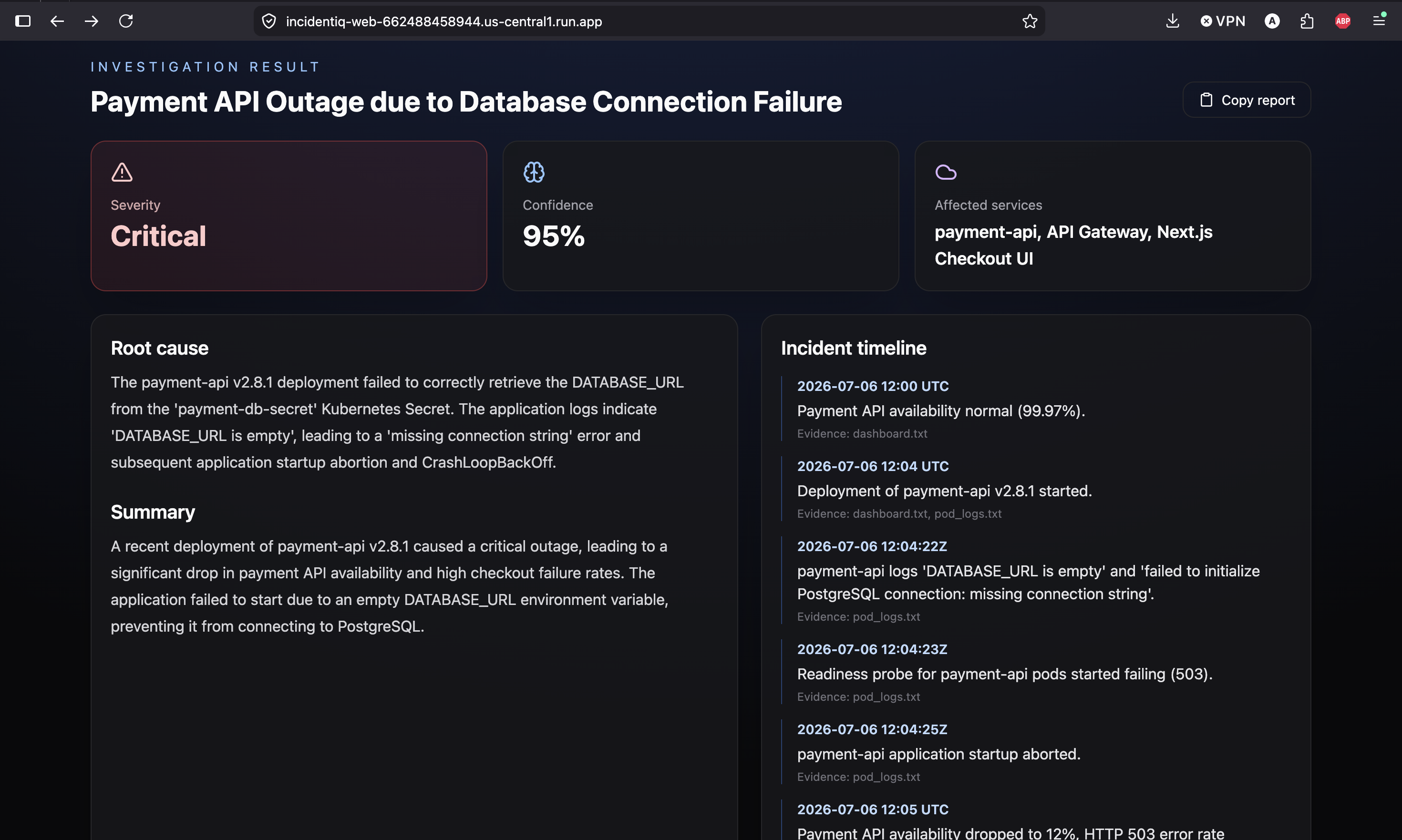
Incident Report Result showing Root Cause, Severity, Confidence, Affected Services and Incident Timeline
-
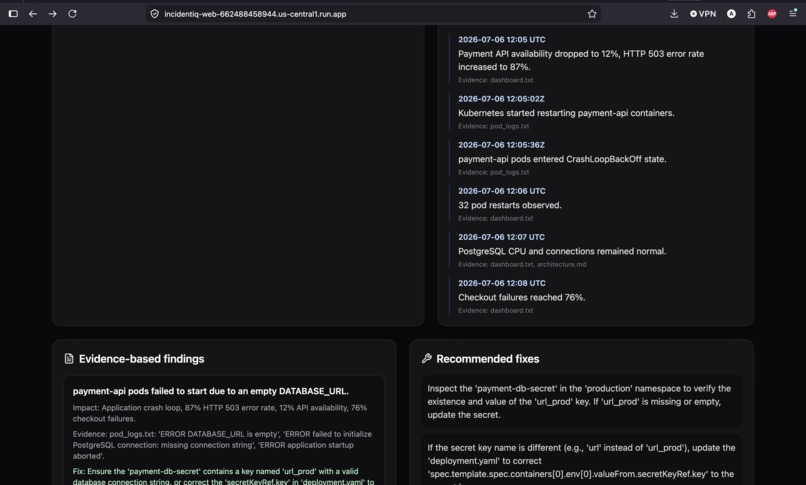
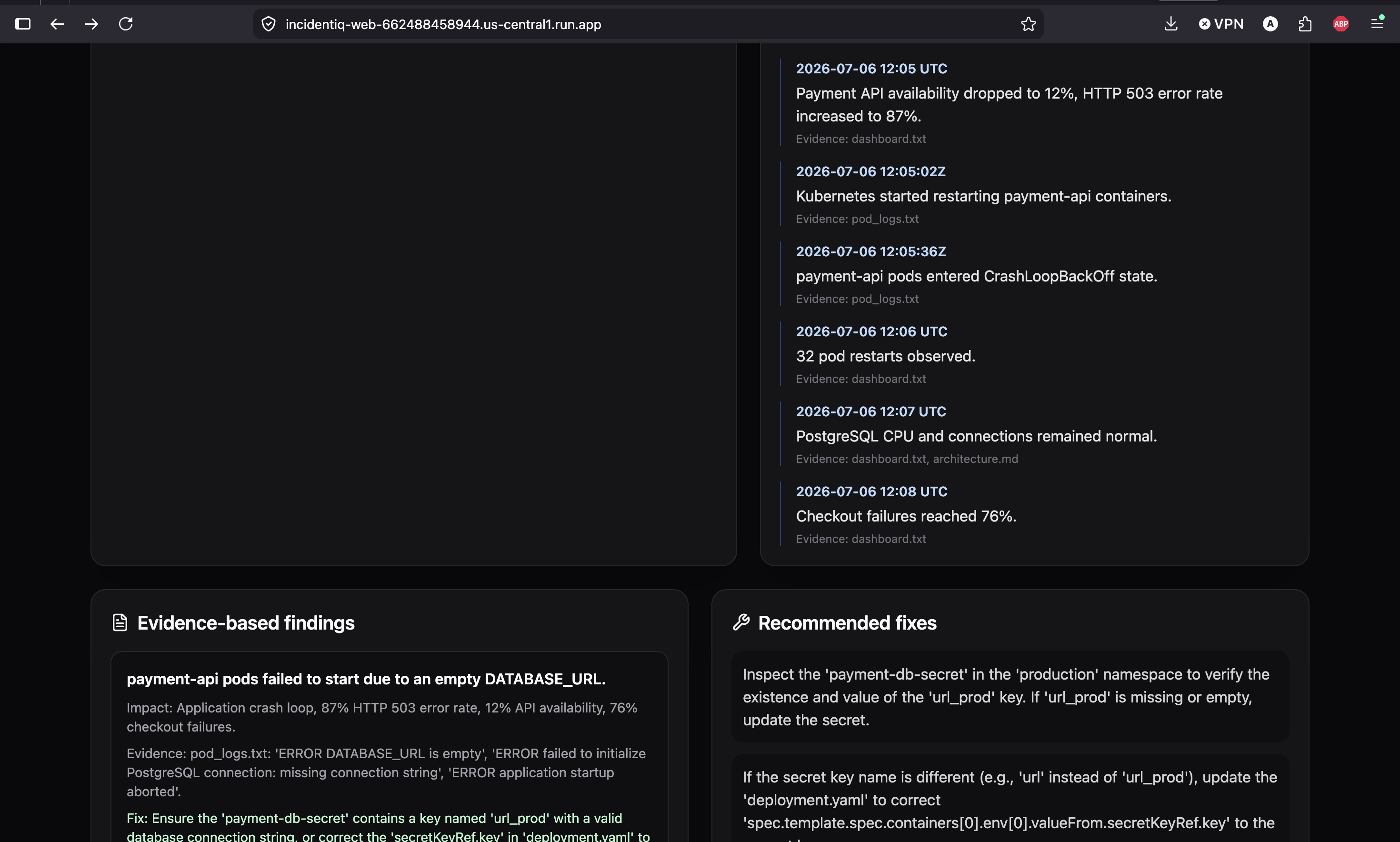
Incident Report showing Incident Timeline, Evidence-based findings and Recommended fixes
-
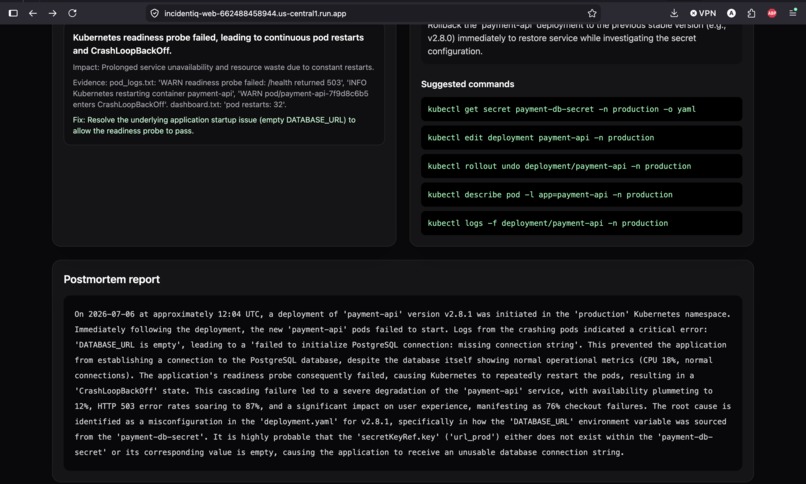
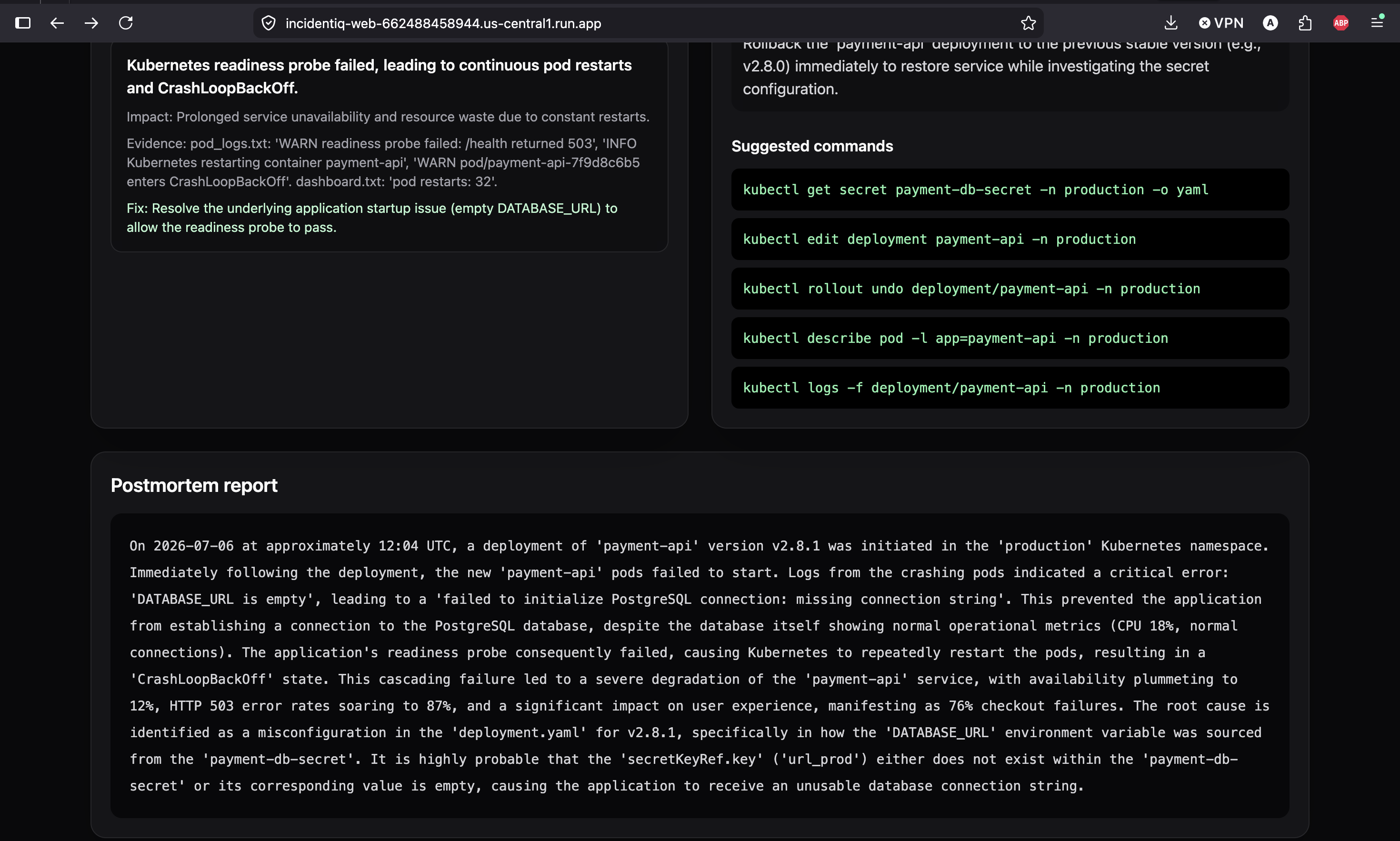
Incident Report showing Postmortem report
Inspiration
As a software engineering graduate, I've spent countless hours debugging projects by jumping between logs, configuration files, screenshots, dashboards, and documentation. Whether it's a Kubernetes deployment failure or an application crash, the information needed to identify the root cause is often scattered across multiple sources.
I wanted to explore how Gemini's multimodal reasoning could simplify this process by analyzing different types of evidence together and producing a clear, structured investigation instead of making developers manually piece everything together.
What it does
IncidentIQ is an AI-powered incident investigation assistant for developers and DevOps engineers.
Users can upload application logs, Kubernetes YAML files, screenshots, and architecture diagrams. Gemini analyzes all of the uploaded evidence together to:
- Generate an incident summary
- Reconstruct the incident timeline
- Identify the most likely root cause
- Assess incident severity and confidence
- Highlight affected services
- Recommend fixes and preventive actions
- Generate a professional postmortem report
Instead of spending hours manually investigating production issues, developers receive a structured investigation with actionable insights in seconds.
How I built it
I built IncidentIQ using Next.js, React, TypeScript, Tailwind CSS, and shadcn/ui for the frontend, creating a clean and intuitive interface for uploading evidence and visualizing investigation results.
The backend was built with FastAPI and integrates with the Gemini API using Google's GenAI SDK. Uploaded logs, screenshots, YAML files, and architecture diagrams are processed together, allowing Gemini to reason across multiple sources of evidence rather than analyzing each file independently.
Gemini returns structured JSON containing the incident summary, timeline, root cause, severity, confidence score, affected services, and recommended fixes, which powers the investigation dashboard.
The application is deployed on Google Cloud Run.
Challenges I ran into
One of the biggest challenges was designing prompts that encouraged Gemini to reason across multiple types of evidence instead of treating each input separately. Logs, infrastructure files, and screenshots all provide different pieces of the puzzle, so creating consistent and reliable outputs required several iterations.
Another challenge was designing a dashboard that presents complex technical information in a way that's both easy to understand and useful for developers during incident response.
Accomplishments that I'm proud of
- Building a complete full-stack AI application as a solo developer.
- Leveraging Gemini's multimodal capabilities to investigate incidents across multiple file types.
- Creating a structured investigation workflow that mirrors how Site Reliability Engineers approach production incidents.
- Deploying the application on Google Cloud.
- Designing a clean interface that transforms scattered debugging information into actionable insights.
What I learned
This project reinforced that successful AI applications are about designing intelligent workflows, not just generating text.
I learned how to build multimodal AI pipelines, design prompts for structured reasoning, work with JSON-based AI outputs, and integrate Gemini into a real-world engineering workflow. I also gained valuable experience deploying scalable AI applications on Google Cloud.
What's next for IncidentIQ
This hackathon project is just the beginning. Future improvements include:
- GitHub integration for analyzing commits and pull requests
- Kubernetes and Google Cloud Logging integrations
- Slack and Microsoft Teams notifications
- Real-time incident monitoring and alert analysis
- Historical incident search and AI-powered knowledge base
- AI-generated architecture and sequence diagrams
- Team collaboration features
- Support for additional cloud providers
The long-term vision is to evolve IncidentIQ into an AI-powered SRE copilot that helps engineering teams investigate, understand, and resolve production incidents faster and more confidently.
Built With
- cloud-computing
- css
- devops
- docker
- fastapi
- firebase
- gemini
- gemini-api
- generative-ai
- github
- google-ai-studio
- google-cloud
- google-cloud-run
- incident-response
- json
- kubernetes
- machine-learning
- multimodal-ai
- next.js
- observability
- python
- react
- root-cause-analysis
- tailwind
- typescript

Log in or sign up for Devpost to join the conversation.