-
-
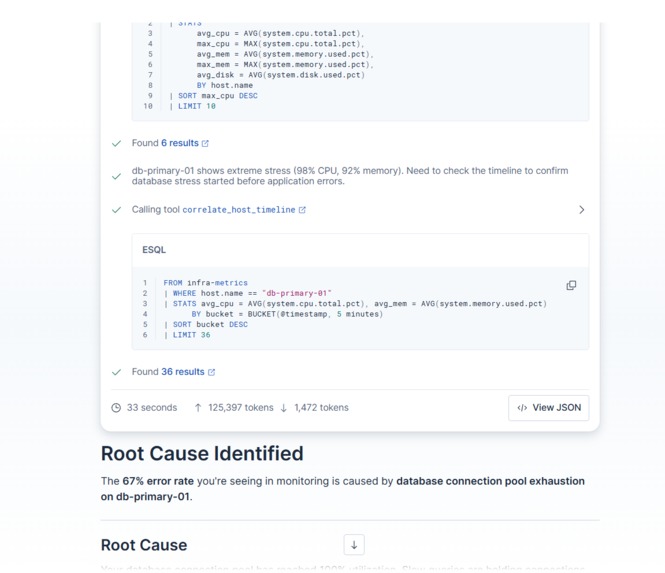
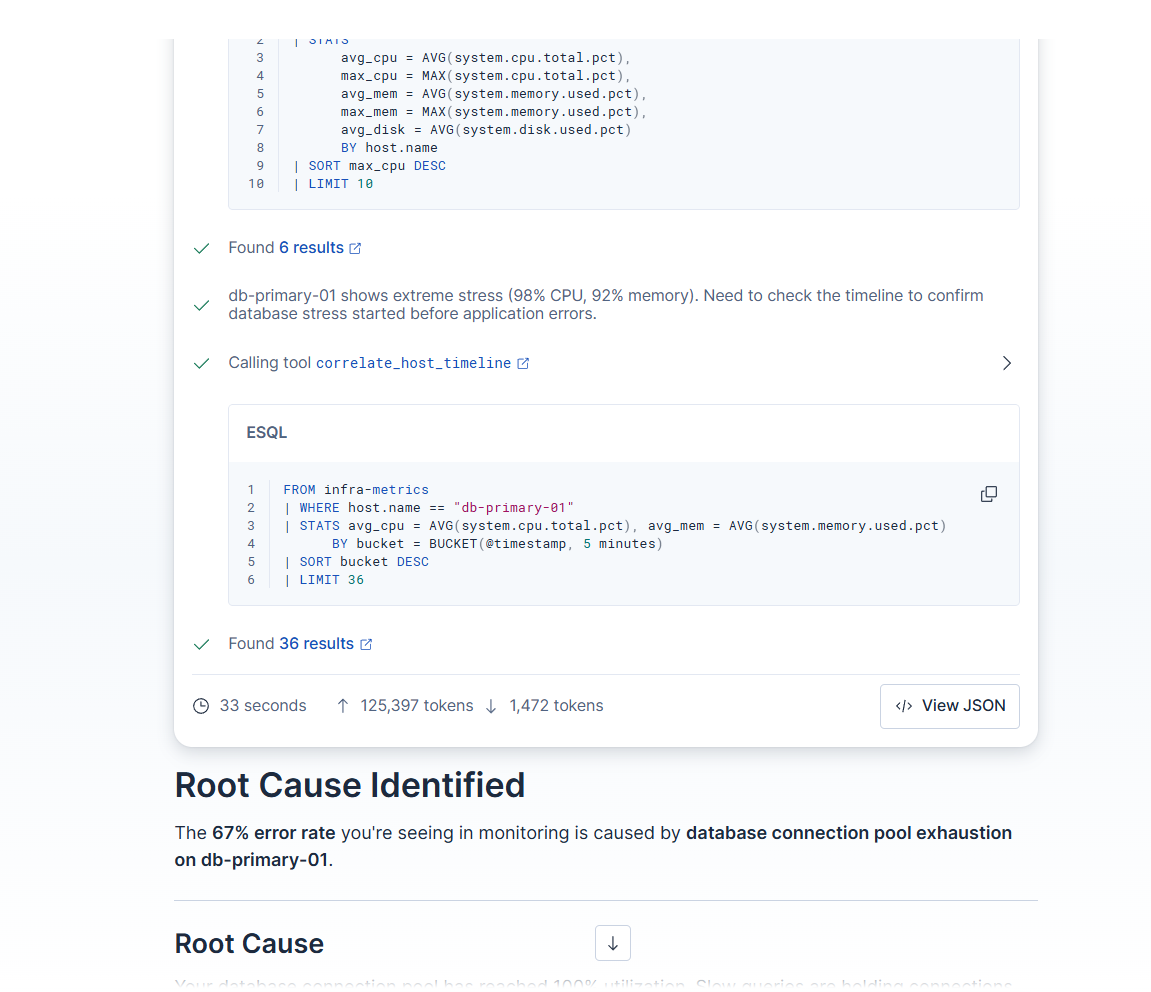
Reasoning tools called by IncidentIQ
-
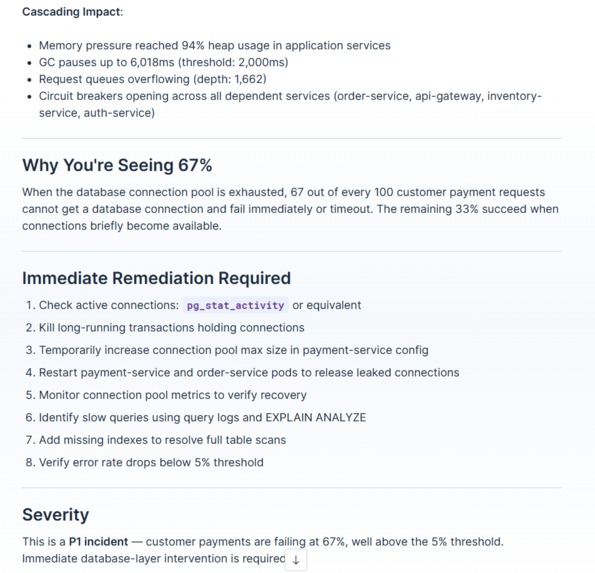
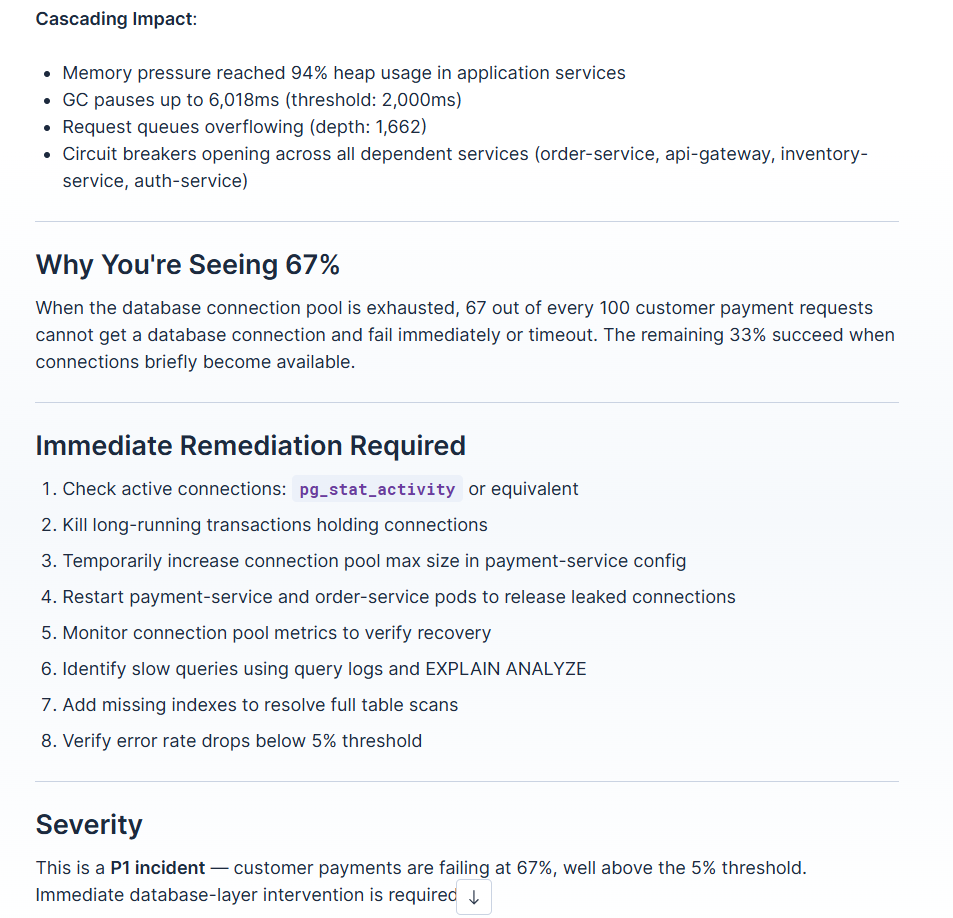
Gives steps with solution
-
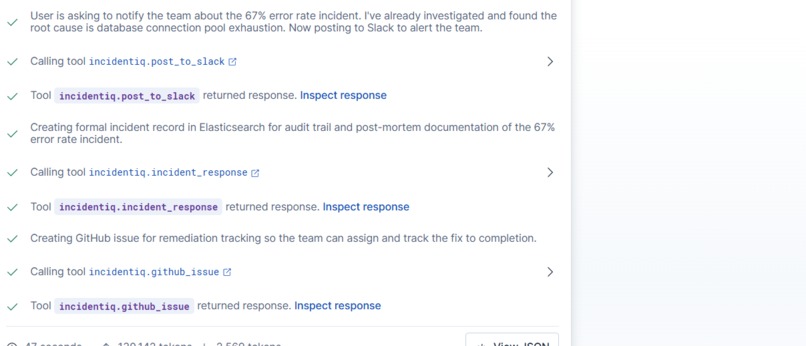
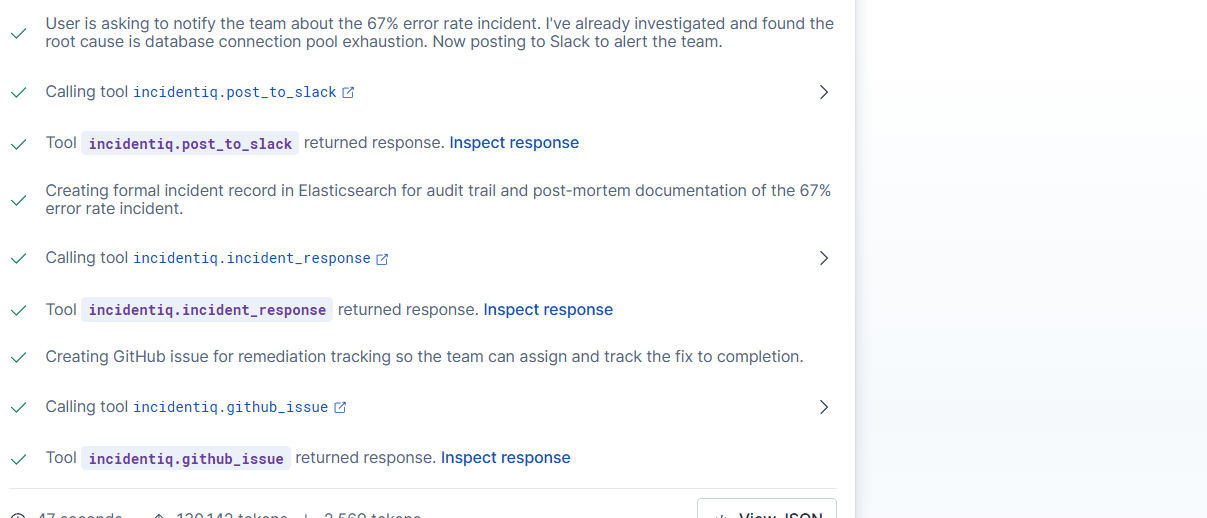
Triggering the workflows with tools
-
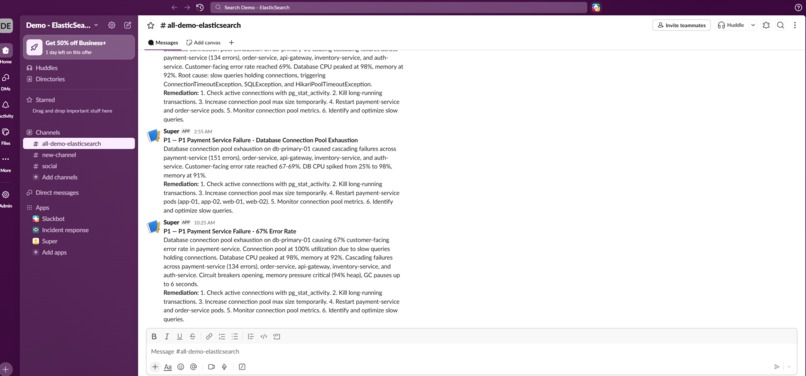
Slack Notification through Elastic Workflows
-
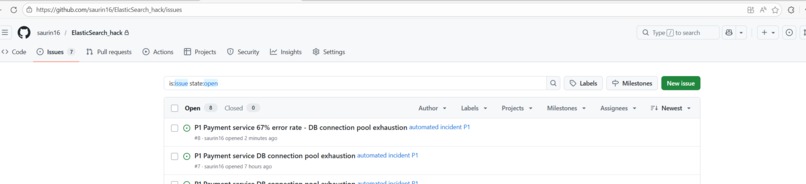
Github Issue with workflows
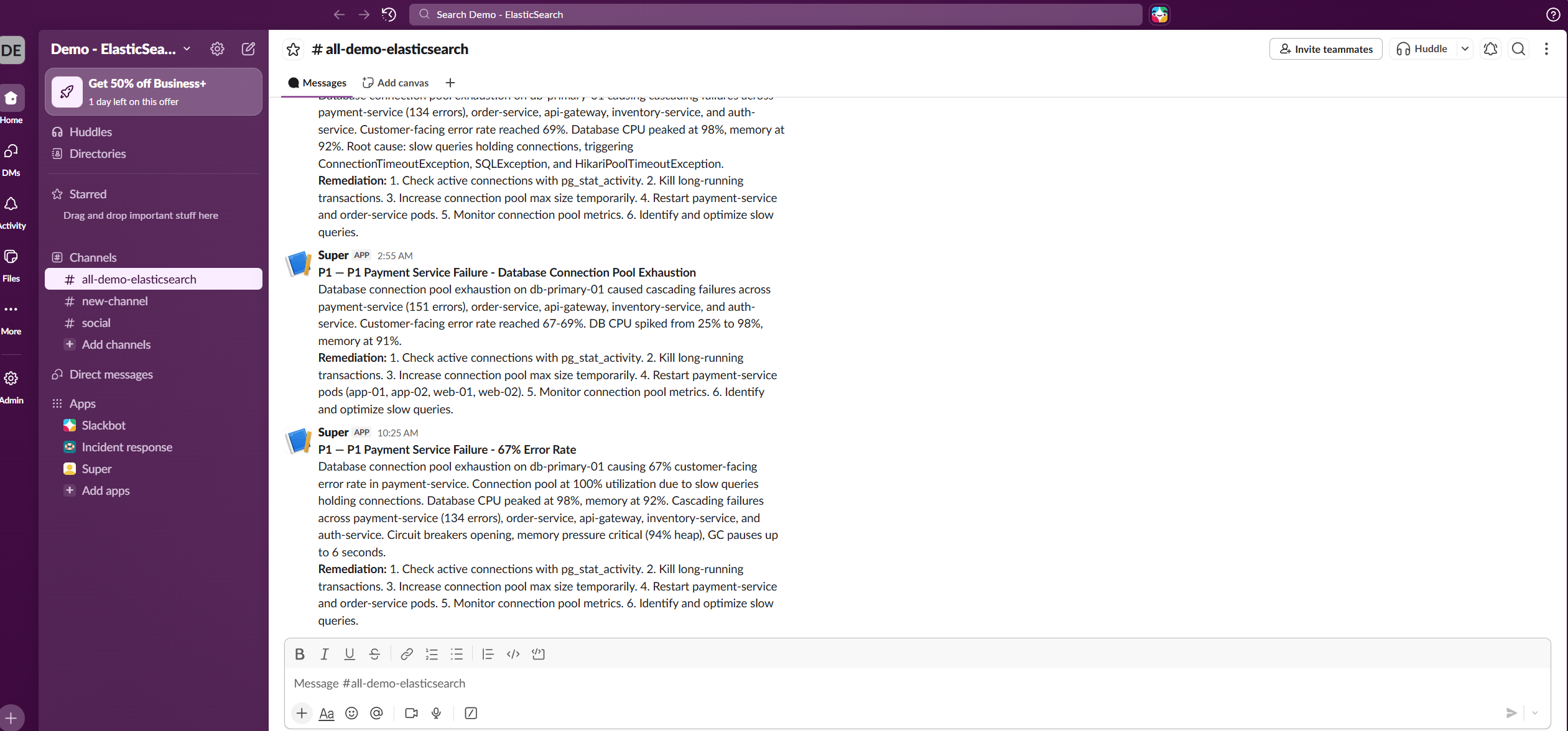
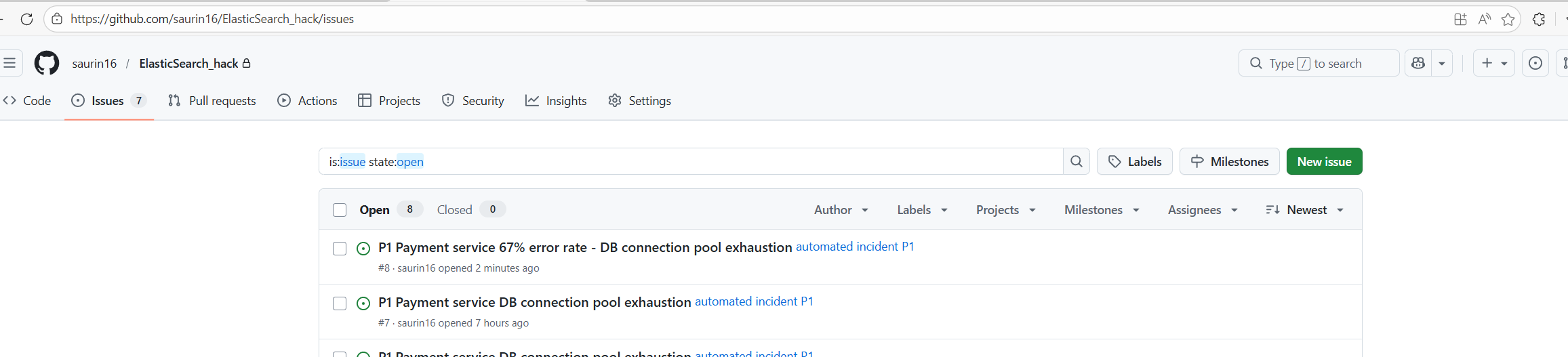
IncidentIQ
AI-Powered Incident Response — From Alert to Resolution in Under 3 Minutes
Submission for the Elastic Agent Builder Hackathon | January – February 2026
Inspiration
Picture this: It's 3:07 AM. Your phone screams. The order-service is down. Customers can't checkout. Revenue is bleeding at $12,000 per minute. You open your laptop, squinting at 5 different tabs — logs, metrics, alerts, Slack, runbooks — trying to figure out what went wrong. Forty-seven minutes later, 4 engineers deep, you finally find the root cause buried under 12,000 noisy log lines.
That single incident just cost your company $564,000.
We asked ourselves: what if AI agents could do in 2.5 minutes what takes a human team 47? Not by guessing — by using Elasticsearch's most powerful (and most underused) features to find statistically unusual errors, match alert rules via reverse search, and generate a blameless post-mortem before the on-call engineer even finishes their coffee.
That's IncidentIQ.
What It Does
IncidentIQ is a multi-agent incident response system that turns Elasticsearch into an autonomous SRE team. Three specialized agents work like a relay race, each handing off findings to the next:
The Triage Agent is your first responder. It fires up a FORK/FUSE/RRF hybrid search to find 3 similar past incidents in milliseconds, analyzes error trends, and classifies severity. "This is a P1. Here's what happened last time."
The Investigation Agent is your detective. It runs significant_terms and discovers that connection_pool_exhausted is appearing 70x above baseline — that's your root cause, not the noisy TimeoutException flooding the logs. It maps the blast radius: order-service → payment-service → cart → 5 services total.
The PostMortem Agent is your synthesizer. It takes everything from Triage and Investigation, searches for prevention strategies, and writes a blameless post-mortem with a timeline, action items, and recommendations.
Then the workflow fires: Slack notifies #payments-team. Jira creates ticket OPS-2847. The audit log captures everything. Total elapsed time: 2 minutes 30 seconds.
A React 19 dashboard with 9 pages brings it all to life — animated pipeline visualizations, blast radius cascade graphs, live revenue counters, and a guided demo mode that tells the full "3 AM Incident" story.
How We Built It
Architecture
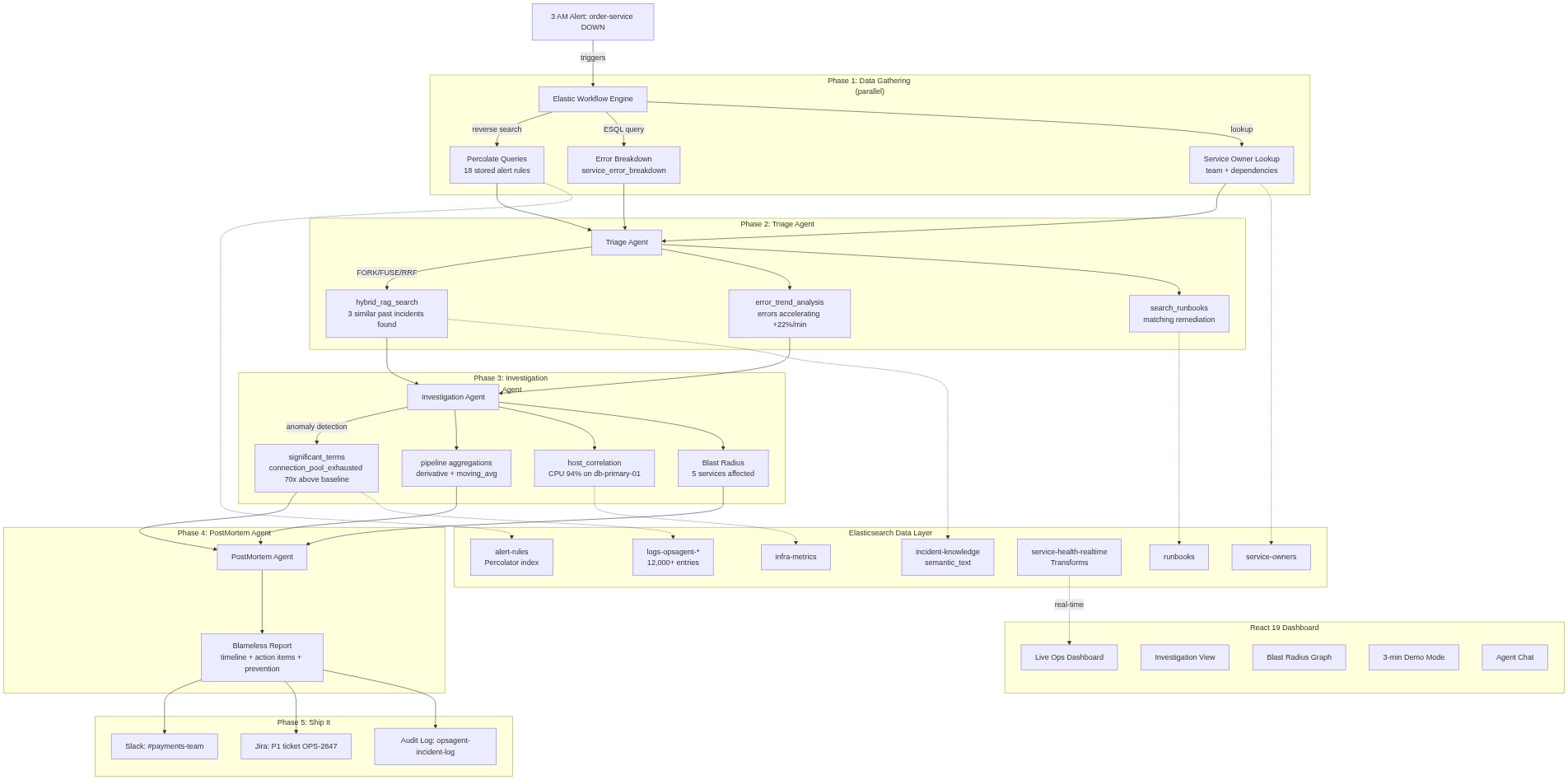
The Agents
Triage Agent — The First Responder
Fast, decisive, gets you oriented in 60 seconds. Uses FORK/FUSE/RRF hybrid search to find similar past incidents instantly. Tools: hybrid_rag_search · error_trend_analysis · service_error_breakdown · search_runbooks
Investigation Agent — The Detective
Doesn't accept "TimeoutException" as root cause — digs deeper. significant_terms finds what's statistically unusual, not what's common. Tools: anomaly_detector · pipeline_aggregations · percolate_queries · host_correlation
PostMortem Agent — The Synthesizer
Turns chaos into a structured blameless report. Combines all findings + prevention strategies from the knowledge base. Tools: hybrid_rag_search · blameless_report · search_runbooks
Ops Agent — The Fallback
Swiss-army knife for when you need one agent to do it all. Access to all 11 tools in a single pass. Tools: All tools combined
Tech Stack
Backend — Elasticsearch:
- Elasticsearch 9.x (Serverless or self-managed)
- Kibana Agent Builder (GA, Jan 2026) — 4 agents, multi-agent orchestration
- ES|QL — 10+ parameterized tool queries with FORK/FUSE/RRF
- Elastic Workflows — 6-phase YAML automation
- Transforms — Continuous materialized views for real-time dashboards
- Python 3.10+ — 12,000+ engineered log entries with per-service error profiles
Frontend — React Dashboard:
- React 19 + TypeScript 5.9 + Vite 7
- Tailwind CSS 4 (dark SRE theme) + Radix UI
- Framer Motion (animations) + Recharts (data viz) + Lucide React (icons)
The 9 Elasticsearch Hidden Gems
We didn't just use Elasticsearch for basic search. We went deep — showcasing 9 advanced features that most teams don't even know exist:
| # | Hidden Gem | The "Aha!" Moment |
|---|---|---|
| 1 | FORK / FUSE / RRF | One ES|QL query runs BOTH lexical and semantic search, then fuses results with Reciprocal Rank Fusion. Our Triage Agent finds similar past incidents with incredible relevance — no separate retrieval pipeline needed. |
| 2 | significant_terms | This is the killer feature. Instead of finding the most common errors (symptoms), it finds the most unusual errors (root cause). connection_pool_exhausted at 70x above baseline? That's your answer — not the TimeoutException that fills every log. |
| 3 | Percolate Queries | Normal search: "find documents matching this query." Percolate: "find queries matching this document." We store 18 alert rules, then reverse-search with the incident to determine which rules fire. Scales to thousands of rules. |
| 4 | Pipeline Aggregations | derivative + moving_avg don't just tell you errors are high — they tell you errors are accelerating at +22%/min and will breach SLA in 12 minutes. Predictive, not reactive. |
| 5 | semantic_text | Zero-config vector search. Add a semantic_text field, index your document, search semantically. No ML pipeline, no embedding model config. Just works. |
| 6 | ES|QL | 10+ parameterized queries with ?param placeholders. The LLM decides which tool and what parameters — but never writes raw queries. Safe from hallucination by design. |
| 7 | Agent Builder | 4 agents with distinct tool sets and system prompts. Multi-agent orchestration where each agent has a clear mission. Not one giant prompt trying to do everything. |
| 8 | Elastic Workflows | 6-phase YAML that gathers data in parallel, calls agents sequentially with handoffs via {{ steps.*.output.content }}, routes notifications by severity, and logs everything. |
| 9 | Transforms | service-health-summary continuously materializes service health from raw logs. Dashboard loads in <1ms. No query-time aggregation. |
Agent Builder Features We Loved
1. FORK / FUSE / RRF in ES|QL — This was the moment we knew Agent Builder was special. Multi-strategy hybrid search in a single query? We went from building a custom retrieval pipeline to a one-liner that fuses lexical and semantic results with Reciprocal Rank Fusion. The Triage Agent finds similar past incidents with relevance we couldn't achieve with either strategy alone.
2. Pre-built ES|QL Tools with ?param Placeholders — Our #1 concern was LLM hallucination. Agents love to mix ES|QL and SQL syntax. Agent Builder solved this elegantly: define tools as parameterized queries, let the LLM choose which tool and what parameters, but never let it write raw queries. Every tool is pre-tested. No hallucinated syntax. Problem solved.
3. Multi-Agent Orchestration via Workflows — Chaining 3 agents with clean handoffs using {{ steps.*.output.content }} template variables was incredibly powerful. Each agent has a focused role, a distinct tool set, and the workflow passes full context between them. It feels like watching a relay race where each runner is a specialist.
Challenges We Ran Into
The "ES|QL vs SQL" Wars — Our first prototype let agents write dynamic ES|QL. Disaster. The LLM would generate SELECT * FROM logs WHERE level = 'ERROR' instead of FROM logs-opsagent-* | WHERE log.level == "ERROR". Solution: lock down every query as a pre-built tool with ?param placeholders. The agent reasons about what to search for, not how to write the query.
Making significant_terms Actually Significant — The significant_terms aggregation is brilliant in theory, but it needs the right data to shine. Random log data produces meaningless results. We spent serious time engineering 12,000+ log entries with distinct per-service error profiles so that the foreground set (incident window) has genuinely different term frequencies than the background set (all historical data). The payoff: connection_pool_exhausted lights up at 70x above baseline while TimeoutException (which appears in every service) is correctly ignored.
The Fallback Rabbit Hole — FORK/FUSE/RRF isn't available on all Elasticsearch tiers. Neither are some ES|QL operators. We ended up building a 3-tier fallback system for every single tool: Tier 1 (full features), Tier 2 (simplified ES|QL), Tier 3 (basic keyword match). Triple the configuration work, but the demo never fails.
Context Across Agent Handoffs — The Investigation Agent needs everything the Triage Agent found, and the PostMortem Agent needs everything from both. Dropping even one detail breaks the post-mortem. We learned to structure each agent's output as a complete, self-contained briefing that the next agent can consume without losing nuance.
Accomplishments We're Proud Of
- 95% MTTR Reduction — 47 minutes → 2.5 minutes. Not a typo.
- $528,000 saved per incident — Revenue loss drops from $564k to $36k at $12k/min
- 9 Elasticsearch Hidden Gems in one project — We think this might be a record
- Zero guessing — Every agent conclusion cites specific
significant_termsscores,derivativevalues, andpercolatematches. Evidence, not vibes. - 3-tier fallback system — The demo works on any Elasticsearch tier. No "works on my machine" moments.
- 12,000+ engineered log entries — Purpose-built data that makes
significant_termsproduce genuinely compelling results
What We Learned
significant_terms is the most underrated Elasticsearch feature. Everyone uses simple counts and top-N aggregations. But finding what's unusual matters infinitely more than finding what's common. This single insight — "the root cause is the anomaly, not the symptom" — is what makes IncidentIQ actually work.
Pre-built parameterized queries > dynamic generation. LLMs are brilliant at reasoning and terrible at syntax. Let them decide what to search for but never how to write the query. Agent Builder's ?param placeholders are elegant precisely because they separate reasoning from execution.
Multi-agent specialization beats single-agent generalization. Three focused agents with distinct tool sets outperform one mega-agent every time. Each agent has a clear mission, constraints, and expertise. The workflow handles coordination.
Percolate queries are magic at scale. Instead of running 18 alert rules against each incident, we store the rules as queries and "reverse search" with the incident document. One query, all rules evaluated. This scales to thousands of rules without breaking a sweat.
What's Next for IncidentIQ
- Auto-Remediation — Agents execute runbook steps automatically: restart services, scale pods, flush connection pools. Not just detect and report — fix.
- Learning Loop — Automatically index resolved incidents back into the knowledge base. Every incident makes the next
hybrid_rag_searchsmarter. - Embedded Agent Chat — Bring Kibana Agent Builder chat directly into the dashboard. One pane of glass for the entire incident lifecycle.
- Cross-Cluster Correlation — Extend blast radius analysis across multiple Elasticsearch clusters and cloud regions.
- Predictive Alerting — Use pipeline aggregation derivatives to trigger alerts before error rates cross thresholds. Alert on acceleration, not just magnitude.
Impact Metrics
| Before (Manual) | After (IncidentIQ) | Delta | |
|---|---|---|---|
| Time to Resolve | 47 minutes | 2.5 minutes | 95% faster |
| Revenue Loss per Incident | $564,000 | $36,000 | $528,000 saved |
| Engineers Paged at 3 AM | 4 | 0 | Zero disruption |
| Tools Needed | 5+ (logs, metrics, alerts, Slack, Jira) | 1 (IncidentIQ) | Single pane of glass |
| Knowledge Captured | In people's heads | Indexed + searchable | Never lost |
| Post-Mortem Written | "We'll do it Monday" | Instant, blameless | Every time |
Try It Out
| Repository | github.com/nihalnihalani/IncidentIQ |
| License | MIT (OSI-approved open source) |
Built With
- elastic-workflows
- elasticsearch-9.x
- es|ql
- fork/fuse/rrf
- framer-motion
- kibana-agent-builder
- lucide-react
- percolate-queries
- pipeline-aggregations
- python
- radix-ui
- react-19
- react-router-dom-v7
- recharts
- semantic-text
- significant-terms
- tailwind-css-4
- transforms
- typescript-5.9
- vite-7


Log in or sign up for Devpost to join the conversation.