-
-
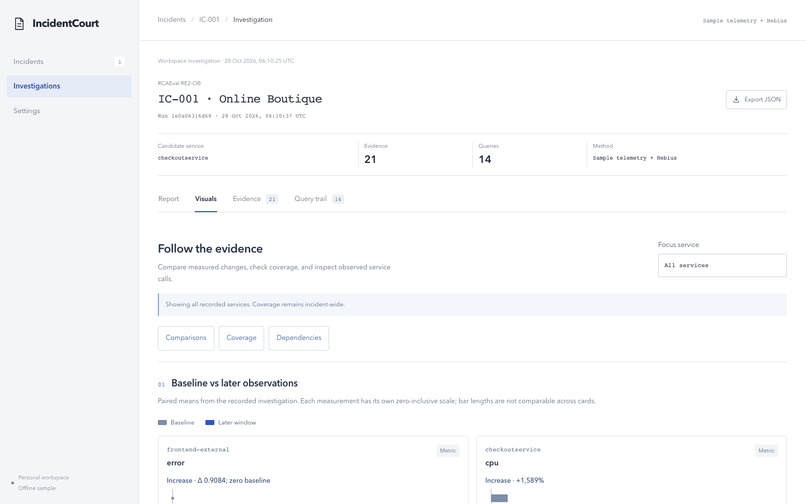
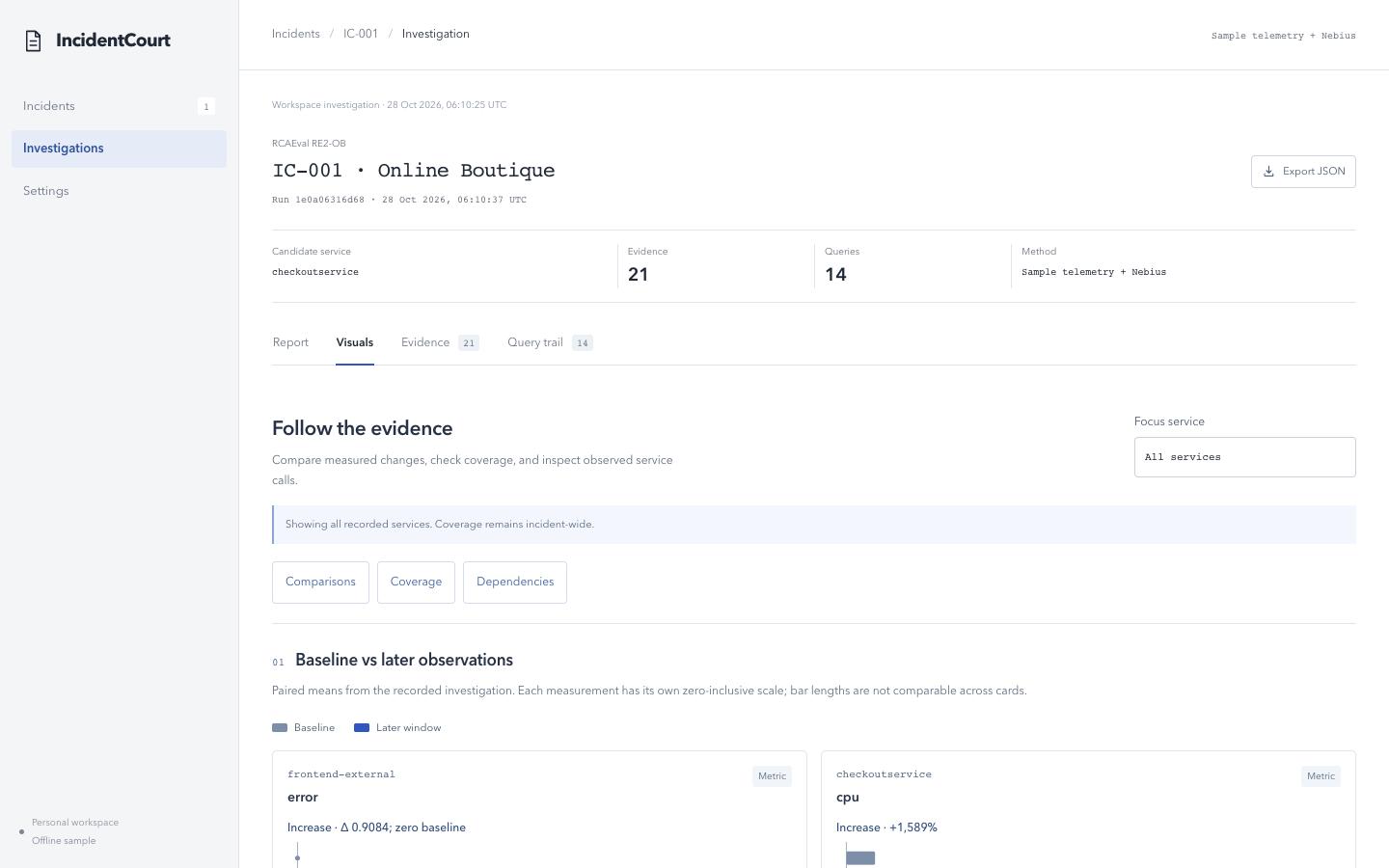
Compare baseline and later telemetry to follow changes across services.
-
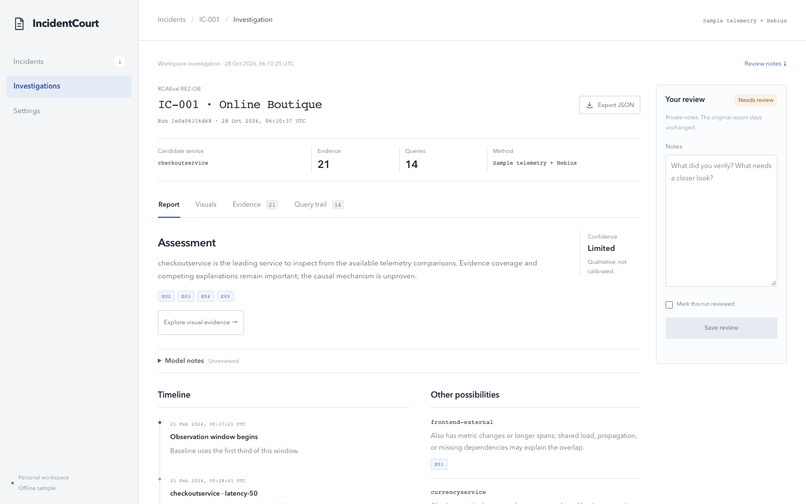
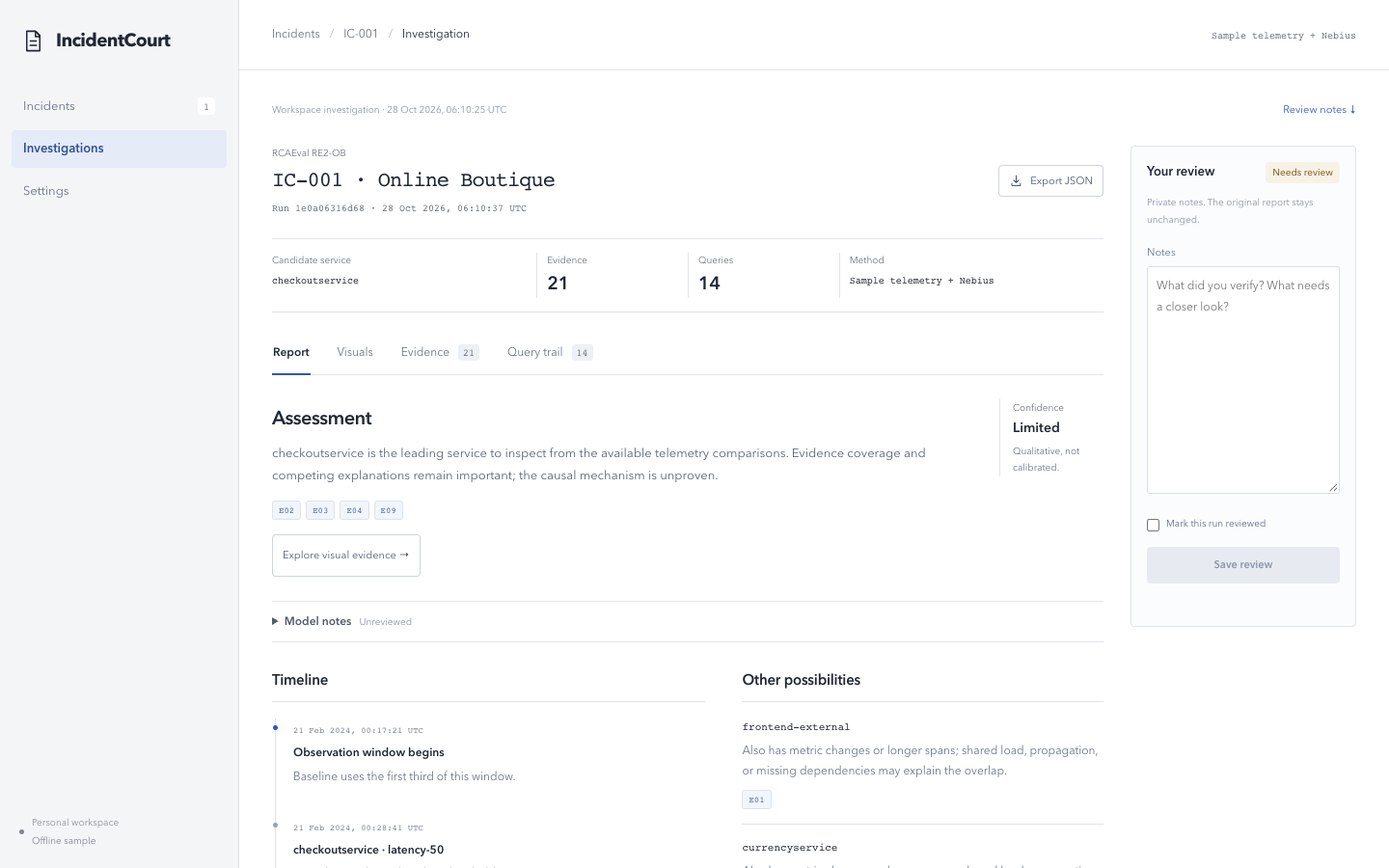
A Nebius-backed investigation presents evidence, alternatives and a confidence assessment.
-
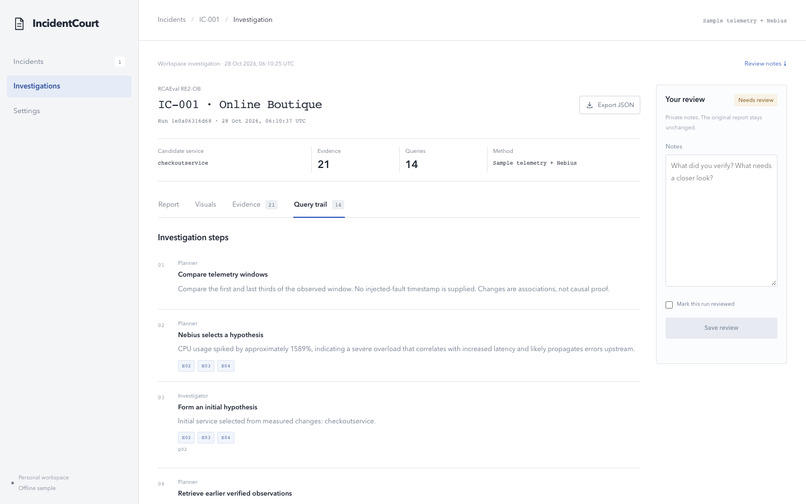
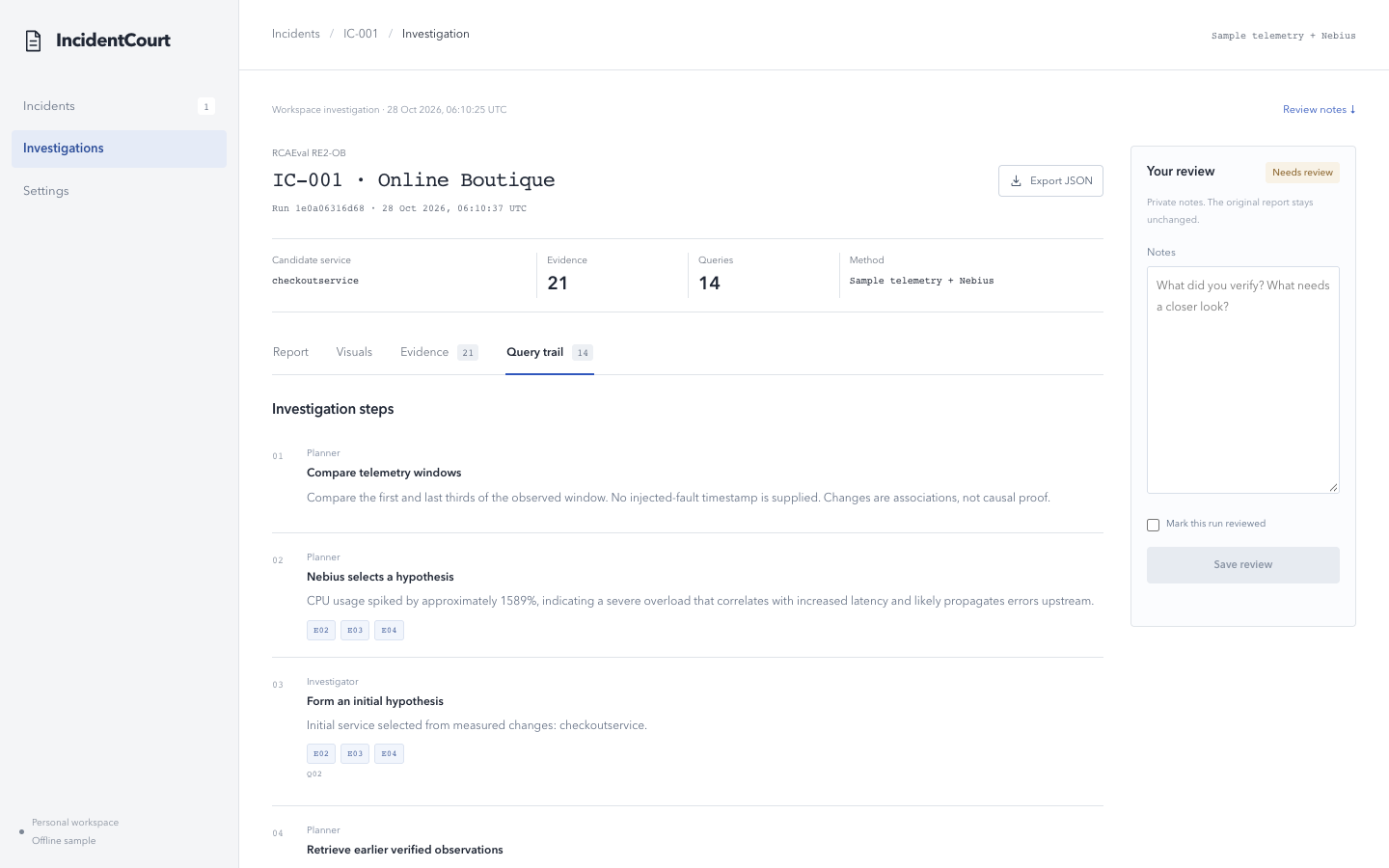
The query trail shows how Nemotron proposes a hypothesis and guides a follow-up.
-
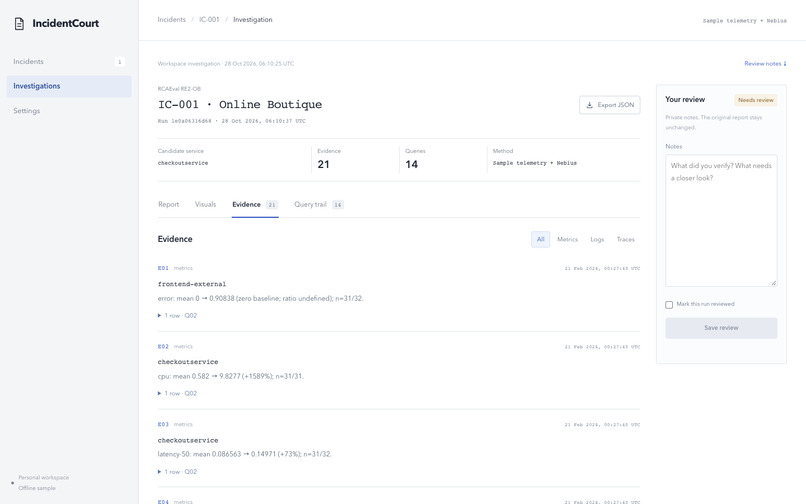
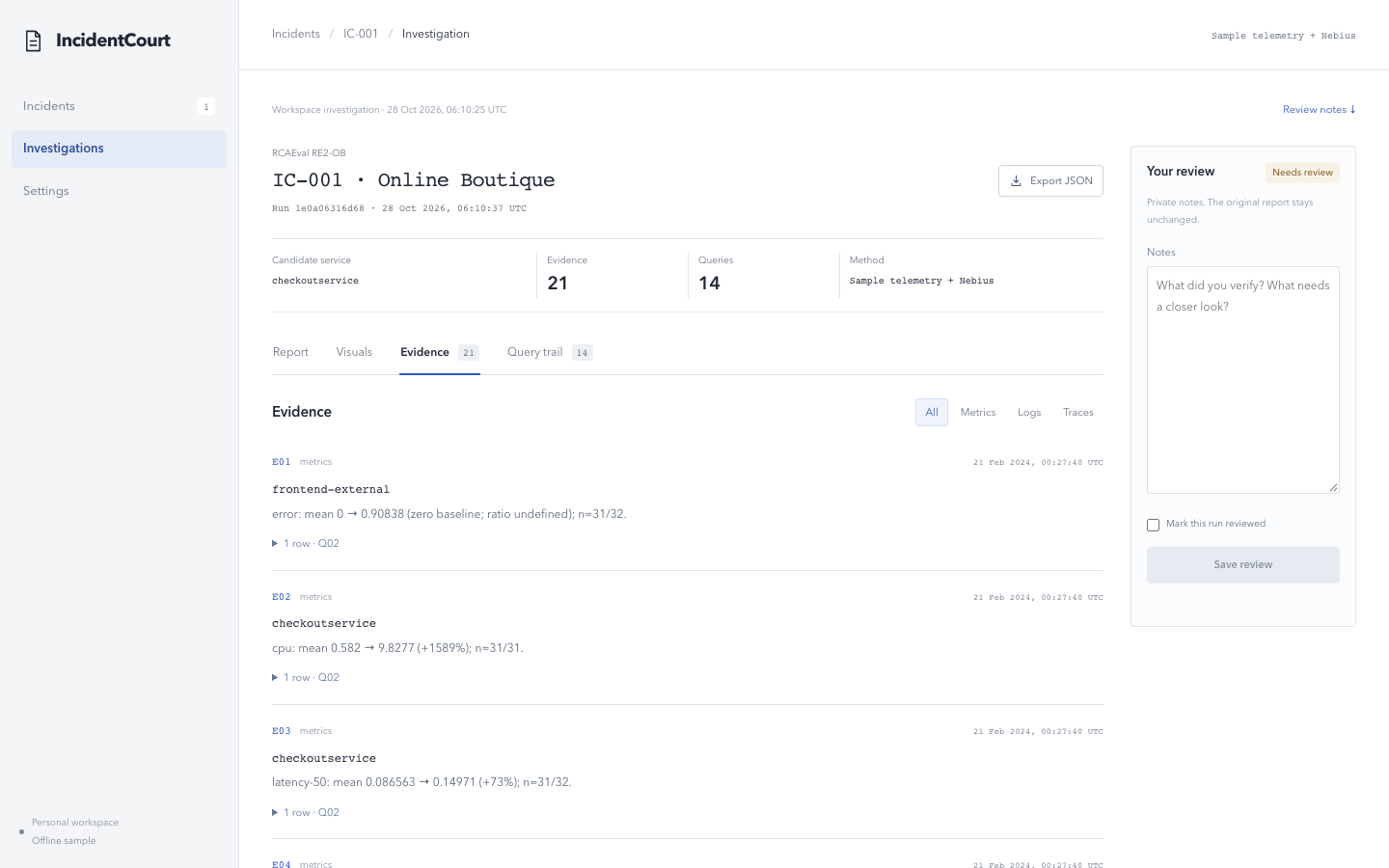
Browse the evidence trail and trace observations back to their SQL queries.
IncidentCourt puts an AI diagnosis on trial: Nemotron proposes a hypothesis, a critic challenges it, and the workspace connects its findings to the underlying telemetry.
Try it live — open the demo, select an incident, and start an investigation. No API key is needed.
The problem
During a service incident, engineers need to compare metrics, logs, and traces while deciding which explanation deserves further investigation. A plausible diagnosis is more useful when responders can inspect its evidence, challenge it, and see what remains uncertain.
What we built
In a browser-started run on the hosted demo, IncidentCourt flagged checkoutservice as a limited-confidence lead and produced 21 evidence records and 14 queries. All checked evidence and query references resolved.
The workspace compares baseline and later observations, proposes an initial service hypothesis, challenges it with independent signals, and presents supporting observations, counterevidence, alternatives, and uncertainty. Reviewers can inspect evidence rows, trace each observation to its SQL query, explore service dependencies, add review notes, and export the report.
How Nebius and NVIDIA fit in
IncidentCourt calls NVIDIA Nemotron 3 Super (nvidia/nemotron-3-super-120b-a12b) through the Nebius Token Factory API. The planner selects an initial hypothesis from supplied services and evidence. The critic requests a follow-up check, and a third request produces an explanation referencing the collected evidence. The application checks the requested and returned model identity, validates structured outputs and evidence identifiers, and records provider-call receipts. It fails an invalid response instead of silently falling back to a different model or an offline answer.
Nebius serves the model. IncidentCourt performs the bounded telemetry queries, applies its own evidence-ranking rules, and manages the evidence and review workflow. The demonstration uses a small, disclosed sample from controlled RCAEval Online Boutique experiments. The local Meterless H-MEM reference recalls eligible earlier observations as leads and rechecks them against current telemetry.
What we learned
- Fail-closed validation makes model behavior easier to audit: malformed decisions or unknown evidence references stop the run instead of being silently replaced by an offline answer.
- A critic pass can direct a follow-up check beyond the initial hypothesis. Showing counterevidence and competing explanations helps a reviewer investigate rather than accept the first plausible diagnosis.
Codex helped build and test the provider integration, citation validation, and browser workflow. The application uses Python, JavaScript, SQLite, Node.js, NVIDIA Nemotron, Nebius Token Factory, Meterless H-MEM, and RCAEval sample data.
Running it
The hosted demo uses sample telemetry and live Nebius inference. The repository also includes an offline sample that runs deterministic rules without a model request.
Limitations
The sample is downsampled telemetry from controlled experiments and can omit brief events. The investigation identifies a candidate, not a proven root cause; a valid citation confirms that a reference resolves, not that every interpretation is correct. A human should review the evidence and model-generated explanation. Hosted sessions are temporary.
What's next
- Cover more RCAEval scenarios and measure diagnostic accuracy against held-out cases.
- Add live telemetry connectors and evaluate the investigation workflow with real operational data.
Built With
- javascript
- meterless-h-mem
- nebius-token-factory
- node.js
- nvidia-nemotron
- python
- rcaeval
- sqlite
