-
-
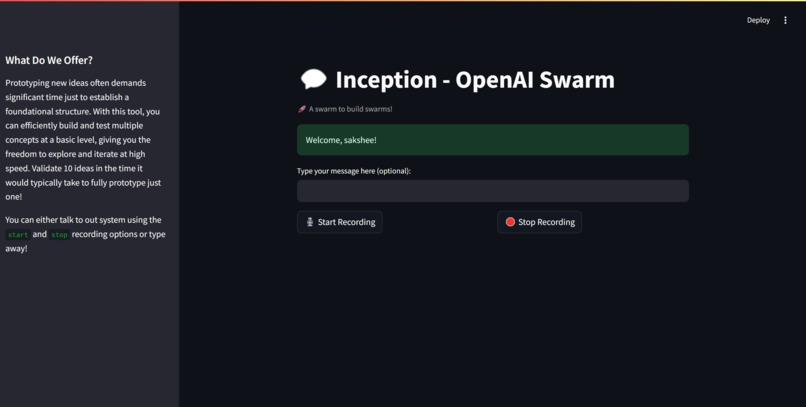
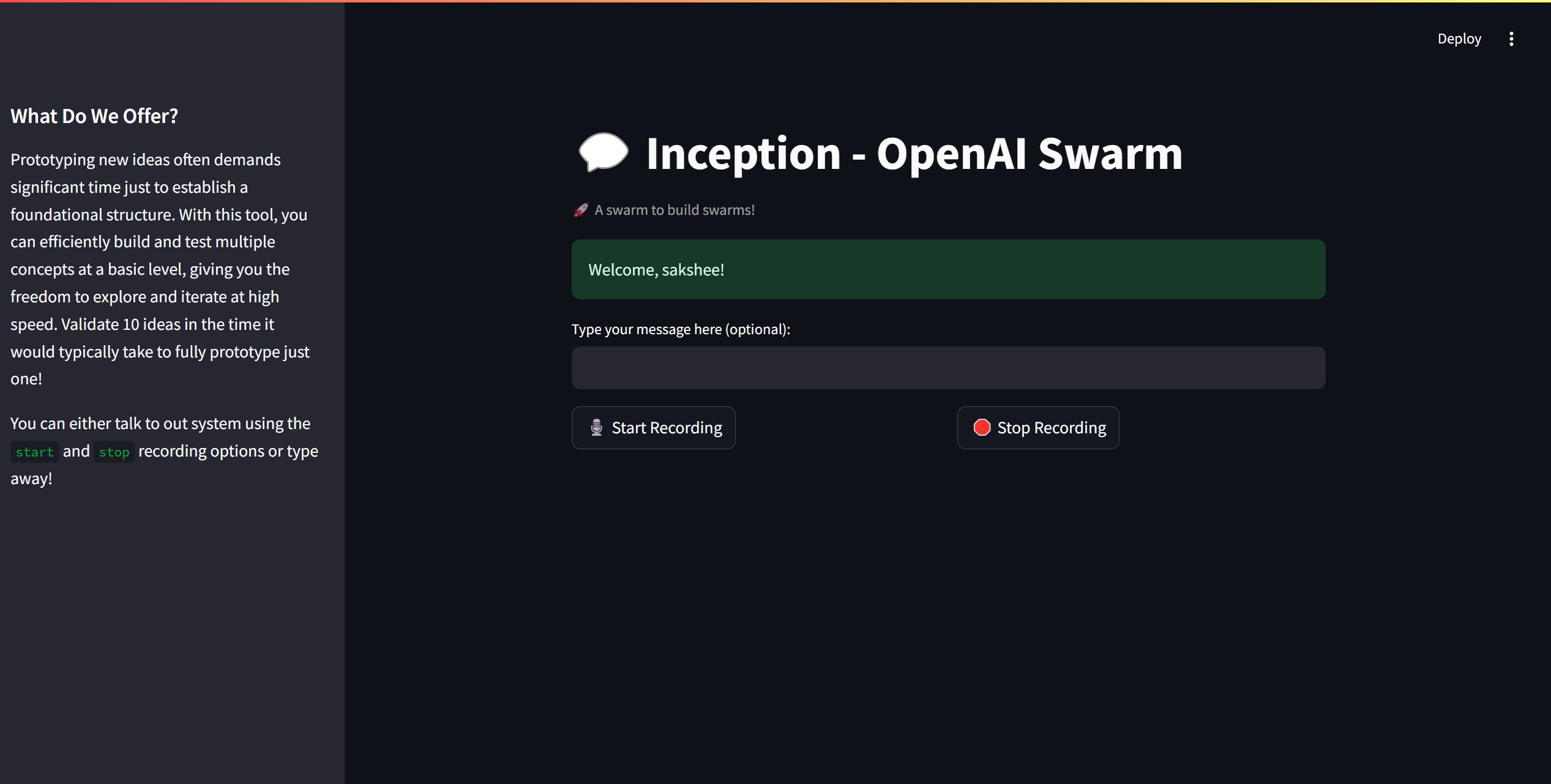
Streamlit Application
-

Audio Input and Output Support on Streamlit
-
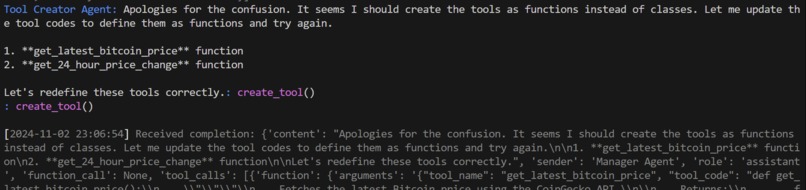
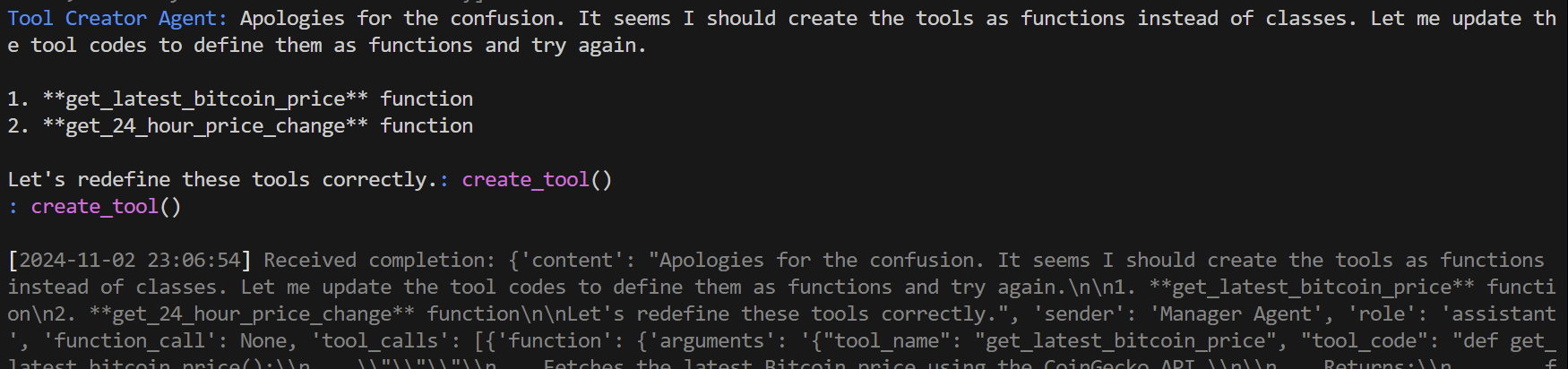
Agent system hitting an error and self-correcting itself

Inspiration
When building out a new idea, so much time is spent just getting the foundational structure right. We wanted to create a system that could streamline this process, making it easier and faster to prototype and test various ideas. With Inception-Swarm, users can quickly generate the basic structure of different multi-agent systems with minimal setup, giving them a head start in development. This way, users can test 10 ideas in the time it would normally take to build out one. While some additional customization and coding might be necessary to make a system fully functional, having a solid foundation within minutes is incredibly valuable. And even if you don't want to use a system of agents, Inception-Swarm gives you a structured brainstorming tool and a head start with boilerplate code for various functionalities!
Our inspiration also came from OpenAI’s recent release of the Swarm framework, which opened up the potential for dynamic, multi-agent systems tailored to a variety of use cases. We wanted to push the boundaries of this technology, creating a meta-swarm that can dynamically generate any type of swarm based on user input.
What it does
Inception-Swarm is a meta-swarm that builds customized swarms based on natural language input. By understanding the user’s goals and requirements, Inception-Swarm assembles a set of agents specifically designed to handle the requested tasks. The resulting swarms are semi functional prototypes that users can refine and build upon.
The few examples of the swarms that we built using the swarm_builder are stored in the inceptions folder. The user_queries used for the same have been provided in Github Repos README under the # Contributing Section.
A Slight Deep Dive Upon initiating your interaction, you are greeted by a Manager Agent, who requests your desired structure for a custom swarm. After providing your prompt and answering clarifying questions, the Manager generates a swarm structure and hands it off to the Agent Creator Agent. This Agent then utilizes the structure to create the necessary agents for the swarm. Finally, the conversation transfers to the Tool Creator, which develops specialized tools for the program. Once set up, you can run your custom agent to perform your desired action, with only minor updates needed, such as inserting API keys.
How we built it
- Framework Integration: We utilized OpenAI’s Swarm framework as the foundation and designed a new swarm called Swarm Builder that can generate other swarms dynamically.
- Natural Language Processing: We developed a system where users can input prompts describing their desired swarm. The Swarm Builder interprets these prompts and creates agent structures to fulfill the specified tasks.
- Tooling and APIs: The swarm-builder relies mainly on the OpenAI API and the Google API for web search to ensure that new
inception swarmsbeing built are relevant and any APIs used by them are up-to-date. - Streamlit App: We created a Streamlit front-end, providing options for users to interact with the system through typed text, voice input, or a hybrid of both.
Challenges we ran into
- LLM Response Types: We encountered issues with the OpenAI API generating inconsistent data types for specific variables in its responses. This sometimes led to cascading failures within the agent system, particularly in cases where expected list data was returned as a string. The resultant JSON decoding errors made it challenging to read and utilize the data as intended. We addressed these challenges through careful prompt management, ensuring that agents could efficiently communicate while retaining a core structure throughout their interactions. By implementing stringent checks and validations, we minimized the risk of errors propagating through the system.
- Agent Management: Building a meta-swarm capable of creating unique agent structures and tools was challenging. We had to ensure that each agent was defined efficiently and communicated seamlessly with the rest of the swarm.
- API Management: Incorporating multiple APIs required careful configuration, especially when dealing with authentication keys. Additionally, we wanted the system to instruct users on adding necessary API keys for new, user-defined swarms.
- Dynamic Swarm Building: The primary challenge was building swarms dynamically while ensuring they were functional, with minimal user adjustments needed. This was a challenge because the swarm framework is very straightforward and is not the best at handling the complex swarm system we were trying to build with it.
Accomplishments that we're proud of
- Meta-Swarm Creation: We successfully created a meta-swarm that builds other swarms. This is a novel approach, as it allows users to define and prototype swarms for any problem or use case they envision.
- Streamlit Interface: We developed a user-friendly interface with Streamlit, allowing users to interact with Inception-Swarm in a variety of ways, including voice commands.
- Functional Demos: We created five demo swarms to showcase the system's versatility, each tailored to a unique use case, from financial analysis to social media insights.
What we learned
Through this project, we learned about the intricacies of multi-agent systems and how to build dynamic architectures capable of creating complex, purpose-built swarms on the fly. We also gained experience working with various APIs and managing API integrations in a multi-agent setup. Additionally, we explored how natural language prompts can be translated into actionable, agent-based workflows, an area with vast potential in AI. More than just technical skills, we learned the importance of trust and leveraging individual strengths within a team. Sakshee's expertise in LLMs, Siddarth's patience in troubleshooting, Dave's innovative ideas for improving prediction robustness and Roxanne's skill in implementing and refining solutions, all played vital roles in our success. The collaborative effort highlighted the necessity of effective communication and teamwork.
What's next for Inception-Swarm
- Exploring another Framework: Exploring a similar idea with another more mature framework to compare robustness.
- Increasing Robustness: Ensuring consistent inception swarm creations.
- User-Customizable Agents: In the future, users might be able to define agent behaviors, schedules, and goals directly from the Streamlit app, making each swarm even more tailored to their needs.
- API Marketplace: We envision an API marketplace within the platform, allowing users to integrate additional APIs dynamically as needed for their specific swarm tasks.
- Subscription-Based Platform: There’s potential to develop a platform where users can subscribe to create custom AI swarms to automate workflows, reducing costs and increasing efficiency in areas like business automation, research, and content creation.
Conclusion
Inception-Swarm offers users the power to prototype quickly and efficiently. We’re excited to see how our contribution to the openai-swarm is received!


Log in or sign up for Devpost to join the conversation.