-
-
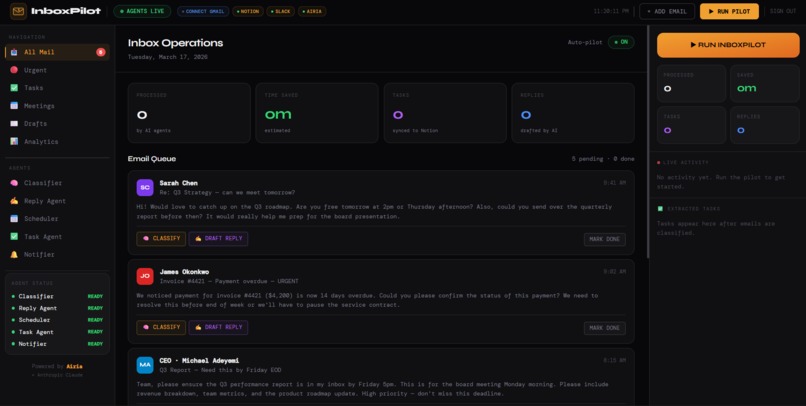
InboxPilot Dashboard
-
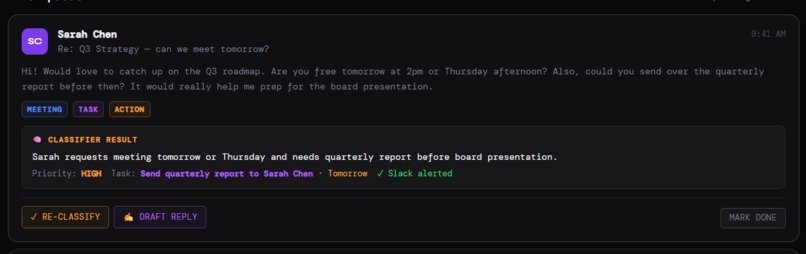
Email classifier
-
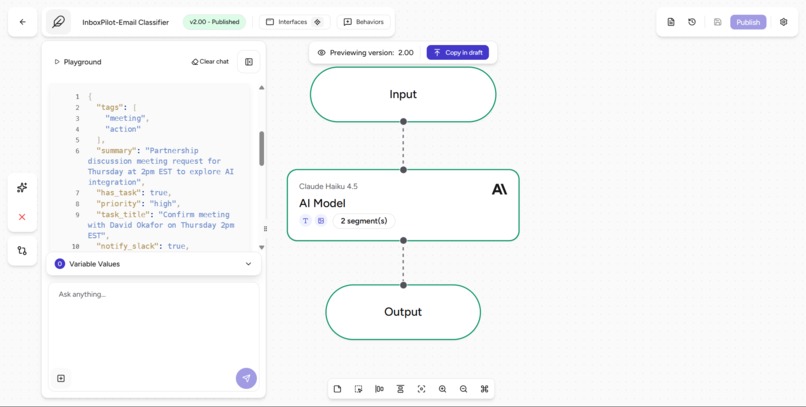
email classifier canvas
-
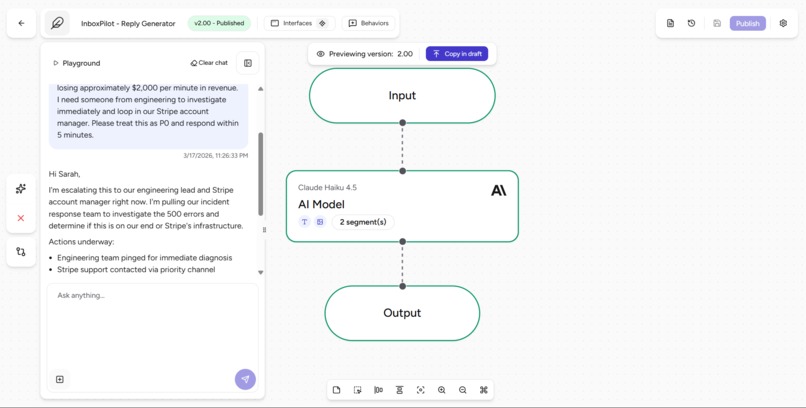
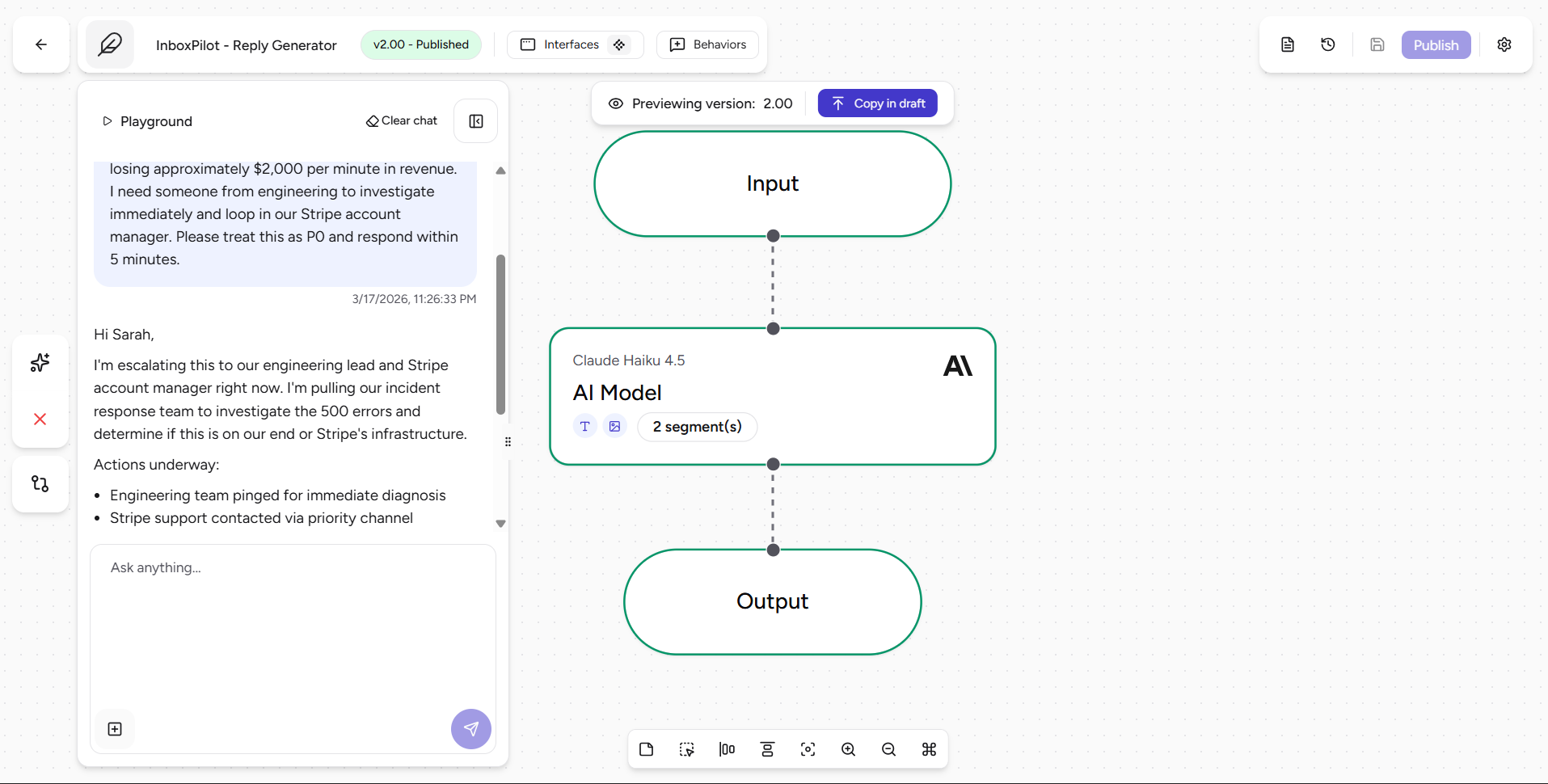
Reply generator canvas
-
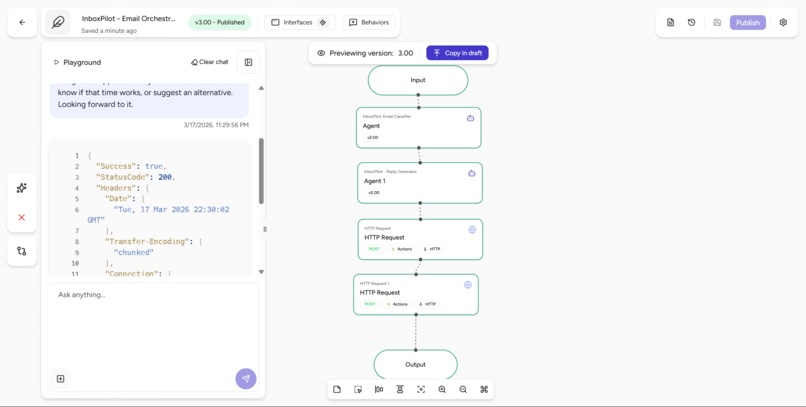
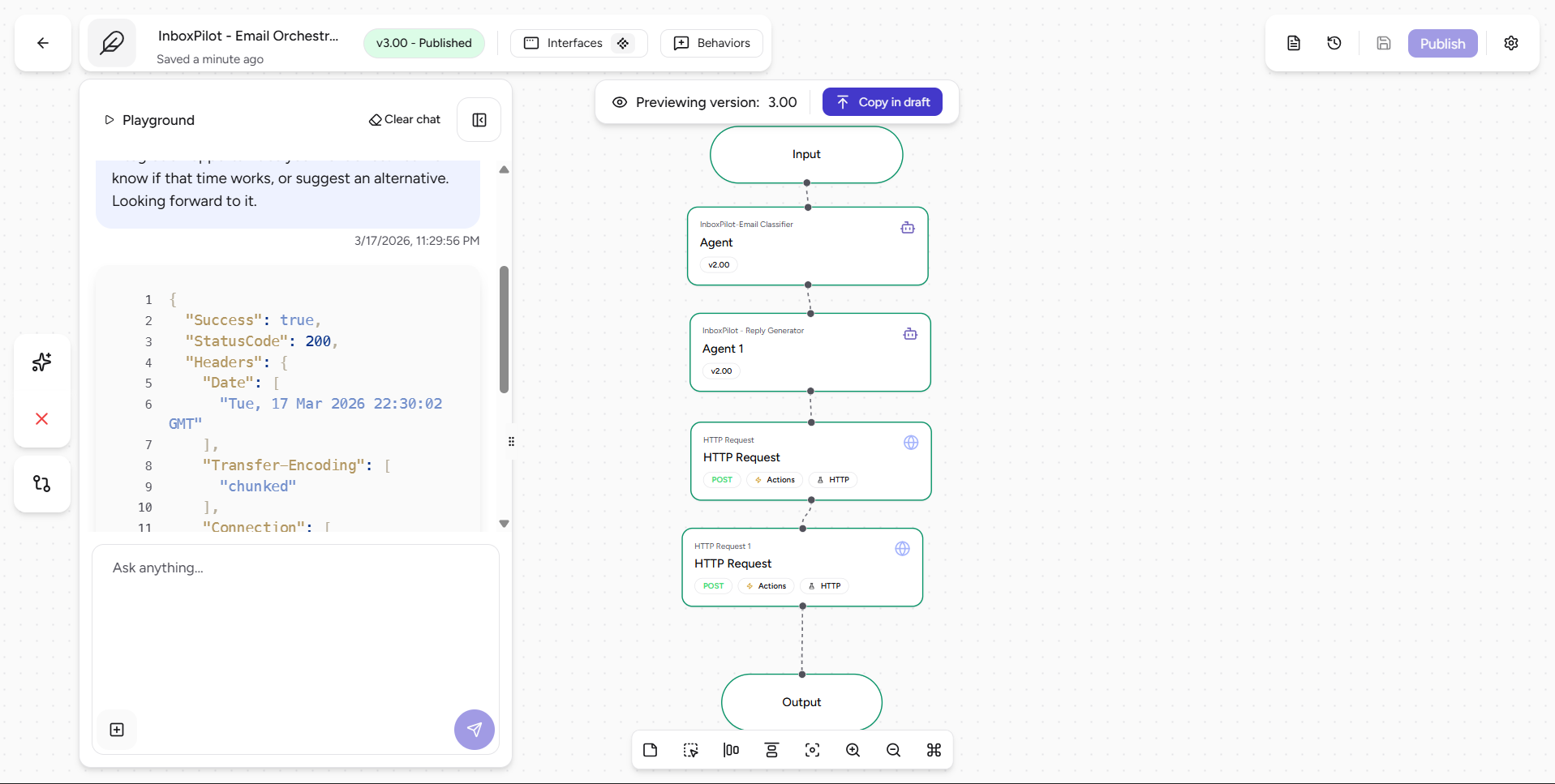
Orchestrator canvas
Inspiration
Every professional knows the feeling — you open your inbox and find 50+ unread emails, each demanding attention. Which ones are urgent? Which need a reply right now? Which contain tasks with deadlines? We spend over 2 hours a day just sorting through email, and critical messages still slip through the cracks. We built InboxPilot because we wanted to solve this problem not with another email client, but with an intelligent multi-agent system that handles the entire triage workflow automatically. The Airia platform gave us the perfect foundation to orchestrate multiple AI agents and external integrations into a single seamless pipeline.
What it does
InboxPilot is an AI-powered email orchestrator that automates your entire inbox workflow through a single Airia multi-agent pipeline. When an email arrives, InboxPilot:
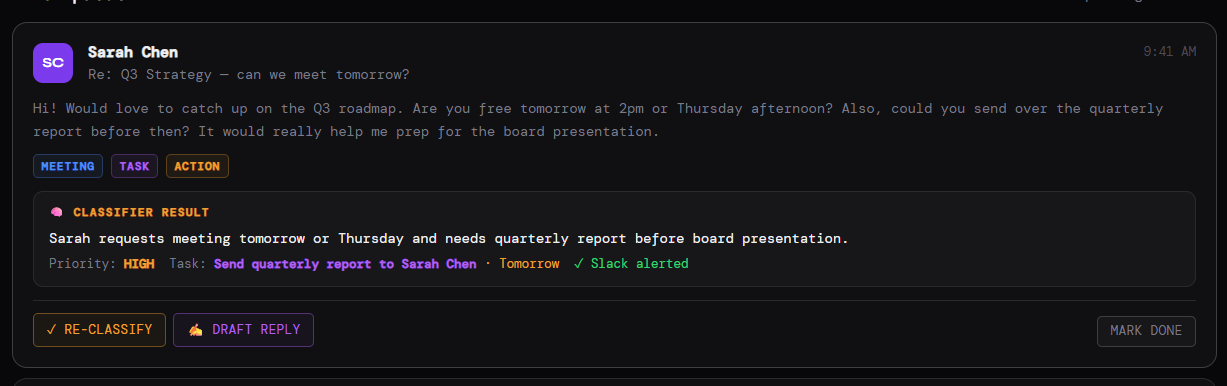
Classifies it instantly — determining priority (urgent, high, normal, low, spam), detecting tasks with deadlines, identifying meeting requests, and flagging emails that need a reply.
Drafts a professional reply — generating a context-aware, tone-matched response ready for you to personalize and send.
Alerts your team on Slack — posting a notification to your team channel so urgent emails never go unnoticed.
Creates a task in Notion — automatically adding the email as an actionable item in your project management database with priority, sender details, and subject.
All four steps happen automatically in sequence through Airia's orchestration engine, turning a 2-hour daily chore into a hands-free workflow.
How we built it
We built InboxPilot using a layered architecture with Airia at the core:
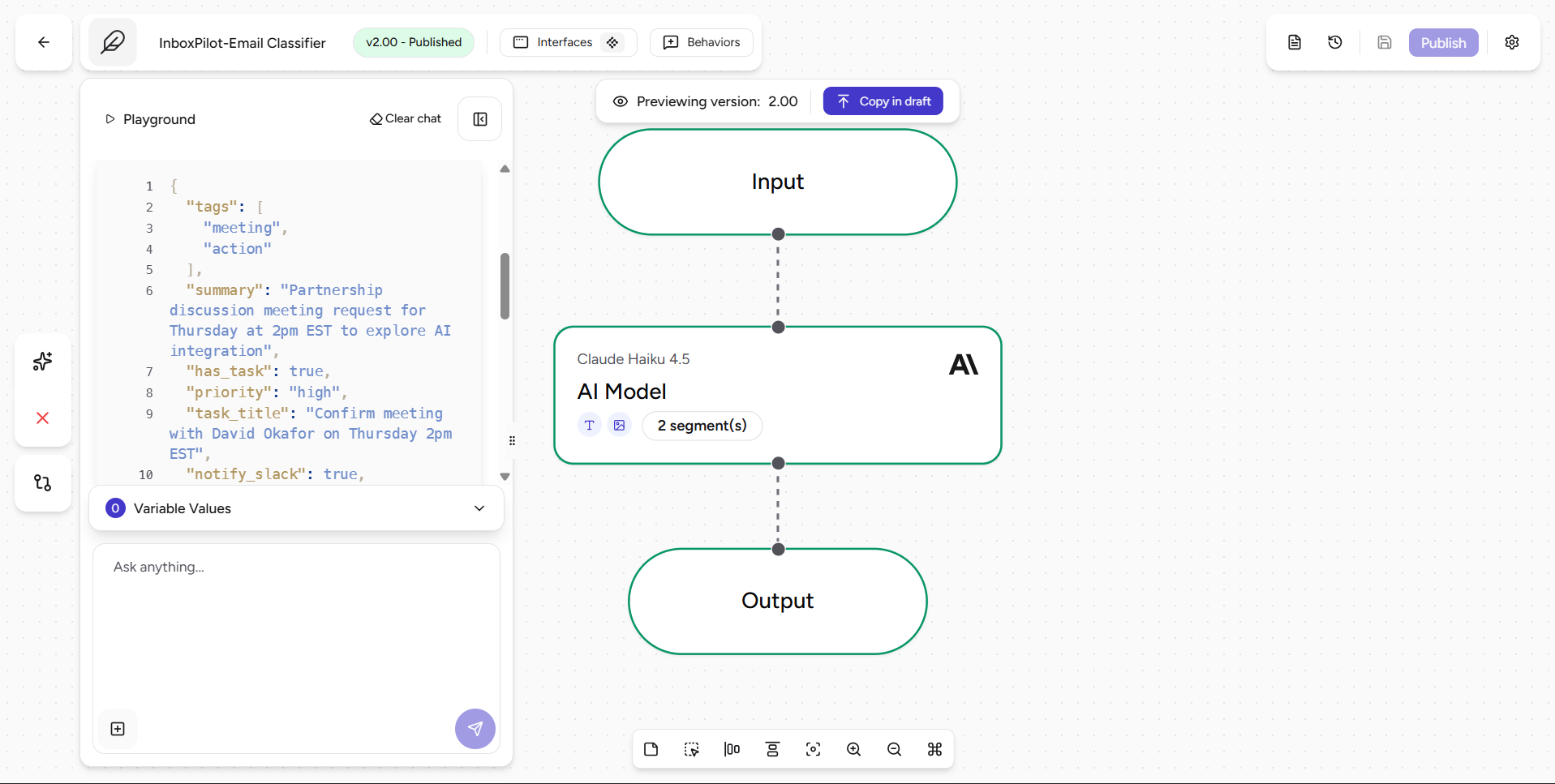
First, we created two specialized AI agents in Airia's Agent Studio. The Email Classifier agent uses Claude Haiku 4.5 with a carefully crafted system prompt and structured JSON output to analyze emails and return classification data. The Reply Generator agent uses the same model with a different prompt optimized for writing concise, professional email replies.
Next, we built the Orchestrator agent that chains everything together. Using Airia's nested agent architecture, the orchestrator calls the Classifier first, then the Reply Generator, then makes HTTP requests to the Slack API to post alerts and the Notion API to create tasks. The entire pipeline runs in under 5 seconds.
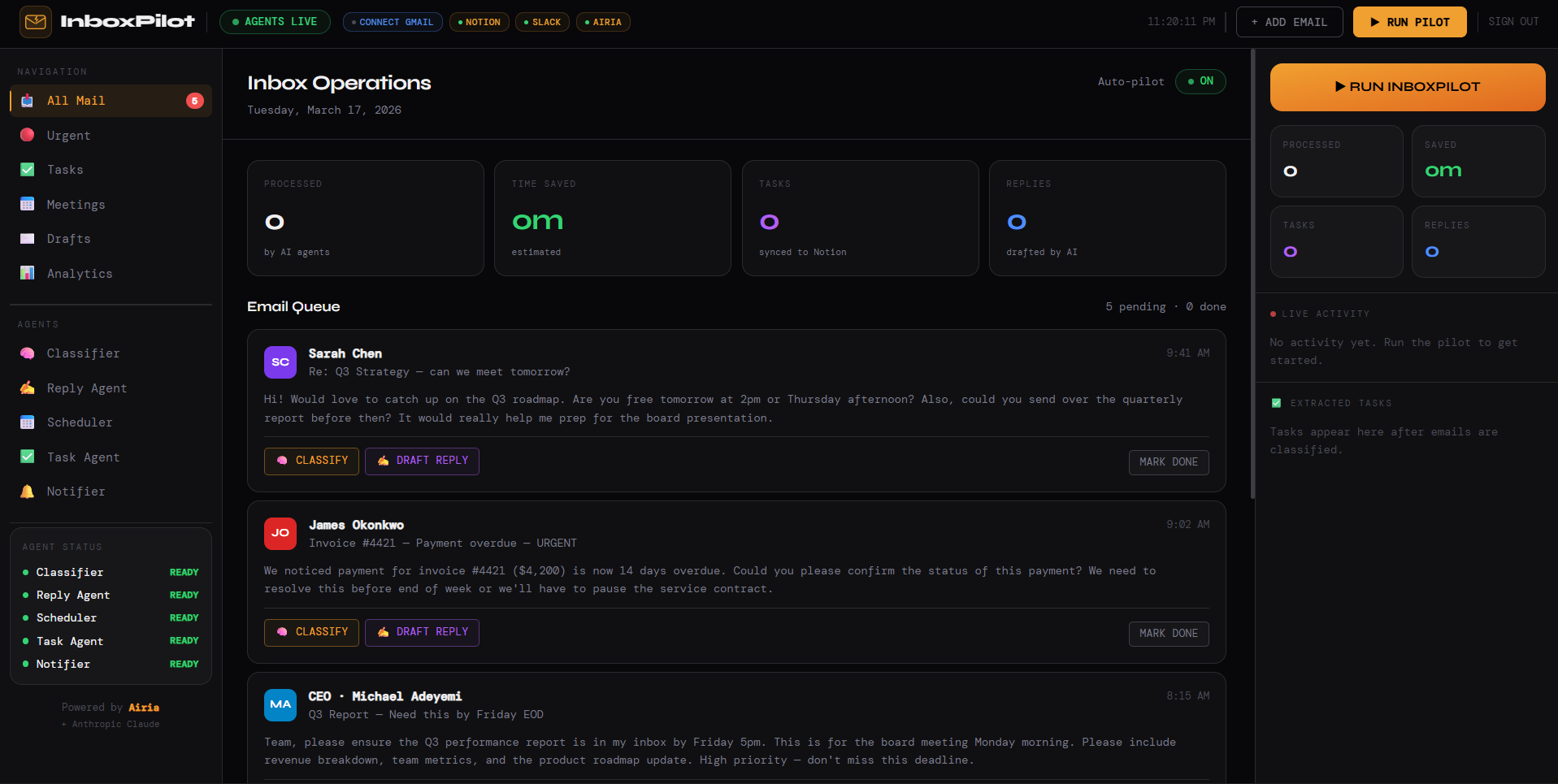
On the frontend, we built a Next.js web dashboard that connects to the Airia orchestrator via its API endpoint. The dashboard lets users view their emails, see AI classifications, read generated reply drafts, and manage their triage workflow. We also integrated Gmail API for fetching and sending emails directly from the app.
The tech stack includes Airia Agent Orchestration, Claude Haiku 4.5, Airia HTTP Request Actions, Slack API, Notion API, Next.js, and Gmail API.
Challenges we ran into
The biggest challenge was getting the external API integrations working correctly within Airia's HTTP Request blocks. We ran into authentication issues with Slack — our initial bot token had the wrong OAuth scopes (calls:write instead of chat:write), which caused silent failures where the pipeline reported success but no messages appeared. Debugging this required carefully inspecting the API response bodies in Airia's debug logs.
With Notion, we initially confused database rows with column headers, creating data entries instead of table columns. We also had to match property names exactly between our API request body and the Notion database schema — even a single space difference (like "Email Subject" vs "EmailSubject") caused 400 errors.
Another challenge was ensuring the input variables flowed correctly through the multi-agent pipeline. We learned that Airia's "Always include user input" toggle and the userInput variable in the Prompt Builder are critical for passing data between the input node and AI model blocks.
Accomplishments that we're proud of
We're proud that InboxPilot demonstrates true multi-agent orchestration across four different systems all running through a single Airia pipeline. The fact that one message triggers AI classification, AI reply generation, a Slack notification, and a Notion task creation in under 5 seconds is something we're really excited about.
We're also proud of the nested agent architecture. Rather than putting all the logic in one massive prompt, we built specialized agents (Classifier and Reply Generator) that each do one thing well, then orchestrated them together. This modular approach makes the system easier to maintain and improve.
Finally, we're proud that we built a complete end-to-end solution — from the Airia pipeline to a fully functional Next.js web dashboard — creating something that could genuinely be used by professionals to save hours every day.
What we learned
This hackathon taught us a lot about building production-grade AI agent pipelines. We learned that Airia's platform makes it surprisingly fast to go from idea to working multi-agent system — the visual Agent Studio canvas, the nested agent support, and the built-in HTTP Request actions eliminated a huge amount of boilerplate code.
We learned the importance of structured output when building AI classification agents. Enabling Airia's structured JSON output feature made our classifier far more reliable than relying on the LLM to produce valid JSON on its own.
We also learned that integrating external APIs (Slack, Notion) requires careful attention to authentication scopes, exact field naming, and proper error handling. The debug logs in Airia were invaluable for diagnosing these issues.
Most importantly, we learned that the real power of AI agents isn't in any single model — it's in orchestration. Chaining multiple specialized agents with real-world integrations creates workflows that are far more powerful than any standalone chatbot.
What's next for InboxPilot
We have an ambitious roadmap for InboxPilot:
First, we want to add conditional branching to the orchestrator — so Slack alerts only fire for urgent/high-priority emails, and Notion tasks are only created when the classifier detects an actionable task. This will make the pipeline smarter and reduce noise.
Second, we plan to add a Human Approval step using Airia's HITL (Human-in-the-Loop) capability. Before sending a reply or creating a task, the system would pause for user confirmation, giving professionals control while still automating the heavy lifting.
Third, we want to expand integrations — adding Google Calendar for meeting requests, Microsoft Teams as an alternative to Slack, and Trello/Jira as alternatives to Notion. Fourth, we plan to deploy InboxPilot as an Airia Slack Bot and Browser Extension, so users can interact with their email triage directly from Slack or from any web page — meeting users where they already work.
Finally, we want to add memory and learning — using Airia's Memory feature so the classifier learns each user's priorities over time, becoming more accurate and personalized with every email processed.
Built With
- airia-agent-orchestration
- airia-http-request-actions
- claude-haiku-4.5
- gmail-api
- notion-api
- slack-api


Log in or sign up for Devpost to join the conversation.