-
-
Project Structure
-
Running Agent
Inspiration
We are Computer Engineering students at the University of Pennsylvania, and we know how complicated college life can become. Canvas is central to our classes, but many assignment announcements, deadline reminders, and course updates also arrive through email. At the same time, our inboxes fill with messages from clubs, university organizations, opportunities, recruiting, events, and other commitments.
It becomes difficult to know what actually needs attention. Students should not have to monitor hundreds of emails every day just to avoid missing an important deadline or opportunity. Student Chief of Staff came from a product we would genuinely want to use ourselves: an agent that makes college life easier by sorting through the noise and helping us stay organized.
What it does
Student Chief of Staff is an autonomous AI agent for college students. It uses Gmail and Google Calendar to identify information that may require action, prioritize urgent items, and help students organize their time.
When the agent detects an upcoming deadline, it can check the student’s calendar, find a conflict-free study window, and recommend a work session. The student stays in control by approving any calendar change before it happens. The system can also surface important messages, summarize commitments, and avoid interrupting the student with low-priority information.
How we built it
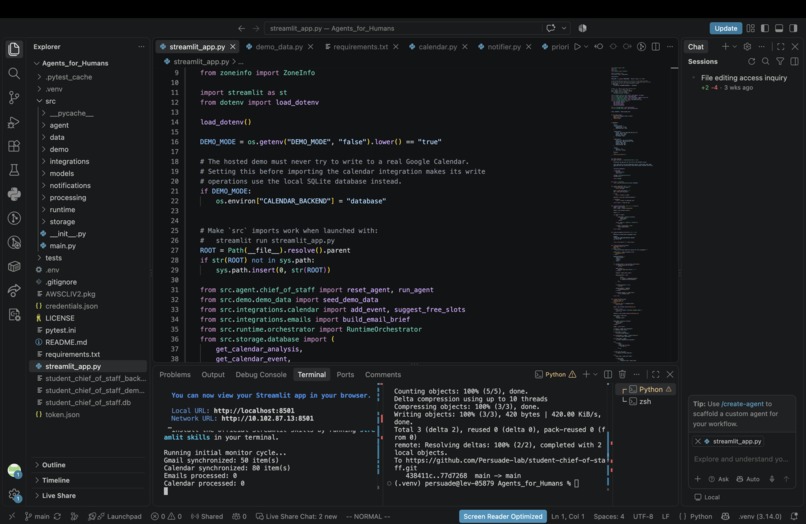
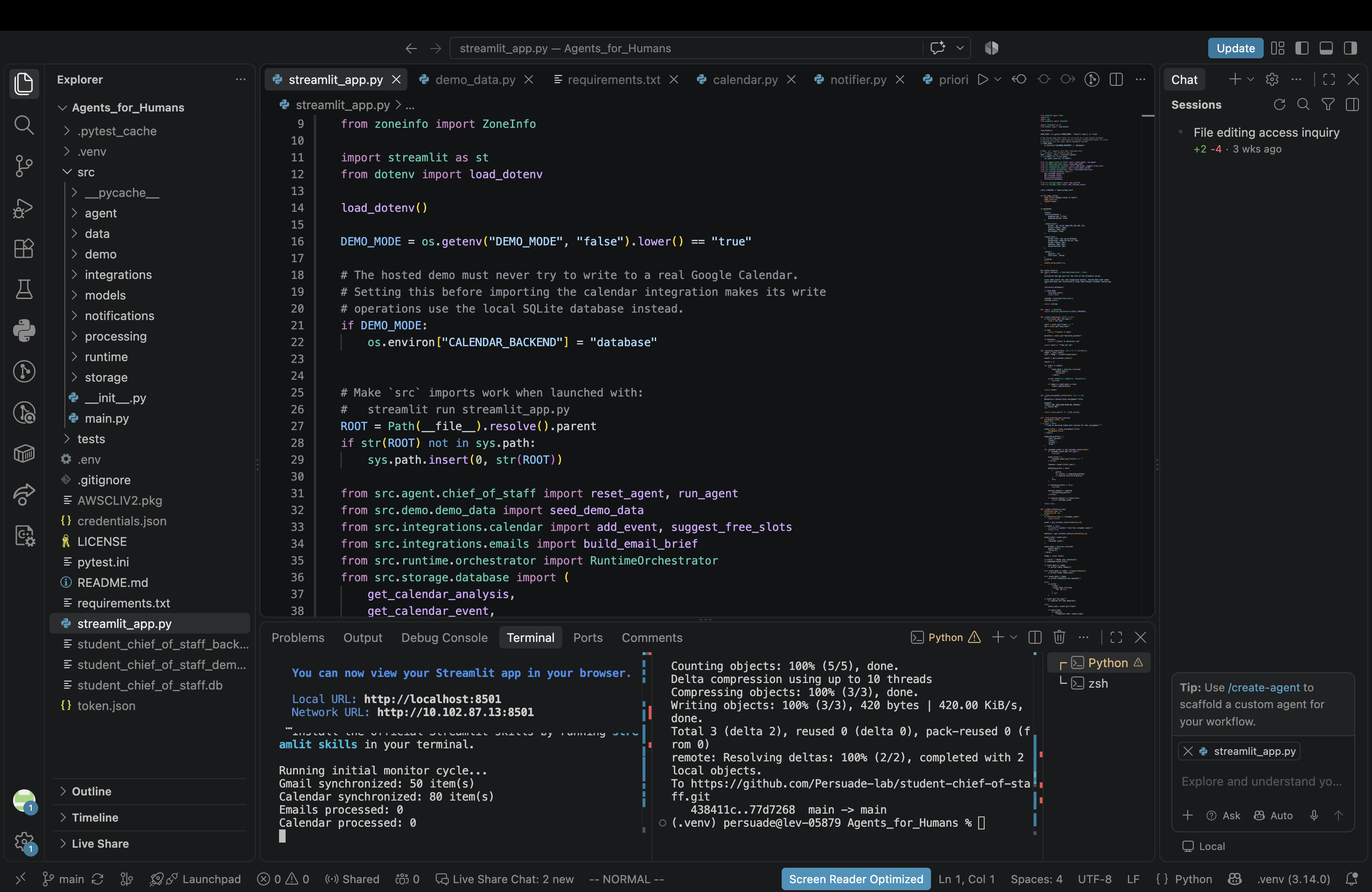
We built Student Chief of Staff in Python using the Strands Agents SDK and AWS Bedrock for reasoning, tool use, and orchestration. Gmail provides message data, while Google Calendar provides schedule awareness and supports calendar actions.
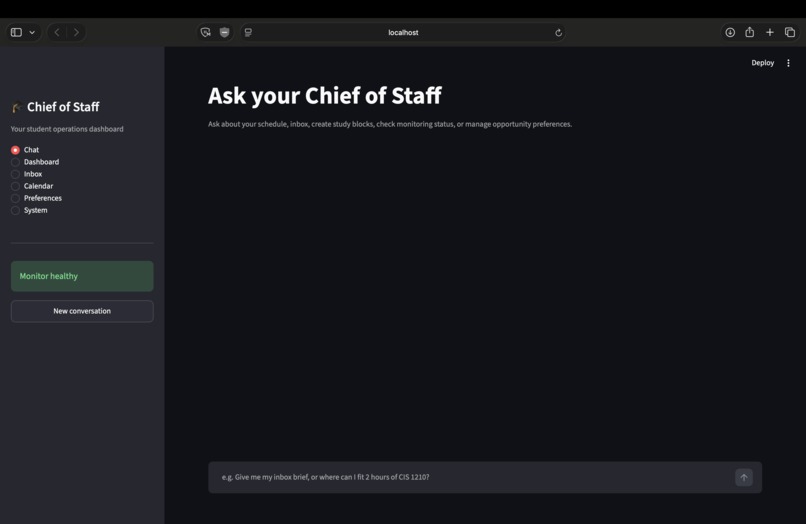
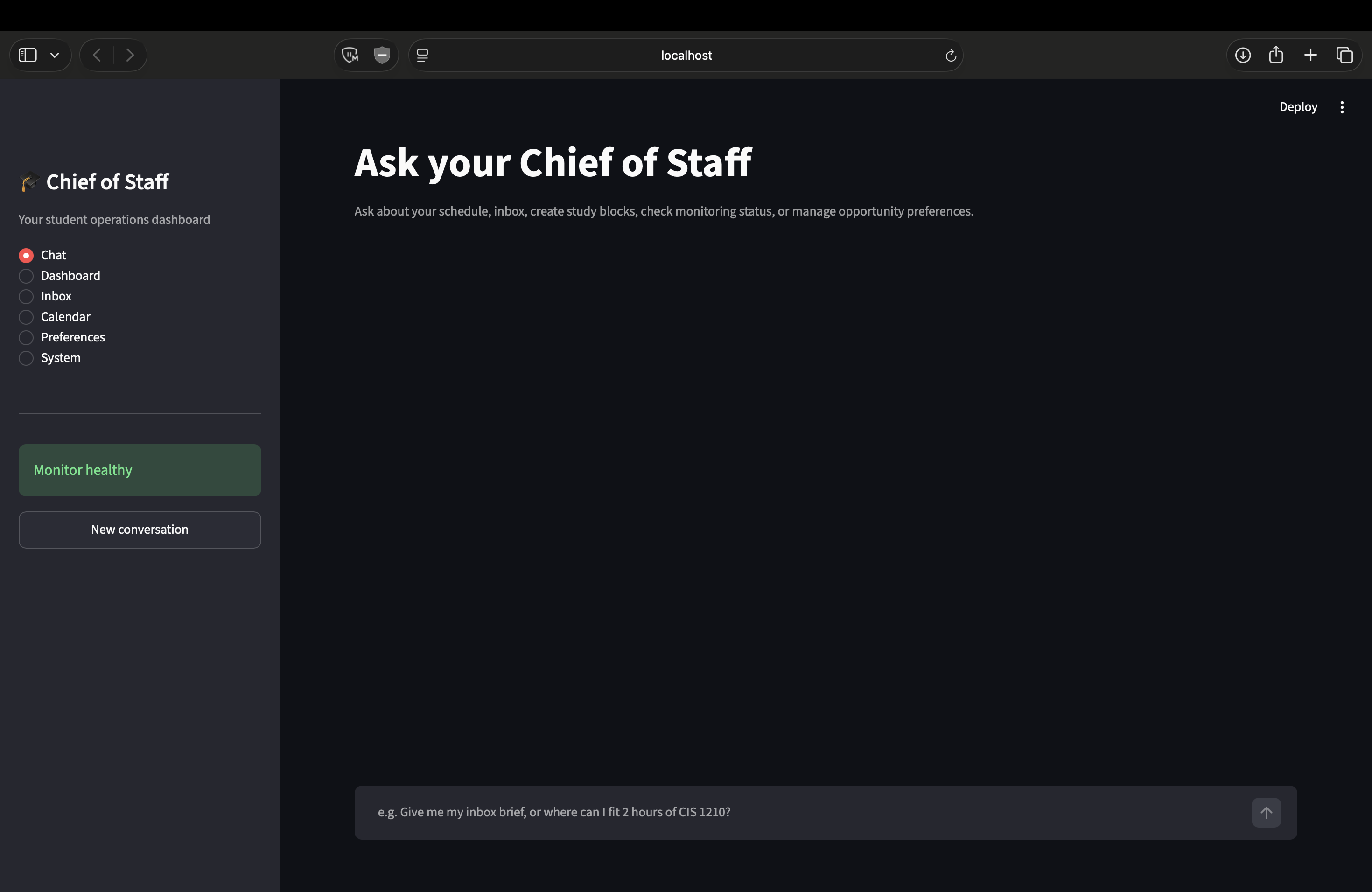
We used SQLite to store persistent data, memory, priorities, and processing state. A Streamlit interface gives students a chat experience, calendar view, dashboard, preferences, system view, and a focused attention page for urgent items. Background monitoring keeps the system updated and allows the agent to react when something important appears.
We also separated AI reasoning from deterministic logic. The agent decides what information matters and which tool to use. Deterministic code handles calendar conflict checks, deadline priority, duplicate notification prevention, and reliable scheduling.
Challenges we ran into
One of the hardest parts was simplifying the project. It later became apparent that a more focused agent is more useful than a system that tries to solve every problem at once. Instead of building another general productivity dashboard, we focused on a specific student need: turning scattered information into clear, actionable next steps.
Another major challenge was making the project feel like an agent instead of another dashboard. A useful system cannot simply summarize every email or event. It has to decide when something deserves the student’s attention.
Reliability was also important. Calendar actions need conflict checks, urgent alerts need to avoid repetition, and external information can arrive in different formats. We also needed to balance autonomy with control. The agent can prepare a recommendation and find a time slot, but the student approves actions that change their calendar.
Accomplishments that we're proud of
We’re proud of building something we would want to use in our own lives as college students. We took a broad idea about managing college responsibilities and narrowed it into a working flow: recognize an urgent deadline, check the student’s schedule, recommend a study session, and update Google Calendar after approval.
Getting that flow to work involved more than generating a useful response. We connected background monitoring, persistent memory, notifications, and calendar actions while keeping the student involved in decisions. We’re especially proud of the details that make the experience more useful, such as avoiding repeated alerts and recognizing when a student has already scheduled time for an assignment.
What we learned
We learned that autonomy works best when it removes routine coordination while preserving human judgment. The most useful outcome is not a long AI response. It is a timely recommendation that helps a student take the next step.
We also learned that agent systems need clear boundaries. Giving an AI model access to tools is only part of the solution. A reliable agent also needs structured data, persistent memory, deterministic safeguards, and a clear human-in-the-loop experience.
What's next for Chief of Staff
Our next step is to test Chief of Staff with other college students. We want to understand which messages deserve an interruption, which recommendations students find useful, and where the agent still creates extra work. That feedback will help us refine priorities and make notifications more reliable.
We also want to improve personalization so recommendations better reflect each student’s interests, study habits, and preferred working hours. Over time, we hope to support more campus information sources and make setup easier. Our focus will remain on specific tasks where the agent can reduce everyday coordination and help students follow through.


Log in or sign up for Devpost to join the conversation.