-
-
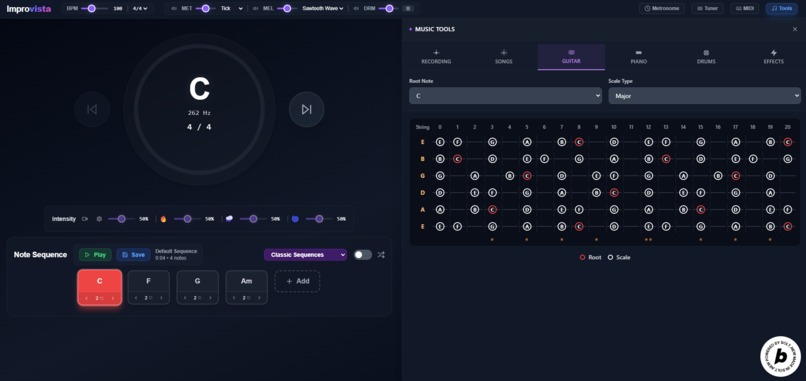
guitar scales
-
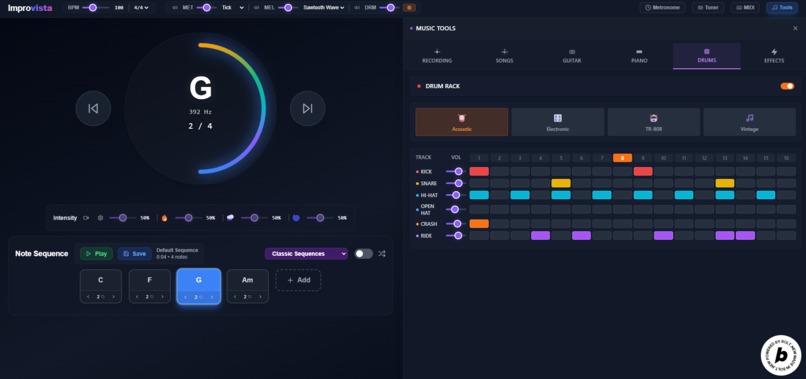
drum sequencer
-
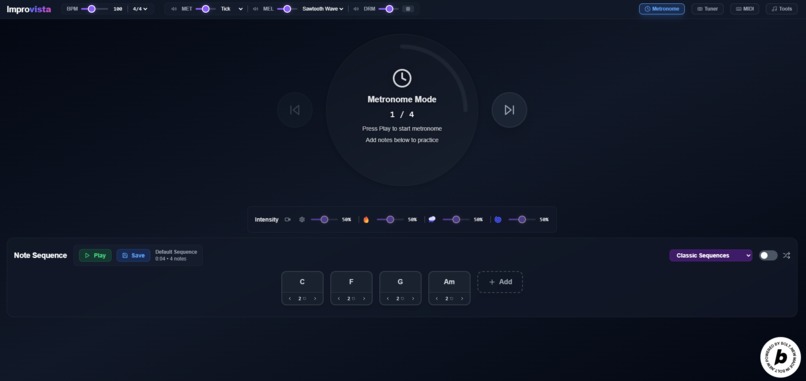
main
-
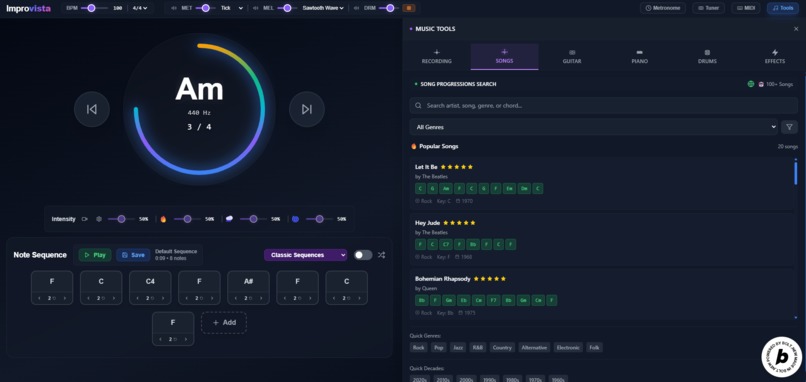
song sequences
-


Inspiration
Teaching music to my 3-year-old son sparked the idea for Improvista. Watching him struggle to understand which notes "sound good" together made me realize how abstract music theory can be, even for adults. I wanted to create a visual bridge between hearing music and understanding it. As a guitarist myself, I've spent years in jam sessions wishing there was a way to silently communicate musical intentions to my bandmates—"let's bring the energy up" or "time to mellow out"—without interrupting the flow. Improvista was born from these two needs: making improvisation visually intuitive for learners and creating a universal visual language for musical communication.
What it does
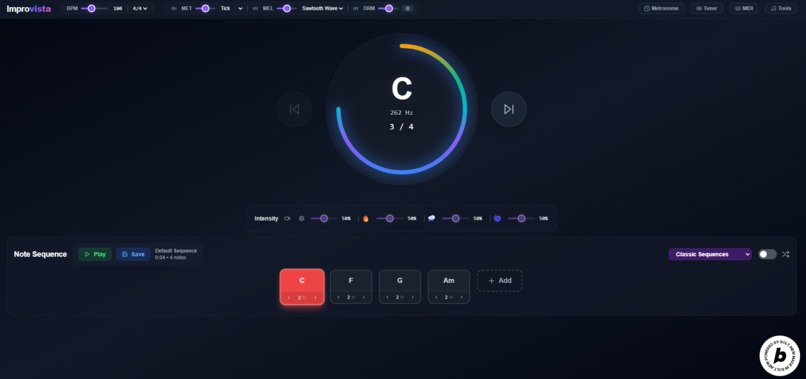
Improvista transforms musical improvisation into a visual experience. It automatically plays chord progressions while displaying the appropriate scales in real-time on both guitar fretboard and piano interfaces. Musicians can see exactly which notes work over each chord as the progression advances. Beyond practice, it serves as a visual communication system for bands through dynamic backgrounds—fire for intensity, rain for calm moods, psychedelic for experimental sections. Users can load hundreds of preset progressions, create their own, and define how many bars to practice each chord. It's a complete ecosystem for learning, practicing, and performing improvisation.
How we built it
The entire application was built using Bolt.new. This modern approach to development enabled me to go from concept to functional application in record time. The app is built with React and modern web technologies, utilizing tone.js for sound generation. Deployment was streamlined through Netlify. The AI-assisted development process allowed me to focus on user experience and musical functionality rather than getting bogged down in technical implementation details.
Challenges we ran into
The biggest challenge was managing the complexity of synchronizing multiple systems—audio playback, visual transitions, beat counting, and scale calculations all had to work in perfect harmony. Debugging timing issues was particularly tricky; even small delays could throw off the entire musical experience. Ensuring the note sequences respected the defined cycles while maintaining smooth transitions required careful state management. The Web Audio API presented its own challenges, especially when implementing effects and managing multiple sound sources simultaneously. Creating visualizations that were both beautiful and performant across different devices required constant optimization and testing.
Accomplishments that we're proud of
As someone who started programming with AI just a couple of months ago, building a fully functional application that musicians are already using feels surreal. I'm not a traditional programmer—I'm a musician (kind of) who saw a problem and used AI to build a solution. This project proves that AI has democratized software development, allowing people with domain expertise to create professional tools without years of coding experience. The fact that Improvista can genuinely improve musicians' practice sessions and help bands communicate better is incredibly fulfilling. It's proof that with AI assistance, anyone can transform their ideas into tools that enhance people's lives. Me and my son now can understand better each other, in the world of music.
What we learned
I learned to read and modify code directly, adjusting parameters and fixing bugs independently. The project required understanding servers, domains, API integrations, and deployment pipelines—concepts that seemed impossibly complex just months ago. Beyond technical skills, I deepened my understanding of music theory while building the scale calculation system. Most importantly, I learned that AI isn't just a coding assistant—it's an educational partner that can help anyone become a creator. The intersection of music, technology, and AI opened up possibilities I never imagined.
What's next for Improvista - Music improvisation buddy
Native ios and android app. Proyector or aux monitor display effects. Improvista will adopt a freemium model without advertisements, keeping the core experience pure and focused on music. Basic features—chord progressions, scales visualization, and essential backgrounds—will remain free forever. Premium features will be extremely affordable (thinking $2-3/month) to achieve economy of scale and maximize accessibility. Premium offerings will include: advanced visualization themes, unlimited custom progression saves, band synchronization features for remote collaboration, MIDI export capabilities, and access to masterclass progression libraries from famous songs.
The strategy focuses on volume over high prices—if we can help millions of musicians for the price of a coffee, we're building something sustainable and impactful. Future development includes mobile apps with offline capability, integration with music education platforms, and an API for music schools to incorporate Improvista into their curriculum. We're also exploring AI-powered features that could suggest scales based on the user's playing style and generate custom exercises based on their skill level. The vision is to make Improvista the global standard for visual music communication.
Built With
- bolt
- netlify
- react
- tonejs


Log in or sign up for Devpost to join the conversation.